
Accurate solar energy forecasting is a game-changer for improving project returns. By leveraging advanced prediction tools, solar operators can reduce costly errors, optimize battery use, and improve financial outcomes. Here’s what you need to know:
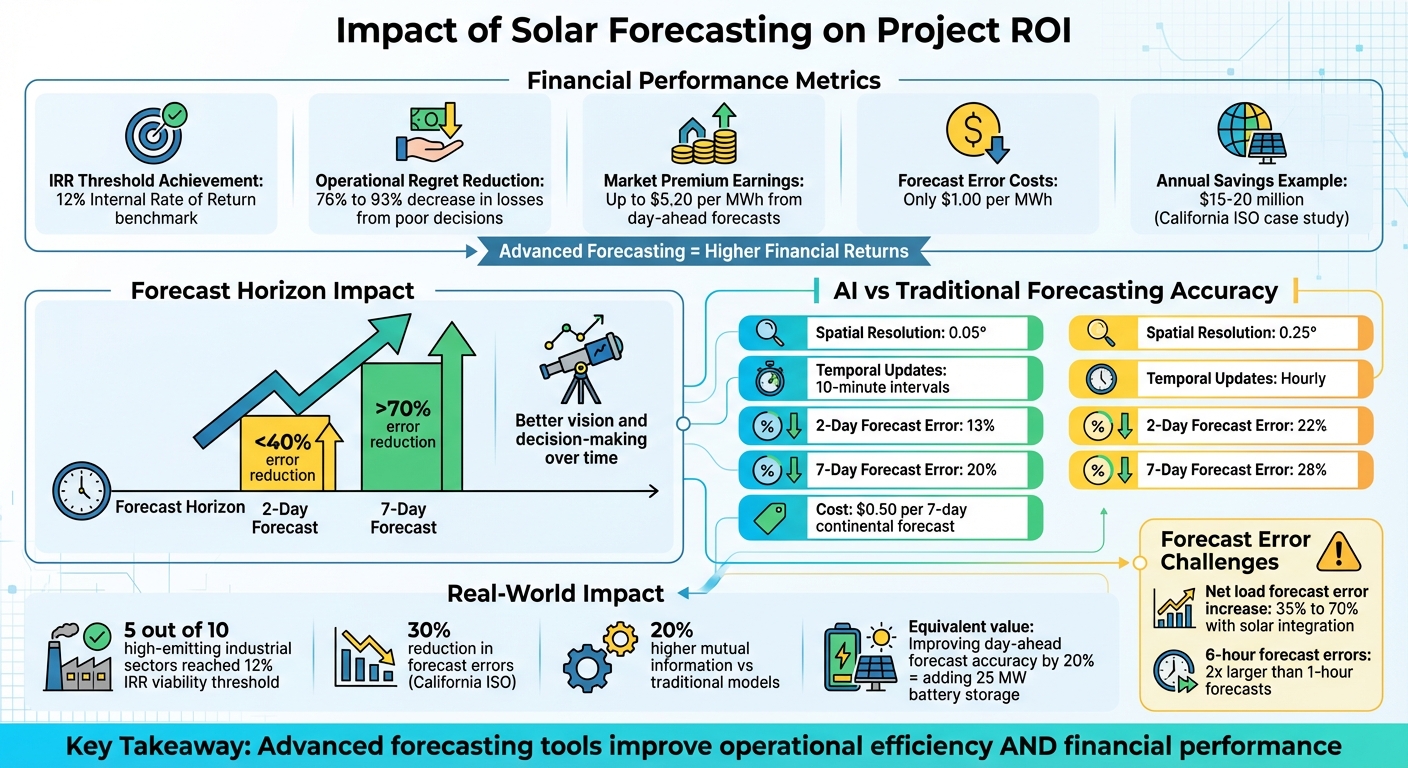
- Better Forecasting = Higher ROI: Studies show accurate forecasts help projects exceed the 12% Internal Rate of Return (IRR) threshold, making them more attractive to investors.
- Reduced Losses: AI-driven forecasting cuts "operational regret" (losses from poor decisions) by 76% to 93%, saving millions annually in some cases.
- Market Participation: Day-ahead forecasts allow operators to earn premiums of up to $5.2 per megawatt-hour, outweighing forecast error costs of just $1 per MWh.
- Longer Horizons Matter: A 7-day forecast reduces decision-making errors by over 70%, compared to less than 40% for shorter forecasts.
Forecasting also enables smarter battery management, better resource planning, and lower financing risks by providing clearer production estimates. This directly impacts project viability and profitability.
Key Takeaway: Investing in advanced forecasting tools not only improves operational excellence but also strengthens financial performance, turning solar projects into more reliable and profitable ventures.
How Solar Forecasting Improves Project ROI: Key Statistics and Financial Impact
What Affects Forecasting Accuracy
Weather Changes and Forecast Challenges
Forecasting solar energy production comes with its own set of hurdles, especially when it comes to unpredictable weather conditions. Factors like cloud dynamics, fog dissipation, and aerosol disturbances can throw predictions off track. Take California, for example – errors in forecasting when low coastal clouds and fog will clear up are among the leading causes of inaccuracies in solar generation projections. These aren’t small discrepancies either. With solar integration, the 99th percentile net load forecast error jumps by 35% to 70% compared to scenarios without solar.
A concept called the "Solar Prediction Paradox" highlights the difficulty here. A model that simply predicts "sunny" every day might achieve an impressive 85% overall accuracy but will fail miserably when it matters most – during cloudy periods when precise forecasts are crucial. Add in challenges like aerosol disruptions, typhoon impacts, and temperature inversions, and the complexity only deepens.
Forecast accuracy also tends to degrade the further out the prediction. For instance, a six-hour-ahead forecast can have errors twice as large as a one-hour-ahead forecast. Stretch this timeline further, and the numbers get worse: AI models show a median relative error increasing from 13% for a two-day forecast to 20% for a seven-day forecast, while traditional Global Forecast System (GFS) models see errors rise from 22% to 28% over the same period.
Tools and Methods for Better Forecasting
The tools used for solar forecasting often depend on the time horizon. For quick, short-term adjustments (within an hour), sky cameras and persistence models are highly effective. Satellite imaging works better for intra-day planning (one to six hours ahead). For longer-term needs, like day-ahead forecasts, Numerical Weather Prediction (NWP) models or AI-driven systems tend to deliver the best results.
AI models are making significant strides in weather forecasting. Systems like SunCastNet, FourCastNet, and GraphCast are now performing at levels that rival or even exceed traditional NWP models on a global scale. For example, SunCastNet boasts a 0.05° spatial resolution and 10-minute temporal updates, which are far more detailed than GFS’s 0.25° resolution and hourly updates. This precision results in 5.10% lower relative errors and 20% higher mutual information compared to GFS.
Between August 2020 and August 2025, researchers led by Zhixiang Dai at NVIDIA and Kairui Feng at Tongji University tested SunCastNet across 2,164 meteorological stations in China. The system provided seven-day forecasts at 10-minute intervals, with the cost of running a seven-day continental-scale forecast on a single NVIDIA A100 GPU coming in at just $0.50. Similarly, the California ISO applied AI-powered satellite image processing to tackle the "duck curve" ramp, cutting forecast errors by 30% and reducing reserve requirements. This approach saved $15 million to $20 million annually.
These advancements in forecasting accuracy are not just technical milestones – they have a direct impact on financial performance, as the following case study demonstrates.
Case Study: How Forecast Accuracy Affects Financial Results
The link between accurate forecasting and financial success is clear in real-world applications. A case study from July 2024 highlights this connection. Researchers led by Muhammad Faizan Tahir used Bi-directional Long Short-Term Memory (Bi-LSTM) with Bayesian optimization to forecast power for the 10 MW Masdar solar project in the UAE. Drawing on 2019 data from the National Solar Radiation Database, the Bi-LSTM model outperformed other approaches like artificial neural networks, support vector machines, and Gaussian process regression. These forecasts were then integrated into the System Advisor Model (SAM) to validate energy yields, showing significant improvements in the project’s Internal Rate of Return (IRR) and Net Present Value (NPV).
Another compelling example comes from the SunCastNet team’s work in China. Over a 25-year investment backtest, they applied high-resolution AI forecasting to reinforcement learning for battery management. This approach reduced "operational regret" by 76% to 93% compared to more traditional decision-making methods. Even more strikingly, the improved forecasting enabled five out of ten high-emitting industrial sectors to surpass the 12% IRR commercial viability threshold, which had previously been out of reach with standard GFS forecasts. As Zhixiang Dai and his team noted:
Improved solar predictions translate directly into economic value: reducing operational regret by 70–90% and enabling up to five of ten industrial sectors per region to exceed the 12% IRR viability threshold.
sbb-itb-2560759
How Forecasting Improves Solar Project ROI
Accurate solar forecasting has become a key factor in boosting the financial performance of solar projects. It builds on earlier analyses of forecasting challenges, showing how precise predictions can directly impact returns.
Avoiding Production Mismatches
When solar energy production forecasts are off, the financial consequences can be severe. Overestimating production often forces operators to purchase costly grid power during peak times, while underestimating production can lead to wasted energy that could have been sold or stored. Both scenarios result in lost revenue.
In the U.S., day-ahead solar forecast errors typically cost around $1.00 per megawatt-hour (MWh). However, accurate forecasting can flip this narrative. By leveraging Numerical Weather Prediction (NWP) models, operators can participate in day-ahead markets and secure premiums that outweigh the costs of forecast errors.
For operators managing solar-battery systems, the stakes are even higher. High-resolution forecasts enable strategies like "valley charging and peak discharging." This involves pre-charging batteries ahead of cloudy weather to avoid relying on expensive grid power during peak demand. Such strategies help address the Solar Prediction Paradox, where high overall accuracy might still fail during critical cloudy periods when accurate forecasts are most needed.
Better Resource Planning and Cost Control
Accurate forecasting reshapes how solar projects manage their resources, especially the costly ones. For example, improving day-ahead solar forecast accuracy by 20% can deliver economic value comparable to adding a 25 MW battery storage system in some grid setups. It also reduces fuel and startup costs for thermal backup units by 0.06% to 3%.
This shift allows operators to move from cautious "robust decision making" to more optimized scheduling. A long-term economic backtest by NVIDIA researchers (spanning August 2000 to August 2025) highlighted the benefits. Using the SunCastNet forecasting system, which provides 0.05°-resolution forecasts at 10-minute intervals, combined with reinforcement learning for battery management, they reduced operational regret by 76% to 93%. This improvement helped five out of ten high-emitting industrial sectors in China reach the 12% Internal Rate of Return (IRR) threshold for commercial viability. As Zhixiang Dai and his team explained:
High-resolution, long-horizon solar forecasts can directly translate into measurable economic gains, supporting near-optimal energy operations and accelerating renewable deployment.
The forecast horizon also plays a critical role. A 7-day forecast can reduce decision regret by over 70%, while a 2-day forecast typically achieves less than 40%. For industrial operators dealing with complex time-of-use pricing, this extended visibility is essential to fully capitalize on their solar-battery systems.
These improvements in operations provide a strong foundation for integrating forecasting into broader risk management strategies for solar projects.
Using Forecasting to Manage Project Risks
Forecasting plays a crucial role in how solar companies handle financial risks. By offering clear data on energy production uncertainties, it transforms high-risk solar projects into viable investment opportunities. This clarity allows forecasting to be seamlessly integrated into financial models, helping to lower financing costs and manage risks more effectively.
Adding Forecasting to Financial Models
When it comes to financing solar projects, lenders often rely on metrics like P50 and P90 to assess the certainty of revenue for loan repayment. Here’s how these values work:
- P50: Represents the energy production level that has a 50% chance of being exceeded annually.
- P90: A more conservative figure, indicating a 90% likelihood of being surpassed.
These metrics are essential for calculating repayment risks and determining financing terms.
However, many solar companies still rely on inconsistent or unclear methods to estimate these uncertainties. As Matthew J. Prilliman from the National Renewable Energy Laboratory (NREL) points out, uncertainty in photovoltaic (PV) energy estimates remains "one of the most critical areas of lack of understanding" among engineers, financiers, and other key stakeholders. This lack of trust in data leads to higher perceived risks, which, in turn, drive up financing costs.
AI-driven forecasting systems are addressing this challenge by providing standardized and transparent uncertainty metrics. For example, a 25-year backtest (August 2000 to August 2025) conducted by NVIDIA Corporation and Tongji University demonstrated how integrating the SunCastNet forecasting system with reinforcement learning for battery scheduling significantly reduced operational risks. Using high-resolution forecasts (0.05° spatial resolution, 10-minute intervals), these systems achieved a 76% to 93% reduction in operational regret compared to traditional methods. This improvement allowed five out of ten high-emitting industrial sectors in China to surpass the 12% Internal Rate of Return (IRR) threshold, turning previously "infeasible" projects into profitable ones.
By increasing transparency, forecasting reduces perceived risks, lowers financing costs, and improves repayment terms. For solar-battery operators, this means moving away from overly cautious planning toward strategies that maximize economic opportunities. These financial models, when paired with long-term forecasting, provide even greater stability for project performance.
Forecasting for Long-Term Project Success
Forecasting isn’t just about managing immediate risks – it also supports the long-term success of solar projects. Reliable long-term forecasts help operators pinpoint the best times for charging and discharging batteries, ensuring consistent and profitable operations.
For example, long-horizon forecasting enables strategies like "valley charging–peak discharging", which require several days of advanced planning. Without accurate week-ahead forecasts, operators might miss out on key opportunities, such as precharging batteries before cloudy weather to avoid expensive peak rates.
The cost of advanced forecasting has also become more accessible, with a 7-day continental-scale forecast now priced as low as $0.50 on a single NVIDIA A100 GPU. This affordability makes it easier for operators to adopt forecasting tools that enhance both short-term and long-term project outcomes.
Conclusion: Using Forecasting to Increase Solar ROI
Accurate forecasting is at the heart of solar project profitability, influencing everything from reducing operational missteps to improving strategic planning. It’s more than just a technical tool – it’s a financial game-changer. Studies reveal that precise energy production forecasting can help projects surpass the 12% Internal Rate of Return (IRR) benchmark, a key measure of financial success. By incorporating forecasting into their processes, solar companies can tap into market premiums through day-ahead market participation and cut down imbalance costs, which often eat into profits.
Main Recommendations for Decision-Makers
To maximize the financial benefits of forecasting, here are some key strategies to consider:
- Focus on 7-day forecast horizons instead of shorter 1–2 day windows. Research conducted by NVIDIA Corporation and Tongji University highlights that extended forecasts can reduce decision regret by over 70%, compared to less than 40% for 2-day forecasts. This broader outlook supports strategies like "valley charging–peak discharging", optimizing returns from time-of-use electricity pricing.
- Assess forecasting tools based on financial outcomes, not just technical error metrics. Metrics like operational regret, IRR, and mutual information offer a clearer picture of financial performance. As NVIDIA researchers point out:
High-resolution, long-horizon solar forecasts can directly translate into measurable economic gains, supporting near-optimal energy operations and accelerating renewable deployment.
- Adopt probabilistic forecasting models over single-value predictions. These models are better equipped to handle uncertainty, especially in areas like reserve procurement and risk management in volatile electricity markets. Investors and financial institutions increasingly require transparent P50 and P90 values to evaluate repayment risks. Standardized probabilistic forecasts not only meet these demands but also improve investor confidence and reduce financing costs.
When implemented, these approaches can significantly enhance operational decision-making and financial performance.
How Blu Banyan Supports Forecasting Integration

Blu Banyan’s SolarSuccess ERP seamlessly integrates forecasting data with everyday operations. This platform combines accounting, CRM, project management, and inventory tracking into a unified system, allowing solar companies to make quicker, data-driven decisions. By channeling forecasting data into an integrated ERP solution, companies can automate critical processes, cut soft costs, and maintain the real-time insights needed to seize opportunities revealed by accurate production forecasts. This integration ensures solar businesses stay ahead in a competitive market.
FAQs
How does accurate solar energy forecasting boost ROI for projects?
Accurate solar energy forecasting is key to boosting the return on investment (ROI) for solar projects. By delivering dependable estimates of energy production, it empowers project developers and operators to make smarter financial decisions, cutting down on unexpected costs that can arise from forecasting errors.
Better forecasting also streamlines operational planning and financial management by syncing energy production more closely with demand. This reliability allows for smarter resource use, improved system efficiency, and, ultimately, higher profitability for solar projects.
What makes accurate solar energy forecasting challenging?
Accurately predicting solar energy production comes with its fair share of challenges. For starters, sunlight variability – influenced by weather changes and seasonal shifts – creates uncertainty. Then there’s the issue with performance models, which might not fully capture real-world conditions, leading to gaps between predictions and actual output. On top of that, system reliability factors, like equipment wear and unexpected downtime, add another layer of complexity to forecasting.
Getting these forecasts right matters a lot. Better accuracy allows decision-makers to plan operations more effectively, lower risks, and boost the overall financial performance of solar projects.
How do forecasting tools help minimize financial risks in solar projects?
Forecasting tools are essential for reducing financial risks in solar projects by providing more accurate energy production estimates. When forecasts are precise, project stakeholders can better manage energy sales, integrate with the grid, and make operational adjustments. This reduces the chances of underperformance, which could otherwise lead to financial setbacks.
Research highlights the impact of forecasting errors, particularly in day-ahead energy markets. In regions with high solar adoption, like California, these errors can cost between $1.00 and $1.50 per megawatt-hour (MWh). However, advanced forecasting methods – leveraging machine learning and large datasets – help solar project operators cut down on these errors. The result? More stable revenue streams, lower reserve requirements, and improved financial predictability. By reducing uncertainty, these tools play a key role in boosting the return on investment (ROI) for solar projects and enabling smarter financial planning.
