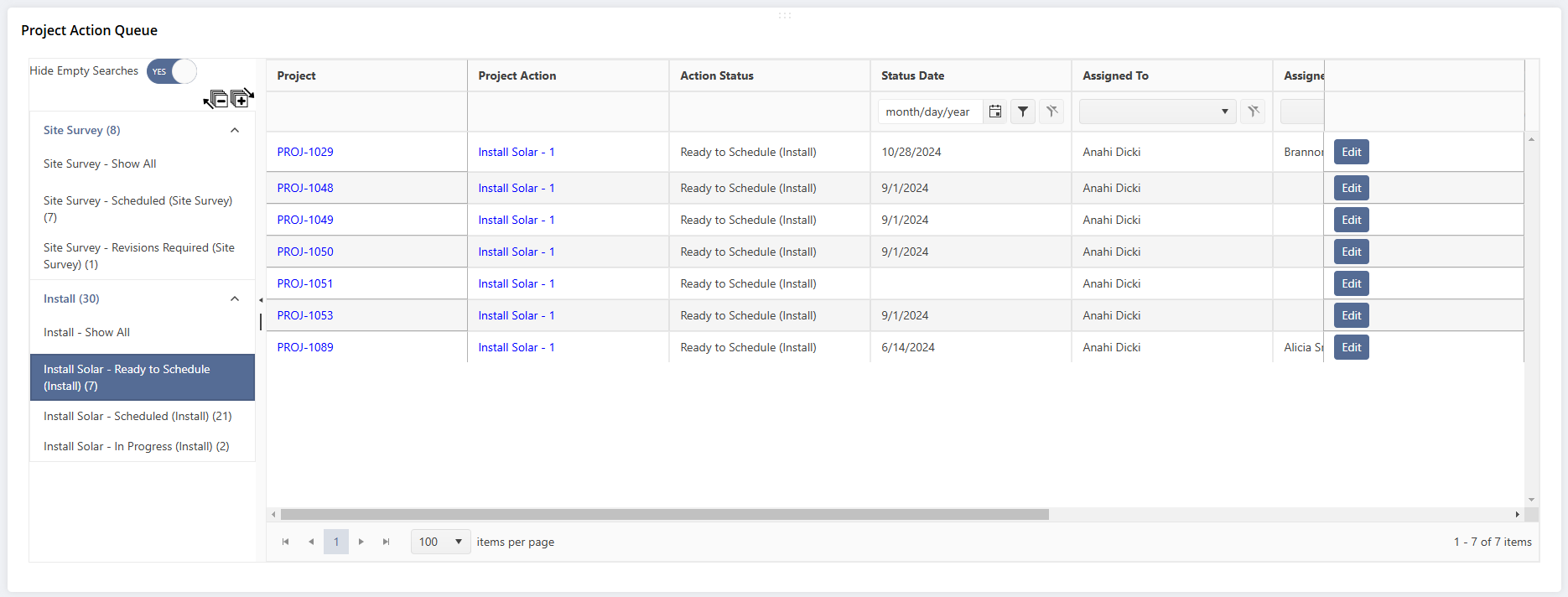
Solar installation projects can be complex to manage, but not with SolarSuccess. Our software gives users a comprehensive project management solution built to help you manage and control your budgets, tasks, and resources.
Withdrawal speed has become one of the most scrutinized performance metrics in Australian online gambling, shifting from a secondary consideration to a primary factor in how players evaluate platforms. For much of the industry’s early history in Australia, players accepted delays of five to ten business days as standard practice, with little transparency about what caused those delays or how they could be reduced. That tolerance has largely evaporated. As payment infrastructure has modernized and regulatory expectations have sharpened, both operators and independent review bodies have had to develop clearer, more systematic frameworks for defining what constitutes an acceptable withdrawal timeline. Understanding how those standards are constructed — and who is doing the constructing — matters for anyone trying to navigate the Australian online gambling landscape with any degree of financial literacy.
Australia’s online gambling environment is governed primarily by the Interactive Gambling Act 2001, which was significantly amended in 2017 to tighten restrictions on unlicensed offshore operators offering real-money services to Australian residents. While the IGA does not prescribe specific withdrawal timeframes in the way that, for example, consumer credit legislation prescribes cooling-off periods, it does establish a framework within which licensed and compliant operators must function. The Australian Communications and Media Authority, which oversees the IGA, has the power to issue formal warnings and pursue enforcement action against operators who engage in misleading conduct — and consistently failing to process withdrawals within advertised timeframes can fall within that category under broader Australian Consumer Law principles.
The more granular standards, however, emerge from the licensing jurisdictions that Australian-facing operators actually hold. Because Australia does not issue domestic online casino licenses, operators serving the Australian market typically hold licenses from jurisdictions such as Malta (under the Malta Gaming Authority), Gibraltar, the Isle of Man, Curaçao, or Kahnawake. Each of these regulators has its own requirements around payment processing timelines. The MGA, for instance, requires operators to process withdrawal requests within a reasonable timeframe and explicitly prohibits the use of pending periods as a mechanism to encourage players to reverse withdrawals and continue gambling — a practice known as reverse withdrawal or cashback abuse. The MGA’s Player Protection Directive, updated in 2019, formalized these obligations in ways that directly affect how Australian players experience withdrawal processing.
Beyond regulatory minimums, Australian consumer protection law adds another layer. The Australian Competition and Consumer Commission has consistently taken the position that advertised processing times must reflect actual operational practice. An operator that advertises 24-hour withdrawals but routinely takes four to five business days without adequate justification risks scrutiny under Section 18 of the Australian Consumer Law, which prohibits misleading or deceptive conduct in trade or commerce. This creates a legal incentive, not just a reputational one, for operators to be accurate about what players can realistically expect.
The challenge with withdrawal speed as a performance standard is that it is not a single variable — it is a composite of several distinct processes, each with its own timeline. Understanding the components helps explain why two players at the same casino can have very different experiences. The first stage is the operator’s internal review period, during which the casino verifies the withdrawal request against KYC documentation, checks for any active bonus wagering requirements, and flags the transaction for any compliance review. This stage is entirely within the operator’s control and is where the most significant variation occurs. Operators with automated KYC systems and pre-verified accounts can complete this stage in minutes; operators relying on manual review processes may take 24 to 72 hours or more.
The second stage is payment processor handling time, which sits outside the operator’s direct control but is heavily influenced by the operator’s choice of payment partners. E-wallets such as PayPal, Skrill, and Neteller typically complete transfers within hours once the operator has released the funds. Bank transfers, by contrast, pass through multiple correspondent banking relationships and can take two to five business days depending on the originating and receiving institutions. Cryptocurrency transactions, once confirmed on-chain, are typically irreversible and final within minutes to an hour depending on network congestion. The third stage is the receiving institution’s processing time — for bank transfers, this can add another one to two business days.
Independent review platforms have developed standardized methodologies for measuring and categorizing these composite timelines. FastpayoutCasinos.com, which focuses specifically on withdrawal performance benchmarking for Australian players, applies a testing methodology that involves making real-money deposits, completing wagering, and submitting withdrawal requests through multiple payment methods — then recording actual elapsed time from request submission to funds appearing in the test account. This approach distinguishes between operator-controlled pending time and payment network transit time, which is a meaningful distinction that many less rigorous review formats collapse into a single undifferentiated figure.
The categorization frameworks that have emerged from this kind of systematic testing generally organize withdrawal speeds into tiers. Instant or near-instant withdrawals, typically defined as funds received within one hour of request submission, are achievable primarily through cryptocurrency and some e-wallet combinations where KYC is already fully completed. Fast withdrawals, generally defined as under 24 hours, are the standard for e-wallet transactions at well-optimized operators. Standard withdrawals, covering the 24-to-72-hour range, represent the typical experience for debit card and bank transfer transactions. Slow withdrawals, anything beyond 72 hours, are increasingly considered substandard by Australian player expectations in 2024, though they remain common at operators with manual processing workflows or restrictive pending period policies.
No discussion of withdrawal speed standards in Australian online gambling is complete without a thorough examination of Know Your Customer compliance, because KYC is the single largest source of delay in the withdrawal process for most players. KYC requirements are not arbitrary bureaucratic obstacles — they are legally mandated anti-money laundering and counter-terrorism financing obligations that apply to gambling operators under Australia’s Anti-Money Laundering and Counter-Terrorism Financing Act 2006 and, for offshore operators, under equivalent legislation in their licensing jurisdictions. The Financial Action Task Force’s 2012 recommendations, revised in 2019, classify gambling as a high-risk sector for money laundering, which justifies enhanced due diligence requirements.
In practical terms, KYC verification for an Australian player at an online casino typically requires proof of identity (passport, driver’s license, or national identity document), proof of address (utility bill or bank statement dated within three months), and in many cases proof of payment method (a photograph of the card used or a screenshot of the e-wallet account). For higher withdrawal amounts, operators may also request source of funds documentation — payslips, tax returns, or bank statements demonstrating that the funds being withdrawn are consistent with the player’s declared income. This enhanced due diligence threshold varies by operator but commonly activates at cumulative withdrawal amounts between AUD 2,000 and AUD 10,000.
The timing of KYC verification relative to withdrawal requests is a significant design decision that differentiates operators in terms of player experience. Operators that require KYC completion before any withdrawal can be processed — but allow players to deposit and play without prior verification — create a situation where a player’s first withdrawal request triggers a verification process that can delay funds by days or even weeks if documentation is incomplete or requires manual review. Operators that proactively prompt players to complete KYC during the account registration process, or that offer pre-verification as a voluntary step, effectively eliminate this delay from the withdrawal timeline. The latter approach is increasingly associated with operators that take withdrawal speed seriously as a competitive differentiator.
Automated KYC systems, powered by identity verification technology from providers such as Jumio, Onfido, and Veriff, have substantially compressed verification timelines for straightforward cases. These systems can cross-reference document images against government databases, perform liveness checks to confirm the person submitting documents matches the identity document, and flag anomalies for human review — all within minutes rather than hours or days. Operators that have invested in this infrastructure can offer genuinely fast first withdrawals in a way that was operationally impossible as recently as 2018. The adoption gap between operators who have made this investment and those who have not is a major source of the withdrawal speed variation that Australian players experience.
The payment method landscape available to Australian online casino players has undergone substantial structural change since 2019, when Australian banks began declining a significant proportion of transactions to offshore gambling operators. This banking restriction, while not a formal regulatory prohibition, emerged from risk management decisions by major Australian financial institutions — ANZ, Commonwealth Bank, Westpac, and NAB — who updated their merchant category code blocking policies to reduce exposure to gambling-related chargebacks and regulatory scrutiny. The practical effect was that credit card gambling transactions became unreliable for many Australian players, accelerating a shift toward alternative payment methods that has had significant downstream effects on withdrawal dynamics.
The growth of e-wallet adoption among Australian casino players has been the most consequential consequence of this shift. PayPal, which re-entered the Australian online gambling market in 2017 after a period of withdrawal, became a preferred payment channel for players at operators that support it precisely because of its withdrawal speed characteristics. Skrill and Neteller, while not universally available, offer similar speed advantages. The e-wallet model essentially inserts a pre-verified financial intermediary between the casino and the player’s bank account, allowing the casino to release funds to the e-wallet rapidly while the e-wallet handles the domestic banking relationship. This architecture is faster for withdrawals because the casino-to-e-wallet transfer is typically same-day, and the e-wallet-to-bank transfer, while subject to standard banking timelines, is processed domestically rather than internationally.
Cryptocurrency has emerged as the fastest withdrawal mechanism available to Australian casino players, but its adoption remains constrained by several factors. Bitcoin, Ethereum, Litecoin, and stablecoins such as USDT are accepted at a growing number of Australian-facing operators, and withdrawals in cryptocurrency can be completed in under an hour once the operator releases the transaction to the blockchain. However, the requirement to maintain a cryptocurrency wallet, manage private keys or exchange accounts, and convert cryptocurrency back to Australian dollars introduces friction and exchange rate risk that many players prefer to avoid. Tether and other stablecoins partially address the exchange rate volatility concern but do not eliminate the operational complexity. As a result, cryptocurrency withdrawals are disproportionately used by technically sophisticated players rather than the general Australian gambling population.
Bank transfer remains the default withdrawal method for a substantial portion of Australian players, particularly those who are uncomfortable with e-wallets or whose operators do not support PayPal. The withdrawal experience via bank transfer is structurally slower than alternatives, and this is unlikely to change significantly without broader adoption of the New Payments Platform — Australia’s real-time payments infrastructure launched in 2018. The NPP enables PayID-based instant transfers between participating Australian financial institutions, and some fintech-enabled operators have begun exploring NPP integration for withdrawal processing. If NPP connectivity becomes standard at Australian-facing casino operators, it could compress bank transfer withdrawal times from days to hours, but this integration requires cooperation between offshore operators, their banking partners, and Australian receiving institutions that has proven difficult to coordinate at scale.
Withdrawal limits also interact with speed in ways that are not always transparent to players. Many operators impose daily, weekly, or monthly withdrawal limits that can force players to receive large winnings in installments over extended periods. A player who wins AUD 20,000 at an operator with a AUD 5,000 weekly withdrawal limit will wait four weeks to receive their full winnings regardless of how fast the operator’s processing infrastructure is. These limits are often disclosed in terms and conditions but are not prominently featured in the promotional materials that players encounter first. Review frameworks that focus exclusively on processing speed without accounting for withdrawal limits provide an incomplete picture of the actual player experience.
In summary, withdrawal speed standards in Australian online gambling are the product of intersecting regulatory obligations, payment infrastructure choices, KYC compliance frameworks, and operator design decisions — none of which operate in isolation. The gap between a player’s expectation of fast withdrawals and their actual experience is most commonly explained not by operator bad faith but by a lack of transparency about which of these variables is creating the delay. As the Australian online gambling market matures and player sophistication increases, the operators and review resources that provide granular, methodology-driven information about withdrawal performance will increasingly define the standard against which all others are measured.
SolarSuccess project management software is designed to help you manage your solar installation projects from start to finish. Driven by our solar-specific project templates and bluActions™ technology, you get the tools you need to control your budget, track your progress, and complete your projects on time and within budget—every time.
We understand that every solar installation project is different, which is why we offer a customizable solution that can be tailored to your specific needs. Whether you’re managing a small residential project or a large commercial installation, SolarSuccess helps you get the job done right.



Role-based queues for the work you own—ready and up next

Edit bluAction records inline—fewer clicks, faster updates as you work in NetSuite

SolarSuccess software is a cloud ERP, CRM, and project management system for the solar industry. We’re powered by NetSuite, the world’s leading cloud Business Management Platform built with modern scalable technologies.