Dramatically Boost Your Team’s Collaboration and Productivity

Skip all the jumping back and forth between applications to communicate with your team. bluChat takes minutes to deploy, and minutes to learn, because it uses the NetSuite navigation and search conventions your staff already know.  Leverage the power and ease of bluChat for better team collaboration, faster issue resolution, and improved productivity and profitability.

The Mechanics of Football Betting Odds as Described by Betzoid

Football betting has evolved from informal wagers placed among friends on match days into a sophisticated, globally regulated industry worth hundreds of billions of dollars annually. At the heart of this industry lies a deceptively complex system: betting odds. For the casual observer, odds may appear to be simple numbers printed next to a team’s name, but in reality, they represent a carefully constructed mathematical framework that encodes probability, risk, and commercial margin simultaneously. Understanding how these odds work is not merely an academic exercise — it is a foundational skill for anyone who wishes to engage with football betting in an informed, rational manner. Without this knowledge, bettors are navigating a landscape they fundamentally cannot read.

The Origins and Evolution of Football Betting Odds

The history of betting odds stretches back centuries, long before football existed as an organized sport. Early forms of odds-making appeared in horse racing during the 18th century in Britain, where bookmakers would set prices based on their assessment of each horse’s likelihood of winning. When association football began to formalize in the mid-19th century and gain mass popularity across England, bookmakers naturally extended their operations to cover the sport. By the early 20th century, football pools — a form of fixed-odds betting on match outcomes — had become one of the most widely participated forms of gambling in the United Kingdom, with millions of working-class participants submitting coupons each week.

The fractional odds format that dominated British betting for most of the 20th century — expressed as ratios like 5/1 or 7/2 — was intuitive for those familiar with it but confusing for newcomers. A bet of 5/1 meant that for every one unit staked, the bettor would receive five units in profit if successful. Continental Europe, meanwhile, developed a preference for decimal odds, which express the total return per unit staked rather than just the profit. A decimal odd of 6.00 is equivalent to 5/1 in fractional terms, since a one-unit stake returns six units in total. The third major format, moneyline odds — predominant in North American markets — expresses odds relative to a baseline of 100 units, with positive numbers indicating profit on a 100-unit stake and negative numbers indicating the amount needed to stake in order to win 100 units.

The globalization of football and the rise of internet-based bookmakers during the late 1990s and 2000s accelerated the convergence of these formats. Today, most online platforms allow users to toggle between fractional, decimal, and moneyline displays, though decimal odds have become the de facto international standard due to their mathematical clarity and ease of conversion into implied probability.

How Bookmakers Construct and Price Football Odds

The process by which bookmakers set odds for a football match is far more rigorous than many bettors appreciate. Modern sportsbooks employ teams of quantitative analysts, statisticians, and former professional players who use sophisticated predictive models to generate what are known as “true” or “fair” probabilities for every possible match outcome. These models incorporate an enormous range of variables: recent team form, head-to-head historical records, home and away performance differentials, player injury and suspension data, squad depth, tactical matchups, weather conditions, travel fatigue, and even psychological factors such as the significance of the match within the context of a season.

Once the trading team has established its internal probability estimates, those probabilities are converted into odds. However, the odds that appear on a bookmaker’s website are not a direct reflection of these true probabilities. Bookmakers apply what is known as an “overround” — sometimes called the “vig” or “juice” — which is a margin built into the odds that ensures the bookmaker retains a profit regardless of the match outcome. In a perfectly fair market, the implied probabilities of all possible outcomes in a match would sum to exactly 100%. In practice, the overround pushes this sum above 100%, typically between 104% and 110% for standard football markets, with the excess representing the bookmaker’s theoretical profit margin.

For example, in a match between two evenly matched teams, a fair price for each side winning might be 2.00 in decimal odds, representing a 50% implied probability each. But a bookmaker might price each team at 1.90, which implies a probability of approximately 52.6% per side — a combined total of 105.2%, with the extra 5.2% representing the overround. This is why consistently beating the bookmaker over a large sample of bets is genuinely difficult: the mathematical structure of the market is designed to work against the bettor over time.

Platforms such as Betzoid provide detailed educational resources and odds comparison tools that help bettors understand these structural dynamics, allowing users to identify which bookmakers are offering the most competitive prices for specific markets and reducing the impact of the overround on their overall returns. This kind of informed comparison is one of the most practical steps a bettor can take to improve their long-term results.

Reading Odds as Probability and Understanding Market Movement

One of the most valuable skills in football betting is the ability to convert odds into implied probability and then critically evaluate whether that probability accurately reflects reality. The conversion formula for decimal odds is straightforward: divide 1 by the decimal odd and multiply by 100. An odd of 3.50, for instance, implies a probability of approximately 28.57%. If a bettor’s own analysis suggests the true probability of that outcome is closer to 35%, then the odds represent potential value — a concept known in betting theory as “positive expected value” or +EV betting.

Market movement — the way odds shift between the time they are first published and the moment the match kicks off — provides another layer of information that sophisticated bettors learn to interpret carefully. Bookmakers typically release odds for major football matches several days in advance, and these opening lines are often set conservatively to attract initial betting action while the trading team gathers more information. As money flows in on particular outcomes, bookmakers adjust their odds to rebalance their liability and maintain their margin. A significant move in odds — say, a team drifting from 2.20 to 2.80 — may indicate that large volumes of informed money have been placed on the opposing side, or that significant negative news (such as a key player injury) has emerged.

However, not all market movements carry equal informational weight. In highly liquid markets such as the English Premier League or UEFA Champions League, odds movements tend to reflect genuine shifts in the balance of informed opinion. In lower-division leagues or less-traded markets, movements may be driven by smaller volumes of money and may be less reliable as signals. Betzoid’s analytical framework emphasizes this distinction, noting that market efficiency varies considerably across different competitions and bet types, and that bettors should calibrate their interpretation of line movements accordingly.

Asian handicap betting represents a particularly instructive case study in how odds mechanics can differ from standard three-way markets. Rather than offering a simple home win, draw, or away win market, Asian handicaps eliminate the draw outcome by assigning a virtual head start or deficit to each team. This creates a two-outcome market with odds that are typically much closer to evens, reducing the bookmaker’s margin and making the market more efficient. The popularity of Asian handicap betting among professional bettors is directly related to these structural advantages, and understanding how handicap lines are set and adjusted is an important component of advanced football betting literacy.

The Role of Data, Technology, and Informed Betting Strategy

The contemporary football betting landscape has been transformed by the proliferation of data and the democratization of analytical tools. Where once only bookmakers had access to sophisticated statistical models, individual bettors can now access a wide range of publicly available datasets, expected goals (xG) metrics, player tracking data, and third-party prediction models that allow for independent probability assessment. This has narrowed — though by no means eliminated — the informational gap between bookmakers and the betting public.

Expected goals, in particular, has become one of the most widely cited metrics in football analytics over the past decade. Developed from shot quality modeling, xG assigns a probability value to each shot attempt based on factors such as distance from goal, angle, assist type, and whether the shot was taken with the head or foot. By aggregating these values across a match or season, analysts can assess whether a team’s results are consistent with the quality of chances they have created and conceded, or whether they have been unusually fortunate or unfortunate. Bettors who incorporate xG data into their assessments are better positioned to identify when bookmaker odds are based on raw results that may not reflect underlying team quality.

Bankroll management is another critical dimension of football betting strategy that is often overlooked in discussions focused purely on odds mechanics. Even a bettor with genuine edge — meaning they are consistently identifying positive expected value opportunities — can face ruin if they allocate stakes irrationally. The Kelly Criterion, a mathematical formula developed by John L. Kelly Jr. in 1956, provides a theoretically optimal staking method that maximizes long-term bankroll growth by sizing bets proportionally to the perceived edge. In practice, most professional bettors use a fractional Kelly approach, staking a fraction of the full Kelly recommendation to reduce variance and protect against the inevitable uncertainty in their probability estimates.

Responsible engagement with football betting also requires an honest acknowledgment of the limits of any analytical approach. Even the most sophisticated models carry substantial uncertainty, and the inherent unpredictability of football — where a single moment of individual brilliance or misfortune can determine a match outcome — means that short-term results will always be highly variable. Betzoid consistently emphasizes the importance of approaching betting as a long-term probabilistic exercise rather than a search for guaranteed outcomes, a perspective that aligns with the mathematical realities of how odds are constructed and what they can and cannot tell us.

Conclusion

Football betting odds are not arbitrary numbers — they are the product of rigorous probabilistic modeling, commercial calculation, and continuous market adjustment. Understanding their mechanics, from the historical development of different odds formats to the mathematical structure of the overround, from the informational content of market movements to the application of expected value theory, equips bettors with a genuinely more sophisticated framework for decision-making. The gap between those who treat odds as simple prices and those who understand them as encoded probability statements is significant, and it is a gap that careful study can meaningfully close. Informed engagement, grounded in mathematical literacy and disciplined strategy, remains the most reliable foundation for any serious approach to football betting.

With Native NetSuite bluChat You Can:

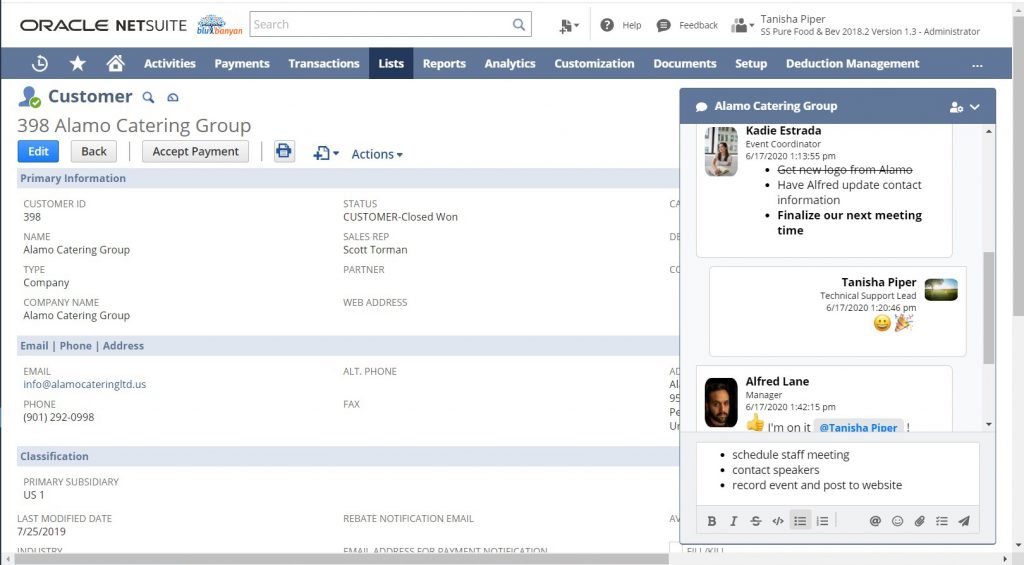
  • Enable chat directly on every writable NetSuite record
  • Use existing staff permissions to determine bluChat access
  • Enhance collaboration and throughput across the entire organization
  • Write workflows to trigger status change alerts in bluChat
  • Set up guest access for partners, vendors and customers 
  • Search the always-available chat history streams

Communication, Collaboration, Tasking

bluChat box

Drag & Drop Multiple Files and Types Into the Chatbox

File Types Icons
  • On-Record & Off-Record Chat
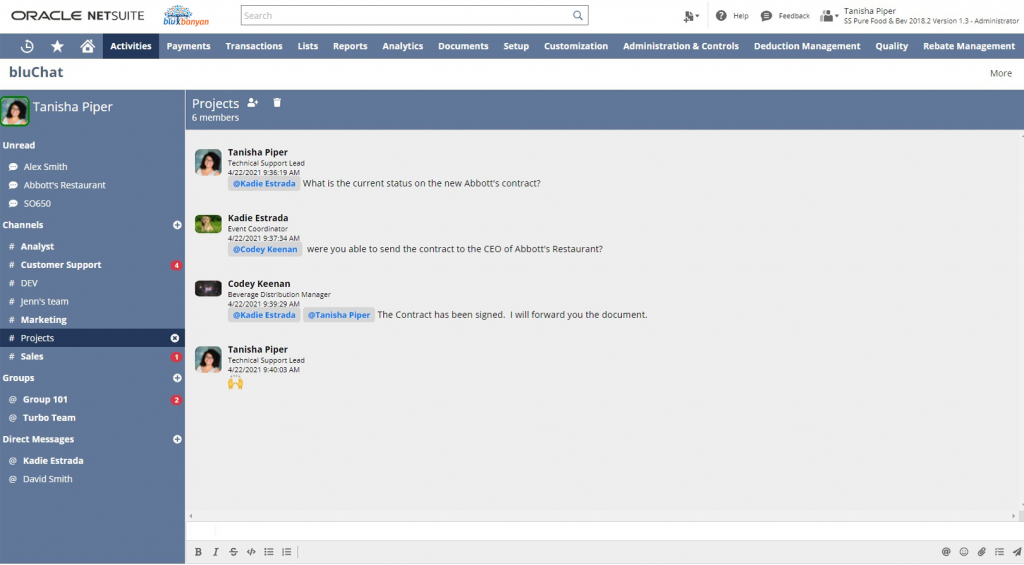
  • Channels, Groups & DMs
  • Chat History Stream Always Available
  • Generate, Assign & Schedule Tasks Directly On-Record
  • Chats are Fully Searchable & Auditable
  • Tagging Users Triggers an Email Alert
  • Tag NetSuite Entity Groups
  • All Custom Records Supported
  • Rich Analytics on Chat Usage
  • Unlimited Simultaneous Users & Groups
  • Workflows can Tag Users with Status Updates
  • Role Permissions Determine Chat Access
  • Customers, Vendors & Partners Can Participate
  • Emojis & Text Formatting
  • User Profiles & Photos
  • Star to Watch a Channel or Specific Record
  • Workflows to Copy Messages to Another Record
  • Opt-in to SMS with bluChat+SMS

On-Record Chat

On record chat

Off-Record Chat

Channels Groups DMs

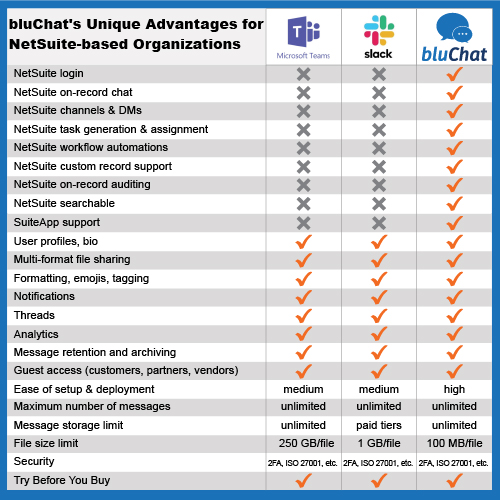
Native NetSuite bluChat App Feature Comparison

bluChat's Unique Advantages for NetSuite-based Organizations

bluChat - for faster issue resolution

Blu Banyan's bluChat chatbox demonstrating faster issue resolution, by assigning tasks directly from chatbox.

Collaborate on-the-go with bluChat+SMS

bluChat+SMS logo
With bluChat+SMS, users can opt in to receive an SMS text message containing the bluChat message when they are tagged, or when responding to chat messages where they are tagged. All SMS text messages will go back to the chat message stream and are saved on the NetSuite record.
 
The SMS function is an optional add-on to bluChat with additional monthly fees.
NetSuite Communication - Team Chat and Collaboration icon

Blu Banyan is committed to the success of
NetSuite users!​

NetSuite Communication - Team Chat and Collaboration icon
Expand the Capabilities of Your Business

with the only native NetSuite team collaboration application. bluChat is the smartest way for any NetSuite-based organization to extend the power, value and productivity of its NetSuite investment, by incorporating a powerful yet easy team collaboration tool. bluChat enables faster and better communication across all company teams and groups, minimizing operational fumbles, and eliminating the back and forth time sink of using non-native chat tools.

Get Started!

In a hurry? Call for a quick chat on 510.929.1075

contact form pattern
shadow

Our Clients