

Managing cash flow is one of the biggest challenges in the solar industry. Solar companies face high upfront costs, unpredictable revenue tied to project milestones, and complex financial processes like deferred revenue and commission payouts. Traditional accounting tools often fall short in addressing these issues.
The solution? Solar-specific ERP systems like SolarSuccess. These tools centralize data, automate key processes like milestone-based invoicing, and provide real-time cash flow insights. The result: better financial planning, reduced financing costs, and streamlined operations.
Key Takeaways:
- Centralized Data: Combines CRM, project management, and accounting for accurate forecasting.
- Automation: Speeds up invoicing and cash flow updates, saving ~$0.04/W.
- Real-Time Dashboards: Offers daily and weekly cash flow insights for proactive decisions.
- Cost Savings: Cuts soft costs by 3–5¢/W and accelerates cash cycles by 40%.
Solar ERP tools aren’t just about improving cash flow – they simplify financial management and support growth in a competitive market.
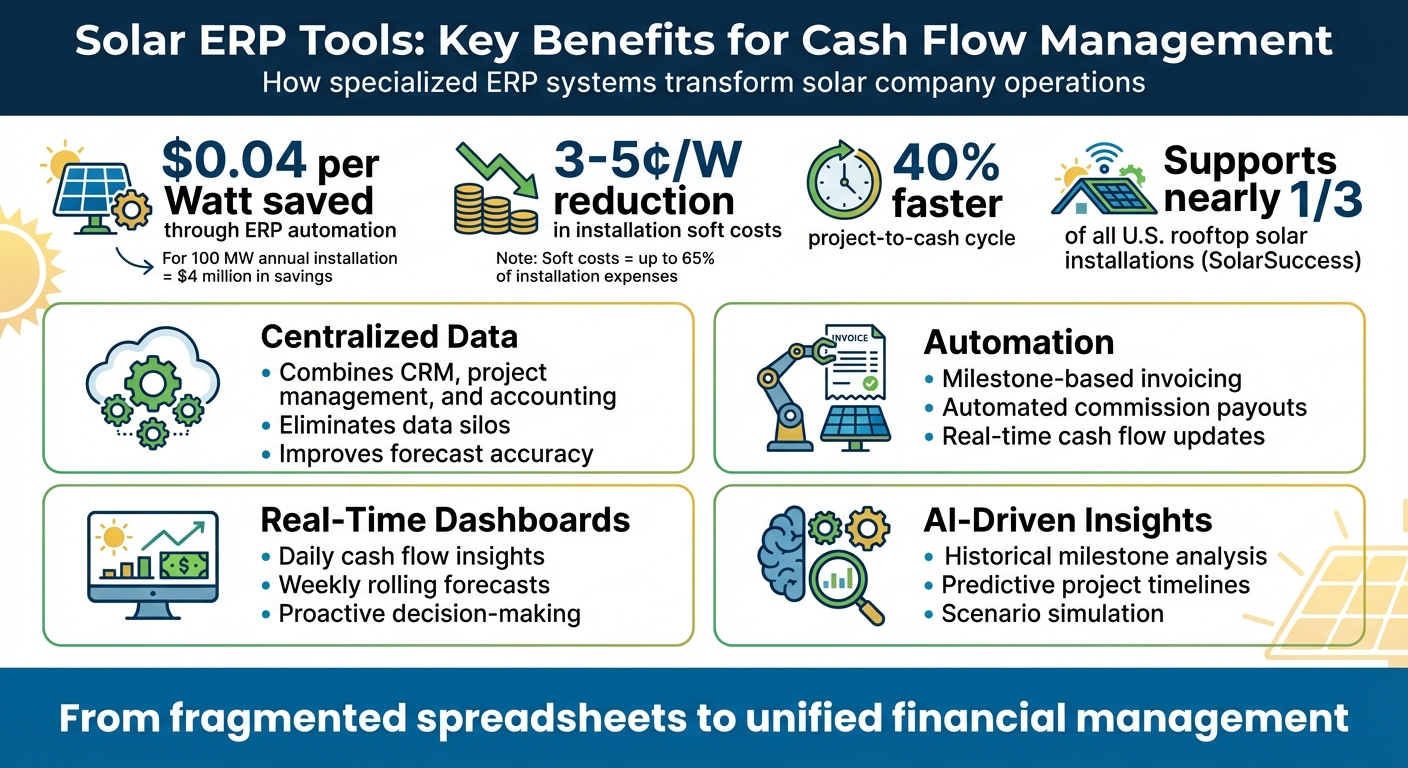
Solar ERP Cost Savings and Efficiency Benefits Infographic
How ERP Tools Improve Cash Flow Forecasting in Solar Operations
Centralized Data for Accurate Forecasting
One of the biggest challenges with traditional accounting software is the existence of data silos across CRM, project management, inventory, and accounting systems. These silos make accurate forecasting a real headache. ERP systems solve this problem by creating a unified data hub. By integrating sales pipelines, procurement, and accounting – and in solar-specific solutions, incorporating historical milestone data – these systems provide more precise forecasts.
Solar-focused ERPs take this a step further. They analyze historical data from completed projects to predict future timelines more accurately. For instance, these systems know how long permitting usually takes, how quickly installations are completed, and even account for delays during grid interconnection. This approach beats the guesswork of spreadsheets, offering a level of accuracy that can significantly refine project forecasts and help lower financing costs.
Take Titan Solar Power, for example. In February 2020, they switched from fragmented systems to the NetSuite-based SolarSuccess ERP under the guidance of Aaron Casillas, their Technology and Infrastructure Director. This move centralized their operational data across the U.S., cutting down on the labor required for partner commission payouts and improving cost and profitability insights as they scaled up to 153.5 megawatts of capacity.
"Having everything connected makes a tremendous difference… Decades of work went into building the NetSuite unified foundation and getting it right; we obviously couldn’t reinvent that."
- Jan Rippingale, CEO, Blu Banyan
Automation and AI-Driven Insights
Manual forecasting is not only time-consuming but also prone to errors. ERP systems solve this by automating key processes. For example, when a project reaches a critical milestone, the system can automatically issue invoices, update cash flow projections, and adjust resource allocation – no human input needed.
Beyond automation, machine learning models within these systems analyze years of transaction data, recurring trends, and customer payment behaviors. This allows solar companies to predict both short-term and long-term cash flow with impressive accuracy. These AI tools can even simulate scenarios, like a two-week payment delay or faster vendor deliveries, giving companies the ability to plan ahead rather than scramble to react. By providing faster and more reliable projections, these tools reduce the need for costly emergency loans.
Ipsun Solar is a great example. They automated most of their residential invoicing with SolarSuccess. The system now generates invoices automatically when a project hits a specific construction stage, eliminating their reliance on manual spreadsheets.
"When a deal moves to a particular stage of construction, for example, SolarSuccess generates invoices based on that specific milestone. That has been the biggest advantage and has definitely helped us out a lot."
- Joe Marhamati, Co-Founder & VP, Ipsun Solar
This shift to automation isn’t just about convenience – it’s about savings. Companies save approximately $0.04 per Watt through ERP automation. For a solar firm installing 100 megawatts annually, that’s nearly $4 million in savings.
These automated systems also extend into real-time monitoring, providing continuous insights into project performance and cash flow.
Real-Time Monitoring and KPI Dashboards
Relying on month-end closes for financial data often leads to delays that can trigger costly emergency financing. Real-time dashboards change the game, offering daily cash flow insights for immediate decisions and weekly rolling views for strategic planning.
With daily monitoring, companies can quickly spot bottlenecks like delayed customer payments, unexpected equipment costs, or permitting issues. Weekly dashboards, on the other hand, help align project schedules with resource allocation and capital investments. SolarSuccess, for instance, uses historical milestone data to generate forecasts, making it a standout solution in the industry. It tracks how projects typically progress – from permitting to installation to interconnection – and applies these patterns to current pipelines for unmatched precision.
"Having a dashboard with daily cash insights at your fingertips is a game-changer you won’t want to function without."
- Blu Banyan
Aaron Casillas from Big Sun Solar (now part of Titan Solar Power) saw firsthand how this real-time visibility transformed operations:
"We finally had a unified view of data across the company including real-time insights into project status, costs, inventory, pricing, purchasing, and profitability."
- Aaron Casillas, Technology & Infrastructure Director, Big Sun Solar
This kind of visibility enables solar companies to conduct cash flow gap analyses, identifying potential shortfalls weeks in advance. With this foresight, they can negotiate better payment terms or secure financing at more favorable rates.
These ERP-driven tools are laying the groundwork for smarter cash flow management, setting the stage for even greater operational efficiency.
SolarSuccess by Blu Banyan for Cash Flow Management

Industry-Specific Features of SolarSuccess
SolarSuccess is designed specifically for solar operations, offering a unified platform that combines accounting, CRM, project management, and inventory management. By consolidating all these functions into a single data source, it eliminates the inefficiencies of juggling spreadsheets and disconnected applications, streamlining operations across the board.
One of its standout features is the milestone-based forecasting engine. This tool uses historical milestone data to predict project timelines with exceptional accuracy, providing some of the most precise daily and weekly cash flow forecasts in the solar industry.
"SolarSuccess is the only solution in the industry that uses your actual milestone duration averages to inform the forecasts for your current projects, offering the most accurate daily and weekly cash forecasts available."
- Blu Banyan
Additionally, SolarSuccess integrates with bluBudget, a financial planning and analysis (FP&A) tool native to NetSuite. bluBudget automatically syncs project timelines with budgets, updating them in real time as schedules change. This reduces carrying costs by trimming installation soft costs by 3–5¢/W and accelerates the project-to-cash cycle by 40%. Together, these tools enhance forecasting and automation capabilities, delivering tangible benefits to solar businesses.
Currently, SolarSuccess supports nearly a third of all rooftop solar installations in the U.S. Blu Banyan’s efforts have not gone unnoticed, earning them the NetSuite Micro-Vertical Solution Provider Partner of the Year award for three consecutive years.
Improved Financial Planning Through Custom Dashboards
The platform’s interactive cash projections dashboard provides real-time insights into daily and weekly cash flows. This visibility allows managers to address issues like delayed payments or unexpected costs before they escalate. The dashboard’s weekly rolling view aligns with solar project schedules, showing exactly when costs and revenues will occur. For companies managing multiple projects, regions, or subsidiaries, portfolio-level insights simplify financial consolidation and reduce reconciliation errors.
Real-time project costing is another game-changer. By tracking labor and expenses directly to individual projects, SolarSuccess helps prevent budget overruns and significantly boosts project throughput – tripling it in some cases.
Spencer Newman, CFO of Norwich Solar Technologies, highlighted the platform’s impact:
"We can look at all of our subsidiaries as standalones or consolidate them into our main financials. That’s been incredibly useful from a financial planning standpoint."
- Spencer Newman, CFO, Norwich Solar Technologies
These tools and insights translate into major operational efficiencies and cost savings.
Case Study: Reduced Financing Costs with SolarSuccess
The benefits of SolarSuccess are evident in real-world applications. When Big Sun Solar (now part of Titan Solar Power) adopted SolarSuccess in February 2020, they streamlined labor-intensive tasks like partner commission payouts. The platform also provided better insights into costs and profitability, enabling the company to scale to 153.5 megawatts of capacity. This success earned Blu Banyan the NetSuite Spring 2025 Solution Provider Spotlight Award for improving real-time costing and project execution.
Ipsun Solar experienced similar results. With automated milestone-based invoicing, the company was able to speed up receivables by initiating billing as soon as project milestones were completed. This reduced the days-to-payment cycle, cutting down the need for costly bridge financing.
Another key feature is SolarSuccess’s universal financier connectivity, which simplifies data sharing between installers and funding partners. This transparency builds lender confidence, often leading to better loan terms and lower interest rates.
Benefits of ERP Adoption for Solar Companies
Better Cash Flow Accuracy
ERP systems bring a new level of precision to cash flow forecasting by combining all financial data into a single, centralized platform. When financial data is scattered across multiple sources, errors and outdated projections are almost inevitable. A unified system ensures real-time visibility across the entire operation, helping solar companies make better financial decisions.
Advanced solar ERP solutions take this a step further with milestone-based forecasting. By using actual project milestone duration averages, these systems generate highly accurate daily and weekly cash flow projections. This precision allows businesses to better manage working capital and minimize reliance on costly short-term loans. With improved accuracy, teams can collaborate more effectively, creating a smoother workflow across departments.
Improved Collaboration Across Teams
Accurate and real-time data doesn’t just improve financial forecasting – it also helps align efforts across departments. When teams like sales, procurement, accounting, and project management share the same data, operational bottlenecks are significantly reduced. ERP systems eliminate the silos that often isolate departments, enabling smoother collaboration. Aaron Casillas, Technology & Infrastructure Director at Titan Solar Power, highlighted this challenge:
"Sharing data across these systems was difficult, and in most cases our only way to ‘patch the holes’ was by adding labor."
By linking project milestones to accounting events – such as customer invoicing or commission payouts – ERP systems ensure that all departments are on the same page. Teams can instantly access shared KPIs and project profitability data, which is crucial for accurate financial planning. This transparency doesn’t stop at internal operations; it extends to external partners like suppliers, contractors, and financing entities, reducing the likelihood of cash flow interruptions.
Long-Term Cost Savings and Scalability
The operational improvements brought by ERP adoption pave the way for long-term growth and cost savings. Automating tasks like invoicing, commission payouts, and data entry boosts efficiency while cutting down on administrative costs. Joe Marhamati, Co-Founder & VP at Ipsun Solar, shared how this has transformed their business:
"We’re doing more with the same number of people and we have a system that’s more reliable and less stressful than tracking a million different spreadsheets."
Cloud-based ERP platforms are particularly advantageous for growing businesses. They allow companies to scale effortlessly by adding users, managing multiple subsidiaries, and consolidating financials without a proportional increase in administrative workload. Additionally, replacing several standalone applications with one integrated system lowers long-term licensing and maintenance expenses. This combination of efficiency and scalability empowers solar companies to better manage cash flow while supporting sustainable growth.
sbb-itb-2560759
Conclusion
Managing cash flow remains one of the toughest hurdles for solar companies, with soft costs making up as much as 65% of installation expenses. ERP tools like SolarSuccess are stepping in to simplify this complexity by centralizing data and automating processes. These systems provide real-time operational insights, handle invoicing with ease, and even streamline commission payouts.
The need for efficient financial management has never been greater. Tools like SolarSuccess help cut financing costs by automating transactions, saving around $0.04 per Watt. Beyond cost savings, these platforms empower solar companies to plan their finances proactively, using real historical milestone data for daily and weekly cash flow forecasting. This approach eliminates the need for expensive last-minute financing and gives companies the leverage to negotiate better payment terms with suppliers and partners.
The benefits of ERP systems go beyond cash flow management. They create a solid framework for growth by consolidating multiple subsidiaries, automating milestone-based billing, and offering real-time insights into project profitability. For solar companies aiming to scale efficiently, ERP adoption is a game-changer.
For those still relying on disconnected spreadsheets or standalone accounting tools, the message is clear: transitioning to a specialized ERP solution is about more than just cutting costs. It’s about laying the groundwork for sustainable growth in a highly competitive industry. A unified system not only reduces financial strain but also positions companies for long-term success in the ever-evolving solar market.
FAQs
How can solar-specific ERP tools like SolarSuccess enhance cash flow forecasting?
SolarSuccess enhances cash flow forecasting by bringing project, inventory, and accounting data together in a single cloud-based ERP system. This integration offers real-time dashboards that deliver detailed daily and weekly cash flow forecasts, giving solar companies a clearer picture of upcoming inflows and outflows.
By simplifying workflows and minimizing delays in project-to-cash cycles, SolarSuccess helps solar installers cut financing costs and improve financial planning. This allows for smarter resource allocation and more confident decision-making, paving the way for steady growth.
How can ERP systems help reduce costs in solar operations?
Implementing ERP systems in solar operations can result in noticeable cost reductions, often cutting expenses by $0.03–$0.05 per watt of installed capacity. On average, businesses experience savings of about $0.04 per watt.
These cost savings stem from several key improvements, including better cash flow forecasting, more efficient project management, and smoother day-to-day operations. Together, these enhancements support stronger financial planning and help lower financing expenses.
How can automation in ERP systems improve financial outcomes for solar companies?
Automation within ERP systems allows solar companies to simplify their operations and boost financial performance. By cutting soft costs, improving cash flow forecasting, and accelerating project-to-cash cycles, automation helps reduce common issues like inventory errors, billing inaccuracies, and financing costs. The result? Higher profitability.
With complex processes automated, solar businesses can access real-time financial data, empowering them to make smarter plans and decisions. This improves overall efficiency, supports steady growth, and ensures projects and resources are managed more effectively day-to-day.
