
In the U.S. solar industry, managing cash flow and forecasting revenue can be challenging due to factors like project delays, weather, and complex financing structures. Solar ERP systems, such as SolarSuccess by Blu Banyan, are specifically designed to address these challenges by integrating financial, project, and inventory data into a single platform. This allows solar companies to improve revenue forecasting, automate key processes, and reduce errors.
Key points:
- SolarSuccess automates revenue recognition based on project milestones, improving accuracy and reducing manual work.
- It simplifies financial consolidation for companies with multiple subsidiaries.
- Generic ERP systems can support solar businesses but often require costly customizations to handle industry-specific needs.
- SolarSuccess powers nearly 1/3 of U.S. rooftop solar installations, offering tools tailored for the unique financial and operational demands of solar companies.
For small businesses, starting with a general ERP system may work. However, as companies grow and manage more complex projects, solar-specific solutions like SolarSuccess become essential for accurate financial planning and efficient operations.
1. SolarSuccess by Blu Banyan
Revenue Forecasting Features
SolarSuccess combines real-time financial and project data to deliver precise budget and profitability forecasts. By tracking project milestones and automating accounting events, it optimizes revenue timing and ensures accurate financial management. The platform also monitors critical metrics like cost per watt, ITC handling, and rebate tracking using solar-specific financial templates built on NetSuite’s ERP system.
With automated tools for managing change orders and contracts, SolarSuccess captures scope adjustments to update budgets and prevent revenue loss. This capability has earned industry recognition – Blu Banyan’s bluBudget received an Honorable Mention in the Financial Planning & Analysis category at the 2025 Top Products competition by Solar Power World. Notably, it was the only financial software honored, highlighting its reliability in revenue forecasting. These features integrate seamlessly with the platform’s data systems, ensuring operational insights enhance financial accuracy.
Data Integration Capabilities
SolarSuccess stands out by unifying financial, CRM, project, and inventory data into a single workflow, eliminating the inefficiencies caused by data silos. Its universal financier connectivity links directly to banks and lenders, simplifying loan and PPA workflows while speeding up payment reconciliation, which reduces days sales outstanding. Blu Banyan’s expertise in creating essential integrations earned it Platinum Partner recognition from Celigo, further solidifying its reputation for streamlining workflows between NetSuite and other systems.
Customization for U.S. Solar Models
Designed with the U.S. solar market in mind, SolarSuccess powers nearly one-third of rooftop solar installations across the country and is trusted by top residential and commercial installers. The platform supports complex funding structures, integrating financing mechanisms and incentive programs. Its streamlined document management handles permits and interconnection paperwork efficiently. Solar-specific templates also automate rebate and milestone payments, simplifying the intricate financial models of U.S. residential solar projects.
Automation and Real-Time Analytics
Customizable dashboards provide instant insights into project progress, costs, margins, and key performance indicators (KPIs). Additional SuiteApps like bluChat, bluDocs, bluConnect, and bluTime enhance operational efficiency by aligning departments on a unified platform. This level of integration not only improves cost control but also strengthens forecasting capabilities. Recognizing these achievements, NetSuite awarded Blu Banyan the Spring 2025 Solution Provider Spotlight Award for implementing SolarSuccess at Big Sun Solar, where it enabled real-time costing, unified operations, and streamlined project execution.
2. Generic ERP Solutions for Solar Companies
While SolarSuccess comes equipped with solar-specific revenue forecasting right out of the gate, generic ERP platforms need extra features to meet the unique demands of the solar industry.
Revenue Forecasting Features
Generic ERP platforms provide financial modeling tools that incorporate solar irradiance data, weather patterns, and diverse revenue streams – like power purchase agreements (PPAs) and renewable energy certificates (RECs). These tools calculate crucial financial metrics such as net present value (NPV), internal rate of return (IRR), and levelized cost of energy (LCOE) for project lifespans of 25–30 years. They also allow for sensitivity analyses, helping solar companies prepare for best- and worst-case scenarios by projecting revenue down to specific project tasks. However, the accuracy of these forecasts is heavily reliant on high-quality data and often requires further customization to accommodate solar-specific project milestones.
Data Integration Capabilities
Generic ERP systems consolidate data from accounting, inventory, project management, and CRM into a single platform, reducing conflicts caused by disconnected applications. They integrate key data, such as bills of materials and KPIs like project profitability and commission reports. However, without solar-specific upgrades, these systems may struggle with deeper operational integration. This can make tasks like financial consolidation across subsidiaries and connecting with critical third-party systems more difficult. These limitations highlight the importance of tailored integrations when using generic ERP platforms.
Customization for U.S. Solar Models
Unlike ERP solutions designed specifically for solar companies, generic platforms require significant customization to handle the complexities of U.S. solar projects. For instance, systems like NetSuite offer a range of customization options, from document management to milestone-based invoicing. Still, achieving fully solar-specific functionality often demands additional professional services and software add-ons.
Automation and Real-Time Analytics
Automation tools in generic ERPs – such as auto-generated tasks, milestone-based invoicing, dynamic Gantt charts, and pop-up notifications – work alongside real-time dashboards that track margins, ROI, and payment statuses. These features enable quick evaluations and proactive cash flow management. Alerts like pop-up notifications also keep teams informed about forecast updates. While these tools are effective for managing small- to medium-sized projects and aligning short- and long-term forecasts, achieving full functionality for solar-specific needs often requires additional modifications or add-ons. This means that while generic ERPs offer a broad set of automation and analytics tools, their effectiveness in the solar industry hinges on further adjustments.
sbb-itb-2560759
Strengths and Weaknesses
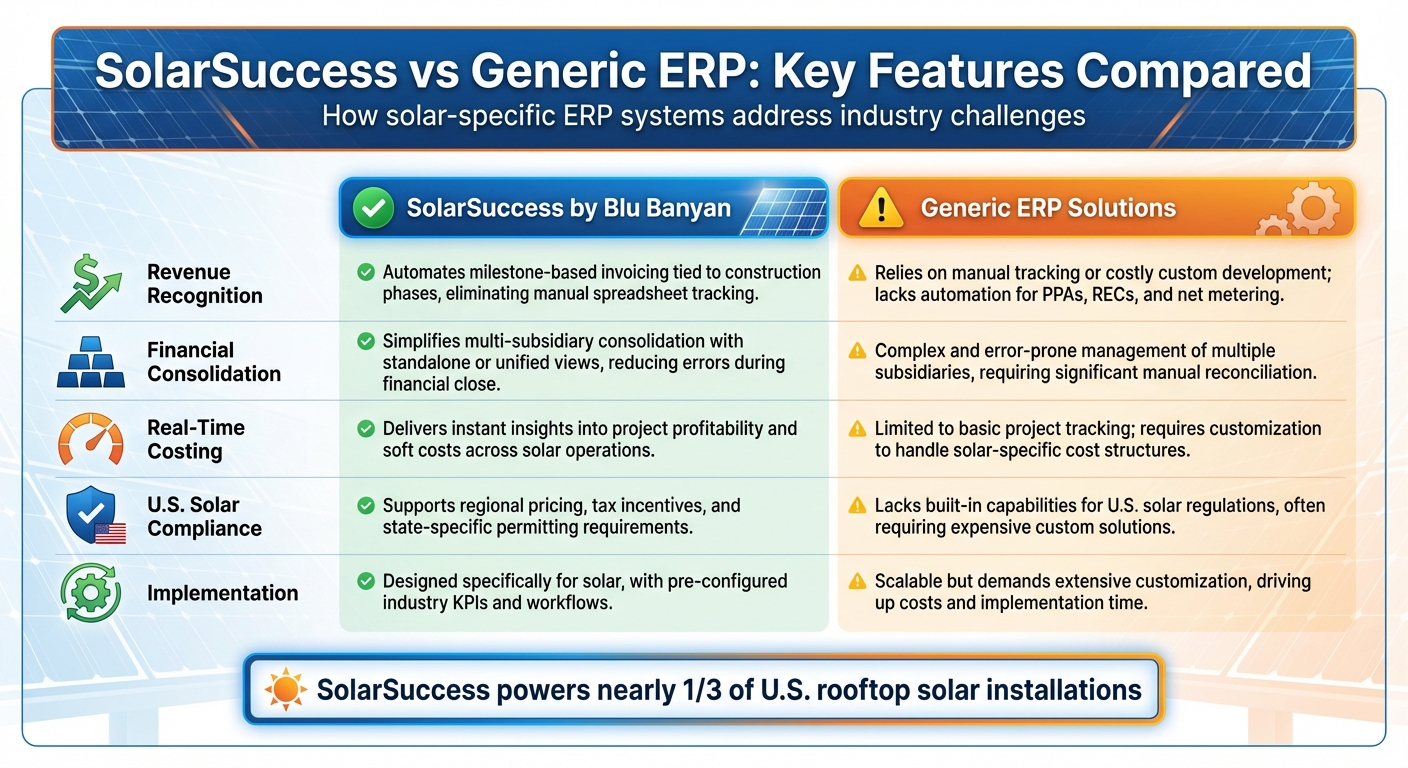
SolarSuccess vs Generic ERP: Feature Comparison for Solar Companies
Accurate revenue projections rely heavily on solutions that address the specific needs of an industry. For U.S. solar companies managing intricate cash flows and revenue streams, tailored solar ERP systems offer significant advantages over generic platforms. The table below highlights how solar-focused features can provide a clear edge in key operational areas.
| Feature | SolarSuccess by Blu Banyan | Generic ERP Solutions |
|---|---|---|
| Revenue Recognition | Automates milestone-based invoicing tied to construction phases, eliminating the need for manual spreadsheet tracking | Relies on manual tracking or costly custom development; lacks automation for solar-specific needs like PPAs, RECs, and net metering |
| Financial Consolidation | Simplifies multi-subsidiary consolidation with options for standalone or unified views, reducing errors during financial close | Managing multiple subsidiaries is complex and error-prone, requiring significant manual reconciliation |
| Real-Time Costing | Delivers instant insights into project profitability and soft costs across solar operations | Limited to basic project tracking; requires customization to handle solar-specific cost structures |
| U.S. Solar Compliance | Supports regional pricing, tax incentives, and state-specific permitting requirements | Lacks built-in capabilities for U.S. solar regulations, often requiring expensive custom solutions |
| Implementation | Designed specifically for solar, with pre-configured industry KPIs and workflows | While scalable, demands extensive customization, driving up costs and implementation time |
Although generic ERP solutions offer tools like dynamic Gantt charts and cash flow forecasting at the project-task level, they often fall short in handling the unique challenges of solar projects. Solar installations involve numerous moving parts and soft costs, which generic systems struggle to manage without extensive customization. This can lead to a tangled web of incompatible applications and conflicting data, increasing the burden of manual reconciliation between project management, accounting, and file storage.
Spencer Newman, CFO of a solar company, emphasized how SolarSuccess has transformed financial planning for businesses with multiple subsidiaries:
Our financial close was complicated and fraught with errors because we have so many subsidiaries consolidating together. That problem has almost gone away completely. We can look at all of our subsidiaries as standalones or consolidate them into our main financials. That’s been incredibly useful from a financial planning standpoint.
SolarSuccess currently powers nearly one-third of rooftop solar installations in the U.S.. These advantages highlight the importance of solar-specific solutions, paving the way for more strategic financial management in the industry.
Conclusion
Selecting the right ERP solution hinges on factors like your company’s size, operational needs, and revenue structure. For smaller solar companies with fewer than 50 employees handling straightforward EPC projects, generic ERP systems can cover essential needs like project timelines, cost tracking, and short-term cash flow forecasting. These options come with lower upfront costs, making them a practical choice for simpler operations. However, as your company scales, the need for a more tailored solution becomes evident.
Mid-sized and larger solar companies with 50 or more employees often face more intricate challenges. Managing hybrid EPC/PPA operations, dealing with subsidiaries, and navigating complex revenue structures – such as 30-year PPA schedules, state-specific milestone payments, and detailed soft cost breakdowns – requires advanced tools. Solutions like SolarSuccess by Blu Banyan are designed for these scenarios, offering automation for revenue recognition, real-time analytics, and multi-subsidiary management. Generic ERP systems may struggle in these areas, often requiring expensive customizations that lead to manual processes and less precise financial forecasting.
SolarSuccess already supports nearly one-third of U.S. rooftop solar installations, demonstrating its ability to enhance revenue forecasting, minimize errors during financial close, and streamline operations with reduced administrative burden. As your solar business grows – whether through expanding into new regions, adopting diverse revenue models, or adding subsidiaries – a specialized ERP solution can significantly boost financial accuracy and operational efficiency.
For small, EPC-focused companies, starting with a generic ERP and transitioning to SolarSuccess as operations become more complex is a smart approach. This strategy balances affordability with scalability, ensuring your financial systems evolve alongside your business needs.
FAQs
Why is SolarSuccess a better fit for solar companies than general ERP systems?
SolarSuccess is designed specifically for the solar industry, addressing the unique challenges and workflows that solar companies encounter. Unlike standard ERP systems, it includes tools tailored for project management, financial planning, and real-time operational insights – all aligned with the needs of solar businesses.
With its focus on solar-specific metrics and processes, SolarSuccess simplifies operations, optimizes cash flow management, and improves revenue forecasting. Its purpose is to help solar companies run more efficiently while offering the clarity required to make smarter, data-driven decisions.
How does SolarSuccess help solar companies improve revenue forecasting?
SolarSuccess transforms how solar companies handle revenue forecasting by integrating all their data into a single, real-time platform. This streamlined system delivers precise analytics, simplifies financial planning, and empowers businesses to make decisions with greater confidence.
Built with the solar industry in mind, SolarSuccess offers tools that make managing cash flow easier and provide clearer insights into essential financial metrics. This improved visibility helps companies refine their projections and run their operations more efficiently.
Why is data integration essential for solar businesses using SolarSuccess?
Data integration within SolarSuccess plays a crucial role in streamlining business operations by consolidating everything into one unified platform. By breaking down data silos, it ensures that consistent and accurate information flows seamlessly across all departments, cutting down on errors and inefficiencies.
With access to real-time data analytics, solar companies can make quicker, well-informed decisions, leading to better revenue forecasting and improved cash flow management. This integration not only boosts collaboration but also offers a clear, overarching view of your business performance, giving you an edge in a competitive industry.
