
NetSuite simplifies billing for solar companies by addressing challenges like milestone-based invoicing and complex revenue models. Paired with SolarSuccess by Blu Banyan, it automates key processes, reduces errors, and improves efficiency. Here’s what you need to know:
- NetSuite handles diverse billing types (one-time, recurring, usage-based) and supports tiered rates, time-of-use pricing, and demand charges.
- SolarSuccess adds milestone-based invoicing, automating billing for stages like permitting and installation.
- Both solutions comply with ASC 606 standards for revenue recognition, ensuring accurate financial reporting.
Quick Summary:
- NetSuite Strengths: Flexible billing options, revenue recognition, and real-time financial reporting.
- SolarSuccess Advantage: Prebuilt workflows tailored for solar, reducing manual effort for milestone-based billing.
For solar firms managing complex projects, SolarSuccess with NetSuite offers a streamlined approach to billing and financial management.
1. NetSuite Billing and Invoicing
Supported Billing Models
Solar projects often present complex billing challenges, but NetSuite’s billing engine simplifies the process. Through SuiteBilling, it supports a wide range of contract types, including one-time, recurring, and usage-based charges – all at the same time. For instance, a cash sale generates a single invoice upon completion, while loans follow a fixed monthly payment schedule. More intricate setups, like leases and PPAs, are managed with features such as multiple billing accounts per customer. This allows for clear separation of charges, such as upfront EPC contracts, ongoing monitoring subscriptions, and kilowatt-hour-based PPA fees.
NetSuite also enables fixed bill-date schedules, such as invoicing on the 1st of every month, and supports annual-in-advance billing for warranties or O&M services, while billing energy usage monthly in arrears from separate accounts. This setup is particularly beneficial for commercial and industrial portfolios, where a parent company might handle recurring site fees while individual locations are billed for actual energy production. All of this is possible within NetSuite’s multi-entity framework. Additionally, the platform supports tiered rates, time-of-use pricing, demand charges, volume discounts, and customer-specific pricing, giving solar companies the tools to handle even the most intricate pricing models without needing custom coding.
Integration with Solar Project Workflows
NetSuite streamlines solar billing by tying its billing engine directly to project construction milestones. For example, as a project moves through stages like permitting, installation, inspection, or final interconnection, the system can automatically generate invoices based on those predefined milestones. This eliminates manual handoffs, ensuring timely and accurate billing.
The platform also works seamlessly with inventory and procurement modules. This means billing reflects real-world progress, such as the delivery and installation of equipment. If components like solar modules or inverters are delayed, the system adjusts billing schedules accordingly, helping to prevent revenue leakage and keeping cash flow aligned with the project timeline.
Automation and Revenue Recognition
NetSuite doesn’t just simplify billing – it also automates revenue recognition for complex solar contracts. It separates performance obligations, such as equipment delivery, installation services, and ongoing monitoring, within a single agreement. Using SuiteBilling and advanced revenue management, companies can set rules to ensure product revenue is recognized at delivery or substantial completion, while service and monitoring revenue are recognized over time. This approach aligns with ASC 606 standards. For bundled or discounted contracts, NetSuite automatically allocates the transaction price across different obligations and generates audit-ready schedules, removing the need for manual spreadsheets and reducing audit risks.
This functionality is especially critical for U.S.-based solar EPCs and independent power producers managing long-term PPAs or service commitments, where the timing of revenue recognition can significantly impact reported profitability and lender agreements. SuiteBilling also handles the entire subscription lifecycle, including proration, charge consolidation, and auto-renewal invoices, freeing up finance teams to focus on strategic priorities instead of manual adjustments.
Reporting and Analytics
NetSuite offers real-time analytics through customizable dashboards, providing insights into metrics like days sales outstanding (DSO), billing cycle times, and project margins. By unifying data across accounting, inventory, project management, and CRM, it eliminates data conflicts and improves overall visibility. Spencer Newman, CFO at a solar company using NetSuite, highlighted the transformation in financial consolidation:
Our financial close was incredibly complicated and fraught with errors because we have so many subsidiaries consolidating together. That problem has almost gone away completely. We can look at all of our subsidiaries as standalones or consolidate them into our main financials. That’s been incredibly useful from a financial planning standpoint.
This enhanced visibility also extends to real-time project costing, enabling solar firms to track profitability as projects progress, rather than discovering margin issues after the fact.
sbb-itb-2560759
2. NetSuite with SolarSuccess by Blu Banyan
Supported Billing Models
SolarSuccess by Blu Banyan expands NetSuite’s billing capabilities by introducing milestone-based invoicing specifically designed for solar installations. With this system, invoices are automatically generated whenever a project hits a key construction milestone. This approach ties billing directly to the progress of solar projects, creating a seamless connection between financial processes and project workflows.
Integration with Solar Project Workflows
SolarSuccess brings together various operational modules into one unified platform tailored for solar operations. By consolidating data and eliminating silos, it links billing directly to real-world project activities. In Spring 2025, Blu Banyan received NetSuite’s Solution Provider Spotlight Award for its work with Big Sun Solar. This implementation unified operations, enabled real-time costing, and streamlined project management through bluActions™. Impressively, SolarSuccess now powers nearly one-third of rooftop solar installations in the U.S. and is trusted by leading residential and commercial installers.
Aaron Casillas, Technology & Infrastructure Director, shared his perspective on the platform’s impact:
NetSuite worked out best for us because it handles accounting and operational logistics items in tandem with project management really well. SolarSuccess streamlined things even further and allowed us to add our own customizations on top of NetSuite.
This adaptability allows solar companies to fine-tune their billing workflows to match their unique operational needs without requiring heavy custom development.
Automation and Revenue Recognition
SolarSuccess takes full advantage of its integration with NetSuite to automate revenue recognition based on project milestones. Its real-time costing features ensure that billing aligns with actual expenses and project progress. For solar companies managing multiple subsidiaries or large project portfolios, the platform simplifies financial consolidation, reducing the need for manual reconciliation and saving significant time for finance teams.
Reporting and Analytics
SolarSuccess enhances NetSuite’s analytics by adding solar-specific dashboards and KPIs. These tools provide a clear view of project tracking, financial performance, and overall operations. By centralizing all data into a single source, SolarSuccess eliminates inconsistencies often caused by disconnected systems. Solar companies can track billing cycles, monitor project profitability, and manage cash flow in real time, enabling quicker decisions and more precise financial planning.
Strengths and Limitations
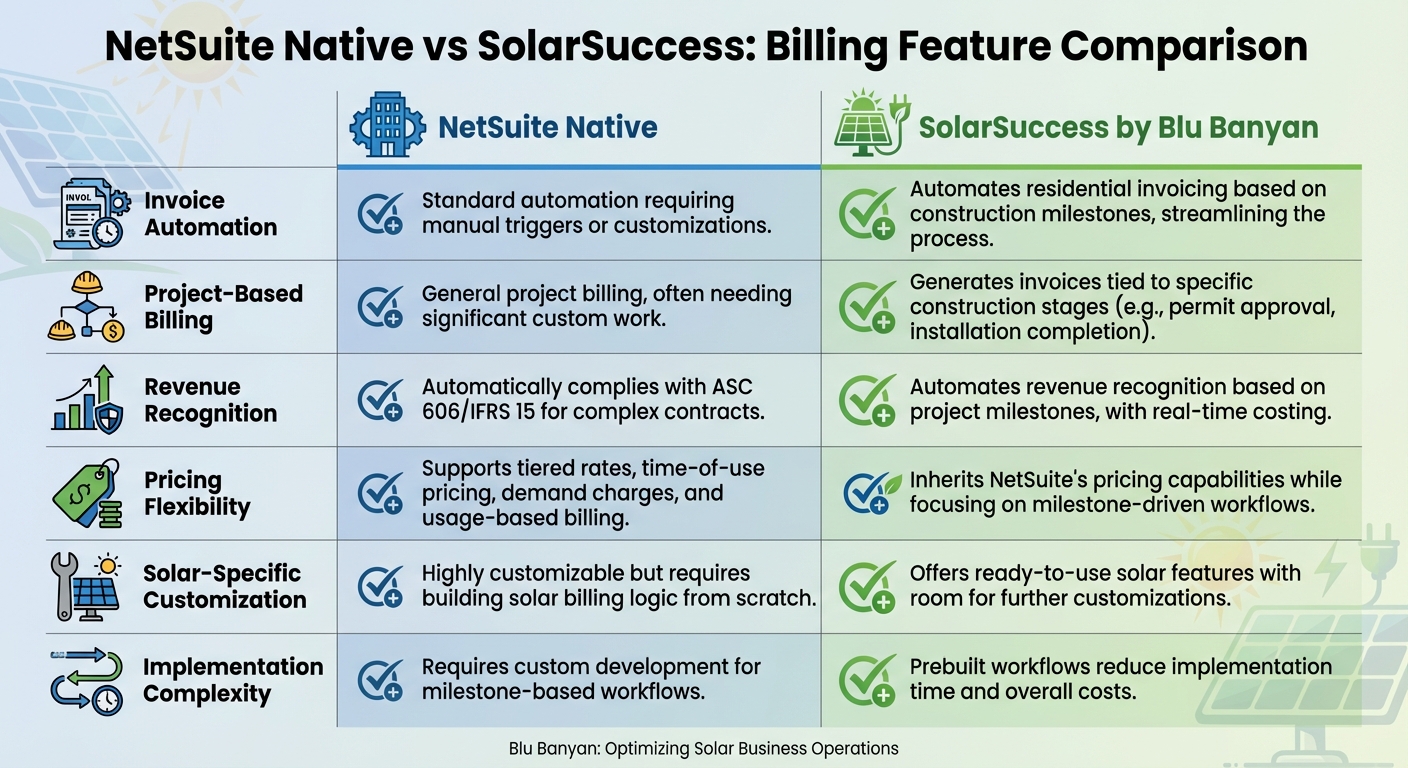
NetSuite vs SolarSuccess Billing Features Comparison for Solar Companies
NetSuite’s built-in billing tools provide flexible pricing options and dependable revenue recognition. It can handle complex pricing structures like tiered rates, time-of-use pricing, and demand charges – all within a single system. This is especially helpful for solar-plus-storage or community solar models, where billing often depends on energy usage. The platform also supports features like recurring subscriptions, consolidated invoices, and automated revenue recognition that aligns with ASC 606 and IFRS 15 standards. Additionally, it offers real-time financial reporting and multi-entity billing, making it a solid choice for companies managing intricate contracts across multiple subsidiaries.
That said, NetSuite’s native capabilities fall short when it comes to automating milestone-based billing. Without the added functionality of SolarSuccess, companies may need to manually track residential invoices, increasing the risk of errors and adding to the workload. SolarSuccess builds on NetSuite’s strengths by automating invoice triggers tied to construction milestones, such as permit approvals, installation completions, and permissions to operate. This eliminates the need for manual processes or custom development. SolarSuccess also provides prebuilt dashboards and KPIs tailored specifically for solar operations, giving finance teams instant insights into project profitability and cash flow. These features demonstrate how specialized automation can elevate standard ERP billing to meet the unique requirements of the solar industry.
Here’s a comparison of key billing features:
| Criteria | NetSuite Native | SolarSuccess by Blu Banyan |
|---|---|---|
| Invoice Automation | Standard automation requiring manual triggers or customizations | Automates residential invoicing based on construction milestones, streamlining the process |
| Project-Based Billing | General project billing, often needing significant custom work | Generates invoices tied to specific construction stages (e.g., permit approval, installation completion) |
| Revenue Recognition | Automatically complies with ASC 606/IFRS 15 for complex contracts | Automates revenue recognition based on project milestones, with real-time costing |
| Pricing Flexibility | Supports tiered rates, time-of-use pricing, demand charges, and usage-based billing | Inherits NetSuite’s pricing capabilities while focusing on milestone-driven workflows |
| Solar-Specific Customization | Highly customizable but requires building solar billing logic from scratch | Offers ready-to-use solar features with room for further customizations |
| Implementation Complexity | Requires custom development for milestone-based workflows | Prebuilt workflows reduce implementation time and overall costs |
When comparing these solutions, solar firms should weigh the time and expense of customizing NetSuite against the convenience of SolarSuccess’s prebuilt workflows. For larger installers managing complex pipelines, incentives, and financing structures, SolarSuccess’s tailored automation can be a game-changer.
Conclusion
NetSuite’s billing and invoicing tools offer a solid ground for solar companies dealing with intricate pricing models, recurring contracts, and strict compliance requirements. The platform supports tiered rates, time-of-use pricing, and demand charges while ensuring ASC 606–compliant revenue recognition. These features are especially important for solar firms managing long-term power purchase agreements and bundled installation contracts. Additionally, its real-time financial reporting and multi-entity support make it a reliable option for businesses operating across multiple states or subsidiaries.
That said, NetSuite’s native functionality lacks milestone-based billing automation, which can lead to errors and delays in cash flow. This is where SolarSuccess steps in, automating residential invoicing based on project milestones like permit approvals and installation completions. By eliminating manual tracking, SolarSuccess enhances reliability and streamlines the process.
For smaller installers with straightforward billing needs and strong IT teams, NetSuite’s core tools might be enough. On the other hand, mid-size to large solar companies handling high project volumes, complex incentive programs, or multi-state operations stand to benefit greatly from SolarSuccess. Its ready-made workflows and solar-specific dashboards have already helped leading installers reduce billing errors and improve efficiency at scale.
Ultimately, the choice depends on your operational complexity and how quickly you need to implement a solution. Companies needing solar-focused automation from the start should consider NetSuite with SolarSuccess. Meanwhile, those with simpler requirements can begin with NetSuite’s core features and expand as their needs grow. Assess your business goals and timeline to decide which option delivers the most value.
FAQs
How does NetSuite support milestone-based billing for solar projects?
NetSuite streamlines milestone-based billing for solar projects by offering customizable billing schedules tied directly to project milestones. With this setup, invoices are automatically created as each phase of a project is completed, ensuring billing stays accurate and cash flow remains steady.
This automation not only cuts down on manual work but also reduces errors, keeping billing aligned with project progress. It’s a practical solution tailored to meet the specific operational demands of solar companies.
How does integrating SolarSuccess with NetSuite benefit solar companies?
Integrating SolarSuccess with NetSuite offers solar companies a robust way to fine-tune their operations. It simplifies essential tasks like billing, invoicing, and project tracking, helping businesses run more efficiently and with greater precision.
By providing real-time access to both financial and operational data, this integration empowers companies to make smarter decisions, manage costs more effectively, and boost overall productivity. Designed specifically for the solar industry, SolarSuccess tackles the unique challenges faced by solar businesses, making it a smart choice for scaling and managing operations seamlessly.
How does NetSuite help solar companies stay compliant with ASC 606 for revenue recognition?
NetSuite supports solar companies in meeting ASC 606 compliance by simplifying revenue recognition processes. Its integrated platform brings all revenue-related data together, ensuring accuracy and clarity. With features like real-time analytics and customizable dashboards, businesses can track contract performance and align revenue recognition with ASC 606 standards. This not only keeps companies compliant but also boosts efficiency in day-to-day operations.
