

Managing solar project costs is challenging. Solar companies deal with long project timelines, complex cost structures, and compliance with U.S. GAAP and ASC 606 standards. Many businesses struggle with fragmented systems, manual data tracking, and errors in financial reporting.
NetSuite ERP provides a solution. It centralizes accounting, automates cost tracking, and ensures compliance, helping solar companies streamline operations and improve financial accuracy. With tools like project accounting, budgeting, and fixed asset management, NetSuite simplifies the financial close process and offers real-time insights into costs and profitability.
Key benefits include:
- Centralized operations: Combines accounting, project management, and billing in one system.
- Automation: Reduces manual tasks like invoicing and revenue recognition.
- Real-time data: Tracks costs, budgets, and project milestones instantly.
- Compliance support: Ensures adherence to U.S. accounting standards.
For solar businesses, tools like SolarSuccess enhance NetSuite by addressing solar-specific needs, such as milestone billing and labor tracking. By integrating systems and automating workflows, companies save time, reduce errors, and gain a clearer view of their financial health.
Why it matters: Solar companies using NetSuite and SolarSuccess can handle complex projects more efficiently, cut back-office costs, and maintain compliance, positioning themselves for growth in a competitive market.
How NetSuite ERP Addresses Solar Cost Accounting Issues
NetSuite ERP tackles the challenges solar companies face by providing a comprehensive platform. Instead of relying on separate tools for project management, accounting, and file storage, solar companies can manage everything within one system.
Centralized Accounting and Project Management
One of NetSuite’s standout features is its ability to integrate all business operations seamlessly. Whether it’s accounting, inventory management, project tracking, or CRM, everything works together within the platform. For solar companies managing complex installations, this level of integration is transformative.
Aaron Casillas, Technology & Infrastructure Director, highlights this advantage:
"NetSuite consolidates previously fragmented systems and handles accounting and operational logistics in tandem with project management exceptionally well."
This unified approach eliminates data silos and ensures that all departments are on the same page. For example, when the procurement team orders materials, that information flows directly to accounting and project management. Similarly, when installation milestones are reached, billing happens automatically. This connectivity reduces errors and minimizes manual tasks.
NetSuite’s project accounting features link every transaction directly to the general ledger, offering real-time visibility into project revenues, expenses, and profitability. Dashboards provide a clear financial overview of each project, laying the foundation for further automation in cost tracking and compliance.
Automated Cost Tracking and Compliance
NetSuite’s automation tools redefine how solar companies manage their most time-intensive tasks. The procure-to-pay automation streamlines vendor invoices and purchase orders, while automated billing ensures invoices are sent promptly based on project milestones.
Joe Marhamati, Co-Founder & VP, shared his experience with these features:
"We’ve been able to automate most of our residential invoices. When a deal moves to a particular stage of construction, for example, SolarSuccess generates invoices based on that specific milestone. That has been the biggest advantage and has definitely helped us out a lot. We’re doing more with the same number of people and we have a system that’s more reliable and less stressful than tracking a million different spreadsheets."
NetSuite also automates revenue recognition, ensuring compliance with U.S. accounting standards like U.S. GAAP and ASC 606. This is especially important for solar companies that need to recognize revenue at specific project stages while adhering to regulatory requirements.
For companies with multiple subsidiaries, NetSuite simplifies the financial close process. Spencer Newman, CFO, described the impact:
"Our financial close was incredibly complicated and fraught with errors because we have so many subsidiaries consolidating together. That problem has almost gone away completely. We can look at all of our subsidiaries as standalones or consolidate them into our main financials. That’s been incredibly useful from a financial planning standpoint."
U.S.-Specific Configuration for Solar Companies
NetSuite goes a step further by offering configurations tailored to U.S. business requirements. The platform automatically handles U.S. dollar currency formatting ($), uses the standard MM/DD/YYYY date format, and supports both imperial and metric units depending on project needs.
Its compliance features are designed to meet federal and state regulations. The system manages complex tax calculations, tracks depreciation schedules for solar equipment, and generates reports to satisfy regulatory demands.
Additionally, real-time dashboards provide customizable KPIs and analytics that solar companies can adapt to their unique needs. Project managers can quickly check installation progress, costs, and profitability, while finance teams gain instant insights into cash flow, accounts receivable, and budget variances.
NetSuite also enables "what if" scenario modeling, allowing companies to explore different pricing strategies, material costs, or project timelines before making decisions. This is particularly valuable in the solar industry, where fluctuating material costs and unpredictable delays, like permitting or weather, can impact project outcomes.
POWERHOME Solar exemplifies the benefits of NetSuite’s centralized approach. After adopting NetSuite ERP to unify their financials, inventory, and project billing, they shortened their month-end close process from 28 days to just 5 days, thanks to automated workflows and streamlined accounting processes.
Key NetSuite Features for Solar Cost Accounting
NetSuite provides a range of tools designed to address the unique challenges faced by solar companies, particularly when it comes to managing costs and finances effectively.
Project and Job Costing
NetSuite’s project and job costing tools give solar companies the ability to tightly monitor expenses. The system tracks everything – labor hours, material costs, and overhead – on a project-by-project basis or even for specific installation tasks. Each transaction is directly linked to the general ledger, offering a comprehensive view of a project’s financial health. This level of detail makes it easier to spot cost variances early and make quick adjustments to keep budgets intact.
This functionality also supports better planning, enabling accurate budgeting and forecasting for future projects.
Budgeting and Forecasting
NetSuite’s budgeting tools are designed to help solar companies avoid financial surprises. With rolling 12-month forecasts and detailed variance analyses, businesses can stay ahead of potential cost overruns. The platform also allows teams to conduct unlimited "what if" scenario modeling. This means they can test different pricing models or factor in material cost changes before committing to contracts.
By comparing real-time actual costs to budgets, NetSuite flags potential overruns early, helping teams take corrective action to keep projects financially on track.
Fixed Asset Management
Solar companies often deal with a wide range of assets, from solar panels to inverters and battery systems. NetSuite simplifies the management of these assets with its Fixed Asset Management module. When a new asset is purchased, the system records essential details like cost, serial number, warranty information, and installation location. Depreciation is calculated automatically in line with U.S. accounting standards, and maintenance schedules are built into the system to ensure assets are properly cared for and warranties remain valid. This approach helps companies maximize the value of their investments while minimizing operational inefficiencies.
Revenue Recognition and Billing
Revenue recognition can be complex in the solar industry, but NetSuite automates this process while ensuring compliance with U.S. GAAP and ASC 606 standards. For milestone-based billing, the system generates invoices automatically when specific project phases are completed.
NetSuite also handles advanced revenue calculations. For example, in a project with $6,000 in costs out of a $10,000 budget (60% complete), the system recognizes $7,080 in revenue using the percentage-of-completion method. Real-time dashboards provide instant insights into accounts receivable, outstanding invoices, and payment statuses, helping finance teams manage cash flow and profitability more effectively.
sbb-itb-2560759
Improving NetSuite with SolarSuccess and SuiteApps
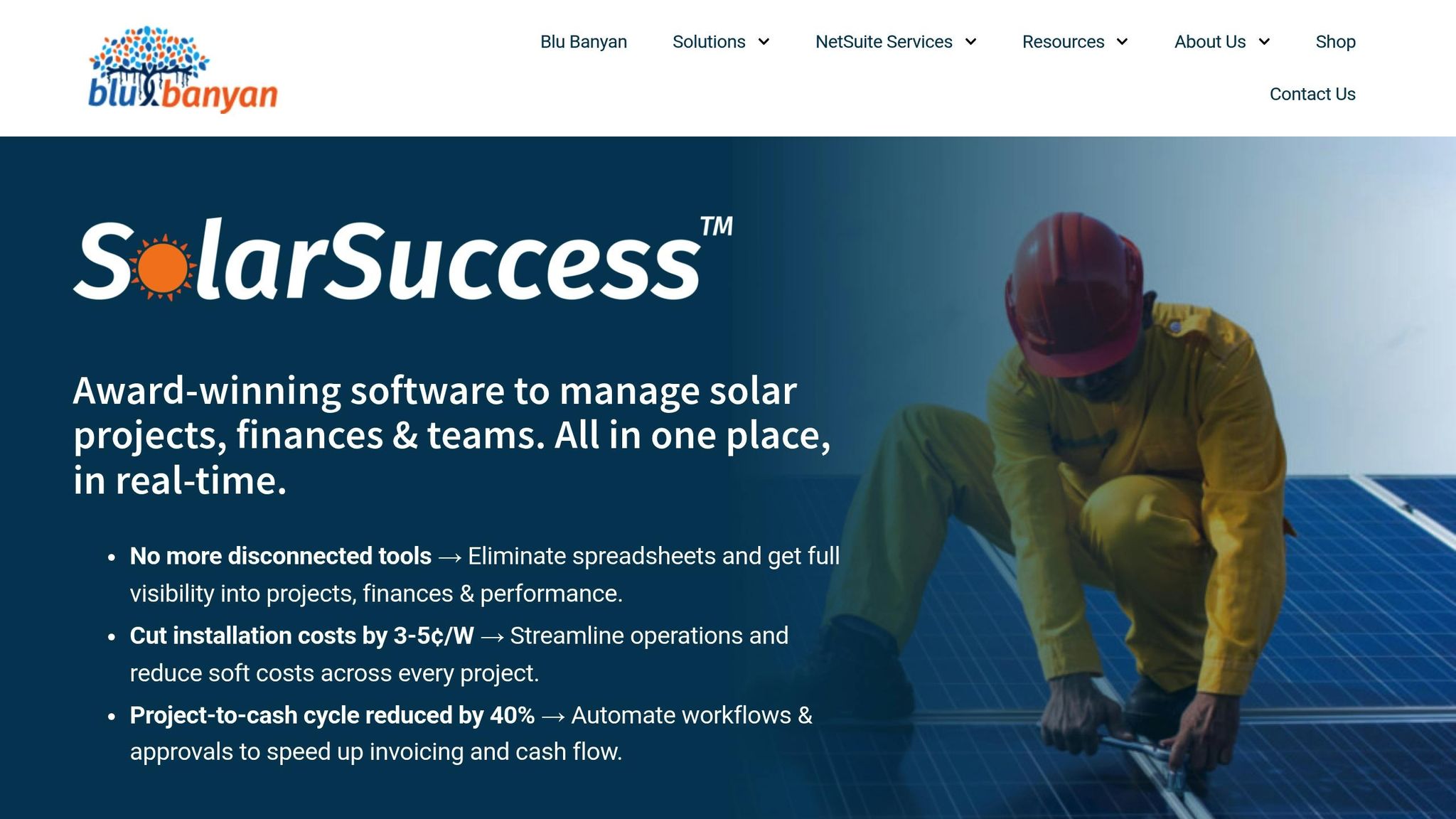
NetSuite provides a strong framework for solar cost accounting, but specialized tools can elevate its capabilities even further. SolarSuccess, developed by Blu Banyan, enhances this foundation with features crafted specifically for the solar industry. These tools address the unique challenges solar companies face, particularly when it comes to managing project costs and operations.
What Is SolarSuccess?
SolarSuccess is a NetSuite-native application built for solar installers. It tackles the fragmented system issues that many solar businesses struggle with by integrating cost tracking and project management into one cohesive platform. Designed with solar-specific workflows in mind, SolarSuccess streamlines how companies handle their operations.
With SolarSuccess, businesses can track installation progress, monitor material costs in real-time, and generate automated invoices tied to project milestones. This automation significantly reduces the manual effort typically required to manage solar project finances.
Aaron Casillas, Technology & Infrastructure Director, shared how SolarSuccess transformed their workflow:
"NetSuite worked out best for us because it handles accounting and operational logistics items in tandem with project management really well. SolarSuccess streamlined things even further and allowed us to add our own customizations on top of NetSuite."
SuiteApps for Solar Productivity
Blu Banyan also offers a suite of productivity tools, called SuiteApps, that complement SolarSuccess. These apps are designed to improve collaboration and simplify daily operations, all while seamlessly integrating with NetSuite’s cost accounting features.
- bluChat: Facilitates real-time team communication via SMS, enabling quick coordination when cost overruns or project delays arise. By streamlining communication, teams can address issues faster, keeping projects on track and costs under control.
- bluDocs: Centralizes document management, which is vital for solar projects requiring extensive permitting, compliance paperwork, and warranty tracking. It organizes documents and provides clear audit trails, ensuring transparency in cost accounting and compliance with regulations.
- bluTime: Simplifies time tracking for employees working across multiple installations. Accurate labor cost allocation is essential for analyzing project profitability, and bluTime ensures every hour worked is correctly attributed to the right project and cost center.
Integration and Customization for Solar Companies
In addition to these productivity tools, Blu Banyan offers tailored integrations that streamline operations and unify data within NetSuite. Their approach focuses on creating a centralized platform that eliminates data silos, improving cost visibility and operational efficiency.
Using tools like Celigo, Blu Banyan customizes NetSuite to integrate with existing systems and third-party applications commonly used in solar operations. Whether it’s marketing automation platforms, permitting software, or equipment monitoring systems, the goal is to ensure all cost-related data flows seamlessly into NetSuite for comprehensive financial reporting.
Aaron Casillas highlighted the value of this approach:
"Blu Banyan’s wide breadth of expertise was a critical resource for us. Our strategic partnership with Blu Banyan enables us to identify and prioritize specific features for development that will increase our productivity."
This customization process allows solar companies to retain their existing workflows while benefiting from integrated cost accounting. Businesses can choose to leverage pre-built automation features or develop tailored solutions to meet their unique needs. Joe Marhamati praised Blu Banyan’s adaptability:
"Whether we wanted to integrate systems or take advantage of out-of-the-box automation, Blu Banyan handled it for us. I think their MO is ‘basically anything is possible.’"
Best Practices for Implementing NetSuite for Solar Cost Accounting
To make the most of NetSuite for solar project cost accounting, it’s essential to approach the implementation with a clear strategy. Done right, NetSuite can streamline processes, improve financial tracking, and deliver a strong return on investment from day one.
Setting Up Projects and Cost Centers
A solid project structure is the backbone of effective solar cost accounting. Within NetSuite, organize your projects to reflect the different phases of solar installations – covering everything from initial design and permitting to final commissioning and warranty management. Break these projects down further by creating distinct cost centers for key business functions like sales, design, procurement, installation, and operations. This level of detail allows you to allocate costs accurately and pinpoint which areas drive profitability. For soft costs, such as permitting or administrative expenses, dedicated cost centers ensure precise tracking.
To keep everything on track, project managers should establish budgets at both the project and task levels. NetSuite’s tools allow for real-time monitoring, so you can compare actual spending against these budgets. Linking every expense to a specific task ensures you’re working with precise data, which helps identify variances early and take corrective action if needed.
This structured approach not only improves cost allocation but also supports better compliance and transparency throughout your operations.
Maintaining Compliance and Transparency
NetSuite’s centralized platform eliminates the inefficiencies caused by disconnected systems. By consolidating all financial data into a single source of truth, the platform makes it easier to stay audit-ready and maintain compliance standards.
For companies with multiple subsidiaries, NetSuite simplifies financial closing processes. Its consolidated reporting capabilities let you view financial data at both standalone and group levels, giving you a clearer picture of your operations.
Take advantage of NetSuite’s real-time analytics and customizable dashboards to monitor financial performance, project costs, and operational metrics. This level of visibility ensures teams can proactively address compliance issues before they become larger problems.
Using Automation for Efficiency
Once you’ve established a strong foundation with organized projects and transparent compliance, automation can take your cost accounting to the next level. NetSuite’s automation features are a game-changer for solar cost accounting, reducing manual effort and improving accuracy across financial processes.
For example, companies have successfully automated residential invoicing tied to construction milestones, eliminating the need for juggling spreadsheets while maintaining reliable workflows.
You can also automate tasks like monthly financial closes, revenue recognition, and financial reporting. NetSuite’s workflows handle routine processes such as generating invoices based on project milestones, approving expenses, and preparing financial statements. Automated alerts for budget overruns, project delays, or compliance deadlines help teams stay ahead of potential challenges.
To further streamline operations, consider integrating NetSuite with third-party tools using platforms like Celigo. Whether it’s connecting marketing automation, permitting software, or equipment monitoring systems, seamless integration ensures all cost-related data flows directly into NetSuite, creating a complete financial picture.
Start with high-volume, repetitive tasks when introducing automation, and gradually expand to more complex workflows. This step-by-step approach builds a more efficient and dependable cost accounting system over time.
Conclusion and Key Takeaways
Solar companies face unique challenges in cost accounting that traditional software often struggles to address. The intricate nature of solar projects, coupled with regulatory demands and the necessity for real-time financial insights, requires a tailored solution. NetSuite, enhanced with Blu Banyan’s solar-specific tools, offers exactly that.
Key Benefits of NetSuite for Solar Companies
NetSuite revolutionizes cost accounting for solar businesses by consolidating fragmented operations and delivering real-time insights into project costs, profitability, and performance metrics through customizable dashboards.
With integrated project and job costing modules, EPC contractors can precisely allocate labor, materials, and overhead to specific projects or tasks. This setup also enables real-time tracking of work-in-progress (WIP) and project profitability – critical for accurate billing and ensuring project success.
NetSuite’s automation features streamline routine processes like monthly financial closes, revenue recognition, and milestone-based invoicing, reducing manual effort and improving accuracy. Additionally, the platform’s built-in compliance tools and audit trails help solar businesses maintain transparency and meet regulatory obligations.
How SolarSuccess Enhances NetSuite
SolarSuccess takes NetSuite’s capabilities a step further, tailoring them specifically for the solar industry. This specialized ERP solution supports nearly one-third of rooftop solar installations in the U.S. and is trusted by leading residential and commercial installers.
One standout feature of SolarSuccess is its ability to automate invoicing tied to project milestones. As Joe Marhamati, Co-Founder & VP, explains:
"We’ve been able to automate most of our residential invoices. When a deal moves to a particular stage of construction, for example, SolarSuccess generates invoices based on that specific milestone. That has been the biggest advantage and has definitely helped us out a lot. We’re doing more with the same number of people and we have a system that’s more reliable and less stressful than tracking a million different spreadsheets."
Blu Banyan further boosts NetSuite’s functionality with SuiteApps such as bluChat, bluDocs, bluConnect, and bluTime. These tools enhance collaboration and productivity across teams, creating a seamless ecosystem for managing solar projects and cost accounting.
Their expertise has earned Blu Banyan significant recognition, including being named NetSuite’s top Micro-vertical Solution Provider Partner of the Year for three consecutive years and winning the Spring 2025 Solution Provider Spotlight award in Energy.
Final Thoughts for Solar Decision-Makers
The rapid growth of the solar industry demands scalable and efficient systems that can handle increasing complexities while maintaining accuracy and compliance. NetSuite, combined with SolarSuccess and Blu Banyan’s SuiteApps, delivers the tools solar companies need to thrive.
The shift toward cloud-based, integrated ERP systems underscores the industry’s need for real-time data, automation, and robust compliance measures. Companies that continue relying on disjointed systems and manual workflows risk falling behind in an increasingly competitive market.
For solar business leaders, the priority should be implementing a scalable solution as quickly as possible. Real-time financial reporting and automation are no longer optional – they are essential for overcoming industry challenges. With NetSuite, companies can cut back-office costs, improve operational efficiency, and scale effectively without adding unnecessary administrative burdens.
Blu Banyan’s expertise in solar workflows, combined with their proven track record in implementing NetSuite solutions, makes them an ideal partner for businesses looking to upgrade their cost accounting processes. Investing in the right ERP infrastructure not only streamlines operations but also sets the stage for long-term growth and success.
FAQs
How does NetSuite ERP help solar companies meet U.S. GAAP and ASC 606 compliance requirements?
NetSuite ERP offers powerful tools designed to help solar companies stay compliant with U.S. GAAP and ASC 606 standards. By automating revenue recognition, it ensures precise tracking of project-based revenue and expenses. This is especially important for solar businesses handling long-term projects that rely on milestone-based billing or percentage-of-completion accounting.
Key features like custom reporting, real-time financial insights, and automated workflows simplify compliance efforts. These tools not only reduce manual errors but also enhance audit readiness, allowing solar companies to navigate complex accounting requirements while keeping their operations running smoothly.
What features does SolarSuccess offer to simplify solar project cost management in NetSuite?
SolarSuccess brings specialized tools to NetSuite, crafted exclusively for the solar industry. It simplifies cost accounting by incorporating advanced project management, real-time financial tracking, and automated reporting. These features allow solar companies to better manage budgets, monitor expenses, and boost profitability.
Beyond financial management, SolarSuccess also enhances CRM and sales automation, team collaboration, inventory and asset management, and service operations. By connecting every aspect of solar projects, it helps businesses stay organized, work more efficiently, and concentrate on scaling their operations.
How does automating revenue recognition and invoicing with NetSuite benefit solar companies?
Automating revenue recognition and invoicing through NetSuite simplifies financial operations for solar companies, cutting down on manual work and minimizing mistakes. Tasks such as creating invoices tied to project milestones can be handled automatically, ensuring billing is both accurate and consistent.
This streamlined approach boosts cash flow management and offers real-time insights into financial performance. With these efficiencies in place, solar companies can dedicate more energy to scaling their business and providing outstanding service to their customers.
