
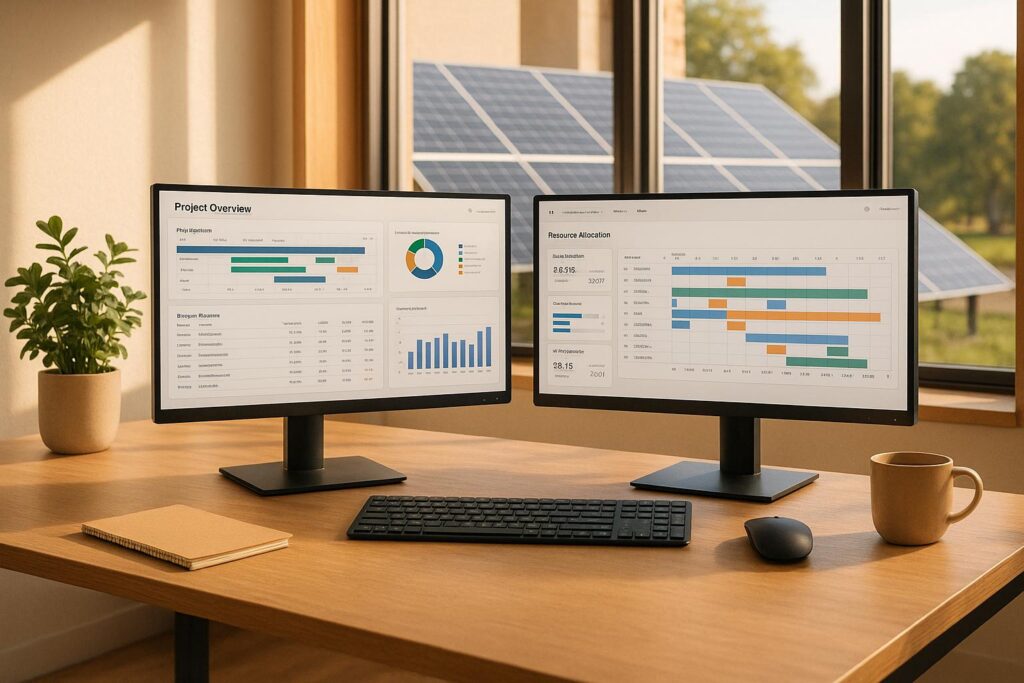
Struggling to manage costs in the solar industry? Here’s the solution: NetSuite and SolarSuccess by Blu Banyan. Together, these tools help solar companies cut costs, improve resource allocation, and manage projects more effectively.
- NetSuite: A cloud-based ERP that integrates financials, inventory, procurement, project management, and CRM into one system. Features like supply planning and project accounting help reduce inventory costs and track profitability in real-time.
- SolarSuccess: Built on NetSuite, this tool is tailored for solar companies. It reduces soft costs (up to 65% of total expenses) with solar-specific workflows, milestone-based billing, and advanced inventory management.
Key Features:
- NetSuite: Real-time reporting, supply chain optimization, and customizable integrations.
- SolarSuccess: Solar-specific tools for billing, inventory tracking, and compliance, plus pre-built workflows to reduce inefficiencies.
Quick Takeaway:
NetSuite is great for general business needs, while SolarSuccess is ideal for solar companies needing industry-specific solutions. The choice depends on your business scale and complexity.
1. NetSuite Core Features
NetSuite provides solar companies with a comprehensive set of tools to manage resource costs efficiently. By functioning as a single, integrated system, it eliminates the headaches and inefficiencies that come with juggling multiple disconnected applications.
Project Costing and Financial Management
NetSuite’s Project Accounting and Job Costing modules offer solar companies precise control over project expenses. These tools help allocate labor, materials, and overhead to specific projects while tracking work-in-progress (WIP) and real-time profitability
. For solar EPC contractors, this unified approach ensures accurate financial oversight and safeguards profit margins by capturing all project-related expenses and revenues in one place.
With NetSuite, solar firms can easily compare planned versus actual costs and timelines, enabling proactive adjustments to stay on budget and schedule. Joe Marhamati, co-founder of a solar company, shared how this system has streamlined their operations:
"We’ve been able to automate most of our residential invoices. When a deal moves to a particular stage of construction, for example, SolarSuccess generates invoices based on that specific milestone. That has been the biggest advantage and has definitely helped us out a lot. We’re doing more with the same number of people and we have a system that’s more reliable and less stressful than tracking a million different spreadsheets."
This level of precision naturally extends to inventory forecasting, ensuring materials are available when needed without unnecessary surplus.
Inventory and Supply Chain Optimization
NetSuite’s Supply Planning capabilities tackle one of the biggest challenges in solar operations: inventory management. By dynamically adjusting reorder points and stock levels based on factors like lead times, seasonal demand, and supply targets, the platform helps solar companies avoid costly delays caused by stock-outs while preventing overstocking of expensive equipment like inverters and panels.
The system also supports vendor contracts with tiered pricing, scheduled deliveries, and self-service portals for real-time collaboration with suppliers. These features reduce manual errors and improve overall efficiency. By optimizing inventory management, companies can cut operational costs by up to 20%. Additionally, NetSuite’s ability to track inventory across multiple locations in real time supports growth without driving up costs.
Integrations and Customizations
NetSuite’s open architecture allows seamless integrations with third-party tools like IoT systems, field service management platforms, and maintenance software. This flexibility helps solar companies automate workflows, connect disparate systems, and reduce manual tasks, which lowers costs and improves efficiency.
For companies with unique needs, NetSuite’s customization options are invaluable. For example, integrating with field service management tools can automate maintenance ticketing and enable real-time asset tracking, enhancing resource allocation and reducing downtime. By eliminating manual data entry, companies not only reduce errors but also free up staff to focus on strategic initiatives. These integrations ensure smoother operations and provide the foundation for data-driven management.
Real-Time Data and Reporting
NetSuite’s real-time analytics give solar companies the visibility they need to identify cost-saving opportunities quickly. Customizable dashboards provide tailored metrics for each department, enabling informed decision-making based on accurate and up-to-date data.
By serving as a unified platform, NetSuite eliminates data silos and conflicting information caused by incompatible applications. This single source of truth ensures reliable reporting and uncovers inefficiencies across operations.
The benefits extend to financial consolidation as well. Spencer Newman, CFO at a solar company, highlighted how NetSuite simplified their financial processes:
"Our financial close was incredibly complicated and fraught with errors because we have so many subsidiaries consolidating together. That problem has almost gone away completely. We can look at all of our subsidiaries as standalones or consolidate them into our main financials. That’s been incredibly useful from a financial planning standpoint."
Aaron Casillas, Technology & Infrastructure Director, echoed these sentiments:
"Solar installation has many moving parts, all generating soft costs, and there is no single application that solves them all, because you have to address inefficiencies across all functions of the entire company. We looked at other solutions, but NetSuite worked out best for us because it handles accounting and operational logistics items in tandem with project management really well."
With real-time reporting, solar companies can make strategic decisions that optimize resources and protect profit margins across their operations. NetSuite’s ability to consolidate critical data into actionable insights ensures that every part of the business runs efficiently.
2. SolarSuccess by Blu Banyan
SolarSuccess by Blu Banyan builds on NetSuite’s core features to tackle the unique cost challenges faced by the solar industry. Designed specifically for solar companies, this ERP solution is built directly on the NetSuite platform and helps reduce the "soft costs" that can make up a staggering 65% of a solar installation’s total expenses. It’s no surprise that SolarSuccess is trusted by companies responsible for nearly a third of all rooftop solar installations in the U.S.. By combining project costing, financial management, inventory, CRM, and project management into one system, it eliminates the inefficiencies that often come with juggling multiple disconnected tools. This tailored platform extends NetSuite’s capabilities, offering solar companies the specialized tools they need to handle their operational challenges.
Project Costing and Financial Management
SolarSuccess takes NetSuite’s project accounting features to the next level with workflows designed specifically for the solar industry. These workflows simplify processes like milestone-based billing and revenue recognition. The platform allows for precise allocation of labor, materials, and overhead while tracking work-in-progress (WIP) and profitability in real time. For example, Titan Solar Power used SolarSuccess to speed up installation times and introduce a homeowner portal for real-time project tracking. SolarSuccess also provides full visibility into cash flow, profitability, acquisition costs, and project summaries. This level of insight helps solar installers spot cost overruns early and make informed adjustments based on data.
Inventory and Supply Chain Optimization
When it comes to inventory management, SolarSuccess builds on NetSuite’s supply planning with features tailored for solar operations. It offers real-time tracking across multiple locations, automated replenishment based on lead times and demand, and procurement processes designed for solar equipment. The platform also supports vendor management, consolidates inbound shipments, and offers complete supply chain visibility – essential for managing high-cost components like panels and inverters. By integrating permitting, scheduling, and supply chain efforts into one system, SolarSuccess eliminates data silos that previously required extra labor to manage.
Integrations and Customizations
SolarSuccess offers seamless integration with other industry systems and extensive customization options. Blu Banyan uses platforms like Celigo to synchronize data across multiple systems, creating a unified source of truth for solar operations. The platform includes pre-built connections to major solar industry applications and supports custom integrations to match specific workflows.
Dan Burke, a Marketing Automation Manager, shared how Blu Banyan integrated their ERP/CRM with their Marketing Automation Platform – a project recommended by Celigo and completed in just a few weeks after their internal team had struggled with it for much longer.
Aaron Casillas, Technology & Infrastructure Director, highlighted its flexibility:
"SolarSuccess allowed them to add their own customizations on top of NetSuite to address inefficiencies across all functions of their company, which previously required adding labor to patch data holes between disparate systems."
By unifying essential systems, SolarSuccess reflects NetSuite’s mission to eliminate data silos. It also includes productivity tools like bluChat, a SuiteApp for team collaboration that enables direct communication among staff, partners, vendors, and customers. These integrations feed into SolarSuccess’s real-time analytics, allowing teams to make proactive adjustments across operations.
Real-Time Data and Reporting
SolarSuccess comes equipped with dashboards and KPIs tailored to the solar industry, helping companies uncover cost-saving opportunities and better allocate resources across projects. Customer feedback has played a key role in shaping its reporting capabilities. For instance, Blu Banyan added a weather portlet to project manager dashboards based on direct input from users, helping them avoid unnecessary site visits due to weather conditions. The platform is automatically updated twice a year in sync with NetSuite’s release schedule, ensuring that users always have access to the latest features and compliance updates without any extra effort or cost. Additionally, SolarSuccess centralizes important project-specific documents like contracts, permits, and compliance records, making them easy to access when needed.
sbb-itb-2560759
Advantages and Disadvantages
When comparing NetSuite Core Features to specialized solar solutions like SolarSuccess by Blu Banyan, understanding the trade-offs is crucial for making an informed decision. Each option has its strengths and challenges, depending on the specific needs of a solar business.
NetSuite Core Features offer a strong starting point, with lower upfront costs and quicker deployment. Its modular design allows businesses to scale efficiently without requiring heavy IT investments. This makes it particularly appealing to growing solar companies that need flexibility in their technology tools. However, since NetSuite is designed for general business use, it may not fully address the unique challenges of the solar industry. Companies often need to invest additional resources in customizations or third-party integrations to handle specific requirements like permitting workflows or detailed project tracking.
On the other hand, SolarSuccess by Blu Banyan takes a more tailored approach, addressing solar-specific needs right out of the box. By eliminating data silos and streamlining processes, it tackles one of the industry’s most significant challenges: high non-hardware (soft) costs. These soft costs can account for as much as 65% of total installation expenses, and SolarSuccess’s targeted features aim to significantly reduce them, potentially leading to substantial financial benefits.
However, this specialization comes with its own set of challenges. SolarSuccess generally requires a higher upfront investment and longer deployment timelines due to its comprehensive customization and integration needs. Additionally, businesses must rely on Blu Banyan for ongoing support and updates, which could be a consideration for long-term planning.
| Aspect | NetSuite Core Features | SolarSuccess by Blu Banyan |
|---|---|---|
| Initial Investment | Lower costs, faster deployment | Higher upfront costs, longer timeline |
| Industry Focus | General business; needs customization | Pre-built solar-specific workflows |
| Integration Complexity | Modular SuiteApps with standard options | Deep solar integrations included |
| Data Visibility | Real-time, may require extra work | Unified, real-time across solar functions |
| Cost Optimization | Strong supply chain/project accounting | Focused on reducing soft costs (up to 65%) |
| Scalability | High, supports multi-entity operations | Tailored for solar industry growth |
| Vendor Relationship | Managed via NetSuite or partner network | Specialized support from Blu Banyan |
| ROI Timeline | Moderate; depends on customization | High potential through targeted efficiency gains |
NetSuite’s tools are robust and adaptable to a variety of industries, but solar companies often discover a need for additional customizations during implementation. SolarSuccess addresses this by including pre-integrated solar-specific workflows, which reduces the need for separate point solutions. Still, its comprehensive nature may require more extensive training and change management efforts.
In terms of reporting, NetSuite provides solid general capabilities, while SolarSuccess enhances this with compliance tracking and KPIs specifically designed for solar operations.
Ultimately, when evaluating the total cost of ownership, companies must weigh their operational scale and industry focus. For smaller solar businesses or those with simpler needs, NetSuite Core Features might suffice with selective customizations. However, larger installers or organizations looking to scale and improve project margins often find SolarSuccess’s tailored approach more beneficial. Its ability to minimize reliance on separate tools and reduce integration complexity can lead to significant efficiency gains over time.
Conclusion
Deciding between NetSuite Core Features and SolarSuccess by Blu Banyan comes down to your company’s specific needs, operational complexity, and growth plans. NetSuite’s modular design offers scalability, ranging from basic ERP functions to managing multi-subsidiary operations, all without requiring significant IT investments.
For businesses with simpler operational models – such as solar distributors focused on inventory and order management – NetSuite Core Features provide a reliable starting point. These companies can leverage essential tools like basic financials, project accounting, and supply chain management, enjoying lower upfront costs and quicker deployment. Plus, the modular structure allows for the addition of advanced features, such as supply planning or field service management, as their needs evolve.
On the other hand, companies dealing with data silos, fragmented systems, or manual processes may find SolarSuccess by Blu Banyan a better fit. This is particularly true for solar installers managing complex operations, multiple subsidiaries, or intricate financial consolidations. With soft costs accounting for up to 65% of total installation expenses, SolarSuccess addresses these challenges with workflows tailored to the solar industry, helping reduce inefficiencies and costs. Features like advanced inventory management and project accounting streamline operations, making it a strong choice for installers looking to scale effectively.
SolarSuccess is especially valuable for residential and commercial solar installers who need tools like automated milestone-based invoicing or advanced workflow automation to boost team productivity. Its deep solar-specific integrations and real-time visibility across operations make it a standout option. Unlike NetSuite’s customizable module-based scaling, SolarSuccess offers pre-built workflows designed specifically for solar businesses, eliminating the need for extensive customization. Blu Banyan’s solutions currently support nearly one-third of rooftop solar installations in the U.S., a testament to their effectiveness. Additionally, the twice-yearly updates – provided at no extra cost – ensure users stay up to date with the latest industry features and compliance requirements.
Ultimately, the decision comes down to your long-term goals. NetSuite offers broad flexibility to adapt as your business grows, while SolarSuccess delivers specialized tools designed to meet the unique demands of the solar industry. Whether you prioritize scalability or industry-focused efficiency will guide your choice.
FAQs
How does SolarSuccess by Blu Banyan help solar companies lower soft costs?
SolarSuccess takes the hassle out of managing key business processes by automating and simplifying administrative tasks. Designed specifically for the solar industry and built on the robust NetSuite platform, it offers customized solutions that seamlessly integrate with your operations, making workflows smoother and more efficient.
With real-time project data and tools that enhance collaboration, SolarSuccess helps reduce common setbacks like delays and mistakes – two major drivers of soft costs. This means solar companies can better allocate their resources and channel their energy into scaling their business.
How does NetSuite help solar companies optimize inventory and supply chain costs?
NetSuite provides robust tools designed to help solar companies simplify inventory management and cut down on supply chain expenses. With features such as real-time inventory tracking, demand planning, and automated procurement, businesses can maintain the right materials on hand, reducing waste and preventing stock shortages.
On top of that, NetSuite’s customizable dashboards and detailed reporting offer actionable insights into supply chain performance. These insights empower solar companies to spot opportunities to lower costs and boost operational efficiency. By utilizing these tools, businesses can better allocate resources and improve profitability across the board.
How do NetSuite and SolarSuccess integrations help solar companies operate more efficiently?
NetSuite, combined with SolarSuccess, provides specialized integrations and customizations tailored for the solar industry. These tools simplify workflows, enhance data accuracy, and bring operations together in one place, helping solar companies cut down on inefficiencies and make the most of their resources.
With features like real-time financial insights, project tracking, and automated processes, SolarSuccess equips solar businesses to make informed decisions and prioritize growth. Its adaptable approach ensures solutions can address specific operational needs, leading to noticeable gains in efficiency.
