

When it comes to managing solar businesses, real-time data synchronization is a game-changer. Unlike traditional ERP systems that rely on batch updates, NetSuite offers instant updates across all operations. This ensures better coordination, faster invoicing, and up-to-date compliance tracking – all critical for solar companies juggling multiple projects.
Here’s why NetSuite stands out:
- Unified database: Updates reflect instantly across all modules like accounting, inventory, and project management.
- Solar-specific tools: Solutions like SolarSuccess automate invoicing, streamline compliance tracking, and provide tailored dashboards.
- Integration-friendly: With native APIs and SuiteApps like bluDocs and bluTime, NetSuite connects seamlessly with other tools.
- Real-time workflows: Unlike other ERPs that rely on scheduled updates, NetSuite processes changes in milliseconds.
Other ERP systems often struggle with delays, manual reconciliation, and limited scalability, making them less suited for the fast-paced solar industry. NetSuite’s real-time capabilities not only save time but also reduce errors and improve decision-making, giving solar companies a competitive edge.
NetSuite’s Real-Time Data Sync Features
Unified Database and Cloud Architecture
NetSuite stands out with its single database architecture, a significant departure from traditional ERP systems that often rely on separate, disconnected databases. By centralizing all business data – financials, CRM, inventory, project management, and more – into one cloud-based platform, it eliminates data silos. For example, if a solar installer updates a project milestone while on-site, that update instantly reflects across accounting, scheduling, and customer management modules.
This cloud-based system uses event-based updates to synchronize data in real time. Imagine a solar panel installation reaching the "inspection complete" stage: NetSuite immediately updates financial records, adjusts inventory, and triggers the next steps in the workflow. This ensures that project managers, field teams, and office staff always have access to the latest information.
Unlike systems that rely on batch processing (which might update every 15 minutes or longer), NetSuite processes changes as they happen. This real-time consistency is a game-changer for solar companies juggling multiple projects, where precise timing can affect crew schedules and cash flow. It’s this foundation that enables solutions like SolarSuccess by Blu Banyan to thrive.
SolarSuccess by Blu Banyan
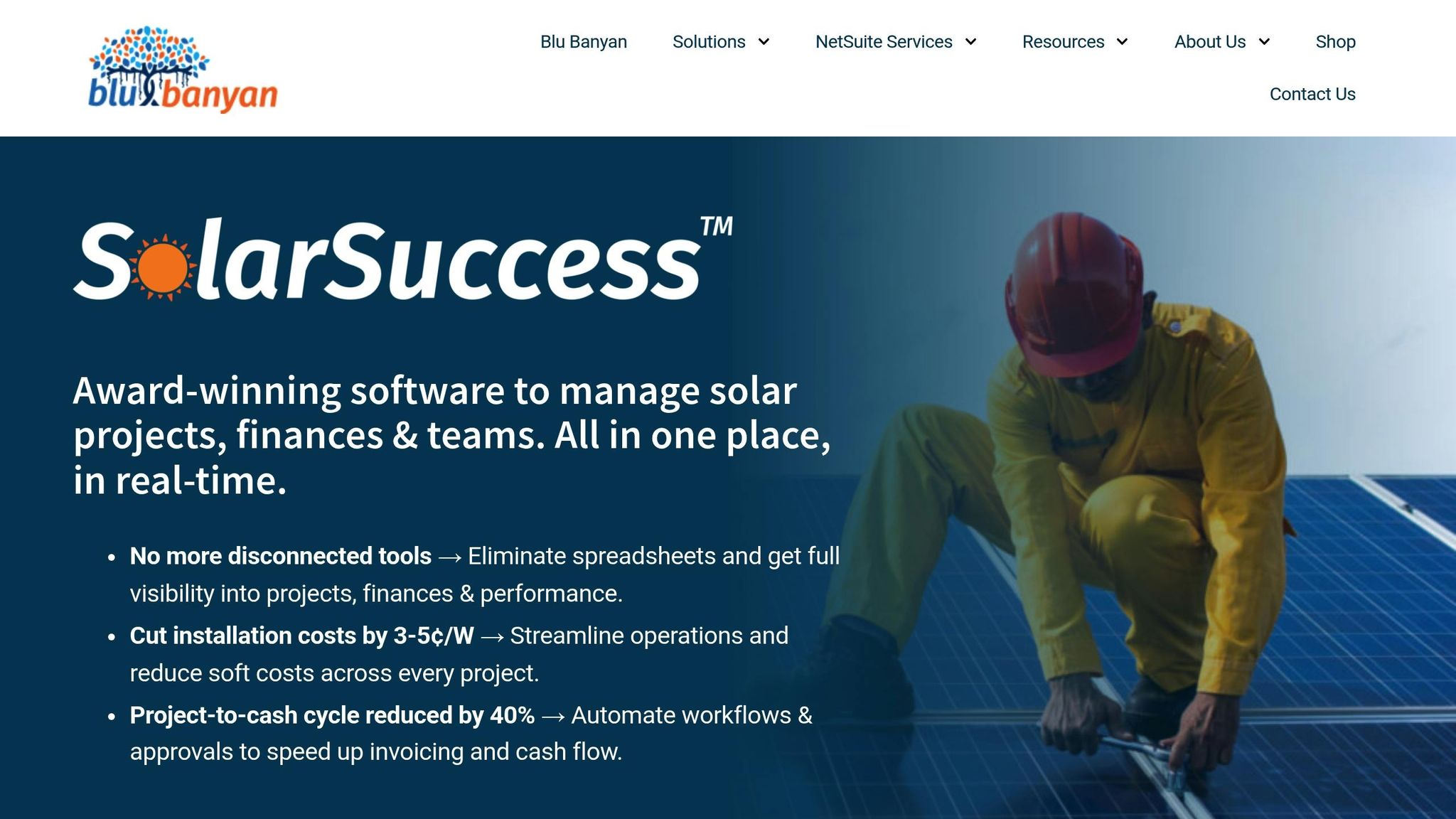
Built specifically for the solar industry, SolarSuccess leverages NetSuite’s real-time capabilities to solve challenges unique to this sector. It’s no small player either – this solution supports nearly one-third of rooftop solar installations in the U.S..
One of its standout features is automated milestone-based invoicing, which eliminates the need for manual tracking and reduces delays. For instance, when a solar project hits key stages like permit approval, installation completion, or utility interconnection, SolarSuccess automatically generates invoices based on the contract terms. This streamlines billing while maximizing NetSuite’s real-time synchronization.
SolarSuccess also offers industry-specific dashboards that provide up-to-the-minute insights into project statuses, financial health, and operational KPIs. These dashboards are customizable, giving teams across departments – whether in sales, engineering, installation, or finance – instant access to the data they need for faster, smarter decisions.
Another vital feature is its real-time compliance tracking. The platform automatically updates permit statuses, inspection results, and utility interconnection progress, ensuring that solar companies maintain accurate records without manual reconciliation. This is particularly useful for audits and regulatory reporting, saving time and effort while minimizing errors.
Customization and SuiteApps Integration
NetSuite’s SuiteScript platform takes customization to the next level, allowing solar businesses to tailor workflows, automate processes, and generate reports that respond instantly to data changes. This flexibility ensures that real-time data sync aligns perfectly with specific business needs.
Blu Banyan’s SuiteApps add even more functionality to NetSuite’s real-time capabilities:
- bluDocs ensures that contracts, permits, and technical drawings are always up-to-date and accessible with instant synchronization across projects.
- bluChat+ integrates SMS-based team communication directly into project records, so updates from the field appear immediately in NetSuite dashboards.
- bluTime simplifies time tracking by automatically posting labor data to general ledger accounts, ensuring that project costs and profitability calculations stay accurate in real time.
These tools enhance NetSuite’s single source of truth philosophy, providing specialized features that integrate seamlessly. For example, when a technician logs their hours using bluTime, that data instantly updates payroll, project costs, and billing without any additional input.
"SolarSuccess streamlined things even further and allowed us to add our own customizations on top of NetSuite."
- Aaron Casillas, Technology & Infrastructure Director
Additionally, the SuiteAnalytics Connect add-on enables robust real-time integrations, supporting automatic schema discovery and syncing data with over 50 external systems. NetSuite’s REST and SOAP APIs further expand its capabilities, allowing businesses to connect with third-party apps and create event-driven workflows. Whether it’s sending customer notifications, updating inventory, or initiating equipment orders, these integrations ensure that processes are triggered the moment relevant data changes. This level of customization makes NetSuite an invaluable tool for managing solar projects efficiently and accurately.
How Other ERP Systems Handle Data Synchronization
Common Data Sync Methods
Most non-NetSuite ERP systems rely on scheduled batch processing and middleware solutions, leaving them without genuine real-time synchronization.
Batch processing is the go-to method for many ERPs, where data gets transferred at set intervals – hourly, daily, or even weekly. Imagine a technician updating project details at 2:00 PM, but the accounting team only seeing those updates at 6:00 PM. For solar companies juggling tight schedules and multiple projects, these delays can lead to serious operational headaches.
Another approach is modular integration, which uses APIs or connectors to sync specific parts of the system. However, these integrations often falter when handling large volumes of data. For instance, some ERP connectors are limited to syncing around 1,000 items per run and operate every 15 minutes. If a solar company exceeds that limit, the system can time out, leaving updates incomplete and causing more harm than good.
Middleware platforms like Dell Boomi, MuleSoft, and Informatica act as intermediaries between applications. While they can link different systems, they also add complexity, increase maintenance costs, and introduce more potential points of failure. Plus, most of these tools don’t support real-time updates natively, which means additional delays in data processing.
These methods come with a host of challenges that can disrupt operations, especially for industries like solar, where efficiency and accuracy are essential.
Problems with Non-NetSuite ERPs
Solar companies often face the challenge of managing disconnected systems for project management, storage, accounting, and CRM.
Aaron Casillas, Technology & Infrastructure Director at a solar company, shared his team’s struggles with inefficient data sharing across multiple systems. To address synchronization issues, his team had to rely on additional labor to manually "fill in the gaps" in their data flow.
"Solar installation has many moving parts, all generating soft costs, and there is no single application that solves them all, because you have to address inefficiencies across all functions of the entire company." – Aaron Casillas, Technology & Infrastructure Director
These integration challenges often lead to duplicate records and force teams to spend more time manually resolving discrepancies. Dan Burke, a Marketing Automation Manager, shared that his team worked for over six months on a single integration project – an effort that consumed significant time and resources.
The solar industry’s unique operational demands only amplify these synchronization issues.
Solar Industry Limitations
Traditional ERP systems, which are not designed for real-time updates, struggle to meet the solar industry’s demand for immediate project visibility. Most lack modules tailored to solar project management, such as those for tracking installation progress, managing incentives, or staying compliant with local and federal regulations.
As a result, solar companies often fall back on manual processes or spreadsheets, which are prone to errors. This reliance on outdated methods increases the chance of non-compliance – a major risk in an industry governed by strict and ever-changing regulations.
Project management is another pain point. Traditional ERPs don’t provide real-time insights into key metrics like project costs, timelines, or resource allocation. Without this visibility, solar companies find it difficult to make quick decisions about crew assignments, equipment procurement, or customer updates.
Compliance tracking becomes a daunting task when data is scattered across multiple systems with delayed synchronization. Maintaining accurate records for audits and regulatory reporting becomes nearly impossible, leaving companies vulnerable to penalties or operational disruptions.
The solar industry’s high-volume data demands further strain traditional ERP systems. Managing data for multiple installations often overwhelms these platforms, leading to timeouts, failed sync attempts, and system slowdowns. This not only disrupts business operations but also delays critical decision-making, creating a ripple effect of inefficiencies.
NetSuite vs Other ERPs: Feature Comparison
Real-Time Features Comparison Table
When it comes to ERP systems for solar companies, the ability to synchronize data in real time is a game changer. Here’s a side-by-side look at how NetSuite, enhanced with SolarSuccess, measures up against traditional ERP solutions:
| Feature/Criteria | NetSuite (with SolarSuccess) | Other ERPs |
|---|---|---|
| Data Sync Speed | Real-time (milliseconds to seconds) | Batch/scheduled (minutes to hours) |
| Visibility | Unified, real-time dashboards | Often fragmented and delayed |
| Integration Ease | Native APIs, SuiteApps, low-code | Typically requires middleware |
| Cost Reduction | Cuts manual work, errors, and delays | Higher risk of inefficiency |
| Scalability | Cloud-native, scales easily | May need upgrades or add-ons |
| Solar Customization | SolarSuccess SuiteApp by Blu Banyan | Generic or limited customization |
| Data Integrity | Automated validation with audit trails | Often requires manual reconciliation |
| Compliance Support | Built-in, real-time reporting | May lag due to sync delays |
NetSuite’s real-time synchronization also helps reduce hidden costs, like those tied to manual reconciliation or workflow delays. These distinctions highlight why NetSuite is particularly well-suited for solar businesses.
NetSuite Advantages for Solar Companies
The comparison table makes it clear: NetSuite’s real-time integration capabilities deliver practical benefits that solar companies can directly leverage. With SolarSuccess, NetSuite is tailored for solar-specific needs, offering workflows like automated milestone invoicing and real-time compliance tracking that streamline operations.
The impact is measurable. For instance, one solar installation company using NetSuite with SolarSuccess reported cutting project cycle times by 20% and reducing billing errors by 30%. These improvements not only boosted profitability but also enhanced customer satisfaction. By automating residential invoices tied to construction milestones, the company eliminated hours of manual administrative work.
"NetSuite worked out best for us because it handles accounting and operational logistics items in tandem with project management really well." – Aaron Casillas, Technology & Infrastructure Director
NetSuite’s event-driven integrations are another standout feature. For example, when a technician updates a project status from the field, it triggers automated workflows across accounting, inventory, and customer management systems instantly. In contrast, other ERPs rely on scheduled batch processing, which delays critical updates.
SolarSuccess takes this functionality even further with solar-specific tools for managing incentives, tracking compliance, and monitoring project milestones. Blu Banyan’s SuiteApps, such as bluChat for team communication, bluDocs for document management, and bluTime for field service tracking, create a fully integrated ecosystem that traditional ERPs struggle to match.
NetSuite’s cloud-based design ensures seamless scalability, while its detailed error-handling mechanisms reduce operational risks. For solar companies navigating complex regulations, the platform’s real-time compliance reporting ensures accurate, up-to-the-minute data, reducing the risk of penalties and providing reliable audit trails.
sbb-itb-2560759
Business Impact of Real-Time Data Sync for Solar Companies
Efficiency Gains and Cost Savings
NetSuite’s real-time capabilities bring measurable benefits to solar companies by streamlining operations and cutting costs. By synchronizing data across various systems, such as project management, accounting, and CRM platforms, it creates a unified source of accurate information that enhances efficiency.
Manual data entry and reconciliation become a thing of the past. For instance, when project managers update installation milestones from the field, this information automatically triggers invoicing workflows, adjusts inventory levels, and alerts customer service teams. The result? Projects move faster, and administrative tasks shrink significantly.
Automated milestone-based invoicing is another game-changer. It reduces manual labor, ensures billing accuracy, and speeds up cash flow. This means solar companies can accomplish more without needing to expand their workforce.
Better Decision-Making and Compliance
Real-time access to accurate data revolutionizes how solar companies make decisions. Dashboards provide instant insights into project progress, financial health, and resource allocation. This immediate visibility is especially critical for meeting regulatory requirements. Solar companies must maintain up-to-date project documentation, financial records, and milestone tracking to comply with incentive programs and government regulations. Real-time synchronization ensures compliance-related data stays current and audit-ready.
The benefits also extend to financial management. Companies with intricate project structures or multiple subsidiaries gain from simplified financial consolidation. Instead of scrambling to fix discrepancies at the end of the month, real-time data ensures consistent, accurate financial information. This makes reporting easier and more reliable. Leaders can quickly adapt to market shifts, reallocate resources for ongoing projects, and address potential problems before they grow.
Case Studies and Results
The success of SolarSuccess by Blu Banyan highlights the tangible benefits of real-time data synchronization. Handling nearly one-third of rooftop solar installations in the U.S., the platform has demonstrated impressive results. Case studies report a 20% reduction in project cycle times and a 15% drop in administrative costs.
Customer satisfaction also sees a boost. Faster response times, precise project updates, and timely billing mean solar installers can keep customers informed about project progress and resolve any issues quickly.
Conclusion
Key Points
The analysis above highlights how real-time data synchronization can reshape operations for solar companies, offering a clear path to greater efficiency and competitiveness.
NetSuite’s real-time synchronization, built on its unified cloud architecture, eliminates data silos and manual reconciliation by creating a single source of truth. This is especially critical for managing the complexities of solar projects and meeting compliance requirements. With over 150 native connectors and compatibility with more than 500 additional sources, NetSuite processes data in milliseconds, enabling instant workflow automation and seamless updates across projects, inventory, and financials.
SolarSuccess by Blu Banyan takes these capabilities even further, offering solar-specific tools that have contributed to nearly one-third of rooftop solar installations in the U.S.. Unlike ERPs that rely on batch processing, NetSuite’s continuous, low-latency synchronization ensures operations run smoothly and efficiently, giving solar companies a competitive edge.
Next Steps for Solar Companies
For solar businesses, the first step is to evaluate current data workflows and identify where delays or inaccuracies occur. The rise of no-code and low-code integration platforms has made it easier for business users – not just IT professionals – to manage and configure integrations, lowering the barriers to adoption.
Collaborating with a seasoned NetSuite implementation partner like Blu Banyan can simplify this transition. Blu Banyan has earned recognition as NetSuite’s top Micro-vertical Solution Provider Partner of the Year for three consecutive years and was awarded the Spring 2025 Solution Provider Spotlight in Energy. This distinction reflects their expertise in both NetSuite’s offerings and the unique demands of the solar industry.
The urgency for real-time analytics and reporting in the solar sector cannot be overstated. Companies that delay adopting these technologies risk falling behind competitors who can quickly adapt to market changes, customer needs, and regulatory updates. NetSuite’s scalable platform, combined with advanced monitoring and error-handling features, equips solar companies to future-proof their operations and achieve the level of operational excellence required for sustainable growth.
Real-time data synchronization is no longer optional – it’s essential for solar companies looking to scale and stay competitive in the ever-changing U.S. market. By implementing these strategies, solar businesses can secure the edge needed to thrive in this dynamic industry.
FAQs
What are the benefits of NetSuite’s real-time data synchronization for solar companies compared to traditional ERP systems?
NetSuite’s real-time data synchronization offers solar companies a central hub where crucial information is updated instantly across all departments. This seamless connectivity breaks down data silos, ensuring every team has access to accurate, up-to-the-minute information.
For solar businesses, this translates to improved tracking of essential metrics, greater transparency in project management, and the ability to make quicker, informed decisions. By simplifying workflows and boosting team collaboration, NetSuite helps solar companies work smarter and maintain a competitive edge in a fast-moving industry.
What features make SolarSuccess by Blu Banyan a game-changer for the solar industry on NetSuite?
SolarSuccess takes NetSuite to the next level by equipping it with tools crafted specifically for the solar industry. It simplifies day-to-day operations, boosts teamwork, and delivers real-time insights into essential business metrics.
Built with industry-specific features, SolarSuccess enables smooth project management, precise financial tracking, and streamlined workflows. These tools empower solar companies to work smarter and grow with ease. Plus, its strong integration capabilities ensure all your systems function seamlessly together, making it a game-changer for solar businesses.
How can solar companies use NetSuite and SolarSuccess to enhance project management and ensure compliance?
Solar companies can take advantage of NetSuite combined with SolarSuccess to simplify project management and ensure they meet industry regulations. SolarSuccess, created by Blu Banyan, is a specialized ERP solution tailored for the solar sector. It integrates effortlessly with NetSuite, offering real-time data insights and greater control over timelines, budgets, and resources.
By using these tools, solar businesses can automate compliance tracking, enhance team collaboration, and streamline operations – minimizing manual tasks and reducing errors along the way.
