
Safety in solar fields is non-negotiable. From high-voltage risks to unstable equipment, hazards are everywhere. A well-structured safety checklist can prevent accidents, reduce costs, and improve efficiency. Here’s what you need to know:
- Why It Matters: Safety checklists help identify risks, ensure compliance with OSHA standards, and streamline operations using digital tools.
- Checklist Essentials: Include PPE checks, site-specific hazards, equipment inspections, and emergency protocols. Tailor these to each project’s unique conditions.
- Regulatory Compliance: Follow OSHA standards for construction (29 CFR 1926) and maintenance (29 CFR 1910). Ensure proper fall protection and crane operation protocols.
- Digital Tools: Platforms like SolarSuccess ERP simplify safety management with real-time updates, multimedia documentation, and automated workflows.
What to Include in Solar Field Safety Checklists
OSHA Solar Safety Standards: Construction vs Maintenance Requirements
Creating an effective safety checklist means combining standard safety protocols with digital tools to keep every solar site secure and well-monitored.
General Safety Procedures
Begin with the basics. Confirm that all crew members are equipped with the required personal protective equipment (PPE) – hard hats, safety glasses, gloves, and proper footwear. Verify their training for high-voltage work and fall protection is documented. Include clear evacuation routes, the locations of first aid stations, and emergency contact numbers specific to the site.
Make sure technicians have the tools and parts they need, using real-time inventory tracking to avoid delays or unsafe improvisations. As Blu Banyan emphasizes, "track inventory and truck stock in real time, so your techs show up with the right parts every time, eliminating discrepancies and costly extra truck rolls". Additionally, ensure that equipment inspections are signed off by a competent person, and confirm that only qualified workers operate specialized machinery.
Finally, adjust these general safety measures to address the unique conditions of each site for more thorough risk management.
Site-Specific Considerations
Every solar installation has its own set of challenges, so safety checklists should be adaptable. Factors like terrain, weather, and the type of equipment in use require tailored safety protocols. Use a three-column Job Hazard Analysis (JHA) format to break this down: list the task, identify potential hazards (e.g., unstable roofing, extreme heat, uneven ground), and document preventative actions. Enhance this with real-time photos, videos, or audio for clarity.
For example, a desert site may call for extra hydration plans and shaded work areas, while a coastal installation might need regular corrosion checks and wind monitoring. Digital tools make this process easier by offering customizable checklists and smart scheduling. These tools can "match the right techs to the right jobs using smart filters for skills, location, and job priority", ensuring that experienced workers handle high-risk tasks.
Once tailored, ensure that your checklist complies with OSHA and local regulatory standards.
Regulatory and Compliance Standards
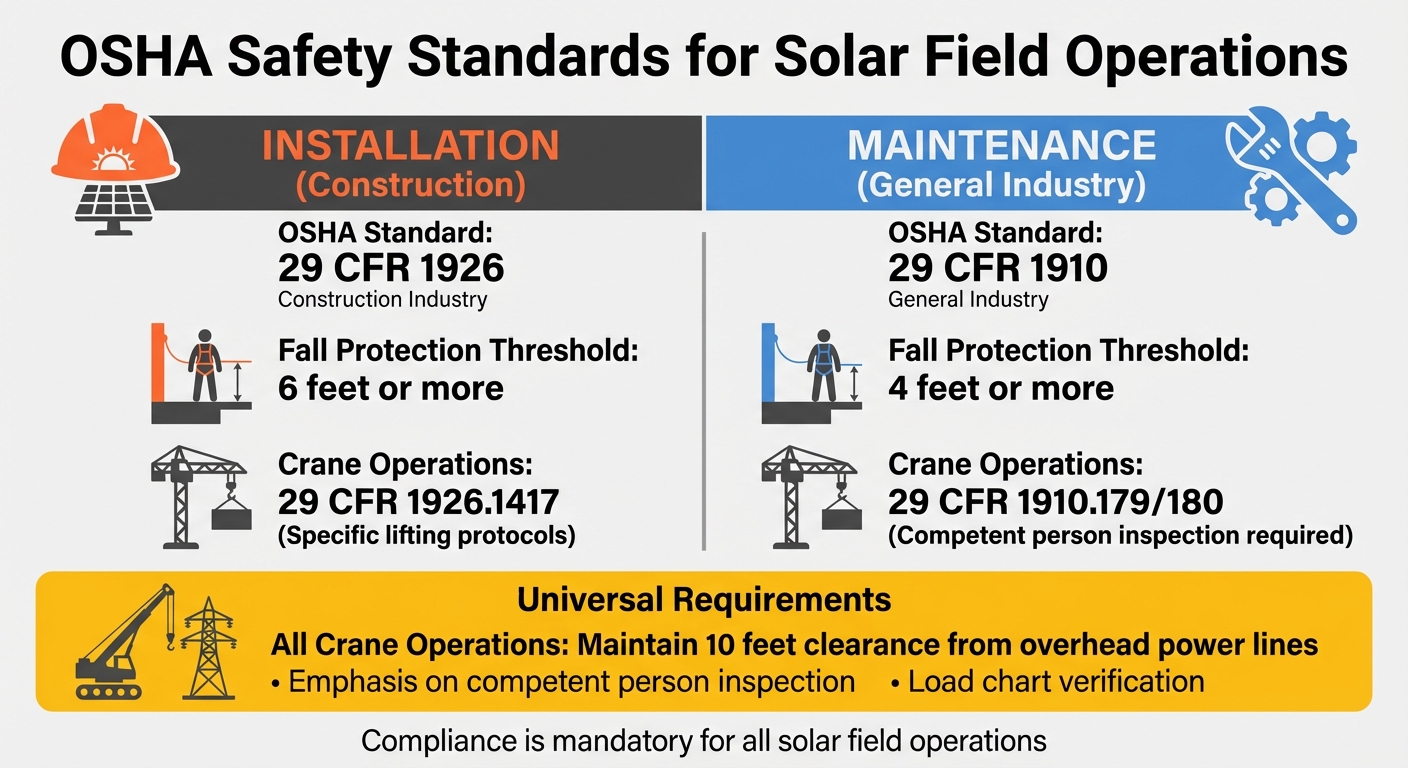
Your checklist must align with OSHA regulations to avoid noncompliance. OSHA standards differ depending on whether the work involves installation or maintenance. For example, construction workers installing solar panels must follow 29 CFR 1926, which requires fall protection at heights of 6 feet or more. Maintenance workers, however, fall under General Industry standards (29 CFR 1910), where fall protection is required at 4 feet or more. This distinction is crucial for passing inspections.
| Activity Type | OSHA Standard | Fall Protection Threshold |
|---|---|---|
| Installation (Construction) | 29 CFR 1926 | 6 feet or more |
| Maintenance (General Industry) | 29 CFR 1910 | 4 feet or more |
| Crane Operations (General) | 29 CFR 1910.179/180 | Competent person inspection required |
| Crane Operations (Construction) | 29 CFR 1926.1417 | Specific lifting protocols |
For lifting operations, maintain at least 10 feet of clearance from overhead power lines. Double-check that load charts match the crane’s configuration before every lift, and verify rigging inspections and operator qualifications. Additionally, include references to the Authority Having Jurisdiction (AHJ) registry to confirm compliance with local permitting requirements. You might also consider using standardized templates like the SolSmart Solar Field Inspection Checklist (PI-12) as a starting point for compliance.
Safety Checklists by Workflow Stage
Breaking down safety checklists by workflow stage ensures every phase of a solar project is covered with tailored preventive measures. From the moment your team steps on-site to the final sign-off, each stage demands specific safety protocols, careful planning, and thorough documentation.
Pre-Work Safety Checklist
Before the first tool is picked up, it’s crucial to prepare both the team and the site. Use smart filters to assign technicians based on their skills, certifications, and the task’s priority. This ensures that only qualified personnel handle high-risk jobs like high-voltage installations. Real-time inventory tracking can confirm that all necessary equipment and parts are loaded onto the truck, minimizing the risk of unsafe improvisations caused by missing materials.
Before heading out, review site-specific hazards with the crew to ensure everyone understands safety protocols and emergency procedures. Equip technicians with mobile access to job details, allowing them to review safety measures and clarify any questions while still in the office. Digital tools not only make this process seamless but also help reduce labor costs by streamlining operations.
With pre-work preparations complete, the focus shifts to maintaining safety during the project’s active stages.
Daily Operations Safety Checklist
Once the work begins, it’s essential to adapt safety protocols to match the specific service being performed. For example, electrical inspections may require different precautions compared to panel cleaning or mechanical maintenance. Use a dynamic checklist that reflects these varying requirements. Technicians should log their work and submit safety documentation in real time via mobile tools, giving supervisors immediate visibility into site conditions.
Critical safety steps should include visual verification. Require technicians to capture high-resolution photos for procedures like Lockout/Tagout (LOTO), fall protection setups, and electrical isolation points. This adds a layer of accountability and ensures compliance. Keep track of parts usage and labor hours to maintain budget accuracy. If unexpected hazards arise or additional materials are needed, real-time communication tools can provide immediate support without compromising safety or deadlines. Digital checklists also help maintain compliance by automatically updating records as tasks are completed.
After daily operations, a thorough post-work review ensures the site remains safe and ready for future use.
Maintenance and Post-Work Safety Checklist
When the job wraps up, a final site walkthrough is essential. This step ensures all tools and equipment are accounted for, work areas are clean, and no new hazards have been left behind. High-resolution photos should be taken to document the completed work and the site’s final condition. These images can then be stored alongside the service case for future reference.
Technicians should log parts, mileage, and labor hours directly into the project record. Linking each maintenance service case to the original project record creates a comprehensive history of system performance and service. This is especially valuable for warranty claims, performance analysis, and planning future maintenance.
Additionally, review the manufacturer’s warranty details for all project components to identify any claimable defects found during maintenance. Organize service tasks by key data points, such as service type, equipment used, and issues encountered. This structured approach not only improves reporting but also provides actionable insights for improving future projects.
sbb-itb-2560759
Using SolarSuccess ERP for Safety Checklists

SolarSuccess ERP is changing the game for safety management in solar field operations. By moving away from paper-based processes or disconnected digital systems, it offers a unified platform that simplifies safety protocols. This system eliminates the headaches of juggling multiple incompatible applications, where teams often waste time manually transferring data – leading to delays and the risk of outdated information being used in the field. With SolarSuccess, solar companies can streamline operations while improving safety compliance and efficiency.
Benefits of Digital Safety Checklists
Digital safety checklists bring consistency and reliability to the table. When technicians can access these checklists on mobile devices with real-time updates, project managers gain immediate visibility into the field, cutting out delays caused by manual paperwork.
Take Skyline Smart Energy as an example. After adopting SolarSuccess ERP, the company reported labor savings of 10%–15% and reduced its financial close process from six weeks to just two. CFO Kevin Burke highlighted how replacing four outdated systems with this integrated platform allowed them to achieve these results without adding more staff.
"We’re doing more with the same number of people and we have a system that’s more reliable and less stressful than tracking a million different spreadsheets."
– Joe Marhamati, Co-Founder & VP, Ipsun Solar
How SolarSuccess Supports Safety Checklist Management
SolarSuccess introduces tools like bluDocs and bluTime to simplify and enhance safety checklist management:
- bluDocs ensures all safety documentation is centralized and up-to-date. When regulations change or procedures are updated, the new versions are instantly available on technicians’ mobile devices, eliminating the risk of outdated forms circulating in the field.
- bluTime adds an extra layer of accuracy with location-based verification. It confirms that technicians are physically present at the site when completing safety checks and tracks the time spent on these tasks at the Project Action level.
The platform also features customizable workflows that automatically trigger specific safety checklists as projects hit key milestones. This seamless integration ensures that safety remains a priority throughout every phase of a project.
Manual vs. SolarSuccess-Integrated Checklists
Here’s a side-by-side look at how SolarSuccess stacks up against the traditional manual approach:
| Feature | Manual/Siloed Approach | SolarSuccess-Integrated Approach |
|---|---|---|
| Data Consistency | Conflicting data from incompatible apps and spreadsheets | Unified data source for all operations |
| Field Updates | Delayed reporting due to manual data entry | Real-time updates between field and office |
| Document Control | Challenging to track revisions across systems | Centralized management with bluDocs |
| Location Verification | Risk of inaccurate entries leading to payroll issues | Accurate tracking with bluTime’s location-based tech |
| Visibility | Limited to specific departments or silos | Real-time dashboards accessible to authorized users |
| Scalability | Requires more labor to bridge system gaps | Automated workflows triggered by project milestones |
"Sharing data across these systems was difficult, and in most cases our only way to patch the holes was by adding labor… SolarSuccess streamlined things even further and allowed us to add our own customizations on top of NetSuite."
– Aaron Casillas, Technology & Infrastructure Director, Titan Solar Power
Currently powering nearly one-third of rooftop solar installations in the U.S., SolarSuccess ensures that only qualified personnel handle critical safety tasks. Its real-time dashboards provide managers with immediate insights into compliance across all active projects.
Conclusion and Key Takeaways
The Impact of Well-Designed Safety Checklists
Safety checklists transform how safety is managed, shifting the focus from reacting to hazards after they happen to identifying and addressing them before they cause harm. This proactive approach not only helps prevent injuries and operational disruptions but also leads to noticeable cost savings.
"Inspection is a vital part of hazard management. An inspection can identify an issue before it causes harm." – Solar Best Practices Guidelines
Beyond financial benefits, well-crafted checklists help ensure compliance with regulations and promote a workplace culture that prioritizes safety. Through tools like daily toolbox talks, they empower team members to take an active role in maintaining safety standards. These advantages highlight the importance of integrating effective safety checklists into operations.
What Solar Teams Should Do Next
To maximize these benefits, start by assessing your current safety practices in comparison to industry standards. Develop a dynamic, site-specific Safety and Operational Risk Register that can adapt to changing conditions. Tailor checklists to fit different stages of your workflows – whether it’s pre-work preparations, daily operations, or maintenance tasks – so they meet the specific needs of each activity.
Consider moving to a digital platform to streamline documentation and automate processes. For example, Skyline Smart Energy reduced its financial close process from six weeks to just two after adopting such a system. The goal is to ensure field technicians can access up-to-date checklists on their mobile devices and submit safety data in real time, creating a seamless connection between field teams and office management.
FAQs
What should be included in a solar field safety checklist?
An effective solar field safety checklist focuses on essential precautions to safeguard workers and maintain compliance. Here are some key areas to include:
- Spotting and addressing hazards: Look out for risks like unsteady ladders or unsecured tools, and take steps to eliminate them.
- Electrical safety measures: Confirm that power sources are deactivated, and ensure workers are equipped with insulated gloves.
- Fall prevention: Regularly inspect harnesses, lanyards, and other fall protection gear, and ensure they’re used correctly.
- Safe equipment handling: Double-check that cranes, hoists, and other machinery are operated according to safety guidelines.
Covering these bases helps create a safer job site and cuts down the chances of workplace accidents.
How can tools like SolarSuccess ERP improve safety in solar field operations?
Digital tools such as SolarSuccess ERP play a key role in improving safety during solar field operations by automating and simplifying essential safety processes. These tools bring everything under one roof, making it easier to track risks, maintain compliance, and address potential hazards quickly.
With features like tailored safety checklists and automated incident reporting workflows, they help ensure teams consistently follow safety procedures. By minimizing manual mistakes and boosting real-time communication, SolarSuccess empowers teams to manage risks effectively and create a safer work environment in the solar field.
What safety standards does OSHA require for solar field operations?
OSHA has set strict safety standards for solar field operations to ensure worker protection. These include implementing fall protection systems for tasks performed at heights, enforcing electrical safety protocols such as lockout/tagout procedures and the use of insulated tools, and requiring appropriate personal protective equipment (PPE) like helmets, gloves, and eye protection.
Conducting hazard assessments, such as Job Hazard Analyses (JHA), plays a key role in identifying potential risks and addressing them before work begins. Regular safety training sessions and thorough audits help reinforce compliance and promote a strong safety-first mindset. Keeping up with OSHA’s latest guidelines is not just about meeting legal standards – it’s about prioritizing the well-being of every worker.
