
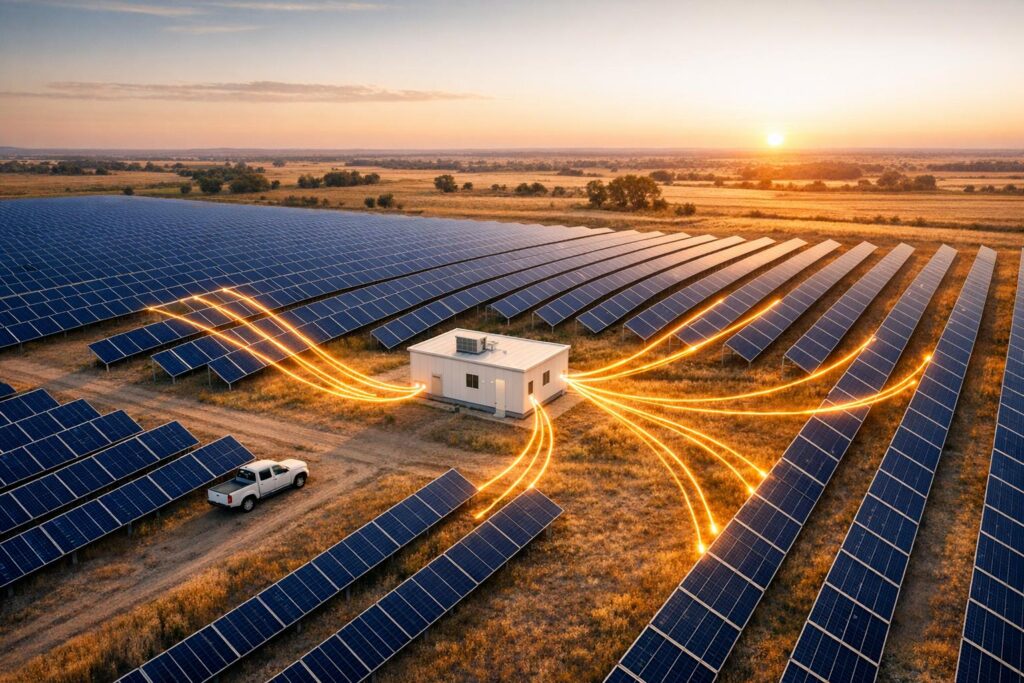
Solar companies are cutting costs and improving efficiency by leveraging real-time field data in their ERP systems. This approach eliminates manual errors, speeds up decision-making, and ensures smooth coordination between field teams and back-office operations. Key advancements include:
- Real-time data collection: Technicians use mobile apps to log hours, inventory, and project updates instantly, reducing delays and errors.
- IoT sensors and cloud platforms: Sensors track metrics like energy output and panel temperature, while cloud systems process millions of data points for immediate insights.
- AI-driven analytics: Predictive maintenance identifies issues early, minimizing downtime and costs.
- Integrated ERP systems: Tools like SolarSuccess unify accounting, project management, and inventory, replacing disconnected software.
These technologies are transforming solar operations by improving service scheduling, inventory management, and financial tracking – all while reducing soft costs like permitting and labor. Companies adopting these tools report faster project cycles and better profitability.
Current Trends in Real-Time Field Data for Solar ERP
Solar companies are finding new ways to streamline operations and drive growth by leveraging real-time field data. Three key trends are taking center stage: IoT sensor networks, cloud-based data processing, and analytics-driven decision-making. Together, these advancements replace manual inspections with automated processes and break down data silos. Let’s dive into how each trend is reshaping efficiency in the solar industry.
IoT and Sensor Integration
IoT devices have revolutionized how solar systems are monitored. These sensors track critical metrics like energy output, voltage, current, panel temperature (°F), and irradiance – all in real time. For example, tools like the ACS712 sensor (accurate up to 30 A with a 1.5% total output error) and the LM35 temperature sensor send data through microcontrollers like Arduino and wireless modules such as ESP8266. This data is then pushed directly to cloud-based ERP platforms.
The result? Real-time monitoring eliminates delays caused by manual inspections. On average, data can travel from a sensor to a smartphone in just 53.02 seconds. When integrated with platforms like NetSuite, this setup centralizes data storage and presents it through intuitive dashboards. These dashboards make it easier to spot trends and enable predictive maintenance by identifying issues early.
Cloud-Based Scalability and Stream Processing
Cloud platforms play a vital role in managing the enormous amounts of data solar systems generate. They handle everything from storage to filtering and advanced analytics, processing millions of time-series data points per second with nanosecond-level precision – essential for AI and machine learning applications.
Take Ju:niz Energy, for example. In 2024, the company rolled out a large-scale energy storage system that collects 1.3 million data points every second, monitoring battery health and environmental conditions. By employing the Modbus protocol and Telegraf to write data to local InfluxDB instances, which then sync with an AWS-hosted cloud cluster, Ju:niz Energy created a seamless system that combines real-time local monitoring with centralized cloud analysis.
Another success story is BayWa r.e. Operation Services LLC, which cut operational costs by adopting SolarAnywhere SystemCheck. This system delivers real-time, weather-adjusted PV production data with up to 99.99% uptime, offering spatial resolutions of 500 meters and temporal resolutions as precise as 5 minutes. These cloud solutions not only enhance data management but also provide the foundation for analytics that drive smarter decisions.
Data-Driven Decision Making with Analytics
Analytics tools transform raw sensor data into actionable insights, offering key performance indicators (KPIs) like project profitability and pipeline health. By using unified ERP platforms, solar companies can access these metrics across departments, solving the challenges of fragmented data systems.
For instance, Big Sun Solar earned recognition in 2025 with the NetSuite Spring Solution Provider Spotlight Award after implementing SolarSuccess ERP. This platform streamlined operations and enabled real-time project costing through automated workflows. Similarly, Omnidian integrates SolarAnywhere SystemCheck data into its machine learning models, delivering high-confidence insights for fleet monitoring across the U.S. .
This shift from reactive, manual processes to proactive, AI-powered maintenance allows operators to detect and address issues before they escalate, ensuring smoother operations and better system performance.
Mobile Field Operations Improvements
Field crews can now update project statuses instantly, eliminating the need to wait until they return to the office. Mobile-first ERP solutions have completely changed how solar companies handle data from installation sites. By creating a seamless connection between field technicians and back-office systems, these tools cut down on manual data entry and reduce errors that used to consume valuable administrative hours. This approach not only speeds up field reporting but also sets the stage for the advanced analytics we’ll explore later.
Real-Time Data Collection from the Field
Mobile apps integrated with solar ERP platforms give technicians the ability to record critical data as soon as they complete a task. For instance, tools like bluTime let field personnel log time and project updates at the "Project Action" level. Location-based verification ensures they’re on-site, while the data flows directly into the ERP system for immediate accounting and tracking.
These platforms also support real-time inventory management. Technicians can check truck stock, log parts used, and track miles and hours directly within project budgets. This ensures accurate costing and helps avoid expensive repeat trips to the site.
"We’re doing more with the same number of people and we have a reliable system that eliminates the chaos of myriad spreadsheets."
- Joe Marhamati, Co-Founder & VP, Ipsun Solar
This instant data flow doesn’t just streamline reporting – it also enhances collaboration across teams.
Better Collaboration and Productivity
Real-time data capture is just the beginning. Integrated communication tools take it a step further by connecting field and office operations seamlessly. Mobile solutions like bluChat+ SMS and bluDocs enable instant messaging, real-time job updates, document sharing with version control, and smart scheduling. These features match technicians to tasks based on their skills, location, and priority. From anywhere, technicians can access job details, submit expenses, and communicate with dispatchers, ensuring everyone operates with the same up-to-date information.
This level of integration has led to clear operational gains for solar companies using implementing unified ERP platforms.
"Reconciliation time decreased substantially, and data was much more accurate, giving leadership confidence in making better business decisions."
- Craig Pals, Vice President and Founder, Tick Tock Energy
The benefits aren’t limited to individual projects. AI-driven predictive maintenance, paired with mobile systems, can cut solar operational and maintenance costs by up to 25%. And with over 80% of new renewable energy systems in the next five years expected to rely on advanced digital tools – including mobile field data collection – the importance of these innovations is only growing.
AI-Driven Analytics for Solar ERP
Artificial intelligence is transforming solar asset management by enabling early detection of potential issues, helping to avoid costly failures. Predictive maintenance uses real-time data and intelligent algorithms to identify problems like partial shading, inverter faults, and material degradation before they impact system performance. This proactive approach significantly reduces the high soft costs associated with solar installations.
For example, at a 50 MW solar installation in Taiwan, AI-powered inverter diagnostics pinpointed 98% of operational issues in less than five minutes. Similarly, a CNN-IoT system deployed in Southern Europe achieved anomaly detection with over 95% accuracy. Long Short-Term Memory (LSTM) algorithms have even provided alerts up to seven days in advance of potential failures. These advancements build upon the real-time data frameworks enabled by mobile and cloud technologies.
Predictive Maintenance and Asset Optimization
Taking these AI capabilities further, advanced machine learning models are now setting new benchmarks in fault detection for solar systems. For instance, Gaussian Process Classifiers have achieved 99.56% accuracy in identifying electrical panel faults, while CatBoost and CNN ensemble models consistently exceed 99% accuracy in multi-class fault detection. In field tests conducted in Malaysia, Random Forest models demonstrated a 98% success rate in accurately identifying specific fault types.
By using CNN-based imaging and IoT sensors to detect issues like thermal anomalies and microcracks early, these tools help extend the lifespan of solar assets and prevent further degradation. This shift from reactive to strategic maintenance minimizes downtime and lowers operational expenses.
Digital Twin Technology for Solar Systems
Adding to the arsenal of AI-driven tools, digital twin technology provides a sophisticated way to manage solar assets. By creating virtual replicas of physical installations, digital twins allow companies to simulate rare defect scenarios and test solutions remotely without requiring onsite inspections. This capability reduces the need for "truck rolls" by enabling remote diagnostics and performance analysis. Instead of manually sifting through data, operators can digitally simulate corrective actions.
Digital twins also enhance scenario planning at the grid level, optimizing maintenance schedules across multiple installations. Some implementations even feature "self-healing" capabilities, enabling energy systems to automatically adjust and maintain performance. When integrated with ERP platforms like SolarSuccess, digital twins deliver real-time insights that feed directly into project management and accounting systems, offering a comprehensive view of asset health and operational efficiency.
sbb-itb-2560759
Integration Methods for Real-Time Field Data in Solar ERP
Integrating field data into an ERP system isn’t just about plugging in numbers; it’s about managing a flood of information – millions of data points per second from sensors, inverters, and monitoring devices – all while ensuring accuracy across every aspect of your operation. Relying on manual spreadsheets or disconnected solar CRM systems can quickly lead to conflicting data, duplicated efforts, and a web of inefficiencies.
ETL Pipelines and SCADA-ERP Connections
To tackle these challenges, modern solar operations often use Edge Data Replication (EDR). This method creates a durable queue at the edge, ensuring data can still flow to centralized systems even during connectivity outages. For example, Ju:niz Energy adopted this approach using Modbus protocols to link iEMS SPS controllers on-site. Their setup collects an astonishing 1.3 million data points every second, tracking critical metrics like battery health and temperature. Data is first gathered by Telegraf into an edge-based InfluxDB and then forwarded via EDR to an AWS-hosted cloud cluster for real-time monitoring and long-term analytics.
Integration also involves converting diverse data formats into a unified structure. Collection agents handle this by translating protocols like Modbus, MQTT, and OPC-UA into a standardized format. Platforms such as SolarSuccess simplify this process with pre-built connectors for widely-used monitoring systems like SolarEdge and AlsoEnergy. These connectors don’t just streamline data flow – they also enable automated processes, such as triggering invoices or procurement orders based on field events.
"Sharing data across these systems was difficult, and in most cases our only way to ‘patch the holes’ was by adding labor… NetSuite worked out best for us because it handles accounting and operational logistics items in tandem with project management really well."
– Aaron Casillas, Technology & Infrastructure Director
Once data is standardized and transmitted efficiently, the focus shifts to ensuring its accuracy and consistency.
Maintaining Data Accuracy and Consistency
Achieving unified data starts with establishing a single source of truth. Big Sun Solar showcased this during their Spring 2025 integration of SolarSuccess, built on NetSuite. This system allowed them to unify operations, enabling real-time costing and smoother project execution through tools like bluActions™. By automating data transfer between systems, they eliminated the need for manual input and the errors that come with it.
Automated logging plays a critical role in maintaining accuracy, creating a detailed audit trail for compliance. BayWa r.e. Operation Services LLC took this a step further by adopting satellite-derived, real-time data for benchmarking PV performance. Using this method, they achieved accuracy levels comparable to those of professionally installed MET stations, reducing operational costs and freeing up staff previously tasked with maintaining ground-based weather stations. As David B., Executive Vice President at BayWa r.e. Operation Services LLC, explained:
"The difference between SolarAnywhere® and that of a professionally installed and calibrated MET station was calculated to be equal to or less than the measurement accuracy of the weather stations."
Weather normalization further enhances data accuracy by incorporating satellite-derived irradiance data in real time. This allows performance benchmarking against original financing expectations. The result? Field crews and office teams operate on the same up-to-date information, accessible from anywhere through cloud-based platforms.
Comparing Real-Time Data Processing Methods
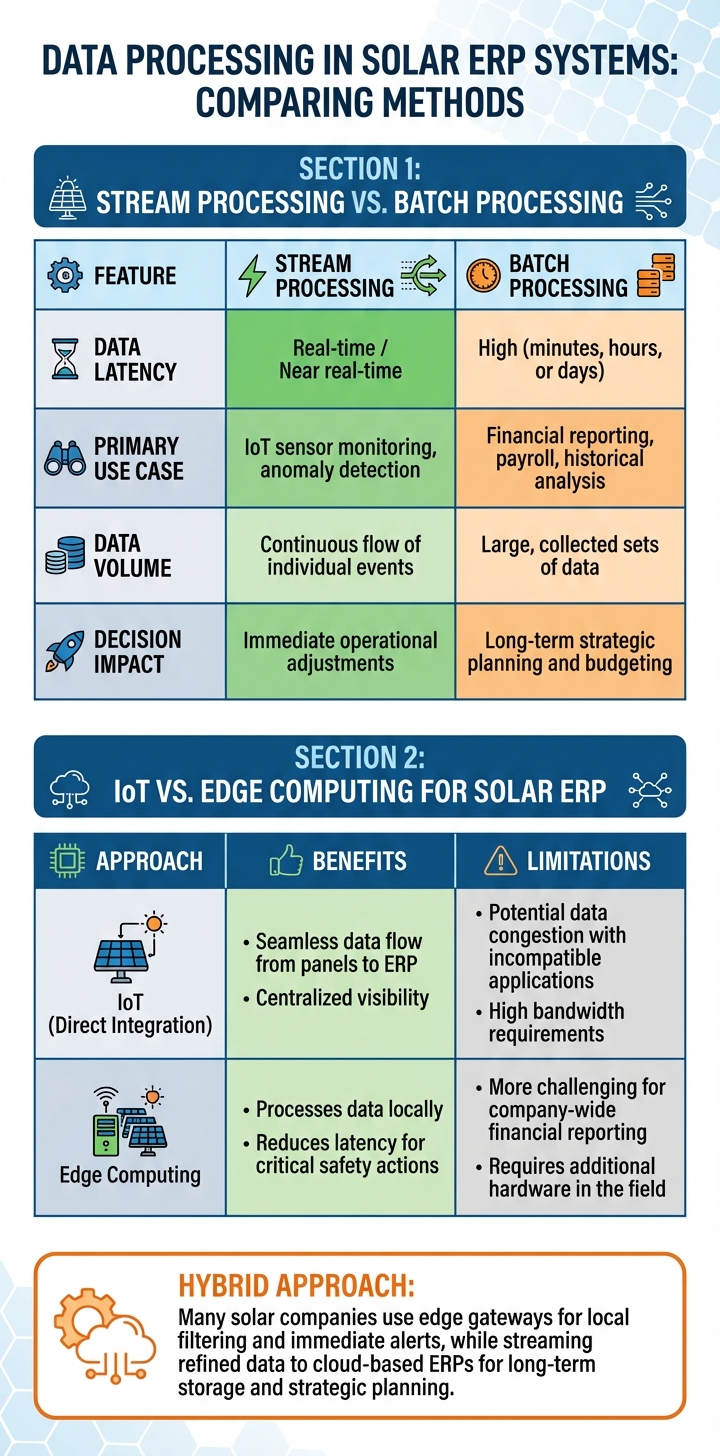
Real-Time vs Batch Processing and IoT vs Edge Computing for Solar ERP Systems
When it comes to managing solar operations, selecting the right data processing approach is key for quick and effective field responses. Two major methods – stream processing and batch processing – offer distinct advantages depending on the task at hand.
Stream Processing vs. Batch Processing
Stream processing deals with data as it arrives from field sensors, enabling immediate actions. For instance, if an inverter starts underperforming or a panel shows early signs of failure, stream processing lets you address the issue instantly rather than waiting hours or days to identify the problem. This method is particularly useful for monitoring energy production in real time.
Batch processing, by contrast, gathers large volumes of data and processes it in chunks, making it better suited for tasks like financial reporting, monthly summaries, and historical performance analysis. While it lacks the immediacy of stream processing, it excels in handling complex accounting needs, such as joint venture accounting or consolidating data across multiple entities, where accuracy matters more than speed.
| Feature | Stream Processing | Batch Processing |
|---|---|---|
| Data Latency | Real-time / Near real-time | High (minutes, hours, or days) |
| Primary Use Case | IoT sensor monitoring, anomaly detection | Financial reporting, payroll, historical analysis |
| Data Volume | Continuous flow of individual events | Large, collected sets of data |
| Decision Impact | Immediate operational adjustments | Long-term strategic planning and budgeting |
The distinction is straightforward: stream processing is ideal for real-time monitoring of field sensors and IoT systems, ensuring swift responses to equipment issues or performance dips. On the other hand, batch processing is better suited for back-office tasks where data completeness and precision outweigh the need for speed. Next, let’s dive into how sensor data is processed at the source, highlighting unique advantages for field operations.
IoT vs. Edge Computing for Solar ERP
The decision between direct IoT integration and edge computing hinges on where the data is processed – centrally in the cloud or locally at the solar farm. With direct IoT integration, all sensor data flows directly to your ERP system, offering centralized control and eliminating the need for managing distributed data. However, this method requires significant bandwidth and can lead to data congestion if incompatible applications are used.
Edge computing, on the other hand, processes data locally at the solar farm before sending it to the cloud. This reduces latency for critical tasks like safety shut-offs and allows operations to continue even during connectivity issues. The downside? It complicates company-wide financial reporting and demands more hardware on-site.
| Approach | Benefits | Limitations |
|---|---|---|
| IoT (Direct Integration) | Seamless data flow from panels to ERP; centralized visibility | Potential data congestion with incompatible applications; high bandwidth requirements |
| Edge Computing | Processes data locally; reduces latency for critical safety actions | More challenging for company-wide financial reporting; requires additional hardware in the field |
Many solar companies are now opting for a hybrid approach. This involves using edge gateways to filter and process data locally for immediate alerts, while also streaming refined data to cloud-based ERPs like SolarSuccess for long-term storage and strategic planning. This strategy combines the strengths of both methods – providing instant responses when necessary while maintaining a broader view for analytics and decision-making. These approaches play a vital role in how integrated ERPs handle solar field data, reinforcing their importance in operational efficiency.
Conclusion
For solar installers looking to grow profitably, real-time field data collection has become a game-changer. By instantly processing sensor data and aligning field operations with back-office systems, solar companies can cut soft costs and eliminate the inefficiencies of managing disconnected applications.
Choosing the right technology comes down to understanding specific operational needs. Integrated ERP solutions have proven to enhance both operational efficiency and financial management.
Blu Banyan’s SolarSuccess is a prime example of this approach, combining accounting, project management, CRM, and inventory into one platform powered by Oracle NetSuite. In Spring 2025, Big Sun Solar adopted SolarSuccess to achieve real-time costing and streamline project workflows. This achievement earned Blu Banyan the prestigious NetSuite Solution Provider Spotlight Award.
With integrated systems, solar companies can expect real, measurable benefits – streamlined operations, better decision-making, and improved cash flow. Synchronizing field and office data eliminates silos, automates invoicing as construction milestones are met, and reduces the risk of manual errors. It’s a smarter way to keep projects on track and businesses thriving.
FAQs
How does real-time field data enhance efficiency in solar ERP systems?
Real-time field data plays a crucial role in improving solar ERP efficiency. It provides immediate access to essential project details, allowing teams to track progress and tackle issues as they happen. This helps cut down on delays, boosts precision, and ensures resources are used effectively.
By leveraging real-time data, businesses can make smarter and faster decisions. This not only streamlines operations but also helps keep projects on track, reducing mistakes and unnecessary duplication of effort.
How do IoT sensors improve solar system monitoring?
IoT sensors play a crucial role in solar system monitoring by delivering real-time insights into energy production, system performance, and surrounding conditions. This constant stream of data allows for precise tracking, better efficiency, and quicker detection of any potential problems.
With their ability to continuously gather and share information, IoT sensors enable proactive maintenance, minimize downtime, and enhance the overall performance of solar systems. As an integral part of modern solar ERP solutions, they support smarter decisions and ensure long-term system reliability.
How does AI-driven analytics improve solar asset management?
AI-powered analytics play a crucial role in improving solar asset management by enabling predictive maintenance. This approach helps detect potential problems early, preventing expensive breakdowns and ensuring smoother operations with minimal downtime.
Beyond maintenance, AI can fine-tune system performance by analyzing real-time data. It offers actionable insights into the condition of assets and highlights ways to improve efficiency. These advancements not only increase energy production but also cut operational expenses, making solar projects more cost-effective and efficient.
