

Running a solar business without tracking key ERP metrics can lead to inefficiencies, higher costs, and missed opportunities. Here are six critical metrics that can help solar companies streamline operations, reduce costs, and boost profitability:
- System Uptime: Measures how often your ERP is operational. High uptime ensures smooth workflows, uninterrupted invoicing, and better cash flow. Downtime disrupts field operations and causes delays.
- Data Processing Speed: Tracks how fast your ERP handles tasks like milestone-based invoicing. Faster processing enables real-time insights, reduces manual errors, and improves decision-making.
- Order Fulfillment Time: Reflects how quickly customer orders are completed. Delays in procurement, inventory, or scheduling can increase costs and impact customer satisfaction.
- Inventory Turnover Ratio: Indicates how efficiently stock moves from warehouse to job sites. High turnover reduces storage costs and prevents outdated inventory, especially important for fast-evolving solar technologies.
- User Adoption Rate: Shows how many employees actively use the ERP system. Higher adoption leads to fewer errors and faster project timelines.
- Integration Success Rate: Measures how well your ERP connects with other tools like CRM, accounting software, and supplier systems. Smooth integration reduces data mismatches and manual work.
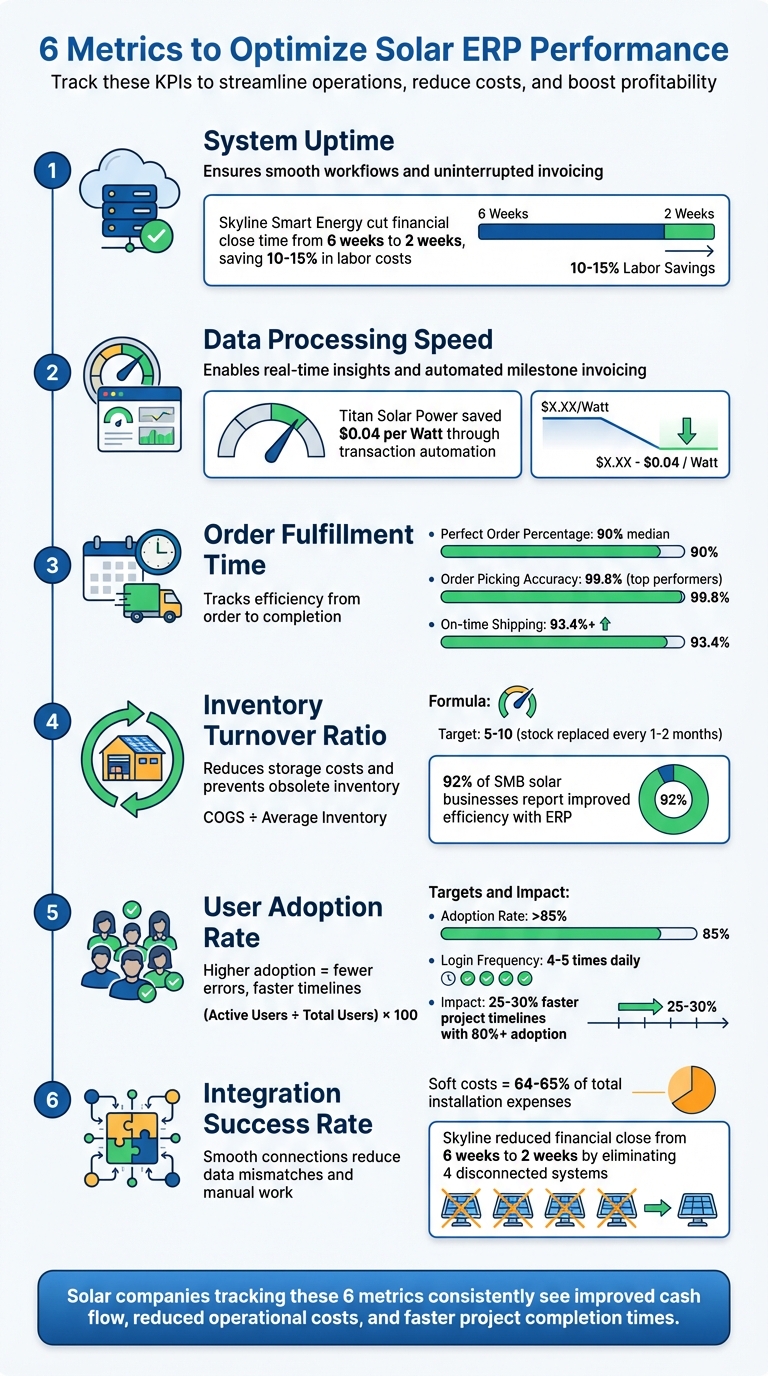
6 Key Metrics to Optimize Solar ERP Performance
1. System Uptime and Downtime Rate
Why This Metric Matters for Solar ERP Systems
An ERP system acts as the central nervous system of your operation, linking sales, accounting, procurement, and project management seamlessly across departments. When the system experiences downtime, teams are often forced to revert to manual processes and fragmented workflows – essentially undoing the efficiency gains the ERP was designed to provide.
"Solar ERP software connects departmental data seamlessly." – Blu Banyan
For solar installers, high system availability is non-negotiable. Downtime doesn’t just disrupt workflows; it can stall milestone-based invoicing, which directly impacts cash flow. Take Skyline Smart Energy as an example: they cut their financial close time from six weeks to two, saving 10% to 15% in labor costs.
Ensuring consistent uptime is vital for keeping both operations and financial processes running smoothly.
How It Affects Daily Operations
Field technicians depend on mobile access to retrieve job details, manage inventory, and log their work. When the system is down, they – and office staff – are forced into manual tracking methods. This often leads to scheduling conflicts, inventory mismatches, and lengthy data reconciliation processes.
"For solar companies, small inefficiencies lead to big consequences for project costs. Misaligned scheduling, inventory discrepancies, and inefficient work order management drive up costs, delay timelines, and shrink margins." – Blu Banyan
Real-time monitoring of these disruptions is crucial to reduce operational setbacks and prevent cascading issues.
How to Measure and Track It in Real Time
Modern cloud ERP platforms, such as SolarSuccess, offer continuous uptime monitoring by integrating with IoT and SCADA systems. These platforms feature dashboards that track system availability against SLA targets on a daily, weekly, and monthly basis. Automated alerts notify users immediately when availability dips below acceptable levels.
This proactive approach ensures that any potential downtime is addressed before it escalates into a larger issue.
sbb-itb-2560759
2. Data Processing Speed and Real-Time Analytics Latency
Processing speed goes hand-in-hand with system uptime when it comes to making timely, informed decisions across operations.
Why This Metric Matters for Solar ERP Systems
A slow ERP system can create chaos by forcing teams to manually transfer data between disconnected systems. This disrupts workflow harmony, leaving departments like accounting, sales, and project management working in silos instead of relying on a unified source of information.
Quick data processing, on the other hand, enables automated tasks like milestone-based invoicing. For instance, when a construction stage is completed, the system can automatically generate an invoice, speeding up the payment cycle. For solar companies juggling multiple projects, this efficiency directly impacts cash flow.
"When a deal moves to a particular stage of construction, for example, SolarSuccess generates invoices based on that specific milestone. That has been the biggest advantage and has definitely helped us out a lot." – Joe Marhamati, Co-Founder & VP, Ipsun Solar
How It Affects Daily Operations
Real-time analytics latency determines whether your team acts on current data or outdated figures. When systems lag, managers lose visibility into critical areas like inventory levels and distributor pricing, which can lead to inaccurate project quotes. This often forces teams to fall back on manual checks and phone calls instead of relying on the ERP system.
After adopting SolarSuccess on NetSuite, Titan Solar Power experienced a transformation. Unified data visibility enabled them to save approximately $0.04 per Watt through transaction automation. Real-time insights into project status, costs, inventory, and profitability replaced their previously fragmented system, which had required significant manual effort.
"With NetSuite and Blu Banyan, we finally had a unified view of data across the company including real-time insights into project status, costs, inventory, pricing, purchasing, and profitability." – Aaron Casillas, Technology & Infrastructure Director, Titan Solar Power
How to Measure and Track It in Real-Time
Cloud-based ERP platforms like SolarSuccess provide real-time dashboards that display operational KPIs, helping managers quickly identify and address processing delays. Key IT metrics such as Ticket Response Time (how quickly data issues are addressed) and Resolution Rate can highlight bottlenecks in the system.
To ensure consistent performance, it’s important to establish benchmarks for repetitive tasks like inventory updates or financial reconciliations. Tracking these benchmarks monthly helps maintain processing speed as your business grows. This approach ensures your system remains efficient and scalable.
Once processing speed is optimized, the next step is refining workflows to enhance order fulfillment and project execution.
3. Order Fulfillment Time and Project Execution Efficiency
Why This Metric Matters for Solar ERP Systems
Order fulfillment time plays a direct role in both profitability and customer satisfaction. For solar companies, even minor inefficiencies can escalate into major cost overruns.
The solar industry faces unique hurdles that make this metric especially important. Many businesses rely on fragmented systems, forcing teams like procurement, accounting, and sales to work in silos. Data often gets shuffled between outdated spreadsheets, leading to manual errors, delayed invoicing, and project delays.
"Solar installation has many moving parts, all generating soft costs, and there is no single application that solves them all, because you have to address inefficiencies across all functions of the entire company." – Aaron Casillas, Technology & Infrastructure Director, Titan Solar Power
How It Affects Daily Operations
Streamlined ERP systems can transform operations by automating processes like milestone-based invoicing. This means invoices are generated automatically when a project reaches a specific stage, speeding up payment cycles and reducing manual errors.
Take Ipsun Solar, for example. After adopting automated milestone invoicing through SolarSuccess, they increased efficiency without adding staff. Co-Founder & VP Joe Marhamati shared: "When a deal moves to a particular stage of construction, for example, SolarSuccess generates invoices based on that specific milestone. That has been the biggest advantage… We’re doing more with the same number of people".
The financial benefits are clear. Skyline Smart Energy cut labor costs by 10% to 15% and eliminated four outdated systems by switching to a solar ERP. Their financial close process also went from six weeks down to just two. Similarly, Titan Solar Power saved about $0.04 per Watt through transaction automation.
Real-time tracking tools further enhance efficiency by providing key performance indicators that quantify these improvements.
How to Measure and Track It in Real-Time
Solar-specific ERP systems offer real-time dashboards that consolidate project status, costs, and profitability into one platform. These systems integrate CRM, project management, and accounting, creating a unified source of truth.
Key metrics to monitor include:
| Metric | What It Measures | Why It Matters |
|---|---|---|
| Total Order Cycle Time | Days from order to receipt | Reflects delivery speed and customer satisfaction |
| Internal Order Cycle Time | Days from order to shipment | Tracks internal efficiency, excluding shipping delays |
| Perfect Order Percentage | On-time, complete, damage-free deliveries with accurate documentation | Indicates overall operational performance (90% median benchmark) |
| Dock-to-Stock Cycle Time | Time from receiving goods to recording in inventory | Ensures parts are ready for installations |
Top-performing companies achieve 99.8% order picking accuracy and maintain on-time shipping rates above 93.4%. Falling below these benchmarks highlights areas for improvement. For perspective, nearly half of online orders are abandoned if the estimated delivery time exceeds six days.
These metrics not only provide insight but also drive continuous operational improvements.
Connection to Solar Industry Requirements
Solar projects involve intricate coordination across stages like sales, procurement, installation, and commissioning. Your ERP needs to accommodate solar-specific workflows such as synchronized Bills of Materials (BOMs), visual project timelines, and milestone-triggered accounting.
Real-time field resource optimization can make a huge difference. Dispatchers, for instance, can assign technicians to jobs based on skills, location, and urgency, reducing delays caused by scheduling issues. Real-time inventory tracking ensures technicians arrive fully equipped, avoiding costly secondary trips that can push projects off schedule.
By linking work order completion and inventory usage directly to billing, an ERP can automate workflows, cut administrative tasks, and speed up cash flow. Additionally, synchronizing BOMs with sales orders helps prevent procurement delays and inventory errors during installation.
These capabilities make a well-configured ERP an essential tool for staying competitive in the solar industry.
4. Inventory Turnover Ratio
Why This Metric Matters for Solar ERP Systems
Inventory turnover ratio measures how quickly stock moves from the warehouse to the job site. This metric directly impacts carrying costs, technology obsolescence, and cash flow.
A high inventory turnover rate means less time spent storing inventory, which lowers inventory costs and overhead expenses. In an industry where soft costs are a significant factor, every efficiency improvement counts. For most industries, the ideal inventory turnover ratio is between 5 and 10, meaning stock is replaced every one to two months.
The solar industry faces a unique challenge: rapid advancements in panel and battery technologies. If components sit in storage for too long, they risk becoming outdated as newer, more efficient models hit the market. Maintaining a high turnover ratio ensures customers receive the latest technology while avoiding the financial burden of obsolete inventory.
"To improve efficiency and profitability, solar installers must have real-time visibility into their entire end-to-end businesses." – Jan Rippingale, CEO, Blu Banyan
How to Measure and Track It in Real-Time
Solar ERP systems combine vendor management, purchase planning, and inventory tracking into one platform. This allows businesses to monitor high-value components, like panels and inverters, across multiple warehouses and project sites in real-time. The turnover ratio is calculated using the formula: Cost of Goods Sold (COGS) / Average Inventory.
Modern ERP tools also use serial and batch tracking to monitor equipment from purchase to installation. Automated dashboards provide instant insights into inventory levels and supply chain bottlenecks, enabling project managers to make informed decisions. The results speak for themselves: 92% of small and medium-sized solar businesses report improved operational efficiency after adopting ERP systems, and 83% see increased sales thanks to better system-driven management.
Another key metric to track is Days Sales of Inventory (DSI), calculated as: (Average Inventory / COGS) x 365. This tells you how many days it takes to clear your current stock and helps fine-tune pricing or purchasing strategies.
"A slow turn can indicate decreased market demand for certain items, which can help a company decide to change pricing, offer incentives to deplete inventory faster or change the mix of goods offered for sale." – NetSuite
By improving inventory tracking, businesses can streamline procurement and installation processes, ensuring smoother operations.
Connection to Solar Industry Requirements
Solar projects require precise coordination between procurement and installation schedules. A well-designed ERP system automates purchase orders based on BOMs (Bills of Materials) and stock levels, helping avoid overstocking and reducing warehouse costs.
For example, an ERP system can automate procurement tied to project milestones. As a project progresses, the system can automatically order materials, reducing surplus inventory and ensuring components arrive just in time for installation. This approach aligns perfectly with the solar industry’s project-based workflows, where timing is critical.
"ERP can guarantee the availability of vital components like solar panels, inverters and BOS materials at the appropriate location and at the appropriate time by combining the vendor management, purchase planning, inventory visibility, and logistics tracking into one system." – 2isolutions
Using SKU-level segmentation, businesses can identify which components drive the most revenue. Typically, 80% of revenue comes from 20% of SKUs, often primary panels and inverters. Monitoring the turnover of these critical items is essential for maintaining healthy cash flow. Regular cycle counts through your ERP system ensure accurate data and better inventory decisions.
5. User Adoption Rate and Login Frequency
Why This Metric Matters for Solar ERP Systems
The user adoption rate tells you if your team is actually using the ERP system or if they’re still relying on spreadsheets and other disconnected tools. This metric measures the percentage of employees actively logging in and using the platform. It’s a direct indicator of whether your solar company is working from a single source of truth or dealing with the inefficiencies of mismatched systems.
When adoption rates fall below 70%, manual processes creep back in, leading to a 15–20% increase in inventory and project errors. For solar companies managing complex workflows like permitting, procurement, and installations, low adoption can mean delayed decisions and missed deadlines. On the flip side, solar EPC firms with adoption rates above 80% have reported 25–30% faster project timelines by consistently accessing real-time ERP data. This metric is essential for understanding how well your team engages with the system on a day-to-day basis.
"Sharing data across these systems was difficult, and in most cases our only way to ‘patch the holes’ was by adding labor."
- Aaron Casillas, Technology & Infrastructure Director, Blu Banyan
How to Measure and Track It in Real Time
To calculate user adoption rate, use this formula: (Active Users/Total Users) × 100. An "active user" is typically someone who logs in at least once a week, with an optimal adoption target of 85% for solar ERP systems. Login frequency is another key metric – top-performing energy companies see employees logging in 4–5 times per day on average.
Modern ERP platforms like NetSuite come with built-in analytics dashboards that show real-time user activity. Set up automated alerts to flag users with fewer than 3 logins per week, which could signal disengagement. Tools like Blu Banyan’s bluTime can track login behavior by role, helping identify whether specific groups, such as project managers or field technicians, are falling behind. Keeping an eye on these metrics ensures teams stay engaged, especially during critical project phases.
| Metric | Formula | Target Benchmark |
|---|---|---|
| User Adoption Rate | (Active Users / Total Users) × 100 | >85% |
| Login Frequency | Average Sessions per User per Day | 4–5 daily |
Connection to Solar Industry Requirements
Just as uptime and processing speed are critical for smooth operations, high user adoption is the backbone of real-time decision-making in solar projects. Solar teams need to coordinate tightly across permitting, compliance, and seasonal installation peaks. During the busy Q2–Q3 installation period, high adoption rates keep teams on top of AHJ permitting updates and ITC deadlines. Without this engagement, projects can face delays of 20+ days, directly affecting financial goals.
Features like mobile access and role-specific dashboards boost adoption by making the ERP system more relevant to everyday tasks. For example, Blu Banyan’s SolarSuccess implementations have shown a 40% increase in adoption rates when field teams use tools like bluChat for real-time updates. One U.S.-based solar EPC saw adoption jump from 60% to 90% simply by reducing login friction. This change eliminated project delays and improved collaboration between office staff and field technicians. Moving away from scattered spreadsheets to a unified ERP system creates measurable efficiency gains and smoother project execution.
6. Integration Success Rate and Error Rate
Why This Metric Matters for Solar ERP Systems
Solar companies often juggle a mix of tools – like QuickBooks for accounting, Salesforce for CRM, and spreadsheets for tracking projects – that don’t naturally work well together. Without smooth integration, this patchwork approach leads to inconsistent data, manual data entry, and higher soft costs, not to mention a greater chance for errors. Integration success rate becomes a key metric here, as it measures how reliably your ERP connects with critical external tools like monitoring platforms (SolarEdge, AlsoEnergy), distributors (BayWa r.e.), and financiers (GoodLeap).
Why does this matter so much? Because soft costs make up a staggering 64–65% of total solar installation expenses. These include permitting, financing, and customer acquisition. When integrations fail, milestone-based invoicing can be delayed, and data mismatches can disrupt workflows. Blu Banyan’s SolarSuccess ERP, which supports nearly one-third of U.S. rooftop solar installations, shows how well-executed integrations can streamline operations and cut through inefficiencies.
How to Measure and Track It in Real-Time
To stay on top of this metric, monitor how often data synchronizations between your ERP and external tools are successful. Many modern ERP systems offer real-time dashboards that show the sync status for all connected applications. These dashboards make it easy to spot and fix issues before they escalate. Automated alerts for failed transactions are particularly useful, especially for critical activities like milestone-based invoicing, where delays can ripple through your financial processes.
Another important metric is the error rate, which tracks how often data transfers result in incomplete or incorrect information. Keeping this rate low ensures that your system remains reliable and that data flows smoothly across all aspects of your solar projects.
Connection to Solar Industry Requirements
In the solar world, where tight project timelines and complex permitting rules dominate, effective integrations aren’t a luxury – they’re a necessity. For instance, the U.S. has 36,177 different Authorities Having Jurisdiction (AHJs), each with unique permitting requirements. integrating tools like the AHJ Registry or SolarAPP+ can help avoid project delays. Similarly, if a customer requests additional wattage mid-project, your ERP must instantly sync that change across design, procurement, and accounting to keep project costs accurate.
Take Skyline Smart Energy as an example. After replacing four disconnected systems with an integrated solar ERP, they cut their monthly financial close process from six weeks down to just two weeks. This kind of improvement shows how a high integration success rate directly supports faster project timelines and reduces operational costs – especially during the busiest installation seasons when every second counts.
Conclusion
Keeping tabs on six key metrics – system uptime, data processing speed, order fulfillment time, inventory turnover, user adoption, and integration success – gives solar companies the insight needed to make smarter choices and improve operations. Regularly tracking these indicators does more than measure performance – it highlights inefficiencies and uncovers opportunities for automation.
For years, solar installers have faced challenges with systems that don’t integrate well, creating data silos that slow processes and inflate soft costs. A unified platform like SolarSuccess addresses these issues by providing a central hub for accounting, inventory, project management, and CRM, ensuring teams work efficiently and cohesively.
SolarSuccess also integrates seamlessly with productivity SuiteApps such as bluChat for team collaboration, bluDocs for managing documents, and bluTime for time tracking. These tools eliminate the need for manual reports or spreadsheet reconciliations by offering customizable dashboards. With real-time insights into project profitability, inventory levels, and integration health, decision-making becomes faster and more accurate.
FAQs
What can solar companies do to maintain maximum uptime for their ERP systems?
To keep ERP systems running smoothly, solar companies should prioritize regular maintenance and proactive monitoring. This means scheduling routine updates to address bugs, strengthen security, and introduce features that align with changing business demands. These updates are key to avoiding downtime caused by system glitches or security weaknesses.
Using automated monitoring tools is another smart approach. These tools send real-time alerts about potential problems, enabling teams to act quickly before disruptions occur. On top of that, practices like scheduled system audits, dependable backup solutions, and thorough staff training play a big role in keeping the ERP system efficient and reliable.
With these proactive measures in place, solar companies can count on their ERP systems to handle essential tasks like project management, financial tracking, and inventory control without interruptions, ensuring smooth and efficient operations.
How can solar companies increase user adoption of ERP systems?
Getting users on board with solar ERP systems starts with clear communication. Explain the system’s purpose and how it benefits their work. When users see how the ERP can make their daily tasks easier – like simplifying workflows, boosting collaboration, and offering real-time insights – they’re much more likely to embrace it.
Next, training and ongoing support are key. Comprehensive training ensures users feel confident navigating the system, reducing resistance that often stems from unfamiliarity. Pair this with accessible support to address any questions or challenges as they arise.
Another important step? Involve key stakeholders early in the process. When decision-makers and team leaders contribute to selecting and customizing the ERP system, it’s more likely to align with their needs. This involvement fosters a sense of ownership and encourages broader team buy-in.
By focusing on communication, training, and stakeholder participation, solar companies can improve ERP adoption rates and make the most of their investment.
Why is the integration success rate important for solar ERP systems?
The integration success rate plays a key role in the effectiveness of solar ERP systems. It ensures seamless data sharing across various modules, providing accurate, real-time insights that enhance operations. This minimizes manual errors, boosts efficiency, and allows businesses to make quicker, well-informed decisions.
A strong integration success rate also simplifies workflows, fosters better team collaboration, and ensures that your ERP system supports your business objectives. This alignment can lead to better overall performance and growth.
