

Solar ERP systems simplify how solar companies manage customer interactions and improve decision-making. These platforms integrate data from sales, project management, and accounting into a single system, offering real-time insights into customer behavior. Here’s what they do:
- Centralized Data: All customer interactions – emails, calls, texts, and contracts – are stored in one location, reducing errors and inefficiencies.
- Lead Management: Automated tools capture and score leads, helping teams prioritize high-value prospects.
- Sales Tracking: Visual tools like Kanban boards map the customer journey, highlighting bottlenecks in the sales process.
- Predictive Analytics: AI tools forecast customer needs and segment them for targeted marketing and resource allocation.
- Real-Time Dashboards: Customizable dashboards display key metrics like conversion rates and project timelines, enabling quick adjustments.
Solar ERPs, such as SolarSuccess, help companies improve customer engagement, reduce manual work, and increase efficiency. By analyzing customer data, businesses can refine pricing, allocate resources effectively, and boost revenue while maintaining smooth operations.
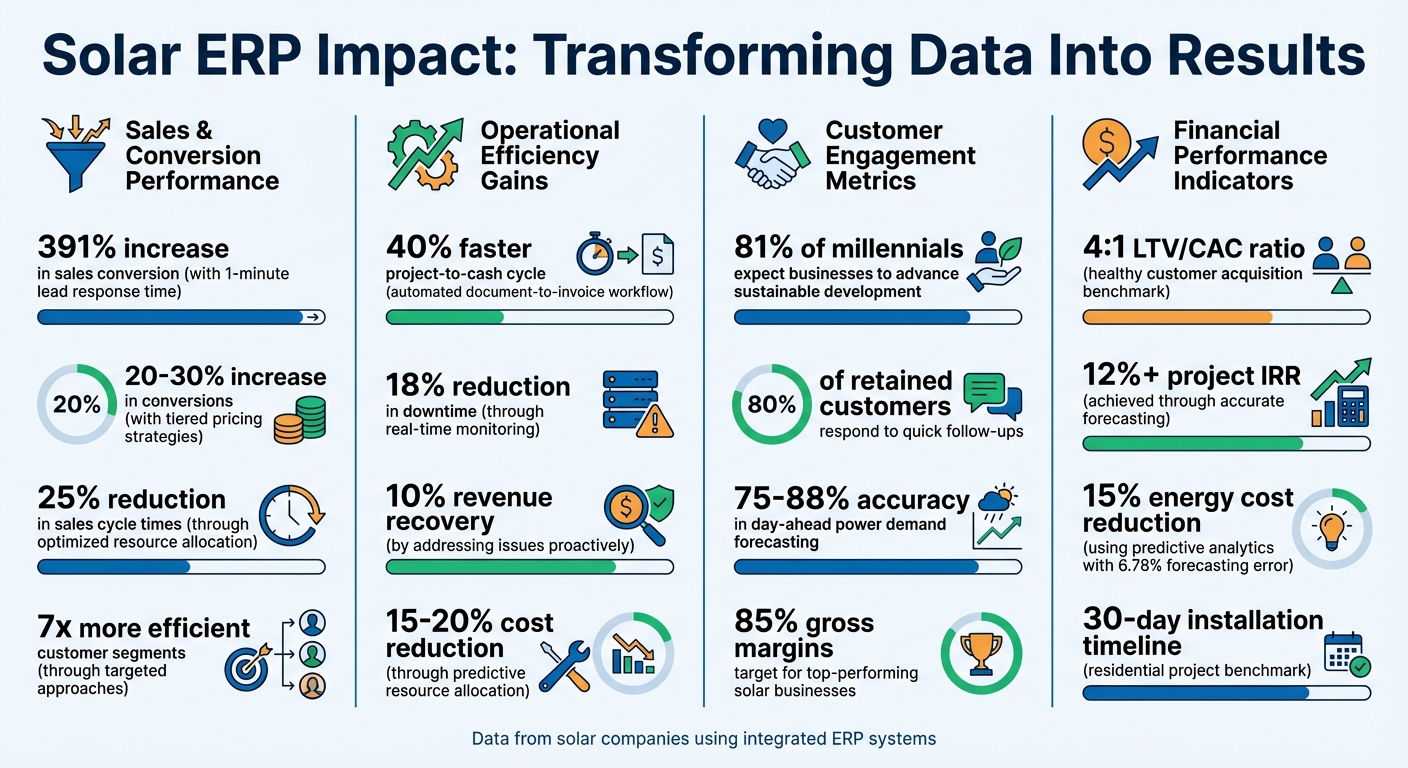
Solar ERP Impact: Key Performance Metrics and Business Outcomes
Setting Up CRM Modules to Track Customer Interactions
SolarSuccess simplifies lead management by automatically capturing data into a centralized CRM hub. This eliminates manual entry, reducing the risk of lost information and paving the way for automated lead scoring and profile organization.
Automating Lead Capture and Customer Profiles
The system seamlessly connects to your lead sources – whether it’s web forms, email inquiries, platforms like SolarReviews, or even door-to-door sales efforts. When someone submits a form or sends an email, the ERP automatically funnels details like contact information, interests, and lead source into a new customer profile.
But automation doesn’t stop at data collection. SolarSuccess assigns lead scores based on engagement signals, ensuring high-value prospects are routed efficiently by territory and team availability. For example, EasySolar saw a 391% increase in sales conversion by responding to leads within just one minute. Proposal tools also sync directly with these profiles, keeping everything in one place.
Field teams can update profiles in real time using mobile devices. They can upload site photos, checklists, and property details on the go, keeping customer profiles up-to-date without waiting for office staff to manually input updates.
Creating a Single Source for Customer Activity Records
Once a lead becomes a prospect, tracking every interaction is critical. The CRM module logs every touchpoint – emails, phone calls, text messages, meetings, and support tickets – all in one centralized profile. SolarSuccess integrates tools like MessageMedia for SMS communication and DocuSign for e-signatures, ensuring texts and signed contracts are automatically recorded. Cloud storage services also link project documents directly to customer profiles.
This unified system ensures that all teams – sales, project management, and accounting – work with the same up-to-date information. Blu Banyan refers to this as a "single source of truth", which eliminates data silos and reduces errors caused by duplicate entries across disconnected systems.
"SolarSuccess enables complete insight on every customer touch point while enabling the sales team to become performance-driven and productive." – Blu Banyan
With everything in one place, your team gains real-time analytics to make quicker, better-informed decisions.
sbb-itb-2560759
Analyzing Customer Behavior Using Sales Pipelines and Metrics
Understanding how customers move through the sales process and measuring their engagement are key to refining strategies and improving outcomes.
Tracking Customer Movement Through Sales Stages
Solar ERPs use tools like Kanban boards to visually map out the journey of each opportunity within the sales cycle. This method makes it easy to identify trends, such as where prospects might be getting stuck or where they’re accelerating toward closing a deal.
These systems guide opportunities through pre-defined stages – from initial inquiries and price quotes to vendor data submissions and, eventually, contract signing. What’s especially helpful is that updates happen in real time, keeping all departments aligned and informed as each opportunity progresses.
Additionally, these tools can shed light on which lead sources are driving the most profitable projects. This insight allows businesses to fine-tune their marketing budgets for better returns.
Beyond just tracking stages, these platforms also dive deeper into customer engagement by analyzing detailed activity metrics.
Measuring Customer Engagement Through Activity Metrics
Building on the foundation of stage tracking, ERP systems collect and analyze activity data to measure how engaged customers are. With consolidated logs, these systems provide a clear picture of customer interactions, which can be used to shape conversion strategies.
For example, commission reports and activity tracking help link customer engagement patterns to the performance of individual salespeople. This makes it easier to identify top performers as well as team members who might need additional support.
A real-world example comes from Titan Solar Power, one of the largest residential solar installers in the U.S. In February 2020, they adopted SolarSuccess to replace their outdated, disconnected systems. Led by Technology and Infrastructure Director Aaron Casillas, this transition unified project management, accounting, and sales data. The result? A significant reduction in labor for partner commission payouts and better overall operational transparency.
"When you’re aggregating a group of point applications – regardless of how good each of those programs is individually – you really need them to be able to talk to one another. The only way to make that happen is with an integrated or unified application suite with 3rd-party integrations on a single database." – Clive Smith, Chief Business Development Officer, Blu Banyan
Using Predictive Analytics and Customer Segmentation
After mapping customer journeys, the next step is leveraging data to predict behaviors and segment customers. Solar ERPs integrate historical data with AI-powered tools to anticipate customer needs and develop more tailored strategies. By analyzing detailed activity metrics, these tools help fine-tune both marketing and sales approaches.
Segmenting Customers for Targeted Marketing
Grouping customers by their buying habits and preferences enables solar companies to move beyond generic marketing strategies. By consolidating data from sales, accounting, and inventory systems, businesses can categorize clients based on factors like project profitability, equipment choices, and interaction history.
Models such as RFM and 3D segmentation are often used to classify customers. These models evaluate economic value, operational costs, and potential social impact, helping businesses understand past behaviors and predict lifetime value. This is particularly relevant as 81% of millennials believe businesses should play a key role in advancing sustainable development.
"A robust Customer Relationship Management (CRM) system is key in the segmentation process. By leveraging the data collated within the CRM, companies can gain insights into various parameters like consumption patterns, past interactions, feedback, and more." – Geoffrey Hodgson, Marketing Manager, Tokara Solutions
Real-time inventory visibility also plays a critical role. When sales teams know what modules and inverters are currently in stock, they can tailor proposals to match available inventory, avoiding backorder delays and enhancing the customer experience. This type of segmentation ensures that marketing campaigns and sales efforts align with what the business can realistically deliver.
Applying Predictive Tools for Lead Scoring and Forecasting
Once customers are segmented, predictive tools take the process a step further by refining lead prioritization and forecasting. AI-powered lead scoring ranks prospects based on their likelihood to convert. Solar ERPs analyze historical outcomes, engagement data, and seasonal trends to identify high-potential leads and automate follow-ups for less promising ones.
These systems also use historical power demand, weather data, and AI models like LSTM to predict both typical and unusual trends. For example, day-ahead power demand forecasting for buildings can achieve accuracy rates of 75–88%.
In August 2025, a manufacturing company used predictive analytics to cut energy costs by 15%, achieving this with an average forecasting error of 6.78%.
"Predictive analytics empowers maintenance teams with early warnings days, weeks, or even months in advance that something is beginning to go wrong." – Jacqueline Vinyard, Director of Product Marketing, GE Vernova
These tools allow solar companies to move from reactive to proactive strategies. Early warnings about equipment issues or shifts in customer demand can inform decisions on pricing, resource allocation, and customer engagement long before problems arise. This forward-thinking approach helps businesses stay ahead in a competitive market.
Creating Real-Time Reports and Data-Driven Insights
Solar ERPs have revolutionized how data is handled by turning predictive insights into real-time dashboards and alerts. This shift replaces outdated, static monthly reports with dynamic tools that allow businesses to make quicker, more informed decisions.
Building Custom KPI Dashboards for Behavior Monitoring
Dashboards bring together key metrics – like customer acquisition costs, installation cycle times, and post-sale engagement – into one centralized view. No more digging through multiple systems. These dashboards rely on modular components called portlets, which are small windows displaying specific data, such as KPI meters, trend graphs, or report summaries.
KPI meters, for example, use color-coded gauges to instantly show progress toward targets. Imagine a solar company tracking its LTV/CAC ratio. A healthy ratio is 4:1, and if it dips below that, the gauge turns red, signaling the need for immediate action. Similarly, top-performing solar businesses often aim for 85% gross margins on residential and commercial sales.
Dashboards also offer role-based views. Sales teams might focus on conversion rates, while project managers monitor installation timelines – ideally keeping residential installations under 30 days. Companies using these real-time tools have seen impressive results, like recovering up to 10% of revenue and reducing downtime by 18% by addressing issues before they escalate.
Integrating platforms like SolarEdge adds another layer of efficiency. These integrations enable fault detection at module, string, and system levels, with alerts feeding directly into dashboards. Pairing this with tools like MessageMedia for SMS tracking creates a seamless system where businesses can monitor every customer interaction – from the first inquiry to post-installation support – all in one place.
These dashboards don’t just display data; they set the stage for immediate action through automated alerts.
Setting Up Real-Time Alerts for Quick Strategy Changes
Automated alerts transform dashboards into proactive tools that notify teams of critical changes, like drops in lead conversion or equipment failures.
Project Action Queues take it a step further by turning data updates into tasks. For instance, if a customer’s system shows a temperature spike or tracker misalignment, the ERP automatically alerts the maintenance team and generates a service ticket. This approach helps fix problems before they impact customer satisfaction.
"With SMS, you are able to provide an automated connection to your customers and deliver timely messages." – MessageMedia
External integrations amplify the power of these alerts. For example, AccuWeather data can help businesses adjust schedules and manage customer expectations when weather conditions threaten to delay installations or affect energy production.
Financial alerts are equally important. If project margins fall below targets or delays increase carrying costs, automated notifications ensure finance teams can step in quickly. Together, these technical, operational, and financial alerts create a comprehensive early-warning system that keeps operations running smoothly while maintaining strong customer relationships.
Improving Customer Insights with Blu Banyan SuiteApps

Tracking customer behavior is essential, but fragmented systems can create blind spots. Blu Banyan’s SuiteApps, built directly for NetSuite, solve this by centralizing communication, documents, and time tracking within SolarSuccess. This setup provides a complete, real-time view of every customer interaction, eliminating the need for disconnected tools and ensuring seamless collaboration across teams.
By sharing a single data source, bluChat, bluDocs, and bluTime prevent the tangled web of software that often hinders solar businesses. This integration not only sharpens customer insights but also boosts operational efficiency at every stage of a project.
Facilitating Team Communication with bluChat
bluChat brings SMS and team messaging directly into the ERP system, making external texts part of the workflow. When paired with MessageMedia, every customer text becomes visible to the entire team. This transparency helps teams make faster decisions and respond more efficiently.
"With NetSuite SMS messaging, every external text becomes part of the workflow – no more missed updates, lost requirements, or invisible conversations." – Blu Banyan
For solar companies handling complex installations, this visibility is invaluable. For instance, if a customer texts about a site access issue or a design change, the message is automatically linked to their project record. Field teams, project managers, and sales reps can all view the conversation and take action. Additionally, bluChat allows authorized users – including staff, vendors, and even customers – to collaborate on problem records, speeding up issue resolution.
Managing Customer Documents with bluDocs
bluDocs simplifies document management by centralizing permits, contracts, designs, and invoices. It integrates seamlessly with Google Drive and SharePoint, ensuring both field and office teams have instant access to the latest versions of critical documents.
This centralized approach helps solar businesses track project progress more effectively. For example, bluDocs can pinpoint delays – like a missing customer signature or a pending permit with the Authority Having Jurisdiction (AHJ). Real-time document statuses highlight bottlenecks, enabling teams to address them quickly. The system also supports version control, ensuring everyone works with the most up-to-date requirements.
What’s more, bluDocs links document completion to automated invoicing. This feature can accelerate the project-to-cash cycle by as much as 40%, a game-changer for companies looking to improve cash flow and efficiency.
Monitoring Time and Productivity with bluTime
bluTime takes time tracking to another level by allowing field personnel to log hours at the "Project Action" level. These entries are then automatically summarized at the project level, providing an accurate picture of labor costs. Location-based verification ensures fieldwork is logged at the correct site, preventing errors and ensuring precise cost allocation.
This detailed tracking helps businesses understand how much time is spent on specific tasks and installations. With this data, project managers can maintain tight timelines, improving customer satisfaction. Additionally, real-time logging reduces administrative burdens, freeing team members to focus on more strategic tasks like researching better components or managing vendor relationships.
For example, in early 2025, Big Sun Solar adopted SolarSuccess and Blu Banyan’s SuiteApps to streamline operations. By replacing their disconnected systems, they achieved real-time costing and improved project execution.
"SolarSuccess streamlined things even further and allowed us to add our own customizations on top of NetSuite. Blu Banyan’s wide breadth of expertise was a critical resource for us." – Aaron Casillas, Technology & Infrastructure Director
Applying Customer Behavior Data to Business Decisions
Solar ERPs are making it easier than ever to transform customer behavior data into actionable business strategies. By analyzing this data, companies can identify which pricing strategies work, which marketing channels deliver the best results, and where resources are being underutilized. This approach not only boosts revenue but also improves operational efficiency.
Adjusting Pricing and Marketing Based on Customer Data
Customer interaction data provides clear signals about pricing and marketing adjustments. For instance, if ERP data shows that customers are hesitant to commit to higher-priced proposals, companies can introduce tiered pricing options. One example: offering residential solar packages starting at $10,000 for more price-sensitive customers. This strategy has led to a 20–30% increase in conversions for businesses that analyzed their sales cycle data.
Segmentation also plays a big role in refining marketing efforts. By categorizing customers based on their interest in specific solar products – like residential rooftop systems versus commercial installations – companies can craft highly targeted campaigns. Solar CRMs that track customer interaction histories have revealed that 80% of retained customers respond well to quick follow-ups. Automated follow-up campaigns, in particular, have driven sales conversions up by an impressive 391%.
Real-time dashboards further enhance pricing strategies. Solar companies can monitor deal values and win rates across different pricing tiers, then test A/B pricing models. For example, if bundled financing options result in a 15% higher uptake, these bundles can be automatically included in quotes, streamlining the process and increasing revenue without manual effort.
"Before, we spent hours searching through spreadsheets and matching data across systems. Now, it’s just a couple of clicks" – Jose Manzano, CFO at Enlight.
But it’s not just about pricing and marketing – this data also plays a critical role in resource allocation.
Allocating Resources Based on Customer Insights
Customer behavior data helps businesses allocate resources where they’re needed most. For example, ERPs can use lead scoring and activity tracking to route high-potential leads – those with greater engagement or larger project sizes – to the best-performing team members. Dashboards also identify overloaded territories or underperforming reps, enabling companies to reassign resources, reduce sales cycle times by 25%, and focus on segments that are seven times more efficient.
This approach isn’t limited to sales teams. Installation and marketing resources also benefit from these insights. By analyzing customer journey data, companies can spot bottlenecks, like high drop-off rates after proposals, and adjust their strategies accordingly. Marketing budgets can be shifted to the most effective channels, and installation resources can be allocated based on demand forecasts. Metrics such as technician utilization rates, delays caused by customer no-shows, and repeated inquiries help guide these decisions. Predictive scheduling and real-time reporting allow companies to move inventory and staff to high-demand areas, cutting costs by 15–20%.
The consistent application of these insights leads to sustained growth. Behavior-driven strategies have been shown to increase revenue by 20–30%, as seen in metrics like improved sales velocity and higher customer lifetime value.
"With NetSuite and Blu Banyan, we finally had a unified view of data across the company including real-time insights into project status, costs, inventory, pricing, purchasing, and profitability" – Aaron Casillas, Technology & Infrastructure Director at Titan Solar Power.
Conclusion
By integrating CRM, sales, accounting, and project management into a ERP and inventory management platform, SolarSuccess eliminates the inefficiencies caused by fragmented systems. This streamlined approach provides real-time insights, which are essential for making quick, informed decisions. It’s no surprise that many solar companies already depend on SolarSuccess to manage their operations effectively. They recognize the need for real-time visibility into customer interactions, sales progress, and project profitability to maintain a competitive edge.
This consolidation shifts the focus from tedious manual data handling to strategic decision-making. Instead of juggling spreadsheets, leadership can dedicate their energy to decisions that drive growth. This emphasis on strategy enables solar companies to adapt swiftly to market changes, fine-tune pricing models, and allocate resources where they’ll make the biggest difference.
Understanding customer behavior goes beyond just tracking numbers – it’s about creating personalized experiences and proactive management. With interconnected CRM tools and seamless communication integrations, businesses can customize their interactions, spot customers who might churn, and take action before it’s too late. This deeper understanding not only boosts customer lifetime value but also cuts down on operational inefficiencies.
The benefits speak for themselves. Solar companies that adopt behavior-driven strategies often experience tangible results, including higher conversion rates, improved inventory management, and more precise revenue predictions. When accurate forecasting pushes project Internal Rate of Return (IRR) beyond the 12% mark, the financial gains become impossible to ignore. By turning raw data into actionable insights, solar companies can thrive in a fast-paced, competitive market. These insights allow for continuous refinement of their strategies, ensuring long-term growth and profitability.
FAQs
What customer data should a solar ERP track?
A solar ERP system needs to keep track of essential customer data to aid in behavior analysis and smarter decision-making. This data typically includes contact details, sales pipeline information, system size (kW), type of financing, permit status, and customer support requirements. Keeping an eye on these elements allows businesses to fine-tune their strategies and deliver better customer experiences.
How does AI lead scoring improve close rates?
AI lead scoring helps boost close rates by examining data such as demographics, financial information, and user behavior to rank leads based on their likelihood to convert. This approach allows sales teams to zero in on the most promising prospects, streamlining the sales process and enhancing forecasting accuracy. By focusing on leads with higher chances of converting, teams can use their resources more effectively, minimize wasted effort, and close deals more quickly.
Which KPIs best show customer behavior changes?
Key performance indicators (KPIs) such as conversion rates, sales velocity, and revenue forecasts offer valuable insights into shifts in customer behavior. Beyond these, tools like solar ERP systems – such as SolarSuccess – allow businesses to track metrics like milestone progress, project costs, and resource usage in real time. This real-time tracking helps companies stay informed and respond quickly to emerging customer trends.
