

Managing solar field operations efficiently requires real-time data synchronization. Without it, delays in communication and manual errors can cost thousands in lost energy production. Work order sync solves this by connecting field technicians with office systems, ensuring updates like task completions and material usage are instantly reflected across platforms.
Here’s why work order sync matters:
- Real-time updates: Technicians can log repairs or flag issues on-site, and these updates sync immediately with systems like SolarSuccess, reducing downtime and lost revenue.
- Error reduction: Automating data entry decreases manual mistakes by 20–30%.
- Faster issue resolution: Faults are addressed hours sooner, minimizing energy losses.
- Improved communication: Tools like bluChat centralize team collaboration, cutting wasted labor by 80%.
- Compliance readiness: Automated logs and e-signatures streamline audits and meet regulatory standards.
Solar companies using work order sync report 15–25% cost savings, faster task completion, and higher energy recovery rates. By integrating tools like SolarSuccess with mobile apps, you can boost efficiency, reduce errors, and maximize uptime for your solar installations.
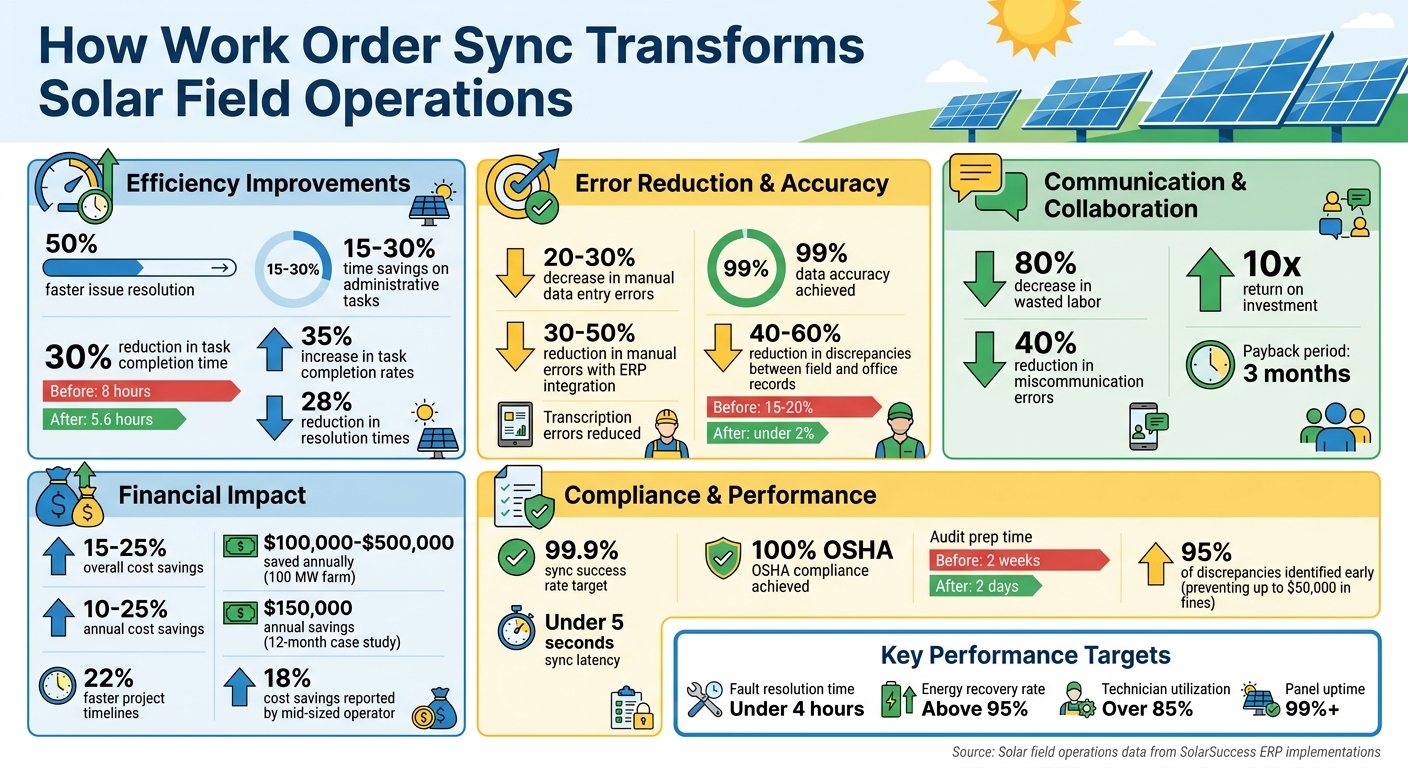
Work Order Sync Benefits for Solar Operations: Key Performance Metrics and ROI
Setting Up Real-Time Data Synchronization
Integrating SolarSuccess with Field Apps

SolarSuccess, built on NetSuite, integrates seamlessly with field apps like bluTime and bluChat+, removing the need for third-party middleware. This direct connection ensures data flows instantly and accurately from field devices into the ERP system, creating a centralized, reliable source of information. For instance, when technicians use bluTime to log hours or update project statuses, their inputs are recorded in real time and summarized for easy tracking.
To enhance data accuracy, you can configure location-based triggers in bluTime, ensuring it only accepts entries when technicians are physically on-site. Similarly, milestone triggers can automatically update work order statuses and generate invoices as projects hit key stages in construction. Joe Marhamati, Co-Founder & VP, shared:
"When a deal moves to a particular stage of construction, for example, SolarSuccess generates invoices based on that specific milestone… We’re doing more with the same number of people and we have a system that’s more reliable and less stressful than tracking a million different spreadsheets."
In early 2025, Big Sun Solar adopted SolarSuccess through Blu Banyan, using bluActions™ to directly link field activities to core ERP processes. This setup highlights how real-time synchronization enables precise costing and smooth project execution.
Reducing Manual Data Entry and Errors
Thanks to its native integration, SolarSuccess automates data capture, significantly cutting down on manual tasks. Automated synchronization removes the need to manually transfer data between project management, accounting, and storage systems. Aaron Casillas, Technology & Infrastructure Director, described the previous challenges:
"Sharing data across these systems was difficult, and in most cases our only way to ‘patch the holes’ was by adding labor… SolarSuccess streamlined things even further and allowed us to add our own customizations on top of NetSuite."
sbb-itb-2560759
Improving Task Tracking and Communication
Real-time synchronization doesn’t just keep work orders up-to-date – it also boosts task tracking and improves team communication. These are critical for keeping solar field operations running smoothly.
Mobile Task Tracking for Field Technicians
Gone are the days of tedious paperwork and manual data entry. Mobile apps now make task management much easier. For example, tools like bluDocs let technicians capture site photos, upload documents, and complete digital checklists directly on their mobile devices. All this data syncs instantly with SolarSuccess, giving office teams immediate access to updates without waiting for end-of-day reports.
Offline functionality is a game-changer for technicians working in remote areas. Even without connectivity, they can complete checklists, and the data will automatically sync once they’re back online. This ensures that no progress is lost, keeping task tracking consistent no matter where the work happens.
Kelly Marett, Service & Operations Coordinator at LightWave Solar, shared how real-time updates have transformed their process:
"We love the instant visibility from folks on-site in the field to in-house engineers during the site survey process. This has already helped us with reducing return visits."
While real-time updates enhance tracking, effective communication is equally important for seamless coordination between the field and office teams.
Real-Time Team Communication with bluChat
Efficient communication is the backbone of fast problem-solving. That’s where bluChat comes in, replacing scattered communication methods like SMS, emails, and phone calls with a single, centralized platform. Conversations are tied to specific work orders, ensuring that everyone – operations staff, field crews, and partners – has access to the same information.
This setup enables instant collaboration between field technicians and office engineers, helping resolve on-site issues in real time, rather than requiring follow-up visits. The results speak for themselves: companies using centralized field operations software have reported an 80% decrease in wasted labor and a 10x return on investment, with payback periods as short as three months.
Monitoring and Optimizing Solar Field Operations
Centralized dashboards make it easier for solar field managers to turn synced data into actionable insights. This helps them identify problems early and fine-tune operations for better results.
Using Dashboards for Key Performance Indicators (KPIs)
SolarSuccess dashboards offer an at-a-glance view of critical metrics. These include fault resolution time (aiming for under 4 hours), energy recovery rate (typically above 95%), and technician utilization (targeting over 85%).
The dashboards feature customizable widgets and visual charts to track trends. For instance, if energy output drops by 20%, managers can quickly reallocate resources to address the issue – potentially improving recovery by 15% within 24 hours. Heat maps help pinpoint high-fault areas, while drill-down tools allow managers to explore specific work order details as needed.
Automated alerts play a key role, notifying the right personnel when thresholds are exceeded. For example, if fault resolution time goes beyond 6 hours or panel uptime falls below the 99% target, alerts are sent immediately. This reduces decision-making delays by up to 50%, ensuring issues are tackled before they escalate.
These tools empower managers to make data-driven decisions that directly enhance operational performance.
Measuring the Benefits of Work Order Sync
Synchronizing work orders has a tangible impact on solar field performance. Companies using synced dashboards report a 30% reduction in task completion time, cutting it from 8 hours to 5.6 hours per work order. Predictive alerts have improved fault resolution by 40%, while better resource allocation has boosted overall efficiency by 25%.
One solar farm tracked its progress over 12 months and achieved $150,000 in annual savings by increasing uptime by 15%. By comparing baseline KPIs with post-sync data, they calculated ROI and identified the changes with the most significant impact. Syncing data also eliminates manual errors, enabling accurate tracking of long-term trends like cumulative energy recovery rates and efficiency improvements.
Maintaining Compliance and Accuracy in Solar Operations
Work order synchronization creates a permanent record of every field activity, logging updates with precise MM/DD/YYYY timestamps. This centralized approach reduces discrepancies between field reports and office records by 40–60%, streamlining compliance with U.S. regulations like OSHA and NEC. When all data – photos, notes, and sign-offs – sync automatically, audits become quicker and less prone to errors. This ensures operational accuracy while maintaining compliance across all solar field tasks.
Maintaining Audit-Ready Documentation
bluDocs simplifies compliance by automating digital checklists for tasks such as panel inspections and grounding verification. Field technicians can capture e-signatures directly on mobile devices, adhering to ESIGN Act standards. These signed PDFs are instantly synced to SolarSuccess ERP, making documents audit-ready in minutes instead of days. For instance, at a 200 MW solar farm in California, integrating SolarSuccess with bluDocs reduced audit preparation time from two weeks to just two days by auto-archiving over 10,000 work orders with e-signatures, achieving 100% OSHA compliance.
bluDocs also auto-fills compliance checklists with key metrics like voltage and temperature, cutting transcription errors from 15–20% to under 2%. For example, daily safety logs for inverter maintenance are automatically generated, requiring e-signatures before syncing, which eliminates manual errors entirely.
Once compliant documentation is automated, the next step is to test synchronization rigorously to ensure optimal performance and adherence to regulations.
Testing and Optimizing Synchronization
Ensuring synchronization accuracy is critical to avoiding compliance violations caused by data lags or failures, which could misreport vital panel performance data needed for FERC reporting. Key metrics to monitor include sync latency (aim for under 5 seconds), data match rates (target above 99%), and error logs. Weekly tests conducted in a 100 MW solar field identified 95% of discrepancies early, preventing potential fines of up to $50,000. Simulating field updates via mobile apps, verifying real-time sync within 10 seconds on the ERP dashboard, and validating key data fields are essential steps. Discrepancy reports should also be documented with e-signatures in bluDocs.
SolarSuccess dashboards provide real-time insights with KPIs like sync success rates (target: 99.9%), compliance checklist completion, and audit readiness scores, formatted in U.S. number conventions (e.g., 1,234.56). In one instance, optimizing these dashboards reduced sync failures by 30%, improving NABCEP certification tracking. Industry experts recommend quarterly reviews and automated testing workflows to stay aligned with updates like the IEEE 1547 grid standards, maintaining KPI benchmarks of less than 1% data drift.
Conclusion
Summary of Improvements
In this guide, we’ve explored how work order sync transforms solar field operations, delivering measurable benefits across the board. By leveraging real-time updates and mobile task tracking, solar companies can significantly enhance efficiency. For example, real-time updates empower field technicians to resolve issues 50% faster, cutting down delays caused by outdated records and manual processes. Integrating SolarSuccess ERP with field apps reduces manual data entry errors by 30–50%, achieving 99% data accuracy that helps avoid costly mistakes and compliance issues.
Time-consuming administrative tasks are streamlined, with time savings of 15–30%, while tools like bluChat and bluConnect reduce miscommunication errors by 40%. A mid-sized U.S. solar operator managing over 500 daily work orders across 50 MW fields reported 22% faster project timelines and 18% cost savings through real-time mobile access and automated alerts.
These operational improvements directly impact financial performance. Solar companies using work order sync can see annual cost savings of 10–25%, which translates to $100,000 to $500,000 on a 100 MW farm. This is achieved through smarter labor allocation, reduced overtime, and minimized equipment downtime. Task completion rates rise by 35%, while resolution times drop by 28%, ensuring installations operate at maximum efficiency.
The integration of SolarSuccess dashboards with Blu Banyan SuiteApps like bluDocs creates a seamless system where field data is instantly accessible to office teams. This real-time visibility supports faster decision-making, quicker responses, and helps maintain compliance, driving better outcomes for solar field management.
FAQs
What systems does work order sync connect in a solar operation?
Work order sync connects essential systems such as NetSuite, project management tools, inventory management, accounting software, and CRM platforms. This integration allows for real-time updates and seamless communication between platforms, simplifying solar operations and boosting overall efficiency.
How does work order sync work when technicians are offline?
Technicians can keep working even when they’re offline. They can complete tasks, record data, and update progress directly on their mobile devices. Once they’re back online, everything syncs automatically with the central system. This ensures all updates are preserved, and workflows stay uninterrupted.
What KPIs should we track to prove work order sync ROI?
When evaluating the return on investment (ROI) of work order synchronization, certain key performance indicators (KPIs) can provide valuable insights. These include:
- Real-time task completion rates: Tracking how quickly tasks are completed after being assigned helps gauge efficiency improvements.
- Reduction in manual data entry errors: Fewer errors mean smoother workflows and less time spent correcting mistakes.
- Faster project turnaround times: Measuring the speed at which projects are completed highlights the impact of streamlined processes.
- Cost savings from streamlined operations: Lower operational costs point to improved resource allocation and better overall coordination.
These metrics paint a clear picture of how synchronized work orders enhance both efficiency and accuracy in day-to-day operations.
