
SolarSuccess consolidates every subsidiary, SPV, and fund structure into one system, so you're not rebuilding the model every quarter just to answer the questions your investors already asked last time.
Weeks → days — month-end close, consolidated across every subsidiary and asset
5 to 200+ assets — built to run your first SPV or your 200th
1 system — financials, offtaker billing & monitoring, connected instead of stitched together by hand
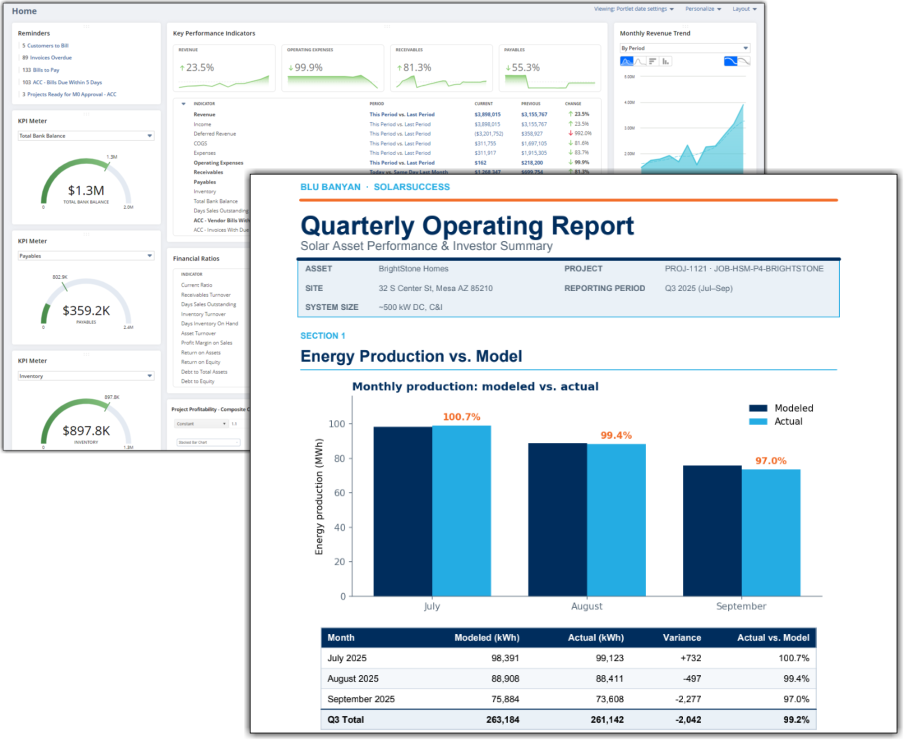
Ask most asset managers if they know how their portfolio is performing, and the answer is yes. Ask them how long it took to find out, and the story changes.
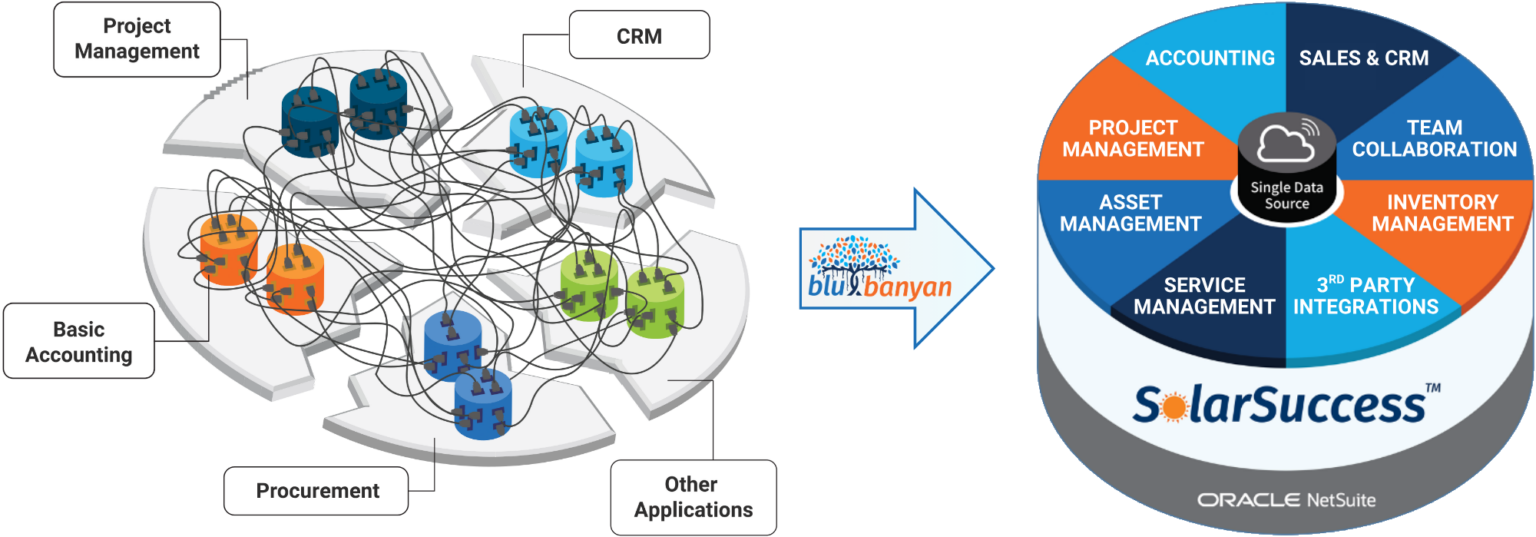
The production data lives in your monitoring platform. The books live in Yardi, QuickBooks, or a NetSuite instance that was configured for building projects, not owning them. The bridge between the two is a key person, a set of exports, and an Excel template that gets rebuilt every single cycle. It works. Until it doesn’t.
Your key person takes a day off. The export requires hours of manual work, when work is already backed up. By the time the report is done, the decision it was supposed to inform has usually already been made.
That’s the pattern behind almost every conversation we have with a solar asset manager.
Multiple subsidiaries. Multiple books. One exhausted finance team stitching everything together by hand every close.
Invoices built from monitoring exports instead of generated from the contract. Errors go undetected until the offtaker flags them.
Monitoring systems flag underperformance, but service dispatch lives somewhere else. The gap between “we saw it” and “we fixed it” costs real production revenue.
A 25-year PPA schedule or a tax equity flip model, built by a CFO or consultant who may no longer be there to explain it.
None of this shows up as a crisis. It shows up as a Tuesday that runs long, every single quarter, until the portfolio outgrows what a spreadsheet and a lot of goodwill can hold together.
Early in a portfolio, a sharp CFO and a well-built spreadsheet can hold everything together. At five assets, manual consolidation is tedious but doable. At twenty, it's a two-day process every quarter. Past fifty, it's a structural risk: one error in a consolidation spreadsheet, one missed PPA invoice, one monitoring alert that never reached the right inbox, and the cost is a lot more than a year of software.
The math that matters isn't "how many assets do we have?" It's "how many investors are asking us questions our current system can't answer quickly?" and "what does one billing dispute or one missed SLA actually cost us?"
"Asset managers: having data doesn't mean having the right data. You spent $25K in January on a $100K O&M budget--is that a problem? If you can't answer instantly, your data is incomplete."
That's the gap SolarSuccess closes. Not by giving you more dashboards to check. By making the underlying data structure connected enough that the dashboards are finally telling the truth.
SolarSuccess runs on NetSuite and is built for solar operators managing the full project lifecycle, from development and construction through asset ownership. Its financial infrastructure is designed for the reality of operating-phase solar: multi-entity fund structures, recurring PPA and lease revenue, and O&M costs tracked against the exact asset that incurred them, rather than averaged across the portfolio.
Here's what SolarSuccess gives your business.
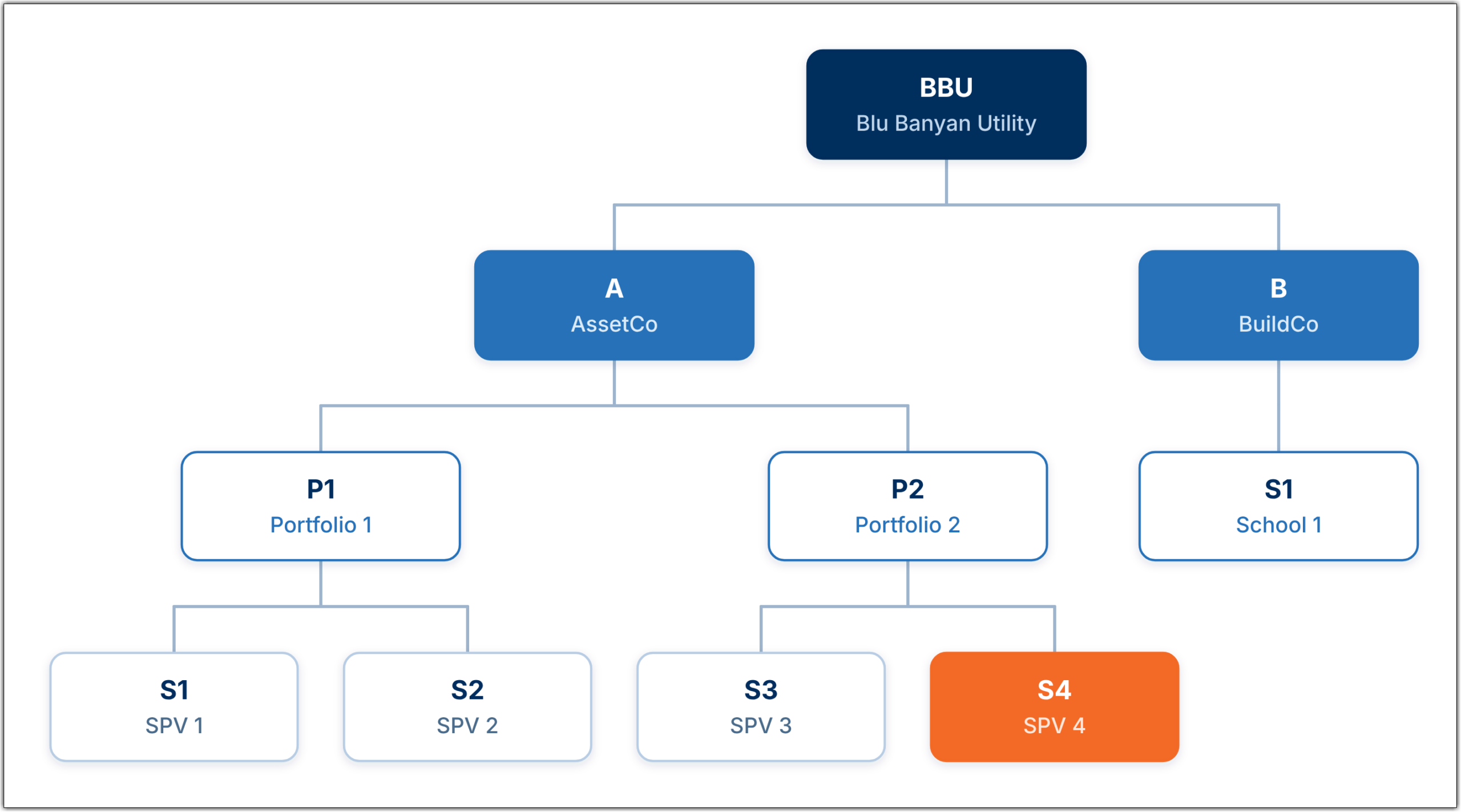
Manage multi-subsidiary and multi-book accounting in one system, with automated intercompany eliminations. Model holdco, tax equity, SPV, and inverted-lease structures with per-entity tax reporting, so obligations land on the right asset instead of getting smeared across the fund.
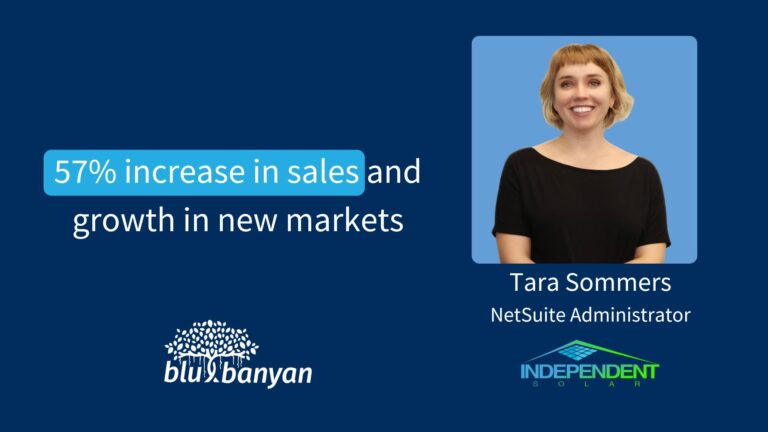
"We can look at all of our subsidiaries as standalones or consolidate them into our main financials. That’s been incredibly useful from a financial planning standpoint."
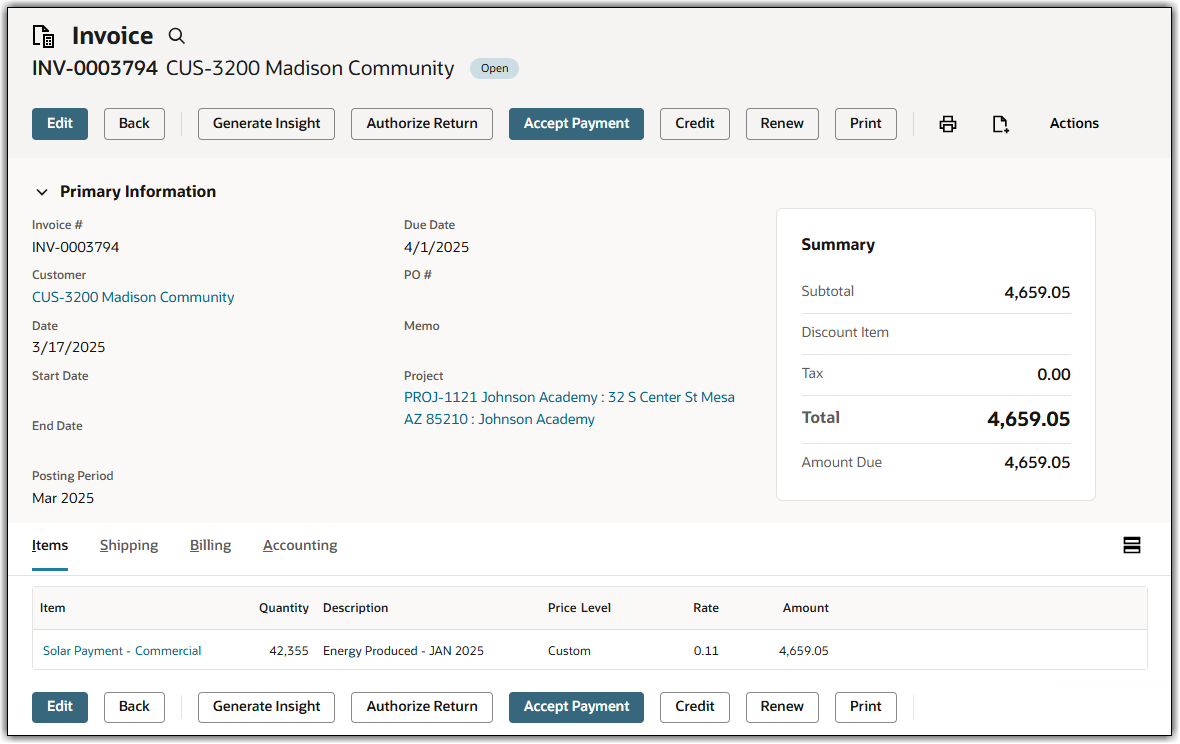
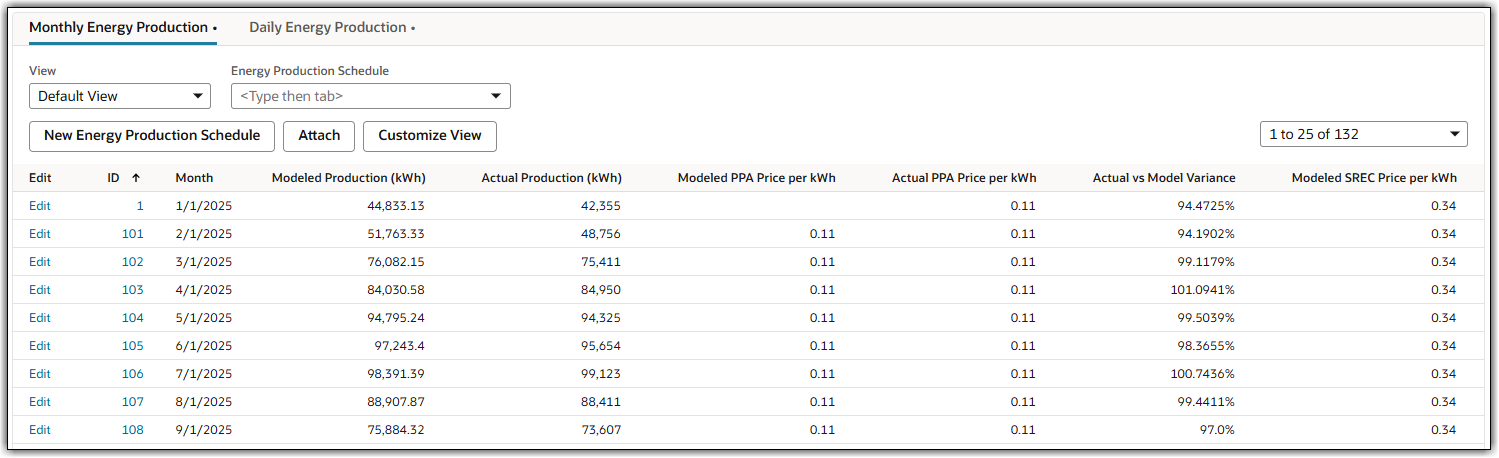
Production data flows in daily from your monitoring platform (AlsoEnergy and others), rolls up into monthly totals, and generates invoices automatically, per offtaker, per rate schedule.
Flexible billing for any offtaker arrangement:

SolarSuccess handles community solar, virtual net metering, split PPAs, and custom pricing without a workaround. The invoice becomes a byproduct of the data instead of a separate manual task every month.
Monitoring data lands directly on the project record instead of sitting in a separate platform your accounting team never sees. Underperformance gets flagged for maintenance before it becomes a bigger repair or a bigger revenue gap. O&M cases tie to the specific asset, so vendor activity and follow-through are visible across the whole portfolio, not buried in someone's inbox.
"By the time something shows up, it's already a problem. We're more reactive than we want to be."
Long-term contracts, depreciation schedules, and tax equity structures all affect asset performance over time.
PPA and lease schedules can span 15 to 30 years, alongside MACRS depreciation and tax equity flip structures. Configure them once, and SolarSuccess carries the schedules forward as years pass, accommodating refinancing without manual rebuilds.
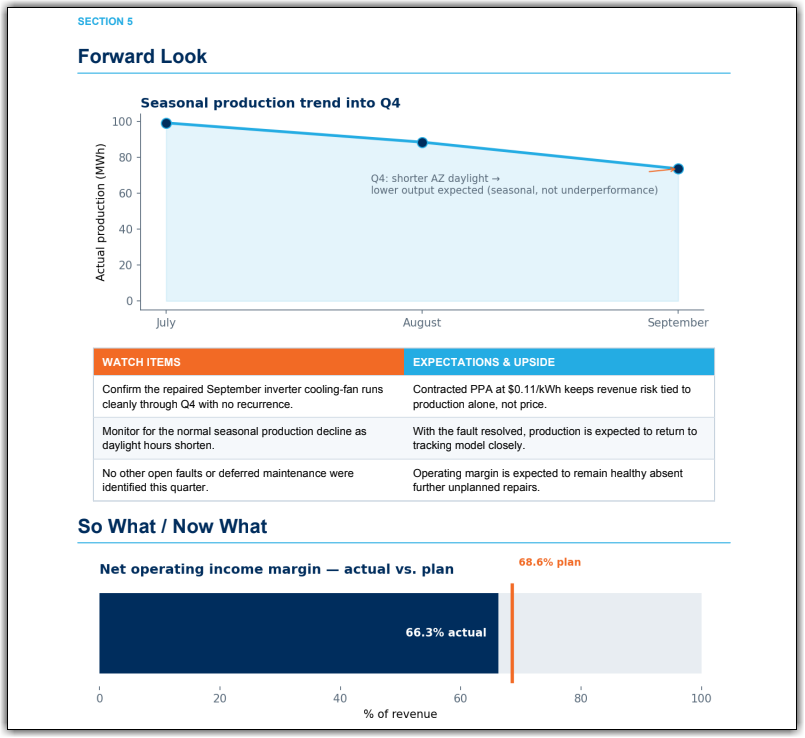
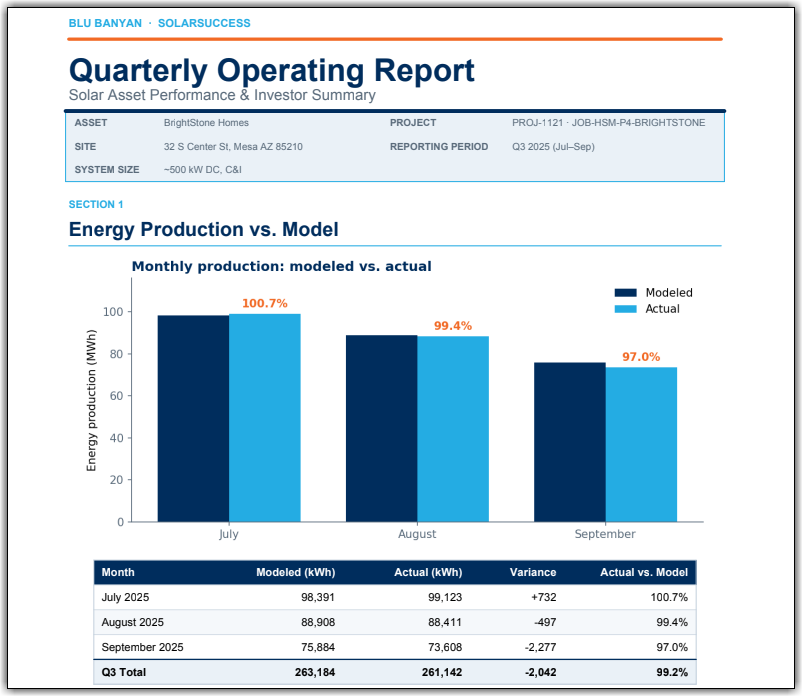
The system captures production, meter reads, service cases, invoices, and vendor bills as they happen. Each transaction stays tied to the asset and entity it belongs to, creating a continuous record of operating and financial performance.
When the operating report is due to your investors, the data is already assembled and ready to print, not scattered across exports that need to be rebuilt each cycle.
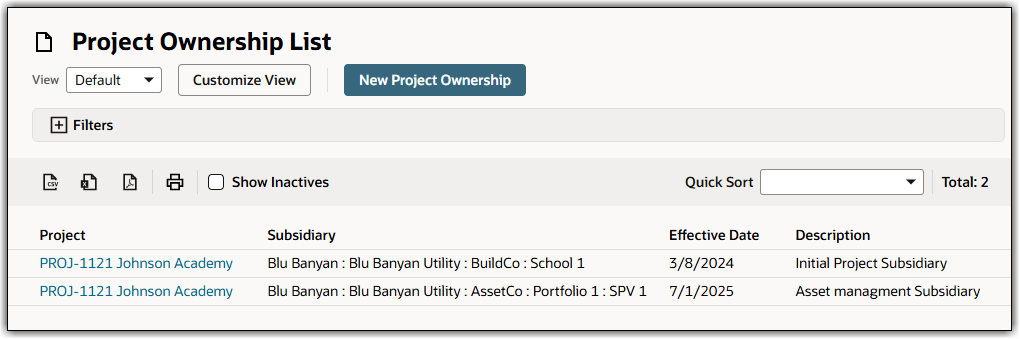
A solar project changes hands several times: from the developer, to the investors who fund construction, to the tax equity partner, to the operating entity that runs it for the next 20 years. SolarSuccess moves the project between legal entities with its accounting history and documentation intact, so each new owner starts with the full record instead of a handoff file.
You're managing 10 or more operating assets, and month-end consolidation takes days instead of hours
Your CFO, Controller, or VP of Asset Management is "the only one who really knows how the consolidation works." When they're off sick, things get dicey.
Offtaker billing is assembled by hand from monitoring platform exports, not generated automatically
You have an active monitoring platform (AlsoEnergy, PowerTrack, or similar) with no real connection to service dispatch or your books
Investor or LP reporting is due quarterly (or more often) and takes more than a week to produce
You're moving from developer to operator, and your first assets in permanent operation are surfacing accounting requirements your current setup was never built for
A fund refinancing, LP secondary, or due diligence process is coming in the next 12 months
WATCH THE CASE STUDY »
WATCH THE CASE STUDY »
WATCH THE CASE STUDY »
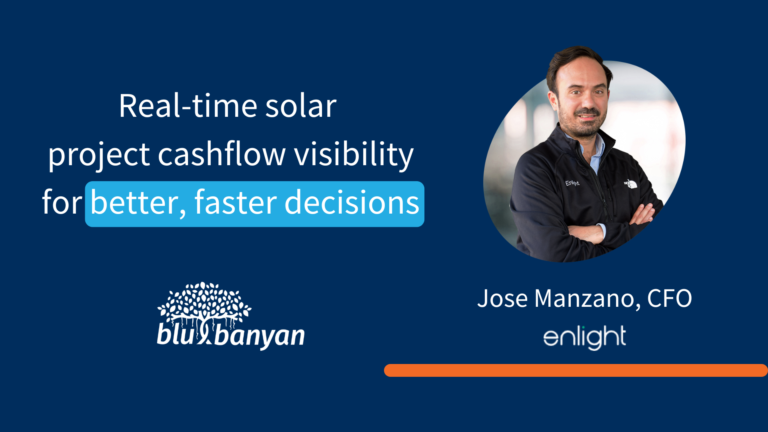
"Our financial close was incredibly complicated and fraught with errors because we have so many subsidiaries consolidating together. That problem has almost gone away completely."
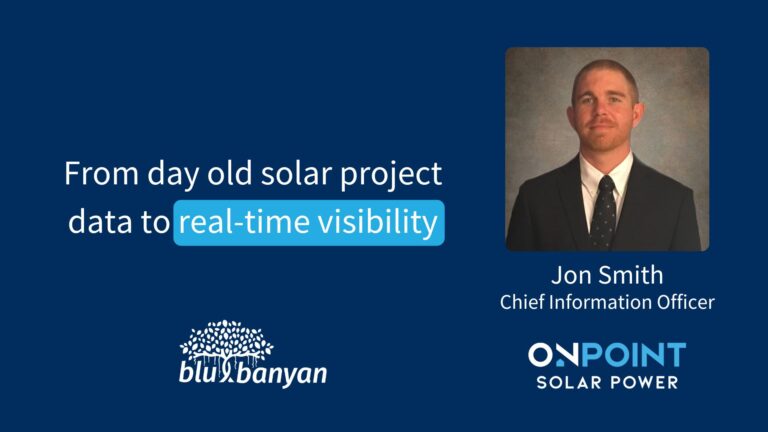
"How do I get really good at taking out variability and mitigating risk? There's really nothing more important than data at the appropriate level of detail."
Managing a solar portfolio with a monitoring platform, a separate accounting system, and an Excel bridge between them is inefficient and costly.
SolarSuccess gives you full financial and operational control of your portfolio in one integrated system.
Holdco, SPV, tax equity, and inverted-lease structures, consolidated with automated intercompany eliminations.
Community solar, virtual net metering, split PPAs, and custom pricing, generated from production data.
Daily data pull from AlsoEnergy and other major platforms, landing straight on the asset record.
Site leases, insurance, taxes, and O&M retainers, generated on schedule and ready to approve.
15 to 30 year PPA and tax schedules configured once, without a manual rebuild every year.
Read-only views for LPs and tax equity partners, configured to match your reporting agreements.
Bring your fund structure, your offtaker billing, and your asset monitoring onto SolarSuccess, and find out what your next month-end close could look like.
Ownership transfer, community solar offtaker management, production-based invoicing.
Direct integration with your monitoring platform, tied to service dispatch.
Align on fund structure, entity setup, and monitoring integration; configure your environment.
Build and test multi-entity consolidation and offtaker billing against your actual structure.
Finance and asset teams begin using SolarSuccess live, with support through your first close.
Month-end close runs on connected data. Your team reviews numbers instead of assembling them.
NetSuite gives you the ERP foundation. SolarSuccess adds the solar-specific layer: multi-entity consolidation built for fund and SPV structures, automated offtaker billing tied to production data, and monitoring that connects to service dispatch.
Yes. We have a direct AlsoEnergy integration, and it’s central to how invoicing and reporting work. Production data pulls in daily, gets allocated by offtaker, and drives the invoice automatically.
Yes. For an inverted lease specifically, we set a project segment on the paying entity’s transactions plus a monthly allocation journal entry, so costs land on the right asset instead of getting averaged across the portfolio.
Yes, and it’s the single most common thing we hear before implementation, and the single most common thing we hear has improved after it. Spencer Newman, CFO of Norwich Solar, described his close as “incredibly complicated and fraught with errors” before implementation, and said that problem “has almost gone away completely” afterward.
It’s not a shipped, out-of-the-box feature, but it configures quickly. We set SLA rules by case type and alert your team proactively, before a deadline is at risk, rather than tracking it on a spreadsheet nobody remembers to check.
Yes. Role-based access lets you give investors or tax equity partners a limited, read-only view into the specific reports relevant to them, without handing over broader access to your SolarSuccess instance.
That kind of true-up ties back to the same monitoring and production-data integration, comparing actual metered production against contract terms. The exact mechanics depend on your contract language, so it’s worth walking through directly during scoping.
The earlier look usually happened at the development stage, when staying on a familiar tool was the easy call. What’s changed is that your monitoring, invoicing, and reporting still don’t talk to each other, so every bit of portfolio growth multiplies the manual work sitting behind the scenes.
We use AI to cut out tedium, not as a headline feature. Narrative operating reports pull structured NetSuite data alongside service case history, so you’re not assembling that story by hand every month. You can also ask, in plain language, how a metric compares to last year and get an answer pulled straight from your own NetSuite data.