
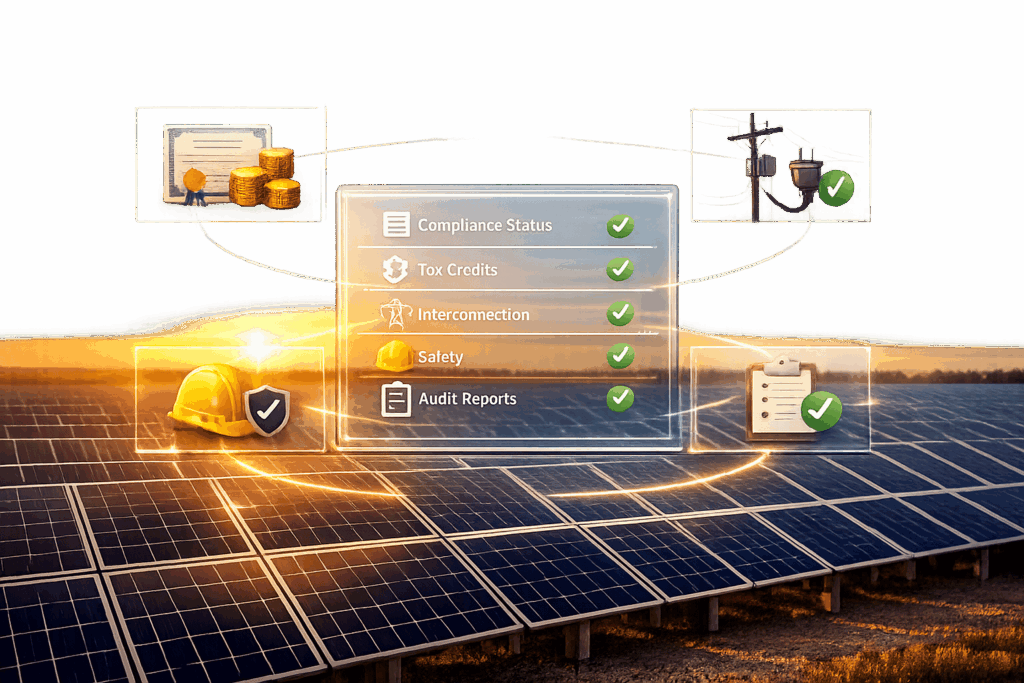
Non-compliance in the solar industry can cost companies up to $1 million per violation per day. Managing regulatory requirements – like tax credits, grid interconnection, and safety standards – is essential to avoid these penalties and ensure smooth operations. Yet, many solar firms struggle with fragmented tools, leading to data silos, financial errors, and missed deadlines.
The solution? A unified ERP system tailored for solar companies. Here’s what you need to know:
- Tax Credit Compliance: Federal tax credits (up to 70%) require precise documentation and adherence to rules like domestic content thresholds and Foreign Entity of Concern (FEOC) compliance.
- Grid Interconnection: Delays in permitting and utility standards add significant costs. ERP systems help centralize applications and automate tracking.
- Safety and Environmental Standards: OSHA compliance, biodiversity monitoring, and waste management demand robust documentation and reporting.
A solar-specific ERP integrates accounting, project management, and compliance tools, offering real-time tracking, automated reporting, and audit-ready data. This guide explains how to meet regulatory challenges, key ERP features to look for, and steps to implementing solar ERP software effectively.
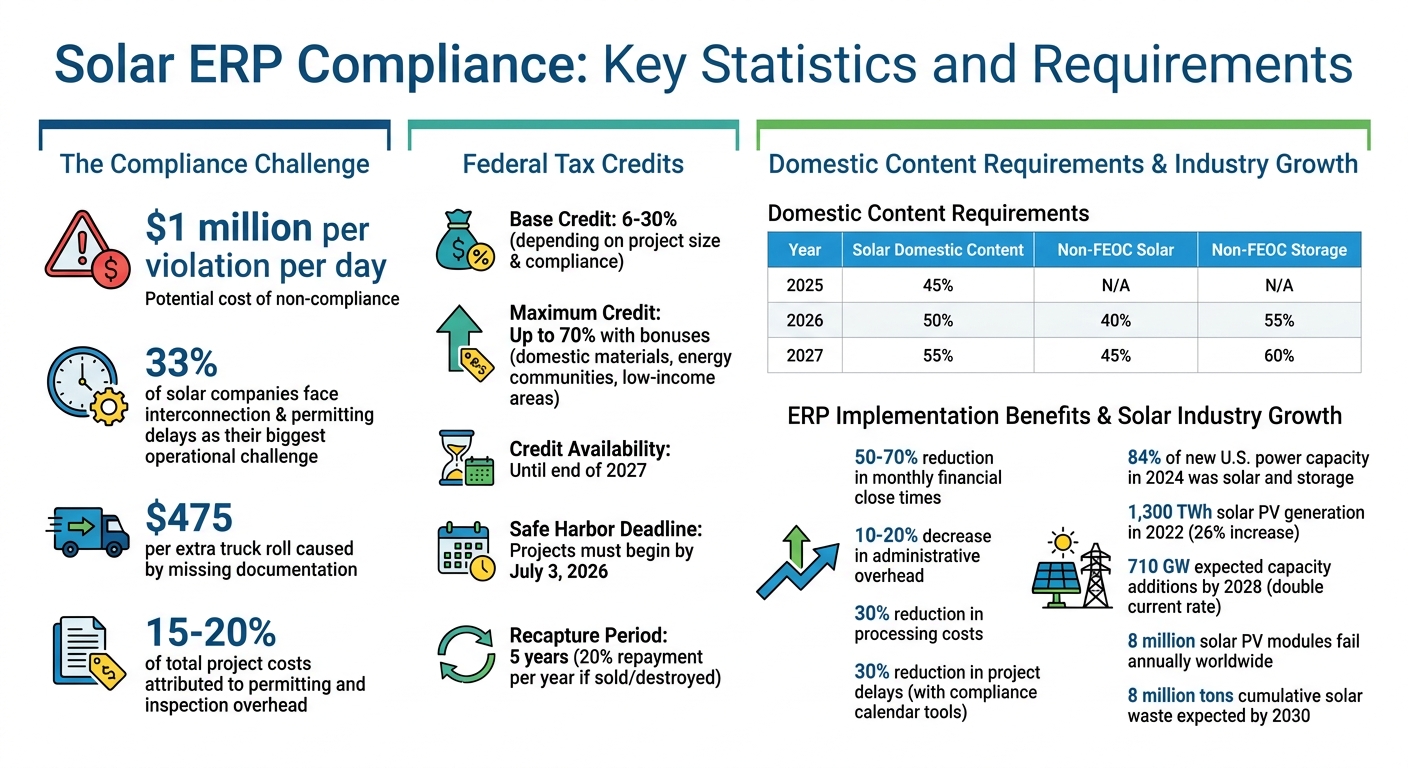
Solar ERP Compliance: Key Statistics and Requirements
US Regulatory Requirements for Solar Companies
Solar companies in the United States must navigate three key regulatory areas that heavily influence ERP system design: federal tax incentives, grid interconnection standards, and workplace safety regulations. Each area demands precise documentation and carries audit risks, making a unified ERP system crucial for consolidating compliance data and automating regulatory reporting. Let’s break down these regulatory challenges and the ERP functionalities needed to address them.
Federal Tax Credits and Incentive Compliance
The Commercial Investment Tax Credit (Section 48/48E), introduced under the One Big Beautiful Bill Act of 2025, is a major federal incentive but will only be available until the end of 2027. The residential credit expired on December 31, 2025, leaving commercial systems eligible for a base credit ranging from 6% to 30%, depending on factors like system size and adherence to prevailing wage and apprenticeship rules. Additional bonuses for using domestic materials, operating in energy communities, or serving low-income areas can push the total credit to 70% of installation costs.
To qualify for the 30% credit, projects must begin by July 3, 2026, with installations extended through 2030. Smaller projects (1.5 MW AC or less) generally require an upfront investment of 6-7% to meet the safe harbor cost threshold. Larger projects must satisfy the Physical Work Test to demonstrate significant progress.
A newer hurdle is Foreign Entity of Concern (FEOC) compliance, which applies to projects starting after December 31, 2025. These projects must prove that at least 40% of the product value comes from approved domestic sources, excluding inputs from countries like China, Russia, Iran, or North Korea. This requirement is non-negotiable for Section 48E eligibility.
"Your documentation needs to be bulletproof – before an audit letter ever arrives." – Energyscape Renewables
An ERP system should automatically generate and store audit-ready documentation, including construction logs, PE-stamped plans, PTO letters, and FEOC attestations. The IRS has flagged 2025 construction starts for "anti-circumvention" reviews in 2026. Additionally, commercial credits come with a five-year recapture period, requiring repayment of 20% per year if a system is sold or destroyed during this time. ERPs must track these recapture windows and centralize compliance data to avoid penalties.
Grid Interconnection and Utility Standards
For 33% of solar companies, interconnection and permitting delays are the biggest operational challenges. Each delay can add roughly $475 per truck roll and necessitate extra site visits, straining cash flow and project timelines. Permitting and inspection overhead often accounts for 15% to 20% of total project costs.
The Energy Permitting Reform Act aims to streamline these processes by enforcing 150-day decision limits for agencies and adopting a "single lead agency" model to cut down on redundant paperwork. These measures could shorten utility-scale project timelines by 6 to 12 months and increase solar deployment by 20% to 30% compared to baseline projections.
ERP systems play a critical role here by acting as a central hub for managing interconnection applications, technical documentation, and utility inspection schedules. Solar-specific ERP platforms can automate the tracking of project milestones, triggering accounting events and ensuring that all necessary documentation is ready for inspections. Some systems even incorporate AI to manage multiple permitting and interconnection processes simultaneously.
"Solar ERP software such as Blu Banyan’s SolarSuccess, connects all departmental data together seamlessly, in a single source of truth. Having a single data source across company operations is important to maintain real-time insight into Key Performance Indicators (KPIs)." – Blu Banyan
Configuring your ERP to issue compliance alerts tied to project milestones can help avoid missed deadlines and ensure all technical requirements for grid interconnection are met.
OSHA and Environmental Monitoring Requirements
Solar companies must maintain detailed Health & Safety files for each site, covering personnel training on hazards like arc-flash, lockout/tagout (LOTO) procedures, step potential, and evacuation protocols.
Environmental responsibilities often include long-term biodiversity monitoring, drainage system upkeep, and careful use of herbicides and pesticides. With roughly 8 million solar PV modules failing annually worldwide and cumulative solar waste expected to hit 8 million tons by 2030, end-of-life tracking is increasingly important. Although less than 10% of decommissioned modules are recycled, experts suggest that 45% to 65% of failed modules could be repaired or repurposed.
Integrating a Document Management System (DMS) into your ERP can simplify record-keeping for as-built documentation, change management, and hazard plan updates. ERPs can also manage "Work Permits" for high-risk tasks and ensure that "Last Risk Assessments" are completed and logged through mobile interfaces before work begins. Automated alerts for expiring safety certifications and tracking water usage for module cleaning or hazardous material volumes can also be managed within ERP systems.
These demanding regulations highlight the importance of ERP systems that centralize compliance data and streamline documentation to meet regulatory expectations.
sbb-itb-2560759
Core Compliance Features in Solar ERP Systems
To meet federal tax credits, interconnection standards, and safety regulations, ERP systems must include specific compliance features at their core. These features turn regulatory challenges into automated workflows, ensuring project eligibility and minimizing audit risks. They directly address the federal, utility, and safety requirements discussed earlier.
Automated Reporting and Audit Preparation
ERP systems play a critical role in tracking compliance milestones, like "commence construction" dates, to secure the correct Investment Tax Credit (ITC) percentages before annual threshold changes. For projects starting after December 31, 2025, the system must calculate the Material Assistance Cost Ratio (MACR), ensuring 40% of solar product value (55% for energy storage) comes from non-FEOC sources.
Managing safe harbor provisions requires documenting the 5% rule (incurring 5% of total project costs) and the Physical Work Test, while also maintaining proof of "continuity of project development". With the July 4, 2026, safe harbor milestone, a four-year construction period is allowed, but only if the ERP system provides comprehensive documentation throughout the project. Advanced platforms like SolarSuccess ensure data revisions are recorded, creating a clear, auditable trail for regulatory agencies, partners, and investors.
"The distinction between entity status and manufacturing location is creating real risk for projects starting construction in 2026 and beyond. To safeguard your project’s ITC, you need to ensure your suppliers are non-PFE." – Kleber Facchini, Director of CC&I Products & Applications, SolarEdge Technologies
An ERP system should maintain a digital repository of signed certifications from manufacturers verifying their non-PFE/non-FEOC status. Even U.S.-based factories could be classified as "Prohibited Foreign Entities" if they have significant Chinese ownership or licensing agreements, making verification of entity status crucial. Built-in tools for domestic and global tax compliance can simplify managing complex accounting and incentive structures across multiple entities.
Real-time tracking and quality management features further ensure compliance throughout the project lifecycle.
Real-Time Tracking and Quality Management
ERP systems go beyond automated reporting by providing continuous monitoring and quality checks. Component-level tracking offers transparency into the allocation and installation of panels, inverters, and other components across various job sites. This unified dataset integrates accounting, project management, and inventory, ensuring teams work with audit-ready information. Considering that 33% of solar companies face permit and interconnection challenges, real-time tracking can prevent costly issues like the $475 per extra truck roll caused by missing documentation.
These systems also streamline the management of building permits, electrical permits, fire marshal approvals, and utility interconnection agreements in one centralized platform. Quality assurance workflows and compliance checks ensure installations meet industry standards before triggering revenue recognition. Synchronizing project Bills of Materials with sales orders helps ensure only approved, compliant equipment is used.
"Integrated accounting provides real-time, up-to-date financial information that’s required for accurate and informed decision-making." – Blu Banyan
Mobile field integration allows crews to capture data and complete compliance checklists in real time, even in remote locations with limited connectivity. This ensures installation and maintenance records remain audit-ready. Additionally, asset maintenance records track service history, inspections, and predictive data for solar arrays and inverters, helping prevent downtime and maintain regulatory reliability.
Integration with Monitoring Tools
Integrating IoT sensors with ERP systems enhances compliance by enabling predictive maintenance for inverters and turbines. These sensors monitor performance in real time, identifying potential issues before they escalate into compliance violations or safety hazards. This creates a continuous compliance loop, from installation to ongoing operations.
By connecting solar design software with project workflows, ERP systems ensure installations align with engineered PV layouts. This alignment guarantees that what is designed matches what is installed and documented for regulatory purposes. Advanced solar ERPs also offer universal financier connectivity, allowing seamless data sharing with financiers to streamline project funding and compliance reporting.
AI-driven automation further simplifies complex tasks like revenue recognition for Power Purchase Agreements and leases, which often require tracking over 20–25 years. These tools reduce manual errors and ensure adherence to accounting standards. Additionally, project-specific document management with revision tracking establishes a clear, defensible audit trail for all regulatory filings.
| Domestic Content Requirements by Year | 2025 Threshold | 2026 Threshold | 2027 Threshold |
|---|---|---|---|
| Domestic Content Bonus (Solar) | 45% | 50% | 55% |
| Non-FEOC Components (Solar) | N/A | 40% | 45% |
| Non-FEOC Components (Storage) | N/A | 55% | 60% |
How to Implement Compliance in Solar ERP Systems
Introducing a compliance-focused ERP system into a solar company involves tackling both technical and organizational hurdles. Companies need to assess their current systems, roll out new tools in stages, and train teams to effectively use the system. The process begins with identifying weaknesses in existing setups.
Evaluating Current Systems and Finding Gaps
Start with a thorough needs assessment to pinpoint organizational requirements. This includes compliance standards specific to the solar industry, like OSHA and EPA regulations, functional capabilities, and integration demands. Involve key departments – finance, project management, and field teams – to ensure every compliance need is accounted for.
It’s equally important to map out regulatory stakeholders. Solar companies must identify all the federal, state, local, tribal, and environmental agencies involved in project approvals. This ensures the ERP system can handle the necessary reporting and communication requirements. With solar and storage making up 84% of new power capacity added in the U.S. last year, navigating the growing regulatory complexity is critical. The evaluation should also determine if the current IT setup can work with new ERP modules using APIs or middleware to bridge gaps between existing systems.
Additionally, review permitting and documentation workflows. A good ERP system should include tools like a compliance calendar and permitting blueprint to track document versions and renewal deadlines. These features can cut project delays by up to 30%. For government-regulated industries, modern ERP systems have been shown to reduce monthly close times by 65–68%, thanks to improved efficiency.
Pay special attention to financial tracking capabilities. The system must handle complex compliance tasks, such as managing the 30% federal solar tax credit available through 2032, along with state-level incentives. Procurement modules should also verify that components meet regulatory certifications, such as those from the North American Board of Certified Energy Practitioners (NABCEP).
Once gaps are identified, the next step is to roll out ERP modules in phases.
Phased ERP Implementation Approach
Rolling out an ERP system in phases helps minimize risks. Begin with core financial, project management, and inventory modules to establish a solid base for compliance tracking. This phase should include features like audit trails and document management to support regulatory filings.
The next phase focuses on integrating the ERP with monitoring and utility systems. This step connects real-time data from IoT sensors, design software, and grid interconnection platforms to the central ERP. Replacing manual tracking or outdated tools for emissions, safety, and ESG performance reduces the likelihood of non-compliance and missed inspections. Test all integration points thoroughly before expanding the system further. Each phase should align with the strict regulatory standards identified earlier.
In the final phase, implement advanced compliance automation. This includes tools for scenario modeling to assess the impact of regulatory changes. For example, the ERP can help evaluate how stricter emissions limits or changes to grid connection rules might affect budgets and timelines.
Employee Training and Change Management
A successful implementation depends on how well teams adapt to the new system. Once the technical setup is complete, ensure every team member is trained for their specific compliance responsibilities. Finance teams need detailed training on managing regulatory incentives like the 30% federal solar tax credit. Project managers should learn how to maintain the compliance calendar and permitting blueprint within the ERP. Tailored training ensures everyone understands their role in maintaining compliance.
"Regulatory compliance for renewable energy projects directly impacts timelines, budgets, and overall project success." – VComply
Change management doesn’t end with training. Set up clear protocols for system updates, regular compliance audits, and ongoing improvements. Assign compliance champions in each department to address issues and promote best practices. Regular review sessions can help identify inefficiencies and ensure the ERP adapts to evolving regulatory requirements.
SolarSuccess ERP: Compliance Solutions by Blu Banyan
SolarSuccess ERP, built on the NetSuite platform, offers tailored solutions designed to simplify compliance for solar companies. Blu Banyan has combined automated regulatory tools with solar-specific features to handle everything from federal tax credits to permitting workflows. By integrating previously disconnected data, SolarSuccess helps reduce processing costs by as much as 30%.
Built-In Regulatory Support and Reporting
SolarSuccess streamlines tax compliance and audit processes by automating revenue recognition, milestone payments, and job costing. Role-based access ensures secure approvals, while automated workflows capture every data change, creating a clear audit trail for reporting to statutory bodies, investors, and partners.
By centralizing data across departments, SolarSuccess provides a single source of truth, reducing errors that often occur with disconnected systems. Real-time dashboards help project managers compare actual costs against budgets, improving financial accuracy and bid precision.
"Real-time records empower you with business intelligence and deliver strategic advantage." – Blu Banyan
A great example of this is POWERHOME Solar (now Pink Energy), which in July 2025 used NetSuite ERP to automate their order-to-cash process. This innovation cut their month-end close from 28 days to just 5 days, enabling them to scale to $600 million in revenue with only six finance team members.
This solid foundation also supports precise tracking of financial incentives.
Custom NetSuite Solutions for Incentive Tracking
SolarSuccess ERP enhances compliance with federal tax credit requirements through automated milestone-based billing. It tracks the 30% federal solar tax credit and state-level incentives, triggering claims and ensuring tax credit eligibility as projects progress. The platform also manages complex solar tax equity structures, automates revenue recognition, and generates the necessary documentation for credit submissions.
For companies with multiple legal entities, SolarSuccess simplifies inter-company reporting and financial consolidation. By connecting accounting with CRM, inventory, and field service modules, the platform ensures no financial data is misplaced. This integrated approach addresses a common issue in the solar industry, where 60% of firms face payment delays, with some waiting over 45 days to collect invoices.
"For all your entities, be it, partners, investors or statutory bodies, reports and submissions are easy." – Blu Banyan
Productivity SuiteApps for Compliance Management
Blu Banyan’s SuiteApps take compliance management a step further by integrating document and communication tools. The bluDocs app provides project-specific document management with full revision tracking, ensuring permits, contracts, and certifications remain up-to-date and auditable. This reduces the risk of using outdated documents during inspections or reviews.
bluChat keeps compliance discussions within the system of record, eliminating the need for external messaging apps. This makes it easier to reference decisions during audits. Field teams can also use SMS capabilities to quickly access compliance information on-site. Additionally, bluTime tracks labor hours and productivity, ensuring accurate reporting.
SolarSuccess uses visual timelines and project milestones to trigger accounting and regulatory events automatically. This ensures all compliance steps are completed before advancing a project. Companies using integrated ERP systems like SolarSuccess report significant benefits, including a 50–70% reduction in monthly financial close times and a 10–20% decrease in administrative overhead due to process automation.
Best Practices for Maintaining Solar ERP Compliance
Maintaining compliance in the solar industry isn’t a one-time task – it’s an ongoing process that requires constant attention and the ability to adapt. Companies that treat compliance as a continuous effort not only reduce the risk of audits but also set themselves up for sustainable growth.
Data Security and Audit Trail Management
A clear and comprehensive audit trail is a cornerstone of compliance. Every change in data, approval, or transaction should be automatically logged with details like timestamps and user information. This creates a transparent record that supports both internal checks and external audits. A well-defined data governance framework ensures clarity around who owns specific data, who has access to it, and how it moves across departments.
Data security is only part of the equation – data quality matters just as much. Automated tools can flag anomalies in real time, such as sensor drift, to prevent compliance issues before they escalate. Techniques like Z-score anomaly detection play a key role in maintaining data accuracy over the long haul. For solar projects with contracts that span decades, this level of precision is critical to ensure accurate reporting throughout the project’s lifecycle.
Tracking data lineage is another way to build trust with regulators. By documenting where each data point originates and how it’s transformed, companies can demonstrate the transparency and accountability that regulators value. These measures not only strengthen compliance but also make it easier to adapt to evolving regulations.
Preparing for Future Regulatory Changes
Being prepared for regulatory shifts is just as important as managing current requirements. Companies with flexible system architectures are better positioned to handle updates without major disruptions. Extensible data models allow new compliance parameters to be added without overhauling the entire ERP system. RESTful APIs and standardized protocols also enable seamless integration with new digital services as they emerge.
Cloud-based infrastructure is another key asset. It scales easily to handle growing data volumes and supports remote, real-time monitoring. With solar PV generation reaching nearly 1,300 TWh in 2022 (a 26% increase) and capacity additions expected to double by 2028 to 710 GW, systems must expand without sacrificing compliance capabilities.
Vertical integration ensures a smooth flow of data from field devices, through SCADA systems, to the ERP. This approach allows organizations to base decisions on real-time, compliant data rather than fragmented information. Standardizing data formats across all projects further reduces errors in revenue recognition and ensures consistent internal estimates.
Measuring and Improving Compliance Performance
An integrated ERP system offers valuable tools for assessing and improving compliance performance. One practical metric is the duration of the month-end close process. Automated order-to-cash workflows can significantly reduce this timeframe, providing a clear indicator of whether the ERP system is effectively supporting compliance or if manual interventions are creeping back in.
Scalability is another critical factor. Companies should monitor how well the system handles the addition of new users, entities, or projects while maintaining data integrity. Real-time financial insights must remain accessible across all departments – whether it’s accounting, CRM, inventory, or field service – ensuring everyone operates from a single, consistent source of truth.
Automated alerts for milestone payments and regulatory deadlines help close compliance gaps before they occur. Built-in business intelligence tools simplify complex reporting, offering a clear view of financial health and compliance status without the need for manual data assembly. In fact, companies using integrated SolarSuccess ERP systems report a 10–20% reduction in administrative overhead thanks to process automation, freeing up resources to focus on strategic improvements in compliance.
Conclusion
Solar compliance goes beyond simply meeting regulations – it’s about creating systems that support growth while adapting to changing requirements. This guide has explored key aspects like federal tax credits, interconnection standards, and OSHA requirements, along with ERP features and strategies that simplify compliance. By taking an integrated approach, businesses can achieve both immediate regulatory alignment and long-term efficiency.
Moving from disconnected tools like QuickBooks and Salesforce to a unified platform eliminates the data silos that often lead to compliance issues. As Blu Banyan notes, "SolarSuccess on the NetSuite platform ensures accurate and long-term financial management that is easily adaptable to your unique challenges". With centralized systems for accounting, project management, CRM, and inventory, manual data transfers – and the errors they cause – become a thing of the past.
Organizations using integrated ERP solutions often experience a 50–70% reduction in the time needed for monthly financial close. These time savings allow resources to focus on strategic growth rather than tedious administrative tasks. By embedding automated compliance triggers and centralizing data, companies can turn operational risks into opportunities. Features like real-time reporting, solar-specific financial templates, and universal financier connectivity ensure that all reporting aligns perfectly with project milestones and regulatory deadlines.
As Blu Banyan highlights, "Integrated business software offers a unified business management suite for all your productivity and growth needs while ensuring a single source of truth across all departments". Whether managing residential, commercial, or utility-scale solar projects, this level of integration shifts compliance from a reactive challenge to a proactive strength. With built-in audit trails, document tracking, and live dashboards, SolarSuccess by Blu Banyan (https://blubanyan.com) equips solar companies to meet today’s demands and prepare for future regulations.
FAQs
What documents do I need to prove ITC and FEOC compliance?
To meet ITC and FEOC compliance requirements, you’ll need to gather three key types of documentation: beginning-construction evidence, placed-in-service records, and proof of the origin of equipment along with supplier ownership. These documents are essential for showing compliance with FEOC regulations and meeting federal standards.
How can an ERP reduce interconnection and permitting delays?
An ERP system helps tackle interconnection and permitting delays by centralizing and automating compliance tasks. For instance, SolarSuccess by Blu Banyan provides tools like a centralized compliance database, automated tracking of milestones, real-time dashboards, and deadline alerts. These features simplify data management, reduce the risk of missed deadlines, and cut down on manual errors. By streamlining the permitting process, solar companies can meet requirements more efficiently, speed up interconnection timelines, and avoid regulatory setbacks.
What should a solar ERP track for OSHA and environmental compliance?
A solar ERP must keep track of OSHA safety standards and various environmental regulations. This includes monitoring air and noise compliance, water quality benchmarks, discharge permits, and environmental protection rules. By doing so, it ensures adherence to critical health, safety, and environmental guidelines.
