

Managing solar projects is complex. Labor costs can range from 10%–30% of total expenses, and outdated manual processes often lead to inefficiencies, errors, and wasted time. Solar ERP systems, like SolarSuccess by Blu Banyan, solve these issues by consolidating labor management, material tracking, and cost control into a single platform.
Key Takeaways:
- Labor Management: Automates scheduling, payroll, and tracking, saving up to $90,000 annually for small teams.
- Material Tracking: Real-time inventory visibility reduces order errors by 15% and avoids delays.
- Cost Control: Real-time expense tracking shortens financial close times by 82%.
- Efficiency Gains: Eliminates manual data entry and integrates operations for better scalability.
While manual systems have lower upfront costs, they create bottlenecks as businesses grow. ERP systems require an initial investment but deliver faster processes, fewer errors, and long-term savings, making them a smart choice for solar companies aiming to improve operations.
1. Manual Processes
Labor Allocation
Managing labor manually often means juggling spreadsheets, emails, and phone calls, leaving project managers to piece together disconnected systems. Aaron Casillas, Technology & Infrastructure Director, captures the challenge many companies face:
"We had a project management system, a file storage system, an accounting system, and others. Sharing data across these systems was difficult, and in most cases our only way to ‘patch the holes’ was by adding labor".
This fragmented approach eats up time – teams can lose up to 20% of their workweek just searching for information across these systems. When a team member calls out sick or a project falls behind, updating every affected system becomes a painstaking task. There’s no centralized view of technician availability, skill sets, or how labor costs affect project budgets.
Small teams, in particular, feel the strain, often spending over $90,000 annually on manual administrative tasks. Instead of focusing on installations, employees waste hours reconciling timesheets, verifying hours worked, and calculating payroll across multiple platforms. This inefficiency not only makes tracking labor costs a headache but also complicates compliance with varying prevailing wage requirements, which differ by location and job type.
The inefficiencies don’t stop with labor – manual systems also create chaos in material tracking.
Material Allocation
Just like labor, material tracking suffers from a lack of integration. Companies often rely on separate spreadsheets for inventory counts, purchase orders, and material deliveries, none of which update automatically. Imagine a project manager trying to confirm if specific solar panels are ready for an installation – they have to sift through multiple sources, hoping the data is accurate.
This disjointed system leads to costly mistakes. According to Aberdeen, companies using manual processes experience a 3.6% order error rate. These errors add up, with order mistakes and rework causing annual losses of over $300,000. On top of that, inventory write-offs from poor tracking can cost between $50,000 and $100,000 annually.
Paper-based records only make things worse. Physical documents are prone to damage, loss, and human error. Workers might jot down material quantities on paper forms, which can easily be misplaced or ruined. Retrieving historical data – whether for past orders or material usage – becomes a tedious task, making it harder to spot trends or plan future purchases effectively.
Joe Marhamati, Co-Founder & VP, sums up the frustration:
"We’re doing more with the same number of people and we have a system that’s more reliable and less stressful than tracking a million different spreadsheets".
Without real-time insights into material availability and location, businesses struggle to plan effectively. This lack of visibility hampers their ability to respond to market trends or adjust to shifting consumer demands. Inaccurate inventory data makes it nearly impossible to decide when to reorder materials or how much stock to maintain.
Cost Tracking
Manual cost tracking creates its own set of challenges. Data from timesheets, invoices, purchase orders, and expense reports must be collected and consolidated manually into cost reports. This process is not only time-intensive but also prone to errors. By the time reports are finalized, they’re often outdated.
Without automated tools for real-time expense tracking, companies can’t quickly spot budget overruns or make timely adjustments when costs spiral out of control. This lack of visibility obscures true profitability, leaving businesses in the dark about which projects or products deliver the best returns.
Manual methods also complicate compliance with prevailing wage requirements. Project managers must manually verify that labor costs align with regional wage rates, which vary depending on location and job classification. Without automated systems to handle this, companies risk violating wage laws, leading to penalties and project delays.
Data Visibility
The core issue with manual processes is the absence of a unified system. When data is scattered across spreadsheets, email threads, and disconnected software, inconsistencies are inevitable. Spencer Newman, CFO, explains the challenges this creates:
"Our financial close was incredibly complicated and fraught with errors because we have so many subsidiaries consolidating together. That problem has almost gone away completely. We can look at all of our subsidiaries as standalones or consolidate them into our main financials. That’s been incredibly useful from a financial planning standpoint".
Manual systems lack real-time visibility. Managers trying to assess project profitability must wait for staff to compile reports from various sources, which delays identifying cost overruns or other issues. Processes like order reconciliation, which should take hours, can drag on for days.
Errors in manual data entry further compound the problem. Mistakes lead to inaccurate stock levels, order processing errors, and discrepancies in financial records. Over time, these inaccuracies result in customer dissatisfaction and financial losses. The true cost of manual systems often remains hidden until businesses analyze wasted labor, order errors, inventory issues, and employee burnout.
As solar companies grow, manual processes become increasingly unworkable. Paper-based systems hold businesses back, limiting their ability to scale efficiently. Hiring more staff to maintain these outdated systems isn’t a solution – it’s just a Band-Aid for a broken process. The growing complexity of operations only amplifies the chaos, creating a ceiling that prevents companies from expanding effectively. Integrated ERP systems offer a way to break through these limitations, providing a unified platform to streamline resource management.
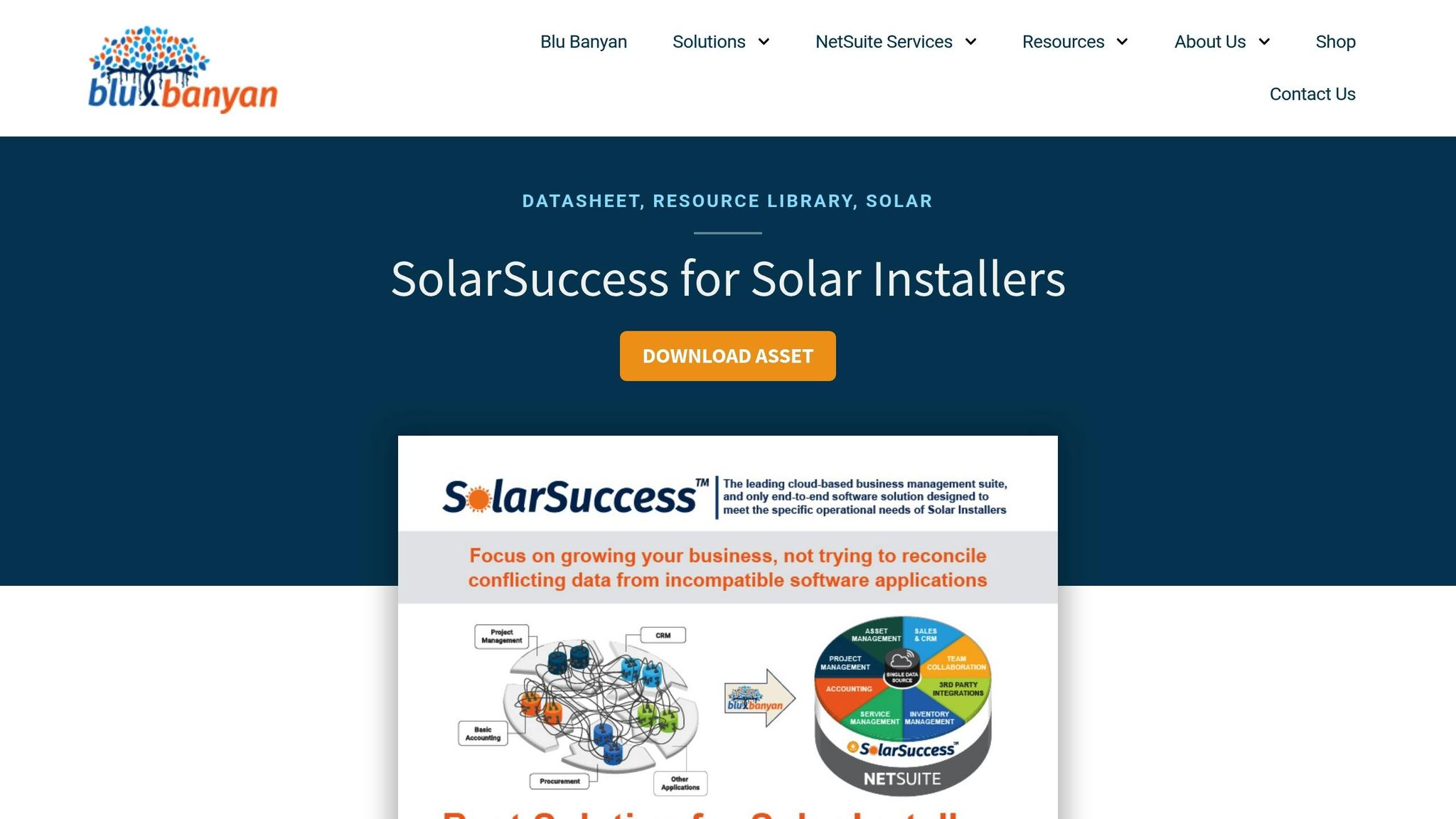
2. Solar ERP Systems (e.g., SolarSuccess by Blu Banyan)
Labor Allocation
Solar ERP systems revolutionize labor management by bringing everything – accounting, project management, CRM, and HR – under one roof. This eliminates the need for piecing together data from separate systems, saving time and reducing errors.
Take SolarSuccess by Blu Banyan as an example. It powers nearly one-third of U.S. rooftop solar installations. When Big Sun Solar adopted SolarSuccess, their operations became more efficient thanks to bluActions™, which allowed teams to coordinate in real time. This streamlined approach even earned Blu Banyan NetSuite’s Spring 2025 Solution Provider Spotlight Award.
With real-time insights into technician availability, skill sets, and labor costs, managers can make quick, informed scheduling decisions. GPS tracking and automated task assignments replace outdated methods like phone calls and spreadsheets. If project needs change or someone becomes unavailable, the system updates schedules automatically and notifies everyone involved.
Payroll is another area where automation shines. By cutting manual calculations by over 80%, payroll processing becomes faster and more accurate. Small teams using ERP systems can save up to 30% in administrative labor costs – around $90,000 annually. Instead of juggling timesheets across different platforms, automated workflows handle everything from time tracking to payroll, letting employees focus on installations rather than paperwork. And just like labor, ERP systems simplify material tracking too.
Material Allocation
Tracking materials becomes much more manageable when all operations are centralized. Solar ERP systems provide real-time visibility into inventory across all locations. Project managers can instantly check material availability, location, and delivery timelines.
For renewable energy projects, where some components have lead times of 6 to 12 months, ERP systems help planners order ahead to avoid delays without overstocking inventory. Tools like NetSuite’s Supply Planning feature account for supplier lead times and production schedules, ensuring materials arrive just in time for project needs. For instance, if a transformer requires a 6-month lead time, the system schedules the purchase order well in advance.
These systems also streamline inbound shipments by consolidating orders from multiple suppliers into single container shipments. This approach simplifies tracking and cuts per-unit freight costs. Plus, automation reduces the typical 3.6% order error rate seen with manual processes.
Joe Marhamati, Co-Founder & VP, captures the relief this brings:
"We’re doing more with the same number of people and we have a system that’s more reliable and less stressful than tracking a million different spreadsheets."
His company automated residential invoices with SolarSuccess. When a project reaches a specific construction stage, the system generates invoices automatically. The same automation applies to material ordering and tracking, ensuring no detail is overlooked.
Cost Tracking
ERP systems also refine financial management, offering real-time cost tracking that replaces outdated manual reports. By gathering data from timesheets, purchase orders, invoices, and expenses, these platforms provide up-to-date, accurate cost reports. Managers can monitor budgets instantly.
This level of visibility allows companies to address budget overruns immediately, ensuring projects remain profitable. Spencer Newman, CFO, highlights the impact:
"Our financial close was incredibly complicated and fraught with errors because we have so many subsidiaries consolidating together. That problem has almost gone away completely. We can look at all of our subsidiaries as standalones or consolidate them into our main financials. That’s been incredibly useful from a financial planning standpoint."
Financial close times are significantly reduced – from an industry average of 28 days to just 5 days, slashing the process by 82%.
Data Visibility
With labor, material, and cost tracking streamlined, a unified ERP system delivers real-time visibility across the board. A single source of truth eliminates inconsistencies that often plague manual systems. Everyone – from sales teams to executives – works from the same set of accurate, real-time data, ensuring alignment throughout the organization.
Role-specific dashboards make it easy to access relevant information. Project managers track labor and materials for their jobs, executives monitor profitability and resource use, and warehouse staff oversee inventory and shipments without sorting through unrelated data.
This real-time visibility empowers data-driven decisions across departments and locations, making coordination seamless. As businesses grow, the platform scales to handle more complex operations without requiring additional administrative resources.
Integration features link field operations with back-office systems. Mobile access allows field teams to update project statuses, log time, and check material availability directly from job sites. These updates sync instantly with the central system, keeping everyone on the same page.
SolarSuccess further enhances visibility with SuiteApps like bluChat, bluDocs, bluConnect, and bluTime. These tools enable real-time collaboration, centralized document management, and accurate time tracking – all within the same ecosystem, effectively eliminating data silos.
sbb-itb-2560759
Pros and Cons
Deciding between manual processes and solar ERP systems comes down to evaluating trade-offs in areas like labor management, material tracking, cost control, and data transparency. For solar companies, finding the right balance between simplicity and scalable efficiency is key to optimizing resources.
Manual processes might seem appealing due to their low upfront costs, but they often hide significant inefficiencies. Fragmented data, time-consuming reconciliations, and error-prone paper records can slow operations and create bottlenecks as the business grows.
Another hurdle with manual systems is the reliance on disconnected tools. Many solar companies juggle multiple incompatible applications, which leads to fragmented data and conflicting information. This forces teams to spend extra time bridging gaps, increasing operational costs. For example, financial close processes can take an average of 28 days when done manually, often involving complex and error-ridden steps.
Research from Aberdeen highlights the downside of manual processes, revealing a 3.6% order error rate. In comparison, ERP systems reduce shipping errors by 15%, offering a clear advantage in operational consistency and accuracy.
On the other hand, solar ERP systems centralize and automate operations, delivering significant efficiency gains. Companies using ERP solutions have reported cutting administrative labor by 30%, translating to annual savings of over $90,000 for small teams. Payroll processing time is slashed by more than 80%, and financial close times drop from 28 days to just 5 days – a remarkable 82% reduction. Order fulfillment speeds up by 30%, streamlining operations even further. For instance, SolarSuccess by Blu Banyan supports nearly one-third of all U.S. rooftop solar installations, showcasing the system’s impact on efficiency.
Another major benefit is real-time project visibility, which replaces outdated spreadsheet management. ERP systems allow managers to monitor labor costs – typically 10% to 30% of total installation expenses – in real time, providing alerts for potential overruns instead of discovering them weeks later.
Scalability is also a standout feature of ERP systems. Unlike manual methods, which require hiring more staff as projects increase, ERP solutions enable lean operations even during rapid growth. Features like GPS tracking and automated task assignments replace inefficient phone-based scheduling, while seamless integrations ensure that updates from the field are instantly reflected in back-office systems.
That said, adopting an ERP system isn’t without challenges. The initial investment is higher, and the transition involves a learning curve as teams adapt to new workflows and move away from familiar tools like spreadsheets. Data migration from legacy systems must also be handled carefully to maintain accuracy. For smaller companies, the upfront costs and adjustments may seem daunting, making them question whether the benefits outweigh the investment.
| Aspect | Manual Processes | Solar ERP Systems |
|---|---|---|
| Upfront Cost | Low initial investment | Higher initial cost; ROI in 12–18 months |
| Labor Scheduling | Spreadsheets and phone calls; outdated info | GPS tracking, automated updates in real time |
| Material Tracking | Paper records; easily lost or damaged | Real-time tracking across all locations |
| Order Accuracy | 3.6% error rate | 15% fewer shipping errors |
| Financial Close | 28 days average | 5 days (82% faster) |
| Payroll Processing | Manual, time-intensive | 80%+ faster through automation |
| Data Accessibility | Scattered across systems | Centralized with role-specific dashboards |
| Scalability | More staff needed as business grows | Handles growth without increasing headcount |
| Cost Tracking | Delayed, manual reconciliations | Real-time monitoring with instant alerts |
| Administrative Labor | High ongoing costs | Saves 30% ($90,000+ annually) |
For solar companies navigating a competitive market, the benefits of ERP systems are hard to ignore. The choice ultimately depends on a company’s readiness for change, growth goals, and ability to invest in long-term efficiency. While smaller operations might stick with manual methods for simplicity, the inefficiencies of these processes tend to add up over time.
Manual systems may feel convenient at first, but they often result in growing operational headaches. In contrast, ERP systems demand upfront effort but deliver measurable improvements in speed, accuracy, and profitability, setting companies up for sustainable success.
Conclusion
The comparison between manual processes and solar ERP systems paints a clear picture: efficiency and scalability favor automation. Relying on spreadsheets and disconnected systems often creates bottlenecks, drives up costs, and limits profitability as companies grow. In contrast, ERP systems offer a streamlined, automated approach to managing operations.
Take Solar ERP systems like SolarSuccess, for example. These platforms simplify workflows and eliminate repetitive tasks, leading to noticeable gains in efficiency. This shift is reshaping how solar companies manage their operations, offering tools to handle growth without the chaos.
Industry experts emphasize that automation replaces tedious manual tracking with reliable, real-time updates. The real-time visibility provided by ERP systems allows solar companies to spot and address budget issues before they escalate. With SolarSuccess supporting nearly one-third of all U.S. rooftop solar installations, its ability to handle operations at scale is well-established.
For solar companies, the choice is strategic: continue hiring more staff to manage increasing complexity or invest in automation. ERP systems often pay for themselves within 12 to 18 months, thanks to the savings and efficiency improvements they deliver. Beyond that, the benefits only grow as the business scales.
For those looking to boost scalability, efficiency, and profitability, adopting an ERP system isn’t just a cost – it’s a smart investment in the future. While the initial implementation requires commitment, the long-term rewards in accuracy, speed, and team productivity make it a game-changer for sustainable growth.
FAQs
How does a Solar ERP system like SolarSuccess streamline labor and material management compared to manual methods?
A solar ERP system such as SolarSuccess takes the hassle out of managing labor and materials by automating tasks that are often tedious and prone to mistakes when handled manually. By centralizing all relevant data, it provides real-time insights into labor schedules, resource allocation, and material inventories. This ensures teams are equipped with the right tools and materials exactly when they need them.
Key features like automated workflows, task prioritization, and built-in communication tools help streamline operations. These tools minimize miscommunication, avoid unnecessary delays, and boost overall efficiency. For solar companies, this translates to smoother collaboration, lower costs, and more precise project planning.
How can implementing an ERP system improve material tracking and reduce costs for solar companies?
Implementing an ERP system can transform how solar companies handle material tracking. By automating key processes and reducing manual errors, it offers real-time visibility into inventory levels. This means materials are allocated more effectively, helping to cut down on waste and avoid expensive delays caused by shortages or overstocking.
An ERP system doesn’t just stop at inventory management – it also simplifies labor and material workflows. By reducing the need for manual tasks, it saves time and lowers operational costs. For example, tools like SolarSuccess from Blu Banyan enable solar businesses to streamline their operations and foster better collaboration across teams, boosting efficiency and profitability.
Why should a solar company consider investing in an ERP system despite the upfront costs?
Investing in an ERP system can transform the way solar companies manage their operations. It simplifies processes, ensures smarter use of labor and materials, and boosts overall efficiency. While the upfront investment might seem steep compared to manual methods, the long-term payoff – fewer mistakes, improved resource allocation, and the ability to scale seamlessly – can result in substantial cost savings and higher profits.
With automated and centralized workflows, an ERP system offers real-time insights into critical operations. This means businesses can make quicker, well-informed decisions and respond effectively to shifting demands. In the rapidly expanding solar industry, where accuracy and streamlined processes are essential, this kind of control and transparency can make all the difference.
