
Running a solar business isn’t simple. Generic ERP systems often fall short when managing the complex workflows of solar companies. From milestone-based billing to tracking serialized inventory like solar panels and inverters, standard tools require heavy customization to meet industry needs.
Solar-specific ERP systems, like SolarSuccess by Blu Banyan, address these gaps by offering pre-configured features tailored to solar operations. These include:
- Automated invoicing tied to project milestones (e.g., design completion, installation).
- Real-time tracking of serialized inventory across warehouses and job sites.
- Built-in tools for permitting, utility interconnections, and compliance reporting.
- Integrated dashboards for solar KPIs, like installation timelines and warranty trends.
If your solar company struggles with disconnected tools and manual processes, a solar-specific ERP could improve efficiency and reduce costs. Here’s how these systems compare to generic ERPs.
Quick Comparison
| Feature | Generic ERP | Solar-Specific ERP (SolarSuccess) |
|---|---|---|
| Project Management | Basic task tracking; needs heavy customization | Pre-built solar workflows with milestone triggers |
| Inventory Management | Standard stock tracking | Real-time tracking of serialized solar equipment |
| Financial Processes | Manual milestone billing | Automated invoicing tied to solar project stages |
| Compliance Tools | Requires manual effort | Built-in tools for permitting and interconnections |
| Implementation Time | Longer due to customization | Faster with pre-configured workflows |
| Best Fit | Smaller companies with basic needs | Mid-to-large solar firms with complex operations |
For solar companies, aligning ERP features with business workflows is key to scaling efficiently. Solar-specific ERPs like SolarSuccess simplify operations by consolidating tools, automating workflows, and reducing manual errors.
1. Generic ERP Systems
Generic ERP platforms like NetSuite, SAP Business One, and Microsoft Dynamics are designed to handle core business functions such as project tracking, inventory, financials, and cross-departmental data sharing. However, these systems often fall short when it comes to managing the complex, non-linear workflows specific to the solar industry. The following sections break down how these systems perform in key areas and where they struggle to meet the unique needs of solar companies.
Project Tracking
Most generic ERPs include project management tools that allow users to create project records, assign tasks, track milestones, and compare budgets to actual costs. While this works well for linear projects, solar installations are a different story. These projects often involve multiple phases, frequent design changes, permit resubmissions, utility interconnection queues, and ongoing permit tracking with Authorities Having Jurisdiction (AHJs). Standard milestone tracking in generic ERPs can’t handle these complexities without extensive customization. Solar companies need to map out their entire project lifecycle to identify where these systems fall short and which workflows require tailored solutions. This gap is a key reason many solar businesses turn to custom-built systems.
Inventory and Procurement
Generic ERPs provide centralized inventory management, offering features like purchase order creation, vendor catalog management, reorder point settings, and supply chain tracking across warehouses. For solar contractors, this means they can monitor inventory levels for panels, inverters, racking, and other components, while managing purchase approvals and comparing vendor pricing.
Research from Blu Banyan shows that automation and integration in ERP systems have helped solar companies reduce inventory management costs by 15%. This is a big deal when dealing with thousands of solar modules and a variety of inverter models across multiple job sites.
However, generic systems often lack support for solar-specific needs, such as tracking performance attributes like wattage ratings, efficiency curves, and degradation rates. They also fall short in managing containerized shipments, serial and lot tracking for rebates, and staging inventory across dispersed job sites. While real-time inventory dashboards can lower carrying costs and improve cash flow visibility, they often require custom fields and reports to capture the data that solar operations and warranty teams rely on.
Financial Management
Generic ERPs shine in core financial tasks like managing general ledgers, accounts payable, accounts receivable, and project-based accounting. They also handle multi-entity structures, intercompany transactions, sales tax management, and standard financial reporting. When set up for project-based accounting, these systems provide tools for advanced budget forecasting, cash flow visibility, and profitability analysis, which are crucial for executive decision-making.
However, these systems typically aren’t configured to automate invoicing based on solar project milestones, such as design completion, material delivery, installation, or permission to operate (PTO). This forces many solar companies to rely on manual processes or spreadsheets. Additionally, the financial structures common in solar projects – like customer financing, rebate tracking, tax equity partnerships, and performance guarantees – require significant customization. These challenges further highlight the need for tailored solutions.
Collaboration and Analytics
Generic ERPs offer features like role-based dashboards, document storage, task assignments, and workflow approvals. These tools help departments like sales, operations, accounting, and field teams share data more effectively, eliminating duplicate entries and creating a centralized source of truth.
That said, these systems often lack native integrations with solar-specific tools like design software, permitting portals, monitoring platforms, or field service apps. Without additional integrations or third-party SuiteApps, information silos can form, limiting collaboration. Analytics in generic ERPs tend to focus on standard financial and operational metrics – such as revenue per project or inventory turnover – rather than solar-specific insights like pipeline conversion rates, installation timelines, PTO delays by jurisdiction, or warranty claim trends. To address these gaps, solar companies often need to develop custom dashboards and reports that pull data from multiple systems.
ERP consultants recommend that solar companies standardize their core processes – such as quote-to-cash, procure-to-pay, and project-to-close – before implementing a generic ERP. They suggest starting with financial and inventory modules, rolling out other features in phases, and working with vendors experienced in energy or construction industries. The goal is to avoid excessive customization early on while planning for solar-focused extensions as the business grows.
2. Solar-Specific ERP Systems (SolarSuccess by Blu Banyan)
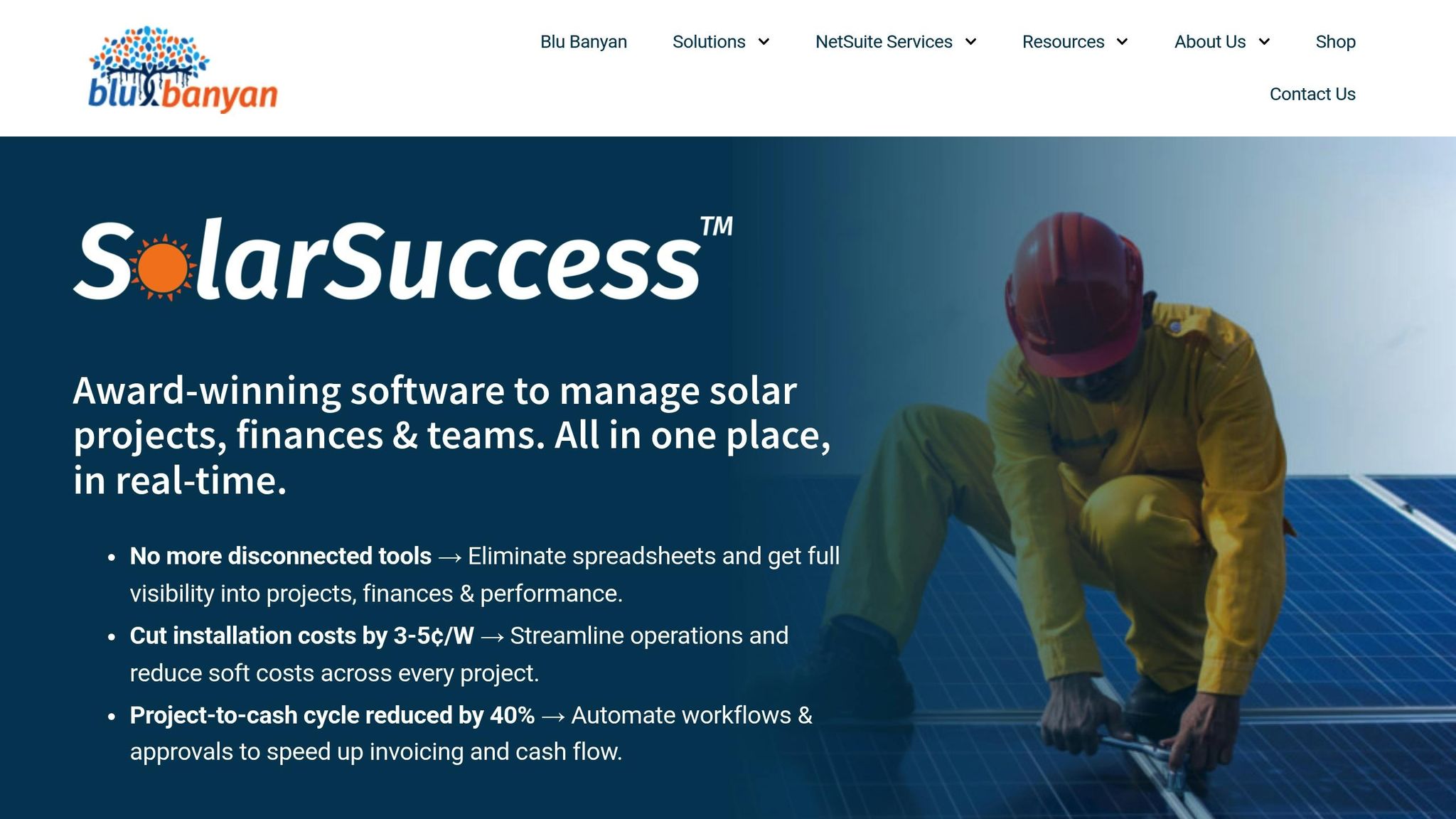
Generic ERP systems are great for general business management, but when it comes to the solar industry, they often fall short. That’s where SolarSuccess by Blu Banyan steps in. Designed specifically for solar installers, developers, and asset managers, SolarSuccess builds on NetSuite to offer pre-configured features tailored to the unique needs of solar companies. It eliminates the need for heavy customization and aligns seamlessly with how these businesses operate.
Project Tracking
SolarSuccess comes equipped with solar project lifecycles baked right into the system. It covers critical stages like site surveys, design approvals, permitting, material delivery, installation, inspection, and the all-important permission to operate (PTO). These lifecycles are paired with visual timelines that trigger key accounting events, like automatic invoicing, at the right milestones.
For example, when a project hits the design completion stage, the system can automatically generate an invoice based on your contract terms. Similarly, when materials are delivered, inventory records are updated, and associated costs flow into project accounting – cutting down on manual errors and saving time.
The platform also excels at document management, offering version control to ensure everyone is working with the most up-to-date permits, contracts, and compliance records. This is especially helpful for field crews and office staff. Aaron Casillas, Technology & Infrastructure Director at a solar company using SolarSuccess, shared:
We looked at other solutions, but NetSuite worked out best for us because it handles accounting and operational logistics items in tandem with project management really well. SolarSuccess streamlined things even further and allowed us to add our own customizations on top of NetSuite.
This level of transparency allows teams to spot potential cost overruns or delays early, giving them the chance to act – whether that means reallocating resources, expediting materials, or renegotiating schedules.
Inventory and Procurement
Managing inventory can be a headache for solar companies, but SolarSuccess simplifies it with multi-location tracking. Whether it’s a central warehouse, regional depot, truck, or job site, the system keeps tabs on where everything is. Item records capture critical details about solar components – like manufacturer, wattage, and warranty – making it easy to trace specific panels or inverters back to their purchase orders for warranty claims or performance issues.
For high-value equipment, the system supports serialized or lot tracking, which is especially useful for managing RMAs or performance claims. If an inverter malfunctions, you can quickly identify its batch, purchase date, and vendor.
On the procurement side, SolarSuccess takes the guesswork out of ordering. By connecting sales forecasts with scheduled installations, the system suggests orders based on supplier packaging and lead times. This ensures you have just the right amount of inventory – avoiding both overstocking and shortages that could delay projects.
The system also tracks vendor-specific pricing, volume discounts, and contract terms, helping buyers prioritize purchase orders based on project schedules. This level of integration reduces idle crews and unnecessary truck rolls, saving time and money. According to a Blu Banyan white paper, companies using SolarSuccess have cut inventory-related costs while improving profitability through better forecasting and purchasing controls.
Additionally, the system synchronizes Bills of Materials (BOMs) with sales orders. This ensures that what the sales team sells matches what engineering designs, procurement orders, and warehouse teams prepare for installation – eliminating costly mismatches.
Financial Management
SolarSuccess streamlines financial workflows by linking inventory processes directly to financial management. It handles complex tasks, like milestone-based invoicing, which aligns with key solar project stages such as design completion, material delivery, installation, and PTO. This automation replaces manual spreadsheet management, saving time and reducing errors.
The system also offers advanced budget forecasting, leveraging financial data to predict project costs and profitability – an essential feature for solar companies operating on tight margins. With a single source of data across all business functions, SolarSuccess eliminates the confusion that arises when sales, operations, and accounting teams work in silos. For instance, when a project manager updates a timeline, procurement and accounting are instantly in the loop. This real-time visibility improves cash flow management and helps executives make smarter decisions about resource allocation, hiring, and growth.
For companies dealing with complex financial structures – like customer financing, rebate tracking, tax equity partnerships, or performance guarantees – SolarSuccess offers the flexibility to configure workflows without starting from scratch. It’s built to handle the unique revenue recognition and compliance reporting requirements that solar businesses face when working with investors, lenders, and tax incentive programs.
Collaboration and Analytics
SolarSuccess integrates seamlessly with Blu Banyan’s SuiteApps, including bluChat for team communication, bluDocs for document management, and bluTime for time tracking. These tools work directly within NetSuite, centralizing communication and data.
- bluChat: Enables team collaboration and quick issue resolution, even via SMS for field crews.
- bluDocs: Manages document storage, tracking, and sharing so that permits, contracts, and design files are always accessible.
- bluTime: Tracks labor hours and productivity, feeding this data into project costing and payroll.
The system also delivers real-time solar KPIs like pipeline conversion rates, installation timelines, PTO delays, warranty trends, and regional project profitability. Dashboards provide a bird’s-eye view of company operations, from lead generation to final commissioning. This visibility helps identify bottlenecks, allocate resources more effectively, and uncover trends. For example, if a specific jurisdiction consistently delays permits, the system flags it, allowing you to adjust project planning accordingly.
sbb-itb-2560759
Advantages and Disadvantages
Choosing between generic and solar-specific ERP systems can be tricky. To make the right call, it’s essential to weigh how each option handles key areas like project management, inventory, financials, and implementation.
Generic ERP systems – think Acumatica or Microsoft Dynamics 365 – are built for broad business needs. They excel in financial management, scalability, and offer a robust ecosystem of third-party integrations. These platforms are ideal for companies with diverse operations and strong IT teams. They also integrate well with tools like monitoring systems and accounting software, and they support compliance with federal tax incentives like the 30% Investment Tax Credit (ITC).
But here’s the catch: generic ERPs don’t come with solar-specific workflows. Processes like PV system design, interconnection applications, or tracking solar incentives require heavy customization. This customization adds to both the setup time and ongoing maintenance costs. Without pre-configured templates for solar financial models or automated compliance checks for permitting and utility rules, errors and delays are more likely. Integration challenges, such as conflicting data or duplicated functionality, can further complicate things, requiring additional labor to resolve.
Now, let’s look at how solar-specific ERPs address these challenges.
Solar-specific ERP systems, such as SolarSuccess, are tailored for the solar industry. Built on NetSuite and enhanced by Blu Banyan, SolarSuccess includes features like visual project timelines that trigger accounting events, synchronized project BOMs on sales orders, and financial templates aligned with U.S. solar business models. These systems provide real-time inventory tracking across warehouses and job sites, solar-specific stock forecasting, and integration with distributor pricing. This level of detail helps companies avoid overstocking and project delays. Studies show that tailored solar ERPs can improve operations by up to 26%, with inventory management costs dropping by about 15% due to better visibility and coordination with suppliers.
However, solar-specific ERPs come with trade-offs. They’re built on specific platforms, which might not align with every company’s existing tech stack or budget. Smaller solar businesses with simpler needs may find the costs of licensing and implementation too high. Even for highly tailored solutions like SolarSuccess, companies with unique business models – like hybrid solar-storage developers using complex financing – may still require significant customization. There’s also the risk of vendor lock-in, though Blu Banyan leverages NetSuite’s broader ecosystem while adding solar-specific expertise.
When it comes to project management, generic ERPs provide basic tools – task tracking, resource allocation, and cost/revenue reporting – but need customization for solar-specific workflows like design approval, permitting, and interconnection. Solar-specific ERPs, on the other hand, come with pre-built templates, visual timelines linked to accounting events, and automatic BOM synchronization, which reduce errors and speed up setup.
In inventory and supply chain management, generic ERPs handle standard tasks like stock tracking, vendor management, and purchase order automation. However, they may lack features like lot and serial tracking for panels and inverters or the ability to manage direct shipments from vendors to job sites – both critical for solar projects. Solar-specific ERPs excel here, offering real-time inventory visibility, solar-specific forecasting, and distributor integration, making them better suited for managing high-value components and tight schedules.
For financial and compliance management, generic ERPs have strong general ledger and reporting capabilities but require custom development for ITC tracking and solar-specific revenue recognition. Solar-specific ERPs simplify this with pre-configured templates that automatically capture ITC-eligible costs, track profitability by project phase, and generate reports aligned with U.S. tax and regulatory requirements. They also streamline compliance with local permitting and utility rules through built-in document management and automated reporting.
Here’s a summary of the key differences:
| Aspect | Generic ERP Systems | Solar-Specific ERP Systems |
|---|---|---|
| Project Management | Basic task tracking and cost reporting; needs customization for solar workflows | Pre-built solar project templates, visual timelines, and automatic BOM synchronization |
| Inventory & Supply Chain | Standard stock tracking and vendor management; lacks solar-specific features | Real-time inventory visibility, solar-specific forecasting, and distributor integration |
| Financial Management | Strong general ledger and reporting; needs custom ITC tracking | Pre-configured templates for ITC costs, milestone invoicing, and profitability tracking |
| Compliance | Customizable but manual effort required for solar permitting and interconnection | Built-in tools for permitting, utility rules, and automated reporting |
| Implementation Time | Longer due to customization | Faster with pre-configured workflows |
| Total Cost of Ownership | Lower upfront but higher long-term customization and maintenance costs | Higher upfront but lower ongoing costs |
| Scalability | Broadly scalable across industries | Scalable within the solar sector, leveraging NetSuite’s ecosystem |
| Best For | Diversified companies or smaller solar firms with basic needs | Mid-sized to large solar EPCs, developers, and installers with complex operations |
Ultimately, the choice depends on your business size, project complexity, and long-term goals. Smaller solar firms might start with a generic ERP for basic financials and CRM, planning to customize later. Meanwhile, mid-sized and large solar companies with complex lifecycles, diverse financing needs, and strict compliance requirements will likely find solar-specific ERPs like SolarSuccess a better fit.
When evaluating options, consider how well each system supports end-to-end solar workflows – from lead generation to PTO and O&M – and how deeply it tracks project profitability by phase, per watt, and by financier. Keep in mind that while generic ERPs may seem cheaper upfront, the cost of customizations, add-ons, and maintenance can make them more expensive in the long run.
Conclusion
Selecting the right ERP system is a critical decision for any solar company aiming to grow efficiently and profitably. Throughout this discussion, we’ve explored how ERP systems can centralize project management, simplify inventory and procurement processes, enhance financial reporting, and ensure compliance with regulatory and permitting requirements. The question isn’t whether your business needs an ERP system – it’s about identifying the one that best aligns with your operations.
Generic ERP systems are versatile and provide solid capabilities in areas like accounting, inventory, and basic project management. They’re designed to work across industries, offering flexibility and scalability. However, they often require significant customization to handle solar-specific needs, such as milestone tracking, permitting workflows, and integrations with financiers.
Solar-specific ERP systems, like SolarSuccess by Blu Banyan, offer a tailored alternative. Built on NetSuite and designed specifically for U.S. solar installers and EPCs, these platforms include prebuilt features that align with the unique workflows of solar businesses. Key functionalities include per-project costing, integrated CRM and installation management, commission tracking, and real-time visibility across the solar lifecycle – from lead generation to operations and maintenance. By consolidating data and automating workflows, SolarSuccess helps reduce soft costs, eliminate redundant data entry, and streamline billing and approvals. It unifies sales, operations, and finance into a single source of truth.
For solar companies operating in a competitive and fast-evolving market, where challenges like permitting delays and fragmented data can hinder growth, a purpose-built ERP system offers a more seamless fit. SolarSuccess addresses U.S.-specific requirements, such as ITC tracking, state rebate reporting, and compliance with local permitting and utility regulations, without requiring extensive customization. Features like visual project timelines and milestone-triggered accounting events ensure that revenue recognition and cash flow align with the work performed – essential for businesses reliant on milestone-based funding and lender draw schedules.
When choosing between ERP options, it’s essential to map your entire solar workflow and evaluate how each system supports key stages. Engage teams across finance, operations, sales, and fieldwork to assess criteria such as built-in solar features, implementation timelines, total cost of ownership, and integration capabilities.
Cloud-based solar ERPs can significantly reduce soft costs by consolidating tools, improving real-time access to data, and breaking down operational silos. This leads to more accurate job costing, better resource allocation, shorter quote-to-install timelines, fewer change orders, and improved cash flow visibility. The result? Higher margins and more predictable growth.
For mid-sized to large solar companies with complex project lifecycles, diverse financing structures, and stringent compliance needs, a solar-specific ERP like SolarSuccess often delivers faster ROI and lower long-term costs compared to heavily customized generic solutions. Start by evaluating your current system’s limitations and scheduling demos with specialized vendors like Blu Banyan. Set a clear timeline – such as aligning ERP selection and implementation with your next budgeting cycle – to turn these considerations into actionable steps.
As the solar industry continues to evolve, companies are moving away from spreadsheets and disconnected tools toward integrated systems that unify CRM, project management, inventory, and accounting. Purpose-built ERPs empower solar businesses to scale effectively, protect their margins, and stay competitive in a market where operational efficiency is key to success.
FAQs
What are the advantages of using a solar-specific ERP system like SolarSuccess instead of a general ERP for a solar business?
A solar-focused ERP system, such as SolarSuccess, is built specifically to meet the demands of solar companies. It offers tools designed for tasks like project tracking, inventory management, and financial reporting. Unlike general ERP systems, it includes features tailored to the solar industry, making operations smoother and more efficient.
With all business processes unified on one platform, SolarSuccess eliminates data silos and provides real-time access to accurate information. This setup encourages better team collaboration and supports informed, data-driven decision-making, helping your solar business maintain a competitive edge.
How does SolarSuccess streamline inventory management for solar companies?
SolarSuccess is built to meet the specific inventory challenges faced by solar companies. It offers tools to efficiently monitor and manage solar equipment, components, and materials across various locations. This ensures accurate stock levels are maintained, helping to prevent delays in project schedules.
With real-time updates and a clear view of inventory, SolarSuccess enables businesses to make the most of their resources, cut down on waste, and streamline their supply chain operations. Its specialized features empower solar companies to stay on top of their projects while keeping tight control over their inventory and materials.
How does SolarSuccess simplify financial processes for solar projects, especially with milestone-based invoicing and compliance reporting?
SolarSuccess takes the hassle out of financial management for solar companies by automating intricate tasks like milestone-based invoicing and compliance reporting. Its specialized ERP features ensure invoices are created with precision and delivered on schedule, tied directly to project milestones. This helps businesses maintain a consistent cash flow while staying on top of their contractual commitments.
On top of that, the platform streamlines compliance reporting by centralizing financial data and aligning it with industry standards. This not only cuts down on manual work and reduces errors but also provides real-time insights into financial performance. With these tools, solar companies can shift their focus toward growth and improving day-to-day operations.
