

When different departments rely on disconnected tools like QuickBooks for accounting or Salesforce for CRM, data silos form, leading to mismatched information and inefficiencies. For solar and construction companies, this can hinder operations, especially when leadership lacks real-time insights. ERP systems solve this by centralizing data, automating workflows, and improving communication across teams.
Key takeaways:
- Shared Dashboards: Teams access real-time, unified data tailored to their needs.
- Real-Time Updates: Automatic syncing ensures accurate, up-to-date information.
- Integrated Workflows: Tasks transition smoothly between departments without manual intervention.
- Unified Communication Tools: Built-in or integrated messaging keeps discussions linked to relevant data.
SolarSuccess ERP, designed for solar companies, offers pre-configured tools like bluChat and real-time inventory tracking, while standard ERP systems provide flexibility but often need more customization for specific industries. For solar businesses, SolarSuccess simplifies collaboration with tools tailored to their unique challenges.
1. SolarSuccess ERP by Blu Banyan

SolarSuccess brings collaboration to the forefront, offering solar-specific tools that connect departments seamlessly. It’s no surprise that the platform supports nearly 1/3 of rooftop solar installations in the United States, showcasing its ability to address the unique demands of solar operations. One standout feature is its customizable dashboards, which help break down departmental silos.
Shared Dashboards
SolarSuccess provides every department with customizable dashboards that pull from a single source of truth. This means sales teams can monitor their pipeline, project managers can track installation progress, and finance teams can review profitability – all using the same real-time data. This approach eliminates the confusion of teams relying on conflicting data sets.
For example, project managers can use weather portlets to plan fieldwork and avoid unnecessary site visits. When Titan Solar Power adopted SolarSuccess in February 2020, Aaron Casillas, their Technology & Infrastructure Director, explained the decision:
"Sharing data across these systems was difficult, and in most cases our only way to ‘patch the holes’ was by adding labor. We wanted to get everything on one system."
This transition unified their solar project management, file storage, and accounting processes, significantly cutting down on manual tasks like partner commission payouts.
Real-Time Updates
SolarSuccess synchronizes field and office operations automatically. When a project reaches a construction milestone, related accounting events – such as generating invoices – happen without manual input. Real-time inventory tracking also connects with distributors like BayWa r.e., providing live updates on catalog items and stock availability. Joe Marhamati, Co-Founder and VP at a Blu Banyan client, shared the benefits:
"When a deal moves to a particular stage of construction, for example, SolarSuccess generates invoices based on that specific milestone. That has been the biggest advantage… we have a system that’s more reliable and less stressful than tracking a million different spreadsheets."
This system allows procurement teams to order materials just in time, ensuring project managers have accurate information before scheduling installations. This avoids frustrating situations where crews show up to a site only to find materials missing.
Integrated Workflows
The platform automates transitions between departments with tools like Project Actions and Preceding Action Automation. When one team completes its part, the system automatically alerts the next team, ensuring projects keep moving smoothly.
In 2025, Big Sun Solar adopted SolarSuccess to centralize its operations. By using bluActions™, they streamlined project execution and enabled real-time costing. This effort earned Blu Banyan the NetSuite Spring 2025 Solution Provider Spotlight Award. This centralization is a key part of improving solar projects through operational excellence. Additionally, purchase orders are automatically created based on a project’s Bill of Materials, keeping procurement aligned with project needs without the constant back-and-forth. Integrated communication tools further enhance this collaborative workflow.
Unified Communication Tools
SolarSuccess includes bluChat, a built-in communication tool that links conversations directly to project records. Unlike general messaging apps, bluChat ensures important discussions are searchable and tied to the relevant project, making them auditable when needed. This allows teams to collaborate efficiently without losing track of key information or switching between multiple platforms.
For external communications, the platform integrates with SMS tools like MessageMedia to automate updates for homeowners. This keeps customers informed about their installation progress, easing the workload on customer service teams while improving the overall customer experience.
2. Standard ERP Systems
Standard ERP systems simplify operations by centralizing data into a single, unified database. Proper NetSuite implementation ensures this transition is seamless. This setup eliminates the headaches of juggling multiple spreadsheets or disconnected software across departments like finance, HR, and operations. A 2023 Forrester survey revealed that 41% of employees lacked trust in their company’s data due to inconsistencies between separate systems. With everyone accessing the same real-time information, cross-departmental decisions become more cohesive.
Shared Dashboards
Standard ERP systems offer role-based dashboards tailored to individual team needs, much like NetSuite customizations for industry-specific solutions. These dashboards pull live data directly from the system’s modules, ensuring there’s no need for manual syncing or outdated reports. By using visual tools like charts and color-coded indicators, teams can quickly identify trends – such as a sudden rise in manufacturing costs or a dip in quality metrics. This instant insight helps teams build trust and resolve issues faster.
Interactive dashboards go a step further by allowing users to drill down into specific data points. For instance, if a cost spike appears, a manager can click through to trace it back to the precise work order or purchase responsible. This level of transparency not only fosters trust between departments but also accelerates problem-solving. Notably, dashboards have grown in importance as a business tool, climbing from 9th place in 2021 to 4th place in 2023, according to a Deloitte survey.
Real-Time Updates
Transactions are instantly synchronized across the system, keeping inventory, financial records, and shipping schedules perfectly aligned. This real-time connection eliminates the need for back-and-forth emails or phone calls to verify the latest numbers.
Real-time analytics also alert teams to issues as they arise. For example, if there’s a supply chain delay or a drop in manufacturing quality, the system sends immediate notifications. Lisa Schwarz, Senior Director of Global Product Marketing at NetSuite, emphasizes this benefit:
"Cross-departmental decisions become more aligned when everyone is using the same underlying, real-time data source".
This proactive approach helps teams address problems before they escalate, ensuring smoother operations. These real-time features rival those found in more specialized solutions, bridging gaps between departments.
Integrated Workflows
Standard ERP systems streamline repetitive tasks through automated workflows, reducing the need for manual coordination. For example, when inventory levels dip below a set threshold, the system automatically generates a purchase order and routes it to the procurement team. Similarly, approving a sales order triggers updates across accounting, inventory, and shipping – all without manual data entry.
By automating these workflows, teams can avoid bottlenecks and focus on higher-value tasks. The system enforces standardized processes – like order-to-cash or procure-to-pay workflows – ensuring consistency across departments and preventing errors or missed steps.
Unified Communication Tools
Collaboration across departments becomes even more effective with unified communication tools integrated into standard ERP systems. These systems connect seamlessly with platforms like Slack or Zoom, allowing teams to access relevant ERP data without toggling between different applications. For instance, during a discussion about a project or issue, team members can pull up related ERP records directly within their chat tool. This integration keeps conversations grounded in real data, making it easier to resolve questions and maintain context throughout discussions.
sbb-itb-2560759
Advantages and Disadvantages
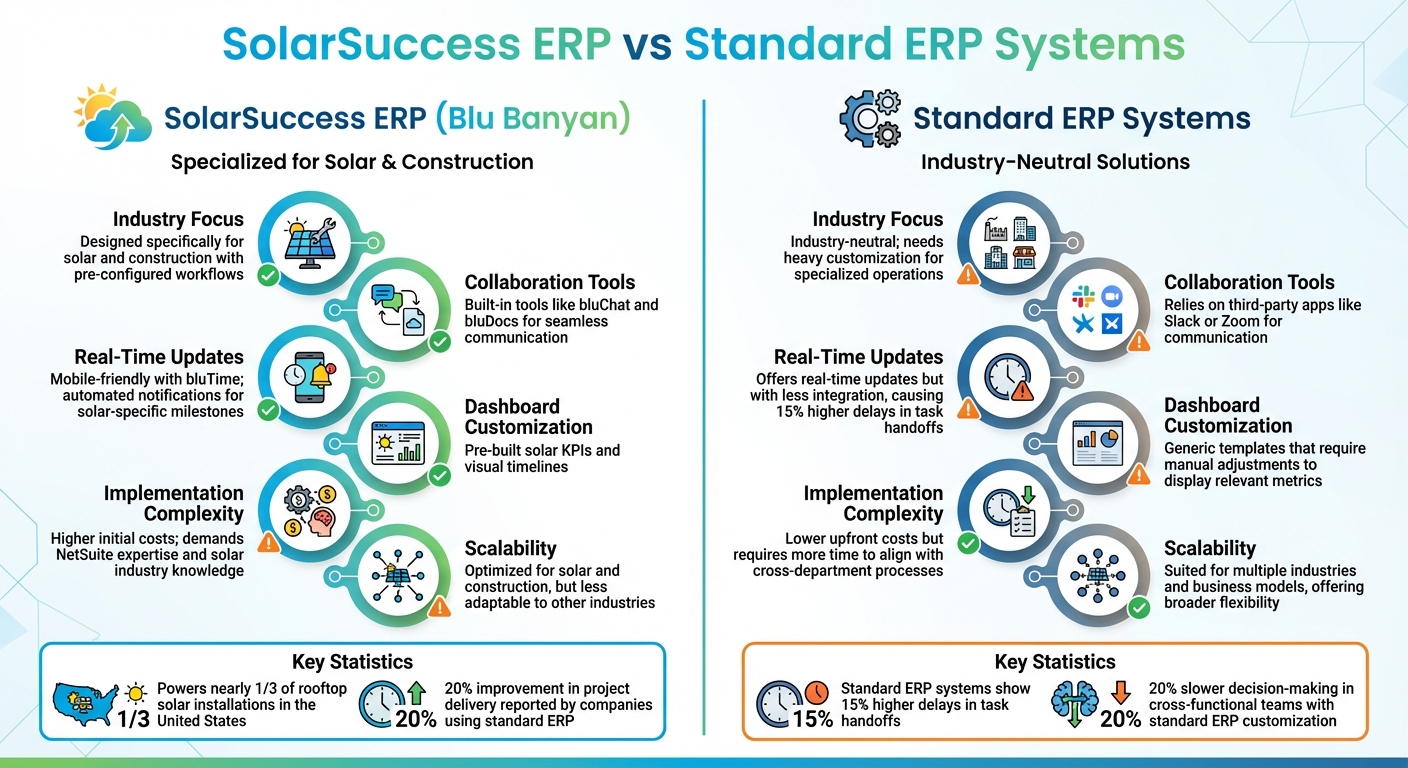
SolarSuccess ERP vs Standard ERP Systems: Feature Comparison for Solar Companies
Successful collaboration across departments relies heavily on pairing the right tools with efficient processes. While both SolarSuccess ERP and standard ERP systems offer valuable features, their ability to meet specific industry needs varies significantly. SolarSuccess ERP stands out with its tailored SuiteApps like bluChat, bluDocs, and bluConnect, which enable real-time collaboration with solar-specific metrics, such as project timelines and installer schedules. This immediate alignment between sales and operations is a key advantage.
On the other hand, standard ERP systems excel in providing centralized data access and shared dashboards that work across various industries. For instance, a mid-sized IT company reported a 20% improvement in project delivery after adopting a standard ERP system that incorporated shared workflows and real-time insights. However, these systems often require extensive customization to match the precision of industry-specific solutions. This additional customization can slow decision-making in cross-functional teams by as much as 20%.
There are clear trade-offs when it comes to implementation and scalability. SolarSuccess ERP may involve higher upfront customization costs and requires expertise in NetSuite, which could limit its appeal for companies outside the solar sector. In contrast, standard ERP systems avoid this dependency but may inadvertently create knowledge silos if departments fail to fully embrace standardized processes. Without proper integration, these systems risk leading to fragmented information and duplicated efforts – issues they are meant to resolve.
Here’s a side-by-side comparison of key features and trade-offs:
| Feature | SolarSuccess ERP (Blu Banyan) | Standard ERP Systems |
|---|---|---|
| Industry Focus | Designed specifically for solar and construction with pre-configured workflows | Industry-neutral; needs heavy customization for specialized operations |
| Collaboration Tools | Built-in tools like bluChat and bluDocs for seamless communication | Relies on third-party apps like Slack or Zoom for communication |
| Real-Time Updates | Mobile-friendly with bluTime; automated notifications for solar-specific milestones | Offers real-time updates but with less integration, causing 15% higher delays in task handoffs |
| Dashboard Customization | Pre-built solar KPIs and visual timelines | Generic templates that require manual adjustments to display relevant metrics |
| Implementation Complexity | Higher initial costs; demands NetSuite expertise and solar industry knowledge | Lower upfront costs but requires more time to align with cross-department processes |
| Scalability | Optimized for solar and construction, but less adaptable to other industries | Suited for multiple industries and business models, offering broader flexibility |
For solar companies, the choice often comes down to whether the specialized tools and efficiency of SolarSuccess ERP outweigh the adaptability of a more generic system. Joe Marhamati, Co-Founder & VP of Blu Banyan, captures this sentiment well:
"We’re doing more with the same number of people, and we have a system that’s more reliable and less stressful than tracking a million different spreadsheets".
While standard ERPs can deliver similar results, they typically demand more manual effort to coordinate across departments. These factors highlight the importance of selecting an ERP that not only addresses industry-specific needs but also strengthens team collaboration overall.
Conclusion
Successful cross-department collaboration depends on four key ERP features: shared dashboards, real-time updates, integrated workflows, and unified communication tools. Together, these elements break down the data silos that 46% of employees face when trying to locate company reports. For industries like solar and construction – where projects involve everything from procurement and installation to invoicing – a centralized system is essential. This unified approach creates an environment where departments can work seamlessly, paving the way for systems tailored to industry needs.
Take SolarSuccess ERP by Blu Banyan, for example. This platform offers solar-specific tools that standard ERP systems can only replicate through heavy customization. Its automated invoicing and specialized features help teams stay aligned and streamline data sharing. Currently, SolarSuccess powers nearly one-third of rooftop solar installations in the U.S., proving its value in managing the intricate workflows that define the solar industry.
While general ERP systems are designed for flexibility across various sectors, they often rely on third-party integrations for communication and lack prebuilt workflows tailored to solar companies. Tasks like tracking equipment, maintaining financier connectivity, and monitoring project-specific KPIs in real time often require additional customization. SolarSuccess, on the other hand, provides these capabilities right out of the box, delivering precision without the extra work.
For solar and construction companies aiming to improve efficiency, industry-specific ERPs like SolarSuccess offer quicker implementation and better departmental alignment. These systems are purpose-built to handle the unique challenges of renewable energy projects. As Lisa Schwarz from Oracle NetSuite highlights:
"Cross-departmental decisions become more aligned when everyone is using the same underlying, real-time data source".
By choosing integrated platforms over a patchwork of disconnected applications, companies can significantly improve project delivery times and team productivity.
The right ERP doesn’t just connect teams – it automates workflows, ensures smooth handoffs, and turns project goals into actionable results.
FAQs
How does SolarSuccess ERP enhance collaboration across departments?
SolarSuccess simplifies collaboration across departments with shared, real-time dashboards and integrated workflows. These tools ensure everyone operates from a single, reliable source of truth. The platform also includes bluChat, a built-in feature that enables instant communication, alongside an integrated CRM and pre-configured third-party tools that keep data and updates effortlessly in sync.
By enhancing communication and keeping teams aligned, SolarSuccess minimizes manual errors and boosts efficiency. It’s a powerful solution for promoting seamless teamwork in the solar and construction industries.
How do real-time updates in an ERP system improve collaboration and efficiency?
Real-time updates in an ERP system ensure that every team has instant access to the most current and accurate information. This level of visibility minimizes delays, speeds up decision-making, and enhances collaboration across departments.
With immediate access to data, businesses can move faster on critical tasks like project timelines, invoicing, and resource allocation. This not only shortens project completion times but also helps cut operational costs. By breaking down information silos, teams can collaborate more efficiently, leading to smoother workflows and a noticeable boost in overall productivity.
What makes SolarSuccess ERP a better choice for solar companies compared to standard ERP systems?
SolarSuccess ERP is built to meet the distinct demands of solar companies, offering features that cater specifically to their workflows. With tools like automated purchase orders, equipment job costing, and custom pick-tickets, it goes beyond the capabilities of generic ERP systems. The platform also includes real-time dashboards and supports seamless third-party integrations, helping to break down data silos and improve overall efficiency.
By addressing the unique challenges of the solar industry, SolarSuccess enables companies to streamline their operations, cut down on soft-cost inefficiencies, and gain clearer insights into their projects. All of this is delivered through a cloud-based system designed to support both growth and teamwork.
