
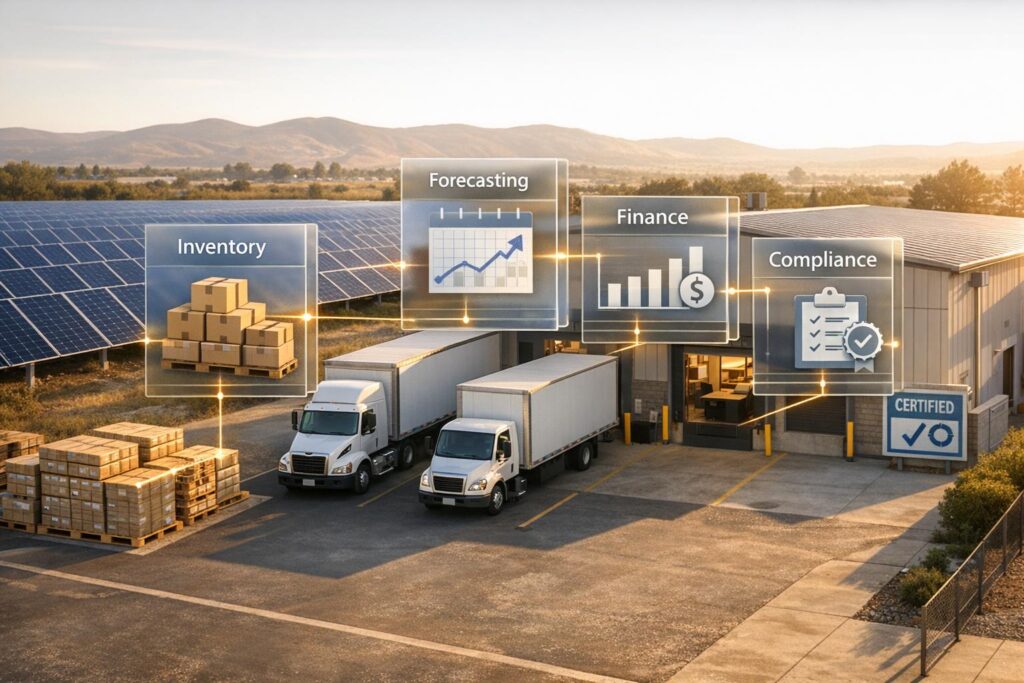
Solar companies face a major challenge: managing complex supply chains while reducing costs. Soft costs, like permitting and labor, make up 64-65% of a solar system’s total price. Relying on disconnected tools like spreadsheets and outdated software slows operations, increases errors, and makes compliance with regulations harder.
Solar ERP systems, such as Blu Banyan‘s SolarSuccess, solve these issues by centralizing data into one platform. This allows teams to track inventory, forecast demand, and manage finances in real time. For example, Titan Solar Power reduced labor costs and improved project timelines after adopting SolarSuccess.
Key benefits include:
- Real-time inventory tracking: Avoid stock shortages or overstocking.
- Accurate forecasting: Use live data to predict demand instead of outdated reports.
- Financial control: Automate job costing and invoicing for better cash flow.
- Simplified compliance: Centralize documentation to meet regulatory demands.
While implementation may involve upfront costs, the long-term savings and efficiency gains make Solar ERP systems a smart choice for solar businesses looking to stay competitive.
1. Traditional Supply Chain Management Methods
Many solar installers rely on a patchwork of tools – like QuickBooks for accounting, Salesforce for customer management, and spreadsheets to fill in the gaps. The problem? These systems don’t talk to each other. This lack of communication forces procurement, accounting, and sales teams to work in silos, creating inefficiencies that highlight the need for integrated ERP solutions. Implementing solar ERP software is the first step toward bridging these gaps.
Real-Time Inventory Tracking
When data is scattered across disconnected systems, it distorts both operational and financial insights. For example, BOM (bill of materials) data often sits isolated in the CRM, leaving procurement teams to guess order volumes. This guesswork can lead to overstocking, which drives up insurance costs because premiums are based on average inventory value. On the flip side, poor visibility can also result in stock shortages, delaying installations and frustrating customers.
Demand Forecasting
The absence of real-time data doesn’t just affect inventory – it also throws demand forecasting off track. Traditional forecasting methods lean on outdated historical reports, often months or years old. By the time these reports are reviewed, the information is already stale. This lag prevents procurement teams from effectively managing supply chain disruptions or sudden changes in solar hardware availability, leaving them stuck in a reactive mode instead of planning ahead.
Financial Control
Manual data entry adds another layer of inefficiency, especially when transferring information between incompatible tools. Teams often spend hours updating spreadsheets, which in turn compromises financial oversight. For instance, project costs – like equipment expenses, labor hours, and material costs – are often spread across multiple systems. By the time accounting teams review these figures, they’re outdated, making accurate job costing nearly impossible.
Compliance and Traceability
Fragmented systems also make compliance and traceability a challenge, increasing operational risks. In the U.S., solar companies must navigate a maze of permitting authorities, each with its own inspection requirements. Traditional methods like manual audits and periodic certifications struggle to keep up with real-time regulatory demands. When project documentation, supplier certifications, and quality records are scattered across unconnected systems, proving compliance during an inspection can turn into a last-minute scramble. Additionally, without automated traceability, it’s tough to verify the origins of battery components, leaving companies vulnerable to environmental and ethical concerns tied to second- and third-tier suppliers.
2. Solar ERP Solutions (Blu Banyan‘s SolarSuccess)

SolarSuccess simplifies operations by centralizing data from various departments into one unified system. Built on Oracle NetSuite, it provides a single, real-time database that streamlines processes across procurement, accounting, and sales. By eliminating data silos, it ensures teams can collaborate effectively without guessing inventory needs.
Real-Time Inventory Tracking
This platform connects directly with distributors like BayWa r.e., bringing live catalog updates and stock availability into the system. Once a project’s Bill of Materials (BOM) is finalized, SolarSuccess automatically generates purchase orders and sends them to suppliers. It also facilitates single-click cycle counts and tracks inventory across multiple locations, ensuring each project has the materials it needs.
The impact of this integration is clear. For example, in February 2020, Titan Solar Power, the third-largest residential solar installer in the U.S., adopted SolarSuccess to replace its project management and accounting systems. Under the leadership of Technology & Infrastructure Director Aaron Casillas, the company consolidated its operations into one platform. This shift resulted in reduced labor for commission payouts, faster installations, and the launch of a homeowner "install portal" where customers could monitor project progress in real time.
Financial Control
Streamlined inventory management translates directly into better financial oversight. SolarSuccess automates invoicing, revenue recognition, and job costing as project milestones are completed. Equipment costs are tracked as materials are allocated, offering leadership instant insights into project profitability. Additionally, the platform supports just-in-time ordering, which keeps projects on schedule while minimizing excess inventory and improving cash flow.
"With NetSuite, we’ve significantly decreased the amount of labor involved in paying out our partners and made that process very consistent across the board."
- Aaron Casillas, Technology & Infrastructure Director, Titan Solar Power
Compliance and Traceability
Adhering to regulations is a crucial aspect of managing a unified supply chain, and SolarSuccess excels in this area. The platform integrates with the AHJ Registry to identify specific building, electrical, and fire codes required for each project location. It also supports the "Orange Button" initiative, which standardizes data across the solar industry, making information exchange smoother throughout the project lifecycle.
With built-in document management and version tracking, teams can ensure that project plans remain up to date during the approval process. The platform provides complete visibility into the supply chain, covering preferred vendors, order status, and inbound goods. This level of traceability ensures that every component can be tracked back to its source, significantly reducing compliance risks.
sbb-itb-2560759
Advantages and Disadvantages
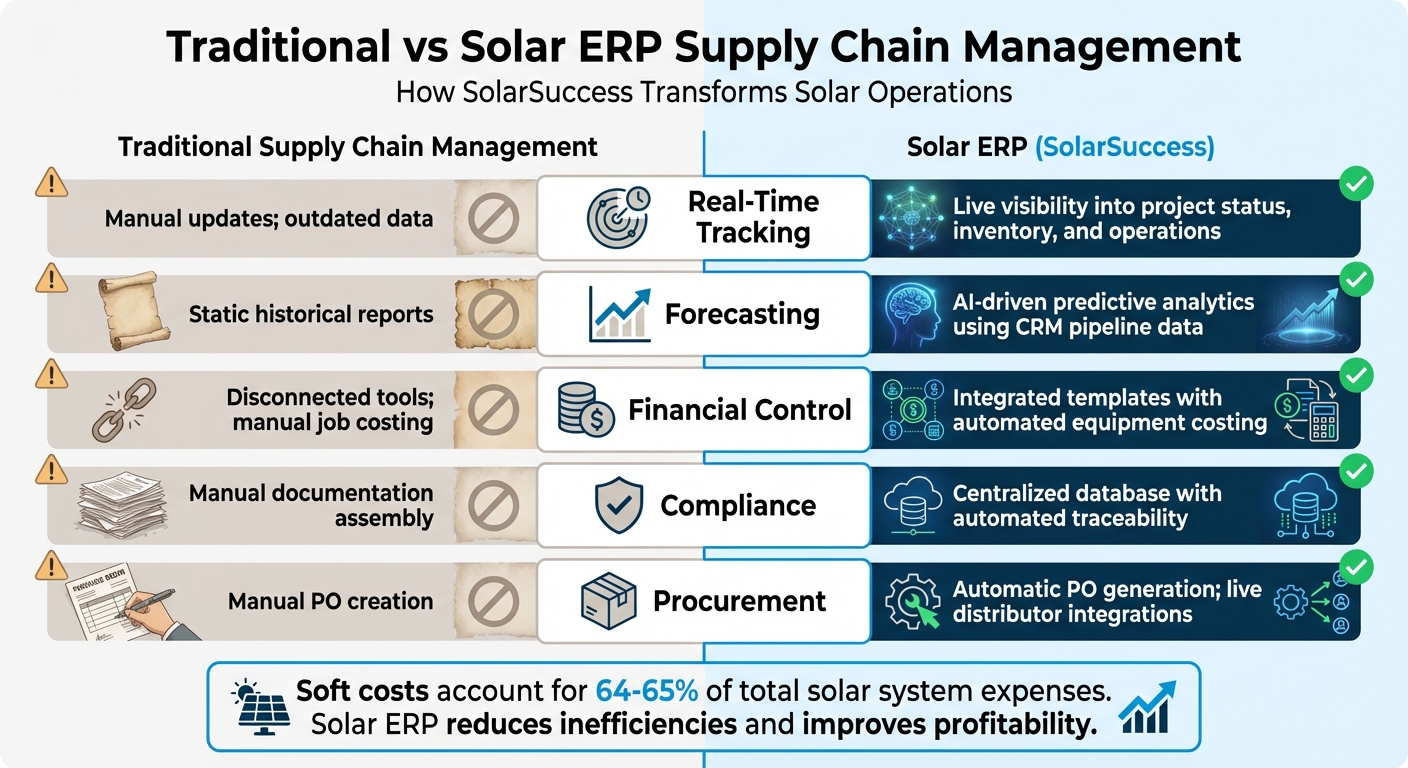
Traditional vs Solar ERP Supply Chain Management Comparison
When comparing traditional supply chain methods to SolarSuccess, the differences are clear. Traditional systems often rely on disconnected tools, leaving teams to work with fragmented data. This creates inefficiencies, as detailed earlier. On the other hand, Solar ERP solutions like SolarSuccess offer a centralized platform where all departments access the same real-time data. This setup streamlines operations with automated workflows, reducing the need for manual data entry.
One standout feature of SolarSuccess is its mobile accessibility. Field teams can update milestones directly from their devices, automatically triggering accounting events without needing to return to the office. Additionally, the platform integrates with distributors to provide live catalog updates. Its AI-driven analytics go a step further by using CRM pipeline data to forecast demand, replacing outdated static reports. These advancements improve order fulfillment and tracking throughout the supply chain.
However, implementing SolarSuccess does come with challenges. Transitioning to the system involves upfront costs and may temporarily disrupt workflows. Solar companies must carefully weigh these short-term hurdles against the long-term benefits of increased visibility and efficiency. Many businesses opt for phased rollouts and thorough demos to ensure the platform aligns with their needs.
Here’s a quick comparison of traditional methods versus SolarSuccess:
| Feature | Traditional Supply Chain Management | Solar ERP (SolarSuccess) |
|---|---|---|
| Real-Time Tracking | Manual updates; outdated data | Live visibility into project status, inventory, and operations |
| Forecasting | Static historical reports | AI-driven predictive analytics using CRM pipeline data |
| Financial Control | Disconnected tools; manual job costing | Integrated templates with automated equipment costing |
| Compliance | Manual documentation assembly | Centralized database with automated traceability |
| Procurement | Manual PO creation | Automatic PO generation; live distributor integrations |
With soft costs accounting for as much as 64% of total solar system expenses, inefficiencies in operations can significantly impact profitability. The advantages of Solar ERP – such as real-time tracking, predictive forecasting, and streamlined procurement – address these pain points. By enabling just-in-time ordering, SolarSuccess helps reduce excess inventory while keeping projects on schedule.
Conclusion
Managing supply chain visibility is crucial for solar companies aiming to reduce soft costs, which can account for up to 65% of a project’s total budget. Relying on outdated tools like scattered spreadsheets and incompatible software often leads to inefficiencies that hurt profitability. Solar ERP solutions, such as SolarSuccess, tackle these issues by offering a centralized platform where real-time data seamlessly connects every department.
Take Skyline Smart Energy, for example – they cut their financial close process from six weeks to just two weeks while saving 10% on costs and 10–15% on labor. Similarly, Titan Solar Power significantly streamlined their partner commission payouts after adopting SolarSuccess in early 2020, as noted by their Technology & Infrastructure Director, Aaron Casillas. These examples demonstrate the tangible benefits of integrated ERP systems for solar companies.
For businesses still relying on fragmented tools, the solution is straightforward. Implementing a solar-specific ERP like SolarSuccess eliminates data silos, automates workflows triggered by milestones, and provides the visibility needed to stay competitive. Improved order tracking and fulfillment lead to faster installations and lower operational expenses. The initial investment quickly pays off through reduced labor costs, quicker financial closes, and the ability to scale without adding complexity.
As the solar industry grows rapidly, companies sticking to outdated supply chain management methods risk falling behind. SolarSuccess offers the tools and features needed for modern solar operations, from AHJ registries to automated BOM synchronization. By integrating order fulfillment and tracking, it enhances efficiency across inventory management, forecasting, financial oversight, and compliance. Moving beyond spreadsheets is no longer optional – it’s the key to achieving the scalability and efficiency that SolarSuccess delivers.
FAQs
How does a Solar ERP improve order tracking from BOM to delivery?
A Solar ERP simplifies order tracking by centralizing real-time supply chain data, covering everything from the Bill of Materials (BOM) to final delivery. By integrating procurement, inventory, production, and logistics, it ensures automated updates while minimizing errors. Tools like live dashboards and mobile access keep teams informed about order status, allowing them to address bottlenecks quickly. This streamlined approach ensures timely fulfillment and boosts efficiency across the entire order lifecycle, from initial planning to delivery.
What data is needed for accurate demand forecasting in Solar ERP?
Accurate demand forecasting within Solar ERP hinges on a mix of critical data points. Internally, this includes historical sales records, current inventory levels, and project-specific details. Externally, factors like market trends, consumer behavior, and macroeconomic conditions play a vital role.
By analyzing these inputs, Solar ERP systems can fine-tune processes such as resource allocation, procurement, and inventory management. This not only boosts operational efficiency but also helps avoid common pitfalls like overstocking or inventory shortages – issues that can significantly impact solar operations.
How long does it take to implement SolarSuccess without disrupting installs?
Implementing SolarSuccess usually takes anywhere from several weeks to a few months. The timeline largely depends on how complex your business requirements are. The system is built to integrate seamlessly without disrupting any ongoing installations, allowing your operations to continue without a hitch during the transition.
