
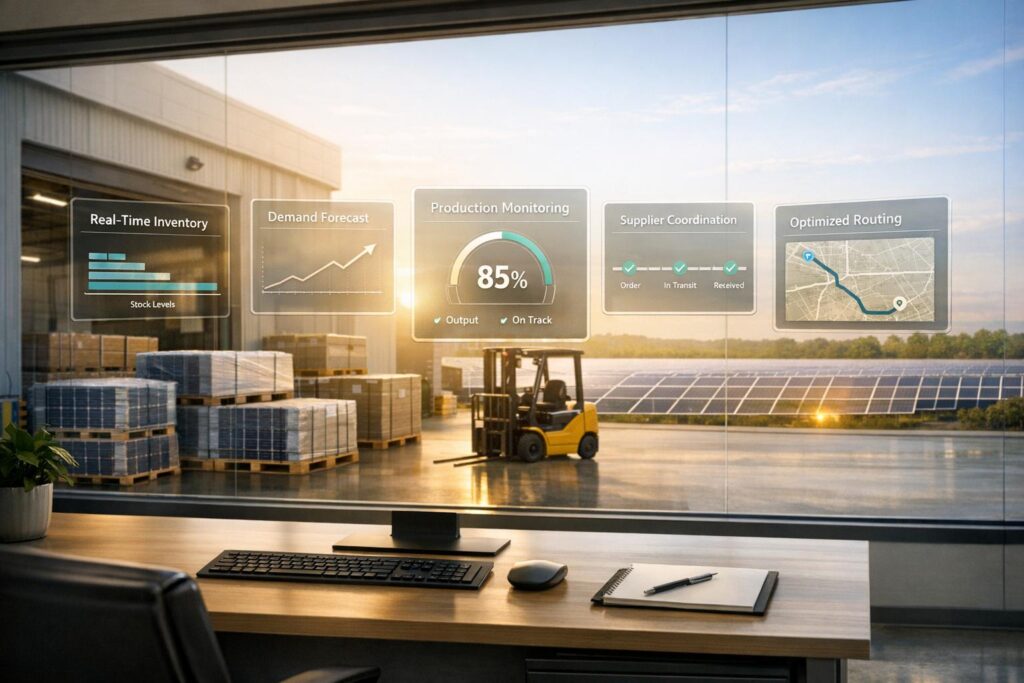
Solar ERP systems are transforming how solar companies handle supply chain challenges by reducing waste, cutting costs, and improving efficiency. Here’s how these systems help:
- Real-Time Inventory Tracking: Avoid overstocking and obsolescence with just-in-time (JIT) delivery and automated purchase orders.
- Demand Forecasting: Use data analytics to predict material needs accurately, reducing excess inventory and waste.
- Production Monitoring: Track materials and equipment in real time to minimize scrap and improve resource use.
- Supplier Coordination: Streamline communication with vendors to reduce errors, optimize packaging, and track sustainability metrics.
- Route Planning: Optimize logistics to cut fuel use, consolidate shipments, and manage recycling efforts.
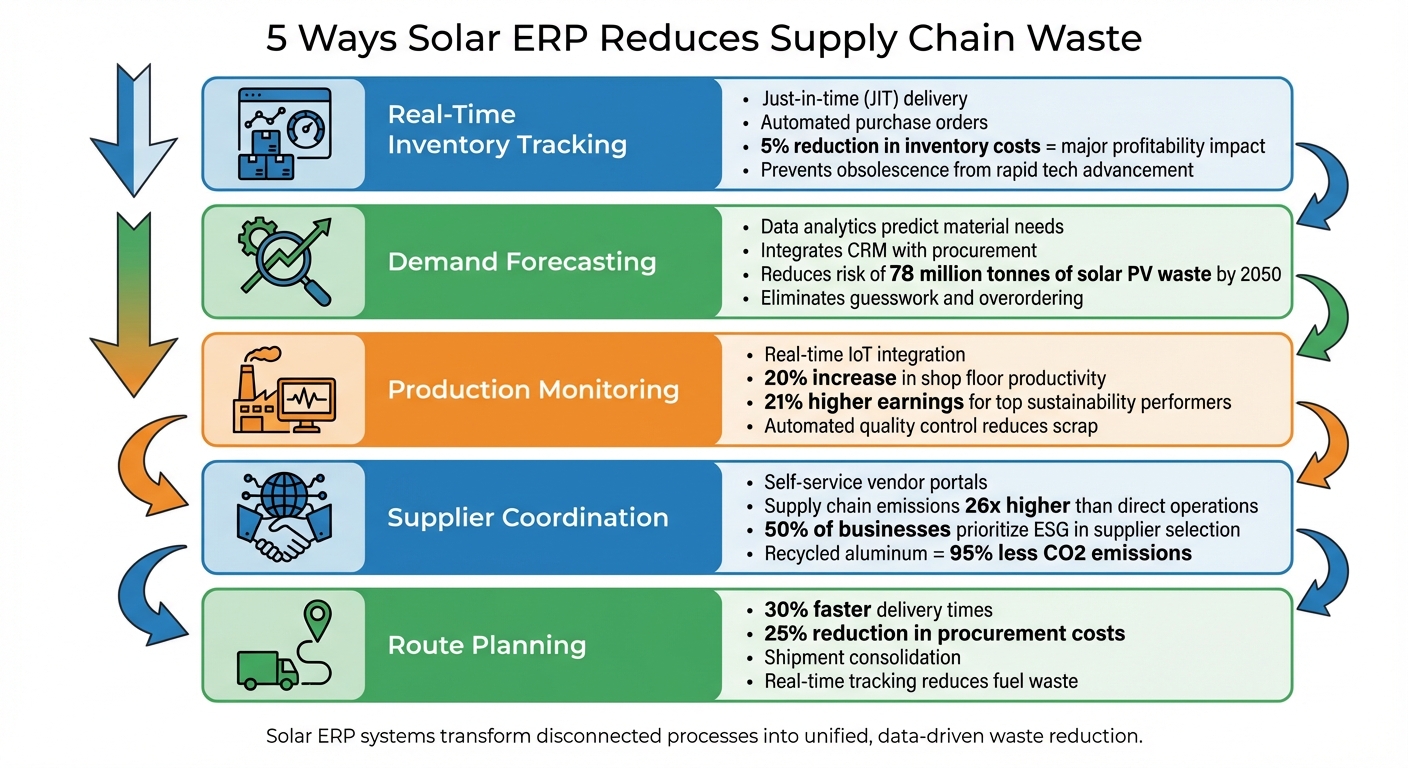
5 Ways Solar ERP Systems Reduce Supply Chain Waste
1. Real-Time Inventory Tracking and Just-in-Time Delivery
Solar ERP systems offer real-time visibility into inventory across all locations. This means you can instantly check the exact quantity of panels, inverters, and other components on hand. By syncing the project Bill of Materials (BOM) with inventory data, these systems can automatically generate purchase orders for only the necessary items, cutting out guesswork and reducing waste.
This real-time tracking also supports just-in-time (JIT) ordering. Instead of stockpiling materials, components arrive precisely when needed for specific projects. This approach minimizes storage time, lowers insurance costs, reduces overhead, and improves cash flow – a win-win for efficiency and budgeting.
The solar industry faces a unique challenge: rapid advancements in technology. With panel efficiency and battery storage improving quickly, holding onto older stock can lead to obsolescence. JIT management helps mitigate this risk by ensuring orders align with the latest technology, further reducing waste.
Some ERP platforms take it a step further by directly integrating with distributor catalogs. This allows real-time stock checks and pricing updates. These systems also analyze inventory needs across current and upcoming projects, factoring in seasonality and historical trends to suggest precise purchases. Since materials account for a significant portion of project costs, even a small 5% cut in inventory expenses can have a big impact on profitability.
To maintain accuracy, regular cycle counts are crucial. These reconcile digital records with physical stock, preventing issues like phantom shortages. For example, Blu Banyan‘s SolarSuccess ERP demonstrates how cloud-based tools simplify inventory management, ensuring efficient use of materials and freeing up working capital.
sbb-itb-2560759
2. Accurate Demand Forecasting with Data Analytics
Guesswork in predicting material needs often results in unnecessary waste. Solar ERP systems tackle this issue by analyzing historical data, seasonal trends, and sales pipeline insights to pinpoint exactly what materials are needed and when. This precision helps avoid overordering and the risks of outdated inventory.
The solar industry has its own set of challenges – rapid technological advancements and sudden price drops are common. As Ranga Bodla, Industry Lead for Wholesale Distribution at NetSuite, explains, "Unanticipated price drops can force solar businesses to sell at below cost". In such unpredictable conditions, accurate forecasting becomes essential to safeguard profitability. By connecting predictive analytics with CRM data, solar ERP systems further refine procurement strategies.
One of the standout features of modern solar ERPs is their ability to integrate CRM data directly with procurement planning. This integration enables purchasing teams to base material orders on real, upcoming projects rather than rough estimates. The system reviews the Bill of Materials across all active and planned projects, offering a clear and consolidated view of required components.
The benefits of precise forecasting go beyond just inventory management. It significantly reduces the risk of generating obsolete inventory and cuts down on waste disposal costs – an increasingly important factor given the projection of 78 million tonnes of solar PV waste globally by 2050. With this level of visibility, procurement shifts from being reactive to proactive, ensuring your inventory aligns with cutting-edge technology that customers expect.
3. Production Monitoring and Material Efficiency
Keeping an eye on production in real time helps manufacturers spot and eliminate waste faster. When ERP systems link up with shop floor machinery via IoT integration, they gather live data on equipment health and material usage. This real-time visibility makes it easier to catch inefficiencies, like machines running below their potential or materials being overused.
Combining MES (Manufacturing Execution Systems) with ERP creates a full picture of the production process. By tracking materials at every stage, manufacturers can pinpoint exactly where scrap is being produced. Steve Bieszczat, Chief Marketing Officer at DELMIAWorks, explains: "ERP systems are proving effective in automating audits and compliance reports that quickly identify where and why gaps occur". These automated insights highlight specific areas where resources are being wasted or where production is falling short of efficiency goals.
Built-in quality control systems add another layer of efficiency by catching defects during production. This allows for immediate fixes, cutting down on scrap. When paired with Material Requirements Planning (MRP), ERP and inventory management systems ensure material levels are kept as low as possible while still meeting production demands – especially critical in the fast-evolving world of solar component technology.
The financial benefits of these monitoring tools are hard to ignore. Machine intelligence in ERP systems can increase shop floor productivity by 20%. On a broader scale, 80% of business leaders report that sustainability efforts help lower costs, and companies with the strongest sustainability practices see 21% higher earnings compared to their less proactive peers. Real-time data displayed on screens or mobile devices keeps shop floor teams informed about production performance and material usage goals. This level of insight also improves supplier coordination and streamlines logistics throughout the supply chain.
4. Supplier Coordination and Responsible Sourcing
Improving production efficiency is only part of the puzzle – working closely with suppliers is just as crucial in cutting waste. Building strong supplier relationships can significantly reduce waste in solar supply chains. Modern ERP platforms make this easier by offering self-service portals where vendors can access real-time data like specifications, delivery schedules, and packaging requirements. This streamlined communication reduces errors and ensures smoother operations. Additionally, automating purchase orders with precise quantities and materials helps suppliers deliver exactly what’s needed while cutting down on excess packaging.
The numbers speak for themselves. For instance, 50% of businesses say that improving their ESG (Environmental, Social, and Governance) profile is their top priority when choosing new suppliers. And supply chain emissions? They’re a staggering 26 times higher than a company’s direct operational emissions. By embedding environmental metrics – like greenhouse gas emissions and water usage – into procurement tools, ERP systems allow solar companies to evaluate suppliers not just on cost but also on sustainability. This dual focus on cost-effectiveness and environmental impact leads to further reductions in waste, especially through packaging collaboration.
Another major advantage is optimizing packaging. ERP systems help manufacturers and suppliers team up on sustainability-focused designs, reducing container materials, switching to biodegradable options, and eliminating wasted shipment space. Solar projects often generate waste beyond the panels themselves, including wooden pallets, crates, cardboard, and leftover cables. ERP-driven planning can even pinpoint local recycling facilities for these materials before a project kicks off.
The financial upside of sustainability is hard to ignore. Companies with the strongest sustainability programs report 21% higher earnings compared to those in the lowest-performing quartile. And consumers? They’re willing to pay 2% to 10% more for products with transparent supply chains. As Steve Bieszczat, Chief Marketing Officer at DELMIAWorks, puts it:
"Sustainability and profitability go hand in hand".
Modern ERP systems also come with track-and-trace capabilities, monitoring materials throughout their lifecycle to ensure compliance with environmental and safety standards. This level of visibility helps solar companies verify that suppliers are using recycled aluminum, which emits up to 95% less carbon dioxide than virgin aluminum. Automated audits further help identify gaps in sustainability performance.
Blu Banyan’s SolarSuccess ERP is a great example of how this integrated approach works. It streamlines supplier coordination, slashes waste, and enhances sustainability across the solar supply chain.
5. Route Planning and Transportation Efficiency
Optimizing logistics is just as important as improving production when it comes to cutting down supply chain waste. Poorly managed transportation not only wastes resources but also adds to carbon emissions.
Modern ERP systems address these issues head-on by improving delivery routes and streamlining transportation planning. By working with logistics partners, these systems enable features like planned route monitoring and real-time tracking. The result? Deliveries are dispatched on time, mileage is reduced, and fewer trucks are needed – leading to lower fuel consumption and a smaller carbon footprint for every project installation.
Another way ERP systems improve logistics is through shipment consolidation. By analyzing inventory across multiple projects, they enable bulk deliveries that minimize packaging waste and cut freight costs. For instance, a leading solar manufacturer in India adopted a specialized solar ERP and saw delivery times improve by 30% while procurement costs dropped by 25%.
ERP platforms also tackle installation waste, managing items like pallets, crates, and cardboard by coordinating on-site recycling efforts. This reduces landfill use and lowers the frequency of waste hauling.
When it comes to reverse logistics, ERP systems shine by managing the collection of end-of-life panels with a certified chain of custody. Their track-and-trace capabilities help pinpoint inefficiencies, such as trucks idling or taking suboptimal routes. According to ECI Solutions, ERP systems provide visibility into the supply chain, empowering companies to make smarter decisions and improve coordination. For solar companies with installations spread across large regions, this level of control is crucial for reducing transportation-related waste.
Blu Banyan’s SolarSuccess ERP takes things a step further by enhancing route planning and real-time tracking throughout the supply chain. This integration underscores how Solar ERP systems support waste reduction from start to finish.
Conclusion
Solar ERP systems are revolutionizing supply chain management for the solar industry by reducing waste and improving efficiency. Instead of relying on disconnected spreadsheets and outdated software, solar installers can now access a unified platform where procurement, accounting, and sales teams work seamlessly with real-time data.
These systems help cut inventory costs while minimizing environmental impacts. By optimizing procurement and logistics, Solar ERP reduces material obsolescence risks and trims expenses. As Blu Banyan highlights, "With a huge portion of your project costs sitting in the inventory and materials that go into the project, even modest discounts (5%) to your inventory costs can have huge impacts on project profitability". Automated workflows not only free up staff for higher-value tasks, like sourcing sustainable materials, but also enable just-in-time delivery to lower warehousing emissions. Route optimization further reduces fuel use, while improved demand planning prevents overproduction and material waste.
For solar companies grappling with surging demand and shrinking margins, adopting cloud-based ERP is no longer optional – it’s critical. Jan Rippingale, CEO of Blu Banyan, underscores this necessity:
"When you’re working with incompatible, incomplete, out-of-date data, it can turn into a nightmare pretty quickly. To improve efficiency and profitability, solar installers must have real-time visibility into their entire end-to-end businesses".
FAQs
How quickly can a solar ERP reduce supply chain waste?
A solar ERP helps cut down supply chain waste by automating tasks like inventory management and procurement. This simplifies workflows, boosts efficiency, and speeds up decision-making, resulting in visible improvements in a relatively short time.
What data is needed for accurate demand forecasting in a solar ERP?
Accurate demand forecasting in a solar ERP system relies on several key data points: current inventory levels, outstanding purchase orders, and historical sales trends. It’s also essential to factor in seasonal demand shifts, sales velocity, and project timelines, as these can significantly impact resource planning.
By integrating real-time data – such as updates on project progress and supply chain hurdles – forecasts become more aligned with actual operational needs. This approach helps minimize waste, streamline procurement processes, and ensure inventory is readily available for solar installation projects.
How does a solar ERP support recycling and end-of-life panel returns?
A solar ERP simplifies the recycling and return process for decommissioned photovoltaic (PV) components, such as modules, electronics, and batteries. By automating tasks like segregation, chain-of-custody tracking, and coordinating with vendors, it ensures efficient operations while meeting compliance requirements. It also facilitates reverse logistics, offers real-time inventory tracking, and provides detailed reporting. These features help companies minimize waste, recover valuable materials, and meet industry standards for eco-friendly decommissioning.
