
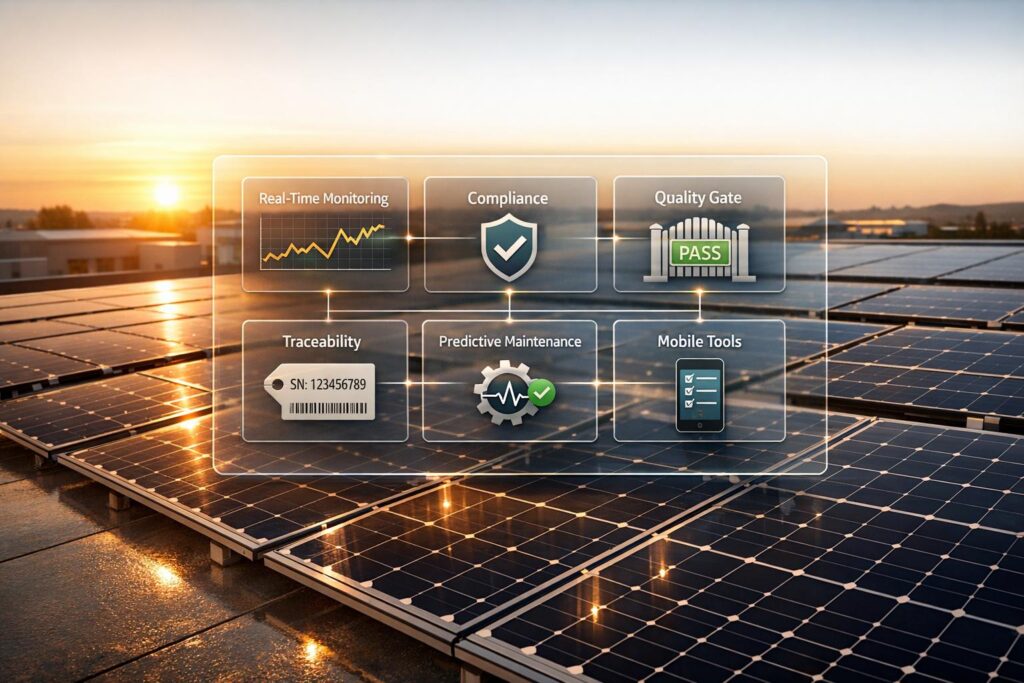
Modern solar installation companies face growing challenges: disconnected tools, manual errors, and regulatory complexities. Unified ERP systems solve these problems by integrating critical functions like accounting, project management, CRM, and inventory tracking. This article highlights key ERP features that improve quality control, reduce inefficiencies, and ensure compliance for solar projects:
- Real-Time Monitoring: IoT sensors and centralized dashboards provide instant updates on solar site performance, reducing delays and errors.
- Automated Compliance Tracking: Simplifies regulatory reporting and ensures permits and certifications are managed without hassle.
- Quality Gates: Enforces standards at every project phase, preventing premature task advancement and costly rework.
- Inventory Traceability: Tracks materials from procurement to installation, ensuring the right components are used.
- Predictive Maintenance: Uses AI and historical data to plan maintenance, reducing downtime and operational costs.
- Mobile Tools: Field technicians can log tasks and inspections instantly, improving accuracy and efficiency.
- Centralized Documentation: Consolidates permits, reports, and records into one system, eliminating data silos.
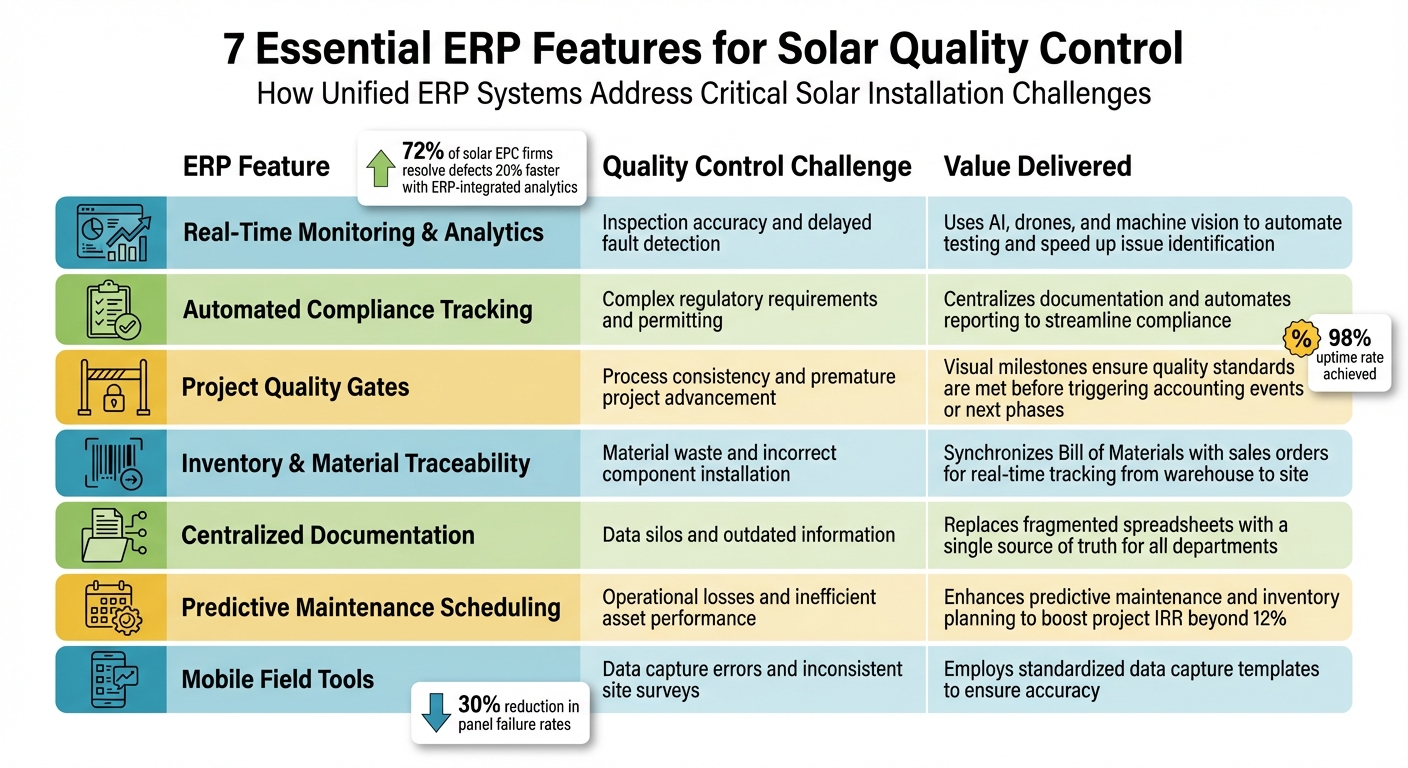
7 Essential ERP Features for Solar Quality Control
1. Real-Time Quality Monitoring and Inspection Data Analytics
Enhances Real-Time Visibility
Modern ERP systems leverage IoT sensors and SCADA systems to provide live updates on critical metrics – like power output, temperature, and voltage – across solar sites. These metrics are displayed on centralized dashboards, allowing field managers to oversee operations remotely. This capability is especially useful for managing large-scale, distributed solar installations.
By moving away from manual spreadsheets to integrated platforms, delays caused by disconnected systems are eliminated. Real-time syncing of inspection data ensures that quality control teams can access updates on panel performance and potential defects instantly through mobile apps. This quick access significantly reduces delays in identifying and addressing issues. According to a 2024 SEIA survey, 72% of solar EPC firms using ERP-integrated analytics reported resolving defects 20% faster. This streamlined data flow not only speeds up defect detection but also enables proactive maintenance planning.
Improves Operational Efficiency
Real-time analytics are revolutionizing how teams handle quality issues. By combining historical and live data, AI and machine learning can predict potential defects such as microcracks or hotspots. This predictive capability improves first-pass yield by 15–25%, and data from 500 GW of installations shows it helps achieve a 98% uptime rate.
In addition to defect prediction, real-time performance metrics support smarter maintenance scheduling, reducing downtime and cutting material waste. A 2023 NREL report on PV reliability highlights that failure rates for solar panels can decrease by as much as 30% with these systems in place. Teams also monitor key metrics like Mean Time to Detect (MTTD) and Mean Time to Repair (MTTR), fostering a cycle of continuous improvement that optimizes resource use across projects.
Supports Quality Assurance Across Solar Installations
Advanced inspection tools such as drones, thermal imaging, and Automated Optical Inspection (AOI) systems integrate seamlessly with ERP platforms. These tools feed standardized defect classifications directly into the system, while mobile apps enable field workers to upload barcodes or photos in real time, ensuring instant data synchronization.
"Drones, AI, and machine vision reduce solar soft costs by cutting inspection labor, speeding fault detection, and shortening permitting timelines." – Blu Banyan
Blu Banyan’s SolarSuccess ERP exemplifies this integration, featuring real-time monitoring modules with SCADA connections. The platform provides a single source of truth for maintaining consistent quality standards throughout installation and operations. Its live dashboards, complete with GIS mapping, enable teams to quickly identify anomalies in panel output or inverter efficiency. This ensures full traceability, from individual components to entire systems, promoting long-term reliability and performance.
sbb-itb-2560759
2. Automated Compliance Tracking and Regulatory Reporting
Ensures Compliance and Regulatory Adherence
Solar projects come with a hefty load of paperwork – permits, certifications, and other compliance documents. ERP systems simplify this by centralizing all compliance-related data, cutting down on manual errors. These systems also handle regulatory reporting automatically and integrate smoothly with subsidy platforms, enabling companies to submit documentation, track subsidy approvals, and generate agency-specific reports without hassle.
With features like complete audit trails and centralized tracking for permits and certifications, ERP systems ensure nothing slips through the cracks. They also automate tax compliance and sustainability disclosures, reducing the chances of missed deadlines or incomplete paperwork that could lead to penalties or delays. This automation provides a clear, real-time view of compliance activities, keeping projects on track.
Enhances Real-Time Visibility
To meet quality control goals, ERP systems offer centralized dashboards that provide instant insights into compliance status across all installations. Managers can easily spot gaps, keep tabs on inspection schedules, and monitor equipment calibration at various sites. Tools like Blu Banyan’s SolarSuccess consolidate data from different departments into a single, unified platform, replacing fragmented systems with real-time project and compliance updates.
"Solar ERP centralizes inventory, forecasting, finance, and compliance to reduce soft costs and improve supply chain visibility." – Blu Banyan
Visual project timelines with automated milestone triggers ensure compliance tasks are tracked as they happen. For instance, when a project hits milestones like "Permit Approved" or "Inspection Passed", the system sends alerts and creates accounting events automatically. Document version control ensures everyone accesses the latest, compliant versions of necessary paperwork. This level of transparency integrates compliance seamlessly into the project lifecycle.
Improves Operational Efficiency
Automation plays a key role in speeding up solar projects by minimizing the manual work tied to compliance documentation. Advanced technologies like AI, drones, and machine vision further accelerate fault detection and permitting processes. Mobile ERP tools enable field technicians to log tasks and upload compliance data in real time, syncing on-site operations with back-office systems.
This instant data flow supports faster milestone billing and financial closing, while cutting down on the labor-intensive aspects of manual paperwork. ERP systems also enforce quality checkpoints, requiring specific compliance or inspection data before moving to the next project phase. This prevents costly rework and ensures standards are consistently met. By automating these processes, solar companies can maintain efficiency while avoiding compliance-related setbacks.
3. Project Management with Quality Gates
Quality gates in ERP systems bring more order and precision to project management, ensuring high standards are met at every step.
Supports Quality Assurance Across Solar Installations
In solar installations, quality gates act as checkpoints during key phases like pre-installation inspections, component checks, installation milestones, and post-installation testing. These gates ensure that no step moves forward unless it meets the required standards. By automating the creation, tracking, and verification of work orders, ERP systems streamline this process across various projects.
SolarSuccess ERP tools often include project management features that enable detailed planning, execution, and monitoring. These modules provide real-time insights into costs, schedules, and resource allocation. By enforcing a strict sequence of tasks and notifying team members instantly, these systems ensure projects stay on track.
Enhances Real-Time Visibility
With quality gates, stakeholders gain a centralized view of multiple tasks and their statuses across different projects. Automated dependency tracking ensures that each phase only begins once all prerequisites are completed. This level of real-time visibility helps managers spot potential delays and address them before they escalate.
"Preceding Action automation also provides visibility into project progress, enabling project managers to identify potential bottlenecks and take corrective action promptly." – Blu Banyan
Dashboards that update in real-time replace the scattered and often confusing methods of using spreadsheets or isolated systems. This synchronization minimizes errors and keeps everyone aligned on project progress.
Improves Operational Efficiency
Automation within quality gates eliminates the need for manual tracking, cutting down delays and reducing errors. The system automatically recognizes when one task is complete and initiates the next, creating a smoother workflow. For solar EPC companies operating on tight margins, this efficiency is crucial. Maintaining high standards while scaling operations can have a direct impact on profitability.
"Automation removes errors in identifying task completions, ensuring accurate task sequencing and project timelines." – Blu Banyan
4. Inventory and Material Traceability
Keeping track of materials from procurement to installation is a cornerstone of maintaining quality in solar projects. ERP systems equipped with detailed traceability features allow companies to monitor every critical component at the serial and batch level. This level of oversight ensures that the components specified in the Bill of Materials (BOM) are the exact ones installed on-site. Below, we’ll explore how traceability supports quality control at every stage.
Supports Quality Assurance Across Solar Installations
Serial and batch-level traceability plays a big role in quality assurance during solar installations. By identifying defective components and tracing them back to their original batch, recurring issues can be avoided. ERP systems assign materials directly to specific projects and track their movement using Goods Received Notes (GRNs) at each site. This systematic tracking not only aids in logging defects but also ensures that only compliant materials are used. Additionally, this detailed mapping integrates with real-time dashboards, offering a clear view of inventory levels while complementing quality checks.
Enhances Real-Time Visibility
Solar ERP systems centralize data from sales, accounting, and warehouse operations, creating a unified source of information. Inventory levels, consumption rates, and material locations are updated instantly, giving teams a complete view of live project inventory, incoming goods, and materials at specific sites. This visibility is essential for verifying the quality of materials delivered to project locations. Real-time integration with distributors further simplifies the process by providing live updates on catalog items, stock levels, and shipment details directly within the ERP system. This eliminates the need for manual updates across spreadsheets and ensures accurate material data throughout the project lifecycle.
Ensures Compliance and Regulatory Adherence
Batch-level traceability in ERP systems helps companies maintain audit-ready records, making compliance with renewable energy standards more manageable. These systems connect with external reporting tools for tasks like generation data and subsidy management, reducing compliance risks. Every major component can be traced back to its manufacturer and linked to its specific installation site – a critical feature for managing warranties and meeting safety standards. Serialized inventory tracking further ensures that every installed component is fully documented, simplifying audits and reducing regulatory challenges.
Improves Operational Efficiency
ERP systems synchronize the BOM with sales orders, ensuring that the exact components specified during the design phase are procured and installed. This eliminates costly rework and additional trips caused by material mismatches. Automated demand planning uses historical and project-specific data to suggest purchases, aligning material availability with project timelines. The system also streamlines cycle counts, reduces stock discrepancies, and enables just-in-time ordering, keeping projects on schedule without overstocking. For solar EPC companies operating on tight margins, these efficiencies can significantly impact profitability by improving forecasting and material management, potentially boosting project Internal Rate of Return (IRR) beyond 12%.
Blu Banyan’s SolarSuccess ERP showcases these capabilities, offering advanced traceability tools that simplify inventory management and ensure quality control at every stage of a solar project. Learn more at Blu Banyan.
5. Preventive and Predictive Maintenance Scheduling
In solar ERP systems, maintenance scheduling goes beyond the basics. It combines automated preventive checks with predictive analytics derived from IoT and SCADA data, helping forecast and avert equipment failures. These strategies align seamlessly with quality monitoring and automated workflows, ensuring smooth operations.
Supports Quality Assurance Across Solar Installations
Automated maintenance scheduling keeps track of maintenance history and organizes tasks to avoid downtime across sites. By tying maintenance tasks to project milestones – like post-installation checks before handover – the system enforces quality checks to confirm that panels and systems meet performance benchmarks throughout their lifespan. For example, if an inverter’s performance dips below a set threshold, the ERP can automatically schedule an inspection, ensuring quick action to prevent further issues.
Enhances Real-Time Visibility
ERP dashboards offer live updates on maintenance schedules, asset conditions, and predictive alerts. This allows teams to monitor efficiency drops or inverter issues instantly across multiple locations and address problems before they affect energy output. When integrated with SCADA systems, the ERP creates what Blu Banyan refers to as a "single source of truth" for equipment performance data. This centralized system enables managers to quickly spot underperforming assets and allocate skilled labor where it’s most needed.
Such real-time insights streamline resource planning and automate work orders, keeping operations running smoothly.
Improves Operational Efficiency
Features like automated work order creation, better resource allocation, and mobile field execution help reduce downtime and human errors, cutting operational delays by up to 30%. The ERP system also predicts the need for replacement parts, aligns inventory with project timelines, and ensures minimal disruption – critical for maintaining operational flow. As Blu Banyan emphasizes:
"Automating routine tasks enhances efficiency, reduces errors, and ensures that projects are completed on time and within budget".
Ensures Compliance and Regulatory Adherence
To support quality monitoring, automated documentation within maintenance scheduling strengthens compliance efforts. ERP systems track inspection schedules, calibration logs, and warranty details, generating reports that are audit-ready for safety and environmental standards. This means solar companies can quickly identify compliance risks, enforce standardized procedures, and maintain records required for renewable energy regulations. Every maintenance activity is logged and traceable, simplifying audits and reducing the risk of penalties for non-compliance – essential for companies navigating strict regulatory landscapes.
6. Centralized Documentation and Quality Assurance Workflows
Centralizing documentation within a single platform brings order to the chaos of scattered files and mismatched systems, which often disrupt solar installation workflows. By consolidating permits, contracts, inspection reports, and warranty records into one ERP system, every team member can access up-to-date information. This approach eliminates the risk of losing critical data and ensures everyone operates on the same page.
Enhances Real-Time Visibility
Centralized ERP systems bring together monitoring data, field reports, and customer feedback in one database, offering instant insights into project quality. For instance, the SolarSuccess ERP solution – used in nearly one-third of all rooftop solar installations in the U.S. – features customizable dashboards that track project milestones and quality metrics in real time. With cloud-based access, authorized personnel can review inspection data anytime, anywhere, enabling quicker resolution of issues.
Ensures Compliance and Regulatory Adherence
These systems simplify compliance by automating statutory reporting and organizing key records like inspection schedules, calibration logs, and permits in one place. This streamlined approach reduces the complexity of audits and regulatory adherence. Blu Banyan highlights this benefit, stating that centralized platforms create "a single source of truth for procedures, automating statutory reporting and maintaining audit-ready records to lower compliance risk". By extending this structure to field operations, companies can ensure consistent quality control.
Supports Quality Assurance Across Solar Installations
Mobile integration adds another layer of efficiency, allowing field teams to log quality checks directly into the ERP system. This reduces manual errors and ensures data accuracy. A great example comes from Big Sun Solar, which underwent a shift in Spring 2025 when Aaron Casillas, Technology & Infrastructure Director, implemented SolarSuccess to unify previously fragmented systems.
Improves Operational Efficiency
Automated workflows reduce redundant tasks like manual data entry, leading to increased productivity. Ipsun Solar, for instance, linked its residential invoices to construction milestones within its centralized ERP, streamlining operations. Co-Founder & VP Joe Marhamati shared:
"We’re doing more with the same number of people and we have a system that’s more reliable and less stressful than tracking multiple spreadsheets."
Integrated tools like bluDocs further enhance efficiency by providing direct access to quality records from project files. This minimizes the time teams spend searching for information. Features like version control ensure that installers always use the most current designs and standards, reducing errors and avoiding costly rework caused by outdated documentation.
7. Mobile Field Work Execution and Data Capture
Mobile ERP systems bring a new level of efficiency to field operations by enabling real-time execution and data capture. Field technicians can use these tools to handle work orders and perform quality inspections directly on-site, cutting out manual processes and reducing errors from transcription delays. With access to real-time project details and work order information, technicians can respond quickly and accurately while avoiding duplicate data entry. These mobile capabilities effectively extend the advantages of centralized ERP systems to field operations, ensuring a seamless flow of information.
Enhances Real-Time Visibility
Mobile data capture keeps field activities in sync with the central ERP system, providing instant updates that allow managers to resolve on-site issues immediately. Cloud-based access ensures that authorized team members can monitor progress, review inspection results, and track resource usage from anywhere. This visibility helps identify bottlenecks quickly and supports better decision-making on the go.
Ensures Compliance and Regulatory Adherence
Mobile ERP applications make it easier for field teams to follow compliance protocols while on-site. Tasks like safety checks, environmental assessments, and inspection schedules can be managed more effectively, ensuring that all requirements are met. Automated alerts for risks and compliance violations further reduce the likelihood of errors, while accurate documentation – complete with timestamps – keeps everything on record and audit-ready.
Improves Operational Efficiency
By automating tasks like work order creation, tracking, and billing, mobile interfaces help reduce administrative burdens, allowing technicians to focus on their core responsibilities, such as maintaining installation quality. Features like barcode scanning, integrated into mobile apps, ensure accurate tracking of inventory and materials during field operations. This reduces waste, improves traceability, and keeps workflows running smoothly, all while maintaining consistent quality standards across different project sites.
Supports Quality Assurance Across Solar Installations
Mobile ERP integration strengthens quality assurance processes by giving field technicians access to real-time performance data and analytics. This allows them to quickly identify and address quality issues during installations. Comprehensive data capture – covering equipment condition, performance metrics, and photographic evidence – is directly fed into the ERP system, creating detailed, audit-ready records. These records not only enhance quality control but also support future maintenance planning. By streamlining the capture of accurate and consistent information, companies can better plan predictive maintenance strategies and improve quality tracking across all installations.
Solutions like Blu Banyan’s SolarSuccess ERP highlight how mobile capabilities can revolutionize field operations, particularly in solar installations, by enhancing efficiency, compliance, and quality control.
Feature Comparison Table
Each ERP feature addresses a specific challenge in quality control for solar installations. By understanding how these features tackle real-world issues, you can better prioritize which capabilities align with your operational needs.
The table below connects ERP features to their respective quality control challenges and highlights the benefits they offer. For example, real-time monitoring and analytics leverage AI and drones to detect faults faster, cutting down on the high labor costs tied to manual inspections. Similarly, automated compliance tracking simplifies navigating complex permitting processes, which can account for as much as 64% of a new solar system’s total cost.
| ERP Feature | Quality Control Challenge | Value Delivered |
|---|---|---|
| Real-Time Monitoring & Analytics | Inspection accuracy and delayed fault detection | Uses AI, drones, and machine vision to automate testing and speed up issue identification |
| Automated Compliance Tracking | Complex regulatory requirements and permitting | Centralizes documentation and automates reporting to streamline compliance |
| Project Quality Gates | Process consistency and premature project advancement | Visual milestones ensure quality standards are met before triggering accounting events or next phases |
| Inventory & Material Traceability | Material waste and incorrect component installation | Synchronizes Bill of Materials with sales orders for real-time tracking from warehouse to site |
| Centralized Documentation | Data silos and outdated information | Replaces fragmented spreadsheets with a single source of truth for all departments |
| Predictive Maintenance Scheduling | Operational losses and inefficient asset performance | Enhances predictive maintenance and inventory planning to boost project IRR beyond 12% |
| Mobile Field Tools | Data capture errors and inconsistent site surveys | Employs standardized data capture templates to ensure accuracy |
This breakdown highlights how a unified ERP solution can address critical aspects of solar quality control. Blu Banyan’s SolarSuccess ERP integrates these features seamlessly, eliminating data silos and reducing manual errors. With real-time data synchronization and actionable insights, it strengthens quality control processes across the board.
Conclusion
Investing in a robust ERP system is a game-changer for navigating the tight margins and intricate demands of solar projects. The features discussed here work together to reduce errors and ensure installations meet quality standards on the first attempt.
To put it into perspective, these integrated tools can increase panel efficiency by 12% through built-in testing and quality control metrics. They also have the potential to push project internal rates of return (IRR) beyond 12%, delivering measurable financial benefits. This shift – from juggling fragmented spreadsheets to embracing scalable, streamlined operations – positions companies for long-term success.
As the solar industry leans further into digital transformation, adopting solar-specific ERP solutions provides a distinct advantage. Aaron Casillas, Technology & Infrastructure Director, highlights the importance of integration in overcoming inefficiencies:
"Solar installation has many moving parts, all generating soft costs, and there is no single application that solves them all, because you have to address inefficiencies across all functions of the entire company… SolarSuccess streamlined things even further and allowed us to add our own customizations on top of NetSuite."
For solar companies looking to elevate their quality control processes, Blu Banyan’s SolarSuccess offers a tailored ERP solution built on Oracle NetSuite. Currently powering nearly one-third of rooftop solar installations in the United States, it delivers real-time insights, automated workflows, and industry-specific tools to ensure quality at every project stage. These capabilities not only simplify operations but also provide a competitive edge in an ever-evolving market.
A well-designed ERP system transforms quality control from a reactive task into a proactive strength. With centralized data, automated compliance tracking, and mobile-friendly tools, your team can focus on delivering top-tier installations instead of wasting time on disjointed processes. By tackling inefficiencies head-on, a solar-specific ERP solution paves the way for scalable growth and unmatched quality in the solar industry.
FAQs
Which ERP features are most important for solar quality control?
When it comes to maintaining high standards in solar quality control, certain ERP features can make a big difference. These include:
- Real-time insights: This allows teams to monitor quality metrics and detect issues as they arise, ensuring quick responses and minimizing delays.
- Centralized data management: By keeping all quality-related data in one place, it’s easier to track, analyze, and share information across departments.
- Automation of compliance and reporting tasks: Automating these processes reduces manual errors and ensures that regulatory requirements are met without extra hassle.
- Integrated collaboration tools: These tools help teams work together seamlessly, improving communication and coordination during quality control processes.
Together, these features boost accuracy, streamline operations, and enable proactive decision-making, all of which lead to better results for solar installations.
How does an ERP help with solar permitting and audits?
An ERP simplifies solar permitting and audits by bringing all compliance data into one place and automating critical tasks. It keeps tabs on permit requirements, inspection schedules, and key regulatory deadlines, sending alerts before anything expires. With real-time dashboards and reporting, you get instant insights into compliance status, making it easier to meet deadlines and stay audit-ready. This not only minimizes manual mistakes but also boosts efficiency and ensures all essential documents are well-organized and easy to find.
What data should field crews capture in a mobile ERP app?
Field teams should use a mobile ERP app to gather essential details such as status updates, photos, and signatures. This approach allows for real-time communication and ensures precise documentation of work progress. Teams can upload photos of installations or maintenance tasks, update task statuses, and capture signatures for approvals or job completion. These features help streamline project tracking, maintain quality standards, and improve coordination between field workers and office staff.
