

When solar companies need to connect their systems, they often face two choices: custom APIs or pre-built integrations. Each option has its strengths and limitations, and the right choice depends on your business’s workflows, budget, and technical resources.
- Custom APIs offer complete control and flexibility, tailored to specific needs. They’re ideal for unique workflows or legacy systems but require more time, technical expertise, and higher upfront costs.
- Pre-Built Integrations are ready-made solutions designed for common tools and workflows. They’re faster to implement, cost less initially, and require minimal technical skills, but they lack the customization of APIs.
Quick Comparison
| Factor | Custom APIs | Pre-Built Integrations |
|---|---|---|
| Initial Cost | $20,000–$100,000+ | $5,000–$15,000 |
| Ongoing Cost | Internal maintenance | $50–$10,000/month |
| Implementation | Weeks to months | Minutes to hours |
| Flexibility | Fully tailored | Standardized |
| Maintenance | Requires in-house or external | Vendor-managed |
| Technical Skills | High | Low |
If your business relies on unique processes or specialized tools, custom APIs might be the best fit. For standard workflows and popular software, pre-built integrations are often sufficient, saving time and effort. Assess your needs, resources, and long-term goals to choose the right solar software for your business.
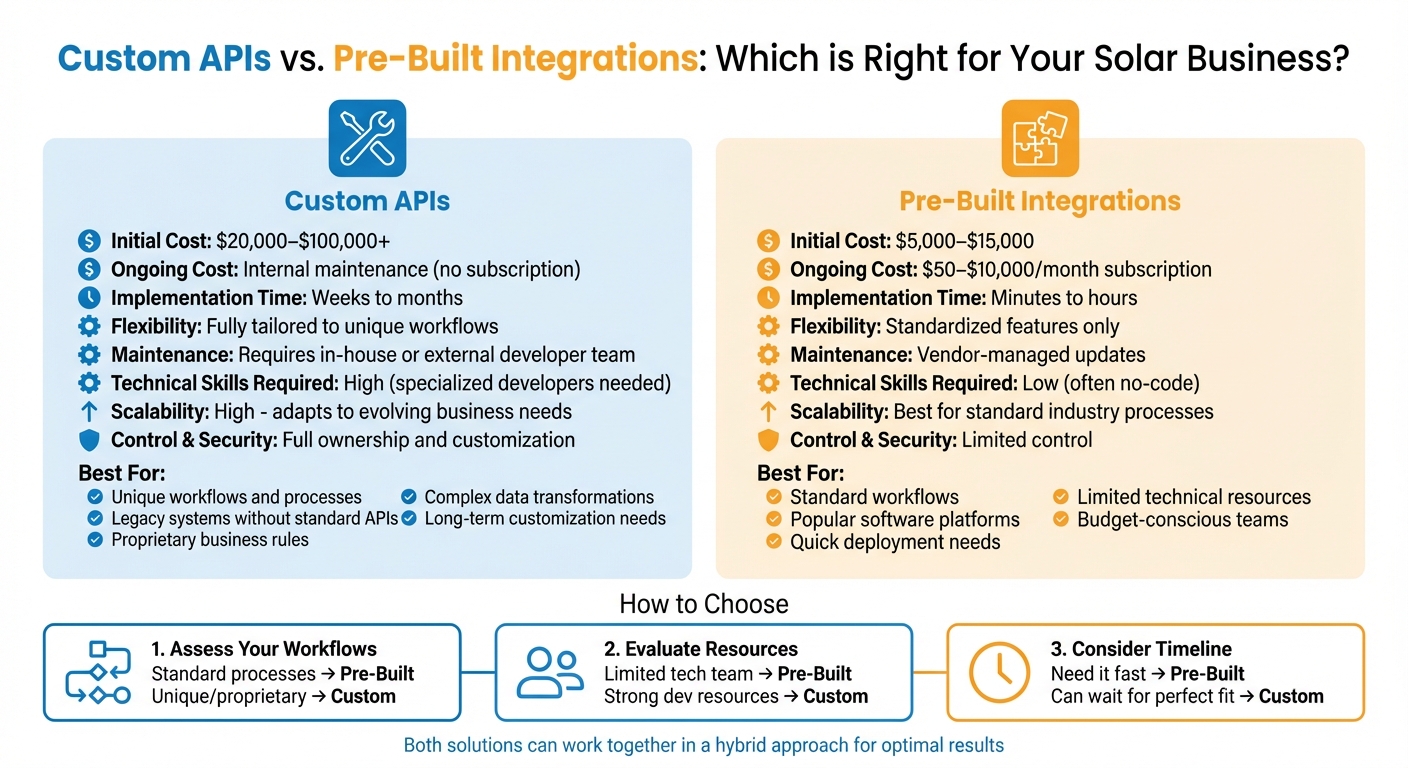
Custom APIs vs Pre-Built Integrations: Cost, Time, and Features Comparison for Solar Companies
What Are Custom APIs?
Custom APIs are tailored solutions designed to meet the unique needs of a business, offering solar companies complete control over how their systems share and process data. Unlike pre-built connectors that rely on fixed logic and standard configurations, custom APIs allow for specific business rules, custom workflows, and unique data transformations to fit specialized processes and requirements.
A major advantage of custom APIs is their flexibility. They can connect to niche or older systems that lack standard APIs by using automated data exchanges through formats like CSV, XML, or EDI. This makes them especially useful for proprietary or specialized solar applications. Let’s take a closer look at what sets custom APIs apart.
"Custom integrations are built specifically for your business processes. They are the right choice when prebuilt connectors cannot support the complexity of your workflows." – Surya Oztek, Nova Module
Creating custom APIs requires advanced technical skills and resources. Teams must be proficient in scripting languages like SuiteScript 2.0 for NetSuite systems and have a deep understanding of solar industry workflows. For instance, they need to know how changes in system wattage impact financial processes or how weather conditions affect site visits. While a full-scale ERP solution might take significant time to develop, some custom features can be delivered in as little as four hours once the need is identified.
Features of Custom APIs
Custom APIs are designed to align perfectly with specific workflows. They can handle complex data transformations that pre-built integrations cannot manage. For example, they might link an ERP/CRM system with a marketing automation platform to ensure seamless lead tracking across both systems.
These APIs are also adaptable to changing needs, though updates require attention from an internal team or an external partner whenever connected systems are modified. A solar company might initially deploy a custom API to automate residential invoicing based on construction milestones, later expanding it to manage commercial projects or integrate with new financing partners.
Another key benefit is eliminating inefficiencies caused by incompatible systems and duplicate data. By creating direct connections between platforms, custom APIs ensure consistent information across accounting, inventory, CRM, and project management systems.
How Solar Companies Use Custom APIs
Solar companies rely on custom APIs to address challenges that standard integrations can’t solve. These APIs are commonly used for tasks like syncing real-time inventory data with distributors such as BayWa r.e., automating invoicing based on project milestones, or linking proprietary customer portals with back-office ERP systems. The result? Enhanced operational efficiency and measurable improvements.
In early 2025, Big Sun Solar adopted the SolarSuccess ERP system (powered by NetSuite) through Blu Banyan to streamline their operations. This implementation introduced "bluActions", a set of custom features that replaced fragmented data silos with unified processes. Thanks to these advancements, Blu Banyan earned the NetSuite Spring 2025 Solution Provider Spotlight Award.
"We’ve been able to automate most of our residential invoices. When a deal moves to a particular stage of construction, for example, SolarSuccess generates invoices based on that specific milestone." – Joe Marhamati, Co-Founder & VP
Another solar company partnered with Blu Banyan to automate invoicing, eliminating manual processes and enabling the team to handle higher workloads without adding staff. In a separate case, a business struggling for over six months to integrate its ERP/CRM with a marketing automation platform saw Blu Banyan deliver a complete solution in just a few weeks.
Custom APIs also enable connections to industry-specific resources. For instance, integrating with the AHJ (Authority Having Jurisdiction) Registry automates the process of identifying inspection and approval jurisdictions for any U.S. address, saving time on permitting research.
sbb-itb-2560759
What Are Pre-Built Integrations?
Pre-built integrations are ready-made connectors designed for solar ERP systems. Think of them as bridges linking your main business platform to the specialized tools your team already relies on. These tools can range from CRM systems like Salesforce and financing platforms like GoodLeap to monitoring solutions such as SolarEdge and e-signature tools like DocuSign. Unlike custom APIs that require tailored development, pre-built integrations come ready to use.
These integrations automate data flow across departments – sales, procurement, accounting, field service – eliminating the need for manual data entry.
"SolarSuccess and our ecosystem of partners enable solar installers to streamline the flow of information between systems without complex in-house integration management."
– Blu Banyan
Pre-built integrations are fast to deploy, cost-effective, and standardized, making them a practical choice for solar companies. For example, over 18,000 professionals in sustainable home improvement already use platforms like GoodLeap through these connections. For businesses juggling multiple software systems, pre-built integrations provide a straightforward way to boost efficiency without the expense of custom development.
Features of Pre-Built Integrations
Pre-built integrations are designed to be user-friendly and quick to implement, requiring little to no technical expertise. This makes them especially useful for solar companies that don’t have extensive IT resources. Their standardized functionality ensures they work reliably across different organizations and help cut down operational costs.
One standout feature is their flexibility. For instance, a basic DocuSign integration might handle simple e-signature tasks, while a more advanced version could automate multiple customer sign-off stages, using templates tied to specific construction milestones.
"Processes can easily digress into a patchwork of spreadsheets containing outdated information that are used to manually shuttle data between incompatible applications. This siloed approach requires lots of labor and simply doesn’t cut it in today’s collaborative world."
– Blu Banyan
How Solar Companies Use Pre-Built Integrations
Pre-built integrations streamline workflows by connecting ERP and inventory management systems to essential tools, improving efficiency across the board. Solar companies often use them to link CRM platforms for consistent customer data, financing tools for automated loan approvals, and monitoring systems for real-time performance tracking.
Take Titan Solar Power, for example. In February 2020, the company, then the third-largest residential solar installer in the U.S., adopted the NetSuite-SolarSuccess ERP along with the bluChat collaboration tool. Under Aaron Casillas, their Technology and Infrastructure Director, Titan replaced its custom-built project management system and disconnected accounting tools with an integrated solution. This change cut down the labor required for commission payouts, sped up project installations, and introduced a homeowner portal for tracking project progress.
"Sharing data across these systems was difficult, and in most cases our only way to ‘patch the holes’ was by adding labor. We wanted to get everything on one system."
– Aaron Casillas, Technology & Infrastructure Director, Titan Solar Power
Other use cases include connecting supply chain tools for real-time inventory updates, payment processors for smoother transactions, and site survey tools for aerial imagery and property data. These integrations ensure seamless coordination between field teams and the home office, improving resource management and boosting profitability – all while eliminating manual data entry.
Custom APIs vs. Pre-Built Integrations: Side-by-Side Comparison
When deciding between custom APIs and pre-built integrations, the choice often comes down to factors like cost, implementation speed, maintenance, and flexibility. Each option has its strengths and challenges, and the right fit depends on your specific needs and technical resources, such as solar ERP software.
Custom APIs typically involve a hefty upfront investment, ranging from $20,000 to over $100,000. While this eliminates ongoing subscription fees, it shifts the burden of maintenance and updates to your internal team. On the other hand, pre-built integrations are more budget-friendly at the start, costing between $5,000 and $15,000, but they come with recurring subscription fees. These fees can vary widely – from $50 per month for small businesses to over $10,000 per month for enterprise-level platforms.
Time is another critical factor. Pre-built integrations are designed for quick deployment, often taking just minutes or hours to set up. In contrast, custom APIs require weeks or even months of planning, development, and testing, often as part of a larger NetSuite implementation. If speed is a priority, pre-built solutions are the clear winner.
Maintenance is another area where these two options diverge. Pre-built integrations come with vendor-managed updates, ensuring compatibility as platforms evolve and reducing the need for hands-on oversight. Custom APIs, however, demand continuous attention from your development team or an external partner to handle updates, security patches, and troubleshooting.
Here’s a quick breakdown of the key differences:
Comparison Table
| Factor | Custom APIs | Pre-Built Integrations |
|---|---|---|
| Initial Cost | $20,000 – $100,000+ | $5,000 – $15,000 |
| Ongoing Cost | Internal maintenance and labor | $50 – $10,000+ per month |
| Implementation Time | Weeks to months | Minutes to hours |
| Flexibility | Fully customizable to unique workflows | Limited to standardized features |
| Scalability | High; adapts to evolving business need | Best for standard industry processes |
| Maintenance | Requires internal team or partner oversight | Vendor-managed updates |
| Technical Skills | High (requires specialized developers) | Low (often no-code or minimal IT involvement) |
| Control & Security | Full ownership and customization | Limited control |
Ultimately, the decision hinges on your organization’s priorities. If you need a tailored solution with full control and scalability, custom APIs are the way to go. But if you value quick deployment and minimal maintenance, pre-built integrations offer a more convenient option.
When to Choose Custom API Development
Custom API development becomes a practical choice when your solar business faces challenges that off-the-shelf solutions just can’t fix. A common issue is dealing with legacy systems that don’t play well together. For instance, many solar installers juggle a mix of tools – QuickBooks for accounting, Salesforce for CRM, and various job-costing software. These systems often operate in silos, forcing teams to manually transfer data, which wastes time and increases the risk of errors.
"We had a project management system, a file storage system, an accounting system, and others. Sharing data across these systems was difficult, necessitating added manual effort." – Aaron Casillas, Technology & Infrastructure Director
Custom APIs solve this problem by automating data flow between systems. They create a unified platform where you can easily track project updates, inventory levels, and financial metrics in real time. This is often a better solution than relying on pre-built integrations that may not fully address your needs.
Another reason to go the custom route is when your operations involve unique workflows that standard tools can’t handle. Solar businesses often require automation tailored to their specific processes. While tools like DocuSign are great for basic tasks, they fall short when you need deeper automation. For example, a custom API can enable milestone-based triggers – automatically syncing bills of materials or initiating accounting events as projects hit certain completion percentages.
"The standard DocuSign integration is great for leads and transactions. The deeper integration utilizes project actions and templates to automate the multiple stages that require customer signoff." – Blu Banyan
Custom APIs also shine in enabling real-time data synchronization across complex operations. They can connect directly to distributor databases for live inventory updates, track commissions, and monitor key metrics like project profitability across departments. A great example is Big Sun Solar, which implemented SolarSuccess ERP in 2025. By leveraging custom bluActions™ functionality, they achieved real-time costing and streamlined project execution.
Reflecting on earlier integration struggles, Dan Burke shared:
"We struggled for over six months to integrate our ERP/CRM with a Marketing Automation Platform before Blu Banyan’s custom integration expertise delivered a solution within weeks." – Dan Burke, Marketing Automation Manager
These examples highlight why custom APIs are often essential. When your workflows demand automation that standard tools can’t provide or you need to connect systems that don’t naturally integrate, custom API development is the way to go. It’s all about bridging the gaps that pre-built solutions leave behind.
When to Choose Pre-Built Integrations
Pre-built integrations are a great option for solar businesses that stick to standard workflows and use popular software like Salesforce for solar CRM, GoodLeap for financing, SolarEdge for monitoring, or Eagleview for site surveys. These integrations allow for quick and seamless connections, supporting essential solar operations – from order-to-cash processes to project management – right out of the box.
One of the biggest advantages of pre-built integrations is the balance they strike between cost and speed. With lower upfront expenses and subscription-based pricing, they’re a practical choice for teams working with tight budgets or limited time. This is especially true when specialized developers aren’t readily available. For resource-strapped teams, these integrations enable fast automation of data flow without requiring large investments or lengthy deployment timelines. For instance, SolarSuccess, which incorporates a range of pre-built third-party integrations, supports nearly one-third of all rooftop solar installations in the U.S..
"Whether we wanted to integrate systems or take advantage of out-of-the-box automation, Blu Banyan handled it for us… We’re doing more with the same number of people and we have a system that’s more reliable and less stressful than tracking a million different spreadsheets."
– Joe Marhamati, Co-Founder & VP, Ipsun Solar
Pre-built integrations shine when dealing with a tangled mix of incompatible applications. They help eliminate conflicting data and duplicated functions across systems by creating a single source of truth. This automation ensures smooth communication between tools like your CRM, accounting software, and project management systems. For businesses experiencing rapid growth, these integrations allow scaling without a proportional increase in headcount or administrative burden.
However, pre-built solutions have their limitations. They operate on fixed logic and predefined mappings, which might not suit businesses with highly specialized or proprietary workflows. If your operations depend on niche legacy tools without standard APIs or require custom business rules, these integrations may fall short. But if your processes are relatively straightforward and your tech stack aligns with industry standards, pre-built integrations provide an efficient, budget-friendly way to reduce manual data entry and improve overall operations.
How to Decide Which Approach Fits Your Business
Integrating systems effectively can streamline workflows and provide real-time insights into critical metrics. Choosing between custom APIs and pre-built integrations depends on factors like workflow standardization, technical resources, budget, and project timeline. Start by analyzing your solar operations. If your processes align with common industry workflows like order-to-cash or procure-to-pay, pre-built integrations might be a good fit. But if your business relies on unique approval logic, custom data transformations, or proprietary rules, custom APIs may be necessary. These decisions directly affect how well your integration performs and impacts operational efficiency.
Your team’s technical expertise plays a key role here. Pre-built solutions often come with no-code setups, making them accessible to teams without deep technical knowledge. On the other hand, custom integrations require development resources – whether in-house or outsourced – for both initial implementation and ongoing maintenance. Reviewing demos of solar ERP modules can help you spot feature gaps and decide if the pre-built options meet 80–90% of your operational needs.
Budget is another critical factor. Pre-built integrations usually have lower upfront costs and subscription-based pricing, making them appealing for businesses with tighter budgets. Custom APIs, while requiring a higher initial investment, can offer long-term savings by automating complex workflows and reducing manual effort. When comparing options, weigh the monthly subscription fees of pre-built solutions against the ongoing developer costs for maintaining custom integrations.
Also, consider your current software ecosystem. Many solar-specific tools – such as SolarEdge, AlsoEnergy, GoodLeap, and Enerflo – offer ready-made connectors for major ERPs like NetSuite. If your platforms support these standard connectors, pre-built integrations are likely the best choice. However, if you’re working with niche tools or legacy systems that lack standard APIs, custom integrations using formats like CSV, XML, or EDI might be your only option.
Think about your business’s growth plans and maintenance capabilities. Pre-built integration providers often handle updates, API changes, and compatibility issues, reducing your workload. With custom APIs, your team or external partner will need to manage updates, security patches, and modifications as your needs evolve. Clive Smith, Chief Business Development Officer at Blu Banyan, emphasizes:
"When you’re aggregating a group of point applications – regardless of how good each of those programs is individually – you really need them to be able to talk to one another".
The ultimate goal is more than just connecting systems. It’s about creating a unified source of truth that delivers real-time insights into key metrics like project profitability and sales pipelines.
Conclusion
Deciding between custom APIs and pre-built integrations comes down to your solar company’s specific needs. Pre-built integrations are ideal if your workflows align with common industry practices and you’re using popular platforms. They offer quick setup and lower upfront costs. On the other hand, custom APIs are better suited for businesses with unique processes, legacy systems, or specialized requirements that set them apart from competitors.
Take a close look at factors like workflow complexity, your technical team’s expertise, budget, and long-term scalability to make the right choice. For companies following standard processes like order-to-cash and using widely-supported CRM and sales tools, pre-built connectors can streamline operations quickly. But if your business depends on custom rules or niche software without standard APIs, custom development – despite its higher initial cost – might be the only viable option.
"The right choice depends on whether your integration needs are standard or unique." – Surya Oztek, Analyst, Nova Module
A solid integration strategy goes beyond just linking systems. It’s about achieving real-time visibility across your operations. Start by auditing your tech stack to identify communication gaps, align workflows with industry norms, and assess whether your team can handle custom maintenance or would rather rely on vendor-managed updates.
The ultimate goal is more than just connecting tools; it’s about building a unified platform that offers insights into key metrics like project profitability and sales pipeline health. Whether you opt for custom APIs, pre-built integrations, or a mix of both, the right approach should cut down on manual tasks, eliminate data silos, and support your growth for years to come.
FAQs
Can I start with pre-built integrations and add custom APIs later?
Yes, starting with pre-built integrations is a smart way to streamline your setup. For example, solutions like Blu Banyan’s solar ERP offer ready-made connections to key systems, saving you from time-consuming development in the early stages.
As your business grows and your needs become more specific, you can layer in custom APIs. These allow you to create workflows tailored to your operations and expand functionality, all while keeping your system adaptable to future changes.
What data should I integrate first to get quick ROI?
Integrating your core operational and financial data is key to seeing quick returns on investment. Start by linking systems like project management, inventory, and financial tools. This streamlines workflows, reduces manual data entry, and gives you real-time insights to make faster, more informed decisions.
By prioritizing supplier and inventory data integration early on, you can also lower costs and boost supply chain efficiency. These steps not only deliver immediate benefits but also set the stage for smoother future integrations.
Who maintains a custom API when my software changes?
When your development team or software provider manages a custom API, they handle updates and provide support whenever your software changes. Keeping the API regularly maintained ensures it remains compatible and works smoothly as your system grows and evolves.
