

Solar companies face complex regulatory challenges that can impact profitability and project timelines. From new subsidy rules to stricter documentation requirements, staying compliant is critical to avoid financial losses and delays. Here’s what you should know:
- New Tax Credit Rules: The One Big Beautiful Bill Act (OBBBA) enforces stricter criteria for federal tax credits, including the "Physical Work Test" and sourcing rules for materials starting in 2026. Missing these can disqualify projects from incentives.
- Grid Connection Changes: FERC Order 2023 introduces cluster-based interconnection studies, requiring developers to prove readiness at every stage. Poor documentation can result in costly project withdrawals.
- Audit Demands: Developers must maintain detailed records, from geotagged photos to Xinjiang-free sourcing affidavits, for up to 10 years to avoid penalties or forfeited credits.
- ERP Systems as a Solution: Industry-specific platforms like SolarSuccess centralize compliance data, automate milestone tracking, and streamline audits, reducing errors and boosting efficiency.
Key takeaway: Regulatory risks in solar development are growing, but adopting integrated ERP solutions can help companies navigate these challenges effectively.
Main Regulatory Risks in Solar Asset Tracking
Government Subsidy and Policy Changes
The One Big Beautiful Bill Act (OBBBA), enacted in July 2025, introduced significant changes to how solar developers qualify for federal tax credits. For projects exceeding 1.5 MW AC, the previous 5% Cost Safe Harbor method (commonly referred to as "check-writing") has been replaced by the Physical Work Test. Under this new requirement, developers must demonstrate that "physical work of a significant nature" has begun by July 4, 2026, to secure full Section 48E credits.
Ryan Kennedy from pv magazine emphasized the stakes involved:
"The difference between a viable project and a stranded asset can now depend on satisfying the specific, strict physical work criteria of the ‘Physical Work Test’".
Starting January 1, 2026, solar projects must also comply with Material Assistance Cost Ratio (MACR) thresholds. Specifically, at least 40% of material costs must come from sources not controlled by prohibited foreign entities. Falling short of this requirement results in total disqualification from federal tax credits. Additionally, the recapture window now spans 10 years, meaning any gaps in documentation during this period could lead to the forfeiture of previously claimed credits.
Adding to these challenges, grid connection requirements are becoming increasingly complex for developers.
Grid Connection and Transmission Requirements
FERC Order 2023 has replaced the old "first-come, first-served" interconnection process with cluster-based studies that require developers to prove commercial readiness at every stage. One critical factor is site control – without proper documentation, projects are immediately removed from the interconnection queue.
This shift raises financial stakes considerably. For instance, at the Large Generator Interconnection Agreement (LGIA) stage, developers must deposit 20% of their assigned network upgrade costs. For a 200 MW solar project with $50 million in upgrades, this means a $10 million deposit is at risk if site control documentation falls short. The pressure is evident in the CAISO queue, where 67% of projects were either withdrawn or rejected after failing initial intake scoring.
Audit and Documentation Requirements
Beyond subsidies and grid regulations, strict audit demands present another layer of compliance risk. Auditors now require detailed evidence, including geotagged photo logs, unredacted master supply agreements, and manufacturer production logs that trace materials from raw sourcing to production batches.
As Baker Botts analysts warn:
"Your documentation needs to be unassailable, preempting any audit flags".
For FEOC compliance, developers must ensure complete traceability, from raw materials to finished modules. A single equipment detention under UFLPA enforcement can result in up to $810,000 in combined legal fees, storage costs, and lost sales. Additionally, projects must maintain PE-stamped plans, time-stamped facility photos, and Xinjiang-free sourcing affidavits for the entire 10-year recapture period.
These increasing documentation requirements highlight the critical role of ERP and asset management systems in streamlining compliance and reducing risk exposure.
sbb-itb-2560759
How ERP Systems Reduce Regulatory Risks
Real-Time Data and Reporting
ERP systems replace scattered spreadsheets and disconnected tools that often lead to audit mistakes. By integrating accounting, inventory, project management, and CRM into one cohesive platform, solar companies get a single, reliable source of truth. This setup addresses potential risks in recording and reporting processes.
Joe Marhamati, Co-Founder & VP, shared how automation transformed their processes:
"We’ve been able to automate most of our residential invoices. When a deal moves to a particular stage of construction, for example, SolarSuccess generates invoices based on that specific milestone."
Customizable dashboards add another layer of control, allowing managers to track compliance metrics in real time. For businesses managing multiple subsidiaries, the system simplifies financial reporting significantly. Spencer Newman, CFO, highlighted this benefit:
"Our financial close was incredibly complicated and fraught with errors because we have so many subsidiaries consolidating together. That problem has almost gone away completely. We can look at all of our subsidiaries as standalones or consolidate them into our main financials."
This unified structure ensures smoother automated compliance monitoring across operations.
Automated Compliance Monitoring
Modern ERP systems are designed to automatically flag potential risks related to safety, environmental regulations, and serial numbers. This ensures companies operate within legal boundaries while maintaining timely communication with regulatory authorities. These platforms also keep track of financial metrics like Debt-to-Equity and Debt Service Coverage Ratios, ensuring compliance with grid and audit standards. They even handle regulatory deadlines – like submitting annual production data to municipalities – by scheduling alerts for overdue tasks.
Additionally, ERP systems evaluate power plant performance and O&M contractor metrics, factoring in exclusions like force majeure to maintain accurate compliance records. This level of automation reduces manual errors and keeps businesses ahead of regulatory requirements.
Centralized Documentation for Audits
Beyond automated monitoring, ERP platforms centralize documentation, making audits far less daunting. Tools like bluDocs store all regulatory documents – ranging from EPC certifications to training schedules – and keep detailed revision histories.
Aaron Casillas, Technology & Infrastructure Director, highlighted the importance of this feature:
"Solar installation has many moving parts, all generating soft costs, and there is no single application that solves them all, because you have to address inefficiencies across all functions of the entire company… SolarSuccess streamlined things even further and allowed us to add our own customizations on top of NetSuite."
When auditors request records for the 10-year recapture period, everything is readily available. The system centralizes critical documents like building permits, environmental permits, power generation licenses, and Xinjiang-free sourcing affidavits. This makes regulatory reviews much more efficient. With nearly one-third of U.S. rooftop solar installers using SolarSuccess, its ability to manage complex compliance needs is evident.
Regulatory Risk Comparison
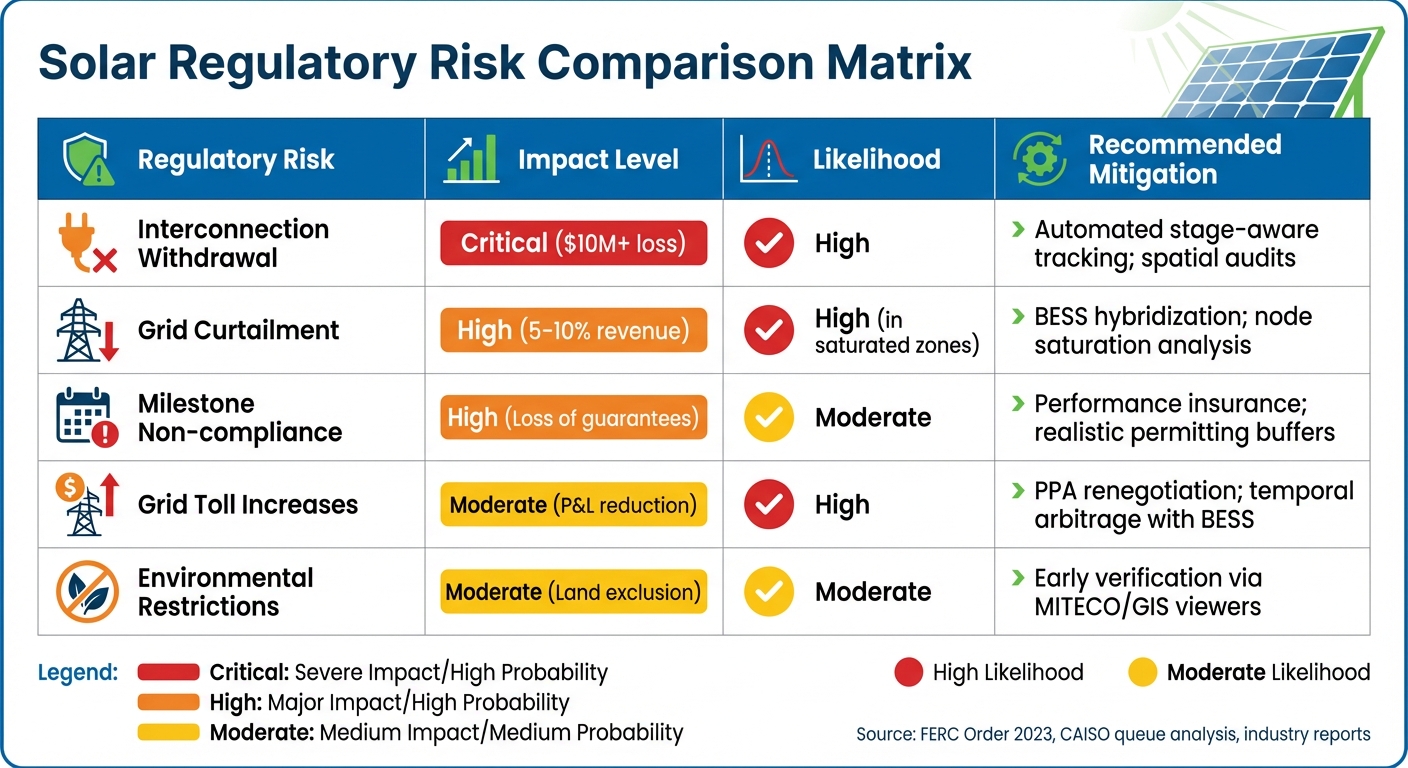
Solar Regulatory Risk Assessment Matrix: Impact Levels and Mitigation Strategies
When considering ERP-based accounting and compliance solutions, it’s crucial to understand how different regulatory risks impact solar companies. These risks vary significantly in severity. Some, like interconnection withdrawals, can cause immediate and substantial financial losses. Implementing cash management excellence tools can help developers forecast these liquidity risks. Others, such as grid toll increases or environmental restrictions, tend to have a more moderate effect on profitability. Understanding these differences helps companies focus their mitigation strategies and allocate resources where they’re needed most.
Interconnection Withdrawal
This is one of the most severe risks, with the potential for massive financial losses. Escalating deposit requirements can lead to losses in the millions, especially during advanced project stages. For example, deposits can start at $5,000 during the application phase and rise to as much as 20% of network upgrade costs by the final execution phase. As Zonevex aptly put it:
"The cost of poor site control documentation was delay. Under Order 2023, the cost is capital destruction." – Zonevex
Grid Curtailment
Grid curtailment represents a significant threat to revenue. In areas with high saturation, it can reduce annual revenue by 5–10%. For instance, Spain’s curtailment rate, which was just 0.3% in 2021, is projected to climb to 5.0% by 2026.
Milestone Non-compliance
Failure to meet critical milestones can lead to the forfeiture of bank guarantees and delays in financing. This risk, while avoidable, requires careful planning and execution to ensure compliance.
Other Risks: Grid Toll Increases and Environmental Restrictions
- Grid toll increases raise operational costs, cutting into profitability.
- Environmental restrictions can limit land usability or necessitate compensatory measures. While these risks are less immediate than interconnection withdrawals or curtailment, they can still have a cumulative financial impact if not managed properly.
Regulatory Risk Comparison Table
| Regulatory Risk | Impact Level | Likelihood | Recommended Mitigation |
|---|---|---|---|
| Interconnection Withdrawal | Critical ($10M+ loss) | High | Automated stage-aware tracking; spatial audits |
| Grid Curtailment | High (5–10% revenue) | High (in saturated zones) | BESS hybridization; node saturation analysis |
| Milestone Non-compliance | High (Loss of guarantees) | Moderate | Performance insurance; realistic permitting buffers |
| Grid Toll Increases | Moderate (P&L reduction) | High | PPA renegotiation; temporal arbitrage with BESS |
| Environmental Restrictions | Moderate (Land exclusion) | Moderate | Early verification via MITECO/GIS viewers |
Conclusion
Navigating the challenges of subsidy changes, grid connection requirements, and rigorous documentation calls for effective solutions. By addressing these issues head-on, ERP systems give solar companies the tools they need to stay compliant and avoid regulatory pitfalls.
Platforms like SolarSuccess provide a centralized system that streamlines accounting, project management, and documentation. This eliminates data inconsistencies and reduces errors that can derail compliance efforts. With real-time dashboards, companies can automatically track critical milestones, ensuring deposit requirements, permit deadlines, and subsidy documentation align with project timelines. As Joe Marhamati, Co-Founder & VP, shared:
"We’re doing more with the same number of people and we have a system that’s more reliable and less stressful".
Spencer Newman, CFO, echoed this sentiment:
"Our financial close was incredibly complicated and fraught with errors because we have so many subsidiaries consolidating together. That problem has almost gone away completely".
Currently, SolarSuccess supports one-third of U.S. rooftop solar installations, setting the benchmark for compliance management in the industry. Companies that continue to rely on disconnected systems risk falling behind and facing regulatory challenges.
FAQs
What qualifies as ‘physical work of a significant nature’ under the Physical Work Test?
The Physical Work Test defines "physical work of a significant nature" as activities like installing racks or structures to secure photovoltaic (PV) panels, collectors, or solar cells at a site. However, it specifically excludes preliminary tasks such as land grading, site clearing, or conducting studies.
What documentation is required to prove site control under FERC Order 2023?
To meet the requirements of FERC Order 2023, you’ll need to submit proof that confirms your control over the site in question. This can include:
- Lease Agreements: Documents showing you’ve secured the right to use the property.
- Purchase Options: Agreements that give you the option to buy the site.
- Other Legal Rights: Any formal documentation that verifies your authority to develop on the site.
These records must clearly establish your ability to proceed with development at the specified location.
What records should I keep for the 10-year tax credit recapture period?
Maintaining detailed records is crucial when it comes to asset management and compliance with tax credit requirements. Keep track of key details like:
- Acquisition dates of assets
- Usage history and any changes in how the asset is used
- Sales transactions or disposals
- Any shifts in use that could trigger recapture
Additionally, make sure you have clear documentation showing compliance with eligibility criteria throughout the 10-year recapture period. These records aren’t just helpful – they’re essential for proving you’ve met all the necessary tax credit requirements.
