
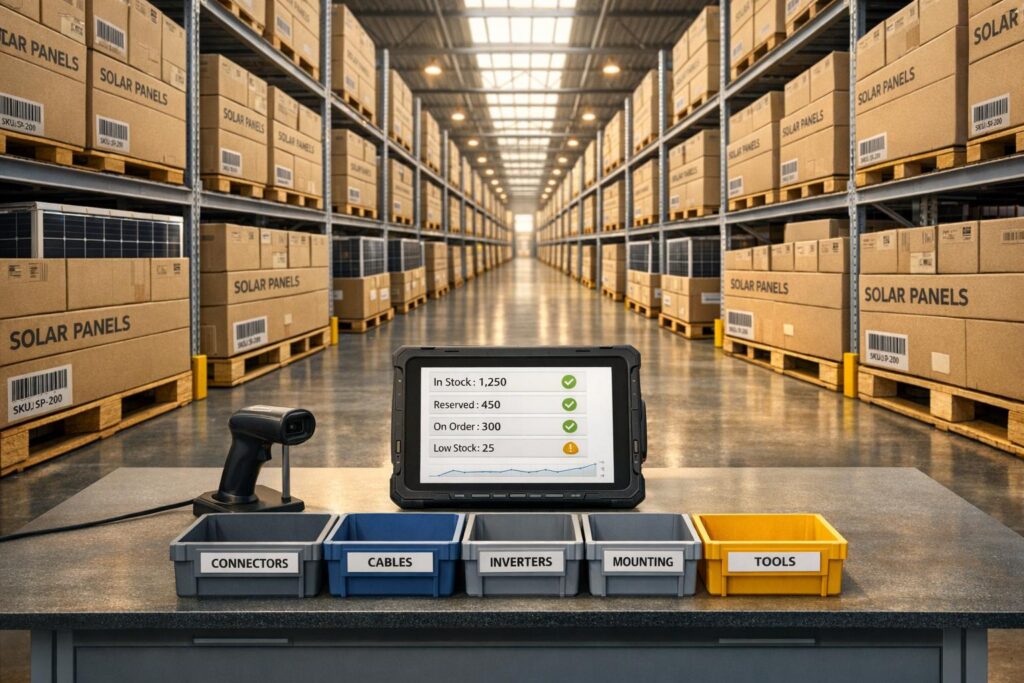
Solar companies are losing up to 20% of their profit margins due to outdated inventory practices. Many rely on spreadsheets, disconnected systems, and manual counts – leading to errors, delays, and wasted resources. Here’s what’s holding them back:
- Stock Discrepancies: Manual methods cause mismatches between recorded and actual inventory, resulting in material waste and project delays.
- Slow Tracking: Disconnected systems make it hard to locate components, forcing crews to reschedule installations.
- Limited Visibility: Companies often buy equipment they already have, tying up capital in unused, depreciating stock.
- Warranty Issues: Poor RMA tracking leads to lost revenue from missed claims and delayed repairs.
- Supply Chain Disruptions: Global price swings and rapid technology changes make forecasting and managing inventory difficult.
Switching to solar ERP systems like SolarSuccess can solve these problems. By automating workflows, offering real-time tracking, and integrating with suppliers, solar companies can reduce waste, improve efficiency, and protect their bottom line.
Challenge 1: Stock Discrepancies and Inaccurate Counts
Relying on manual methods like spreadsheets, whiteboards, and emails for inventory tracking often leads to errors that cause mismatches between recorded and actual stock levels. These outdated practices create a shaky foundation for managing solar inventory effectively.
How Manual Processes Lead to Errors
Mistakes in data entry – such as mislabeling items or delays in logging material usage – can distort stock records, making it seem like more inventory is available than there really is. On top of that, using disconnected systems – like separate spreadsheets for accounting, operations, and field updates – makes it nearly impossible to get a clear picture of inventory. Issues like receiving incorrect quantities from vendors can further throw off stock counts, sometimes leaving them inaccurate for weeks.
These problems don’t just cause headaches – they directly affect your bottom line and how efficiently your business operates. Implementing solar ERP software is a critical step in resolving these systemic inefficiencies.
The Cost of Stock Discrepancies
Poor inventory tracking can eat into a solar company’s profit margins by as much as 15–20%, thanks to material waste and delays in invoicing. Missing equipment can stall installations, leading to frustrated customers and lost revenue.
Overstocking is another costly issue. In 2024, a staggering 95% of the 1.7 million solar modules listed for resale on the secondary market were brand-new. These were often leftover stock from canceled projects or inaccurate forecasting. With solar technology advancing so quickly, excess inventory loses value fast, making it harder to recover costs.
On top of that, failing to track serial numbers accurately can disrupt warranty claims, leaving businesses unable to recover money from manufacturers when equipment fails.
sbb-itb-2560759
Challenge 2: Slow and Inefficient Tracking
Tracking delays are another major roadblock for solar projects. When essential components like solar panels, inverters, and racking hardware are scattered across warehouses, service trucks, and job sites, locating the right item often turns into a guessing game. Without a unified system linking these locations, field crews frequently arrive at installations missing key equipment. This forces rescheduling, disrupts timelines, and damages customer trust.
Why Disconnected Systems Create Tracking Problems
Using spreadsheets, whiteboards, and emails to manage inventory leads to fragmented data, making it nearly impossible to track components in real time. For example, Operations and Maintenance (O&M) teams may spend hours hunting for an inverter that the system says is in a warehouse, only to find it’s already installed or sitting in a service truck. Asset managers often resort to driving between locations to manually verify stock, a time-consuming process prone to mistakes.
The issue worsens when inventory is in transit. Many systems fail to account for items moving between locations, leading to incorrect stock records. This creates false expectations for equipment availability, triggering scheduling conflicts that ripple across multiple projects. All of this inefficiency stretches project timelines unnecessarily.
How Tracking Delays Impact Installations
When crews can’t instantly update inventory or scan serial numbers on-site, back-office teams are left waiting for manual updates. This slows down the entire process. According to the ECOSIRE Research and Development Team:
"The average solar company still manages projects through spreadsheets, disconnected CRMs, and manual inventory counts. This fragmentation costs solar companies 15-20% of potential profit margins through material waste, scheduling conflicts, and delayed invoicing".
The real-world effects are clear: field crews arrive at job sites without the batteries or racking hardware they need, forcing them to leave and return later. These delays frustrate customers and create a domino effect of scheduling conflicts, straining resources across multiple projects. Without mobile tools that allow real-time inventory updates, these problems pile up, delaying project completion and slowing revenue recognition. Real-time ERP tracking could eliminate these inefficiencies, helping solar companies stick to schedules and improve cash flow.
Challenge 3: Poor Visibility into Inventory Levels
When solar companies can’t clearly see their inventory, costly mistakes pile up. A common issue? Buying equipment that’s already sitting in a warehouse – or worse, scattered across service trucks and storage areas. This happens because many companies still rely on outdated, manual tracking systems, leaving them with an incomplete picture of what’s available and where.
Gaps in Inventory Data
The root of the problem lies in fragmented data. Sure, your main warehouse might have accurate numbers, but what about the panels loaded onto trucks for tomorrow’s job? Or the inverters currently en route from your supplier? Without a centralized system, these blind spots turn into unnecessary purchases.
And here’s another risk: solar technology evolves quickly. If you’re not tracking inventory in real time, you could end up with outdated equipment. As Ventory puts it:
"The solar industry is evolving pretty fast, and you don’t want to find yourself with a warehouse full of obsolete equipment".
This lack of clarity can slow operations and lead to financial strain.
How Excess Inventory Hurts Your Bottom Line
The effects of poor visibility go beyond duplicate orders. Overstocking ties up capital in equipment that can quickly lose value as newer technology hits the market. Instead of fueling growth, that money gets stuck in assets that depreciate over time.
The financial toll is significant. The ECOSIRE Research and Development Team estimates that fragmented inventory management and manual processes cost solar companies between 15% and 20% of their potential profit margins. These losses stem from material waste, scheduling problems, and poor purchasing decisions. On top of that, excess inventory means higher costs for storage, insurance, and management.
"Excess inventory is a liability, even more so in the renewable or solar industry".
Solutions like ERP systems, such as SolarSuccess, address these issues by centralizing data. With real-time visibility across all locations, they help prevent overstocking and streamline operations, saving both time and money.
Challenge 4: Inefficient RMA and Warranty Return Processes
Managing decades-long warranties – 25 years for solar panels and 10 years for inverters – is a daunting task for solar companies. Relying on spreadsheets for tracking simply doesn’t cut it anymore.
Problems with Return Merchandise Authorization (RMA) Tracking
Manual documentation is riddled with gaps. For instance, when platforms like SolarEdge or Enphase detect underperforming equipment, disconnected systems often fail to generate service tickets or submit manufacturer claims. This breakdown in communication can cost companies valuable revenue.
Another critical issue is the lack of integrated serial number tracking throughout the product lifecycle, from receipt to installation. Without this, warranty documentation becomes unreliable. Asset managers often struggle to locate the correct parts, which means service crews may show up with the wrong equipment. These inefficiencies not only delay repairs but also frustrate customers and tarnish a company’s reputation.
Ultimately, these tracking problems directly result in revenue loss.
Lost Revenue from Poor Warranty Management
The financial toll of poor warranty management is staggering. Administrative mistakes and disorganized tracking contribute to an estimated $61 billion in losses annually. In the solar industry specifically, fragmented RMA processes can eat away 15–20% of potential profit margins.
The situation worsens with the rapid pace of technological advancements. As panel efficiency and battery technology improve, returned equipment loses value quickly. Manual processes often lead to delayed claims or missed warranty deadlines, further chipping away at revenue. It’s a double hit – lost time and depreciating assets – that solar companies can’t afford.
Challenge 5: Supply Chain Disruptions and Component Shortages
Solar equipment quickly loses value as newer technology emerges and prices drop dramatically.
How Global Supply Chain Issues Affect Solar Inventory
Price swings wreak havoc on solar companies’ finances. Module prices have plunged by as much as 50% recently, pushing companies to double their sales just to maintain the same gross profit margins.
In October 2024, BayWa r.e. Solar Trade, led by CEO Frank Jessel, responded to these challenges by digitizing their sales and planning processes. They cut inventory to a 60-day supply and increased module turnover to six times per year.
"With module prices down by up to 50%, this means we have to sell twice as much to make the same gross profit." – Frank Jessel, CEO, BayWa r.e. Solar Trade
Technology shifts add to the chaos. The fast shift from P-type to N-type solar panels has made older inventory nearly unsellable. Companies stuck with excess P-type modules often face steep losses through distress sales. On top of that, trade disruptions complicate inventory management. For example, solar module imports from Cambodia plummeted from 652 MW in August 2024 to just 140 kW by February 2025 due to anticipated tariff changes.
With these challenges in mind, effective demand forecasting becomes crucial for solar companies to stay competitive and avoid being overwhelmed by outdated inventory.
Why Demand Forecasting Matters
Accurate demand forecasting is a game-changer for navigating price fluctuations and rapid technological evolution. It helps companies avoid being stuck with unsellable stock while ensuring they can meet demand spikes – often tied to the expiration of federal or state incentives. Without strong forecasting, businesses risk either losing sales opportunities or being left with excess inventory. A clear example is the bullwhip effect from earlier inverter shortages, which left many installers struggling with surplus stock they’re still trying to offload.
Better forecasting also reduces carrying costs. Overstocking alone accounts for about 44% of total inventory among larger small-to-medium businesses. That’s capital that could be redirected to other priorities.
"A solid digital foundation can help organizations to stay agile amid global market challenges and continue to meet demand without major changes to their business model structure." – Frank Jessel, CEO, BayWa r.e. Solar Trade
Digital tools turn forecasting into a strategic advantage. Automated systems can predict demand by analyzing historical trends, technological advancements, and subsidy cycles. This enables companies to keep stock levels lean and free up valuable capital. ERP platforms like SolarSuccess simplify these processes, helping businesses adapt to market shifts with greater agility.
ERP Solutions for Inventory Challenges
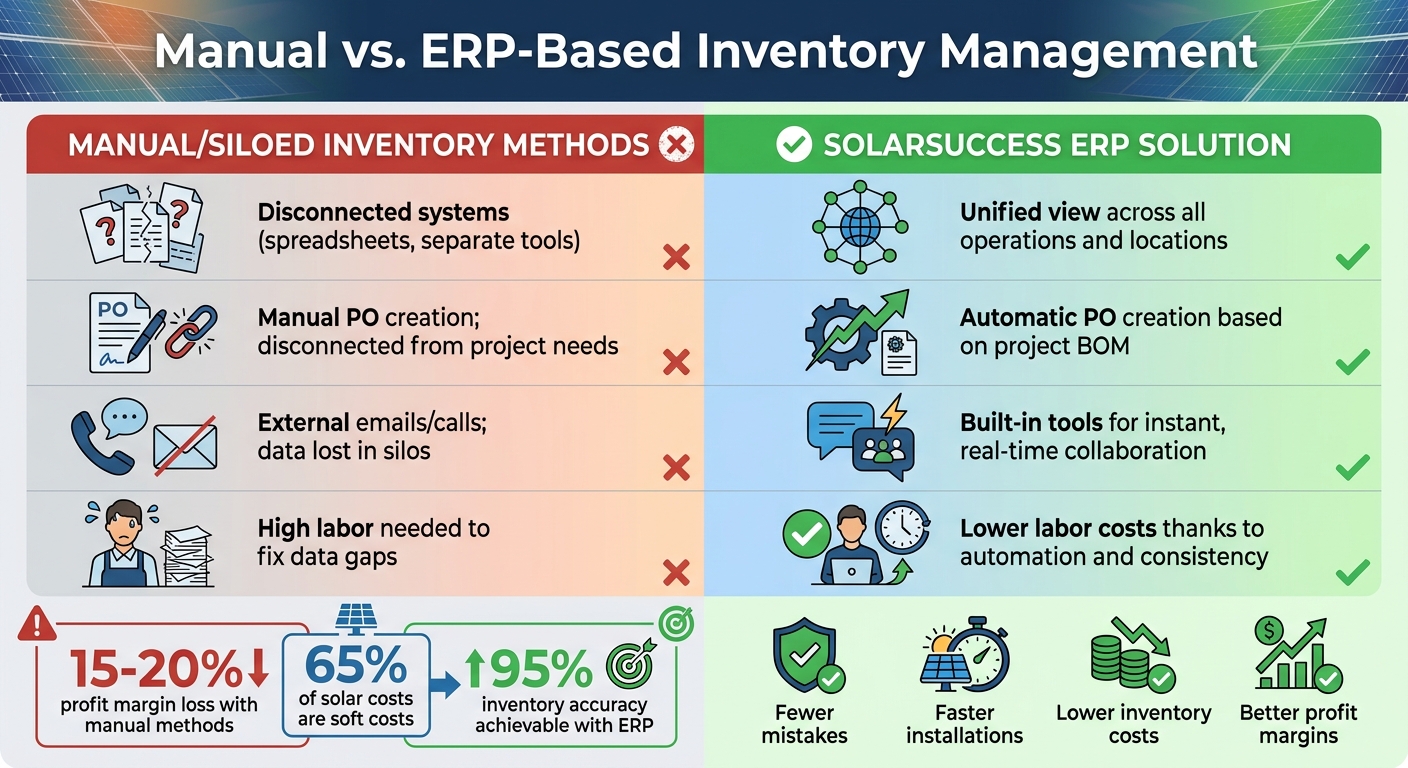
Manual vs ERP Inventory Management for Solar Companies
Tracking inventory manually can lead to problems that only get worse over time. Relying on spreadsheets or disconnected software often results in errors that delay installations and hurt profits. Solar companies need a system that ties accounting, project management, CRM, and inventory together into one reliable hub.
SolarSuccess, built on Oracle NetSuite, does just that. It provides real-time insights into inventory levels across every location, including stock in transit or at project sites. By automating purchase orders based on each project’s bill of materials (BOM), SolarSuccess removes the guesswork from procurement. Plus, one-click cycle counts ensure inventory accuracy without disrupting operations. Let’s explore how SolarSuccess solves these inventory headaches with its real-time capabilities.
Integration with distributors like BayWa r.e. changes the way solar companies handle their supply chains. Users can check live catalog items and stock availability within the system, place orders, and track shipments – all without switching platforms. This just-in-time ordering approach helps projects stay on track while reducing the costs tied to excess inventory.
A great example of this in action is Titan Solar Power. In February 2020, the company – responsible for installing 153.5 MW of capacity that year – migrated from its outdated, disconnected systems to SolarSuccess. Aaron Casillas, their Technology and Infrastructure Director, described the challenge:
"Sharing data across these systems was difficult, and in most cases our only way to patch the holes was by adding labor. We wanted to get everything on one system."
This shift reduced labor costs, improved data visibility, and sped up installations.
Real-Time Inventory Management with SolarSuccess

Building on Titan Solar’s success, SolarSuccess offers advanced real-time tracking that eliminates delays caused by stock discrepancies. Live data ensures every department – from sales to warehouse operations – works from the same accurate information. This centralized system provides instant visibility into inventory levels and distributor pricing, streamlining operations across the board.
Automated stock management features catch discrepancies before they disrupt schedules. SolarSuccess ensures teams order exactly what they need, when they need it, thanks to automatic procurement. Solar-optimized pick tickets simplify warehouse operations, further boosting efficiency.
Vendor integration takes it a step further. Direct links with distributors provide live updates on catalog items and stock availability, enabling quick adjustments during supply chain hiccups. This level of visibility prevents the common issue of misplaced or unavailable parts seen in manual systems.
Jan Rippingale, CEO of Blu Banyan, highlighted the importance of this unified approach:
"Having everything connected makes a tremendous difference… Decades of work went into building the NetSuite unified foundation and getting it right; we obviously couldn’t reinvent that."
SuiteApps for Better Operations
To address the challenges of manual tracking even further, SuiteApps enhance integration and communication. Tools like bluDocs and bluConnect fill the gaps left by fragmented systems.
- bluDocs handles project-specific document management with revision tracking, ensuring teams always have access to the latest technical specs, purchase orders, and warranty documents. This eliminates confusion caused by outdated files scattered across multiple sources.
- bluConnect integrates team chat directly into the system, allowing instant collaboration on inventory updates without needing external messaging apps. For example, if a stock issue arises or a shipment arrives, teams can discuss it within the context of the project, keeping all information organized in one place.
Clive Smith, Chief Business Development Officer at Blu Banyan, explained:
"When you’re aggregating a group of point applications – regardless of how good each of those programs is individually – you really need them to be able to talk to one another. The only way to make that happen is with an integrated or unified application suite on a single database."
Manual vs. ERP-Based Inventory Management
Switching from manual to ERP-based systems directly tackles the inventory issues solar companies face.
| Feature | Manual/Siloed Methods | SolarSuccess ERP Solution |
|---|---|---|
| Data Visibility | Disconnected systems (spreadsheets, separate tools) | Unified view across all operations and locations |
| Procurement | Manual PO creation; disconnected from project needs | Automatic PO creation based on project BOM |
| Communication | External emails/calls; data lost in silos | Built-in tools for instant, real-time collaboration |
| Labor Costs | High labor needed to fix data gaps | Lower labor costs thanks to automation and consistency |
Manual methods often require juggling incompatible tools – like QuickBooks, Salesforce, and spreadsheets for warehouse counts. Project managers might even resort to tracking components on whiteboards. This fragmented approach leads to stock errors, slow tracking, and supply chain risks.
With ERP-based management, all these functions are consolidated into one platform. Data flows seamlessly between departments: procurement teams can forecast demand using real-time CRM data, warehouse staff can use solar-optimized pick tickets for precise handling, and accounting gets automatic updates when inventory moves. The result? Fewer mistakes, faster installations, and lower inventory costs – key advantages in an industry where outdated stock can quickly lose value.
Conclusion
Inventory issues can’t be allowed to stall the operations of solar companies. Problems like discrepancies, slow tracking, limited visibility, warranty management headaches, and supply chain disruptions directly eat into profits. Considering that soft costs make up about 65% of expenses in the solar industry, every wasted hour on manual inventory processes hits the bottom line hard.
SolarSuccess tackles these challenges by offering real-time visibility across locations, automating procurement tied to project BOMs, and integrating seamlessly with distributors like BayWa r.e. It centralizes data for all departments, enabling one-click cycle counts to maintain inventory accuracy without interrupting daily workflows. Plus, its solar-specific pick tickets make warehouse operations smoother and faster.
This system also paves the way for even greater efficiency. Adding tools like SuiteApps – such as bluDocs and bluConnect – enhances document management and team collaboration. Revision tracking keeps files organized, while instant in-system collaboration eliminates the chaos of digging through emails or outdated files. This streamlined approach reduces labor costs, speeds up installations, and avoids costly mistakes caused by disconnected systems.
Transitioning from manual tracking to ERP-based inventory management isn’t just about adopting new technology – it’s about staying competitive. With top companies achieving 95% inventory accuracy, SolarSuccess equips businesses to adapt to rapid technological advancements, handle demand surges tied to incentive deadlines, and improve inventory turnover. The payoff? Faster project completion and better profit margins.
FAQs
What inventory data should an ERP track for solar jobs?
An ERP system needs to monitor critical inventory information like stock levels, locations, and statuses. It should also keep track of equipment and material needs, identify stock discrepancies, and provide real-time inventory insights. These features are essential for avoiding stockouts and handling supply chain disruptions efficiently – especially when managing solar projects.
How do real-time updates reduce install reschedules?
Real-time updates help cut down on installation reschedules by giving teams instant, accurate insights into inventory levels, resource availability, and project progress. With this information at their fingertips, teams can tackle potential delays head-on and sidestep issues like stock mismatches or communication breakdowns.
What’s the fastest way to improve RMA and warranty tracking?
The fastest way to improve Return Merchandise Authorization (RMA) and warranty tracking is by implementing ERP software designed specifically for the solar industry. This type of software centralizes all your data, automates key workflows, and offers real-time visibility into the entire process. By doing so, it simplifies operations, reduces errors, and ensures claims are handled more efficiently and accurately.
