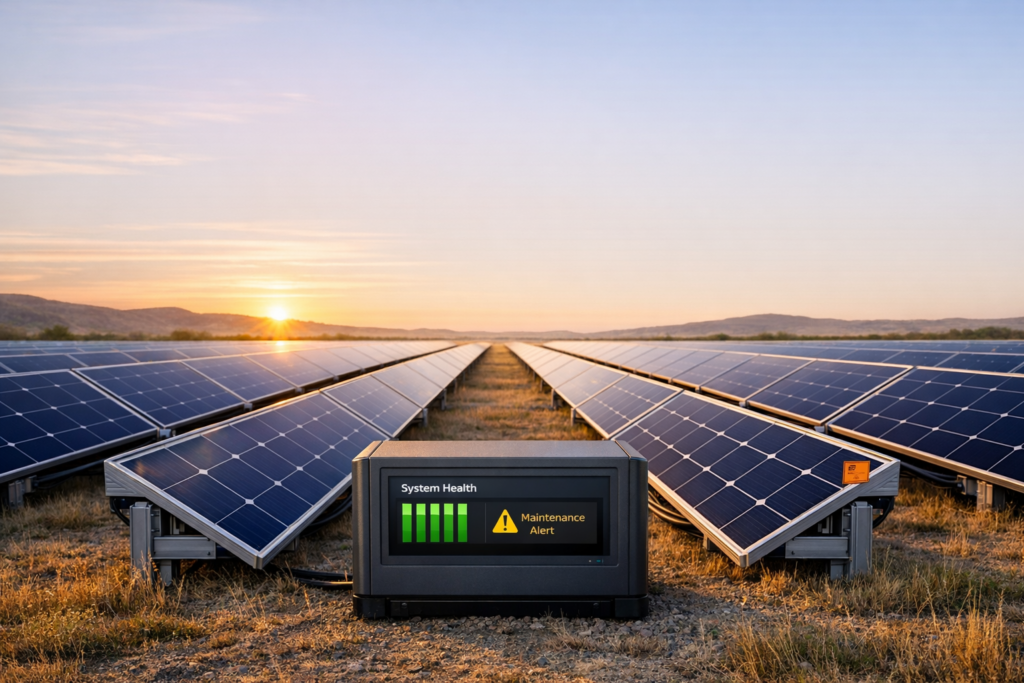
AI is reshaping solar monitoring by improving how solar systems are maintained and optimized. It uses advanced tools like machine learning, IoT sensors, and computer vision to detect issues early, reduce maintenance costs, and increase energy output. Key benefits include:
- Early Issue Detection: AI identifies faults like microcracks, hotspots, and soiling before they escalate.
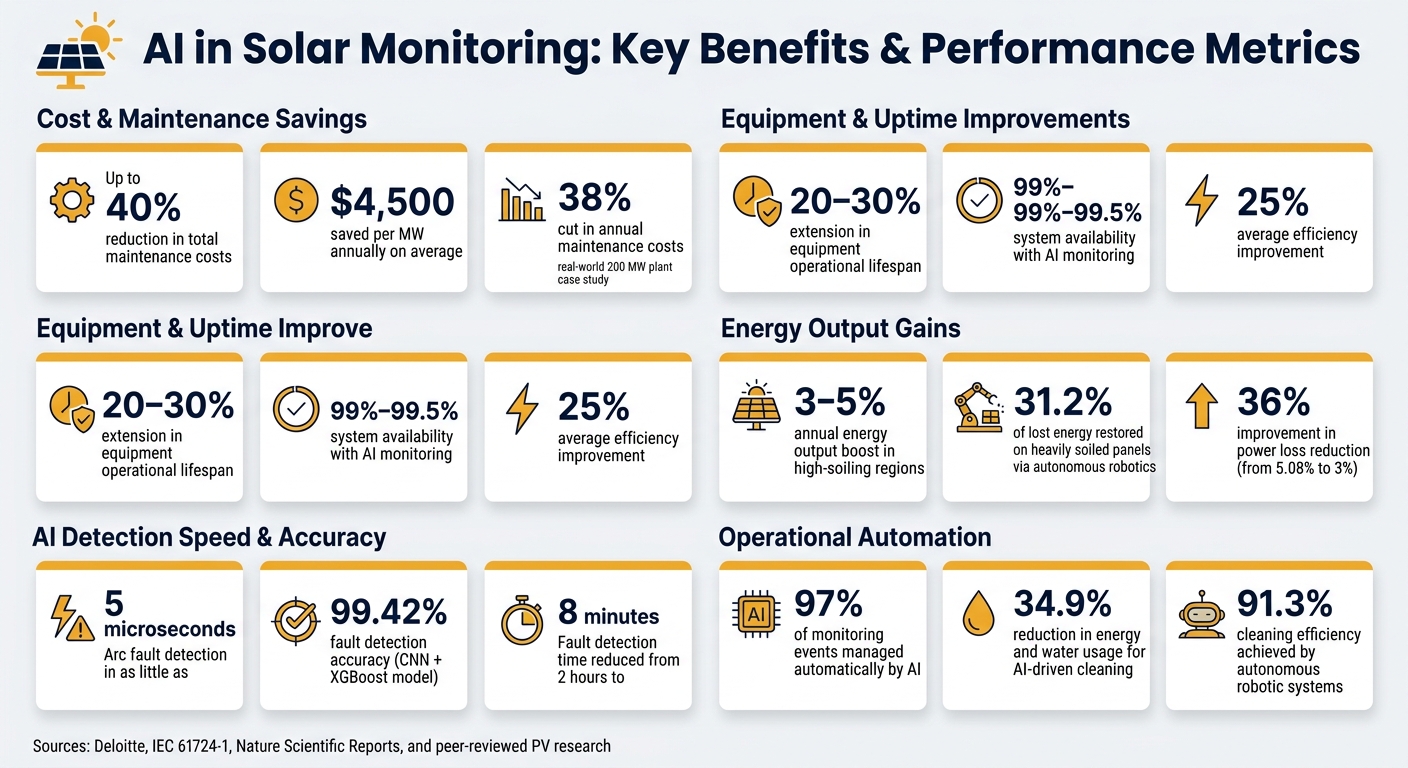
- Predictive Maintenance: By estimating a component’s Remaining Useful Life (RUL), AI schedules maintenance efficiently, cutting costs by up to 40%.
- Higher Efficiency: AI-driven cleaning and monitoring can boost energy production by 3–5% annually in high-soiling areas.
- Improved Safety: Advanced systems detect arc faults and overheating in seconds, reducing fire risks.
- Cost Savings: Operators save $4,500 per MW annually on average, with maintenance costs slashed significantly.
The integration of AI with real-time monitoring systems ensures solar panels perform at their best while lowering costs and risks. For operators, starting small – like testing AI in one workflow – can pave the way for better long-term results.
AI-Driven Predictive Maintenance for Solar Assets
Reactive vs. Predictive Maintenance
Reactive maintenance kicks in only after a failure or when inspections reveal an issue. This approach often leads to unexpected downtime and accelerated wear, which can seriously affect project profitability. As Oluwagbenga Apata from Tshwane University of Technology explains:
“The financial model of renewable energy systems is exceptionally sensitive to unplanned downtime and suboptimal performance.”
Predictive maintenance takes a proactive approach. Using AI, it continuously analyzes real-time sensor data to estimate a component’s Remaining Useful Life (RUL). This allows maintenance to be scheduled at the perfect time – not prematurely (wasting resources) or too late (causing damage). The table below highlights the differences between these two approaches:
| Factor | Reactive Maintenance | Predictive Maintenance (AI-Driven) |
|---|---|---|
| Timing | After a failure occurs | Before failure, based on RUL |
| Cost | High due to unplanned downtime | Lower through optimized scheduling |
| Data Usage | Minimal | High – multi-sensor and historical trends |
| Outcome | Restores function | Maximizes uptime and asset longevity |
AI Methods Used in Predictive Maintenance
AI technologies bring precision and reliability to predictive maintenance.
- Supervised learning models, such as Support Vector Machines (SVM) and XGBoost, analyze electrical data like voltage, current, irradiance, and humidity to classify faults. For instance, an SVM-based system achieved 92.1% accuracy in predicting when solar panels needed cleaning, slashing maintenance costs by 30%.
- LSTM networks (Long Short-Term Memory) excel at identifying gradual performance declines. When paired with hybrid CNN-LSTM architectures, they can enhance fault detection, achieving accuracy rates as high as 99.42% by combining CNN and XGBoost.
Measured Benefits of Predictive Maintenance
The advantages of AI-driven predictive maintenance are well-documented and impactful. Research shows it can reduce total maintenance costs by up to 40% while extending the operational lifespan of solar equipment by 20–30%. Efficiency gains average around 25%.
Energy recovery is another standout benefit. In regions prone to high soiling, such as the American Southwest, AI-optimized cleaning schedules can boost annual energy output by 3–5%. In some cases, autonomous robotic systems powered by AI have restored up to 31.2% of lost energy output on heavily soiled panels. For utility-scale solar farms, these improvements translate directly into higher revenue.
These predictive tools also integrate seamlessly with real-time monitoring systems, enabling early detection of anomalies and further protecting the health of solar assets.
Real-Time Monitoring and Anomaly Detection
Key Parameters Tracked in Asset Health Monitoring
Predictive maintenance thrives on the quality of the data it uses. Real-time monitoring focuses on several parameter categories, each shedding light on a unique aspect of system health.
| Metric Category | Key Parameters | Why It Matters |
|---|---|---|
| Electrical | Voltage, current, DC/AC power | Detects string disconnections, short circuits, and inverter faults |
| Thermal | Panel surface temp, ambient temp | Identifies hotspots, bypass diode failures, and overheating |
| Environmental | Irradiance (GHI/tilt), humidity, wind speed | Establishes the “ideal” performance baseline; flags soiling levels |
| Imaging | EL, IR, and RGB images | Identifies microcracks, delamination, snail trails, and other physical defects |
| Derived | Performance loss ratio, current/voltage error | Separates actual system degradation from weather-driven power drops |
Together, these metrics offer a detailed picture of system performance. For instance, the performance loss ratio helps distinguish between equipment wear and weather-related power fluctuations – something older methods struggled to achieve.
How AI Detects Anomalies Early
Real-time data becomes truly valuable when paired with AI’s ability to act on it swiftly. Early anomaly detection is key to maintaining asset health, and AI excels at spotting issues traditional inspections might overlook. Technologies like advanced EL imaging and IR thermography can now detect microcracks and hotspots in their infancy, allowing for preventive measures.
AI models constantly compare live voltage and current data to a predicted healthy baseline. When discrepancies arise, alerts are triggered long before problems escalate. For example, in a 500 kWp PV system in Ain El-Melh, Algeria, Random Forest and K-Nearest Neighbors (KNN) models identified string disconnections and module short circuits by analyzing voltage and current errors. The Random Forest model achieved an R² of 0.99657 for current prediction. This process even revealed a pyranometer misalignment that had been skewing the monitoring data.
Arc fault detection has also seen major advancements, with some systems now capable of detecting faults in as little as 5 microseconds. This speed is critical for safety, especially during events where every second counts.
How AI Prioritizes Alerts for Maintenance Teams
Spotting a problem is only part of the equation. For large solar installations, maintenance teams often face a flood of alerts daily. Deciding which ones need immediate action is just as crucial as early detection.
AI tackles this challenge by assigning severity scores based on how much an issue impacts energy production. High-priority problems like string disconnections or inverter failures, which cause significant power loss, are flagged for urgent attention. On the other hand, minor issues like soiling are marked for routine maintenance rather than emergency intervention. This ensures that teams focus their efforts where it matters most, improving both efficiency and cost management.
Transparency in this process is increasingly supported by Explainable AI (XAI). Tools like Grad-CAM (Gradient-weighted Class Activation Mapping) provide visual heatmaps, showing exactly where on a panel a defect is located and why it was flagged. A study in Nature Scientific Reports highlighted the importance of this approach:
“The inclusion of Grad-CAM–based interpretability enables transparent localization of defect regions, addressing a critical limitation of many existing PV fault detection studies that report high accuracy without interpretability.”
Operational and Financial Benefits of AI in Solar Monitoring
Better Asset Reliability and Uptime
One of the standout advantages AI brings to solar operations is the shift to condition-based maintenance. Instead of relying on fixed schedules, this approach focuses on addressing faults as they occur, which can extend the lifespan of equipment by 20% to 30%.
AI-powered real-time fault localization, which combines thermal imaging with electrical data, is a game-changer. It can accurately identify issues like microcracks, soldering faults, or disconnected cells, significantly reducing the time technicians spend troubleshooting. On top of that, using AI on edge hardware ensures decisions are made in under 50 milliseconds, allowing for almost instant autonomous responses that prevent faults from escalating.
These improvements in reliability don’t just enhance performance – they also pave the way for major cost savings.
Lower Operations and Maintenance Costs
AI doesn’t just improve reliability; it also slashes operational and maintenance expenses. Deloitte highlights this impact:
“AI-driven predictive maintenance can reduce maintenance expenses by up to 40%, enhance equipment life by 20–30%, and boost overall operational efficiency by 25%.”
For U.S. operators managing large solar portfolios, this translates into fewer site visits, more efficient cleaning schedules, and reduced labor costs. AI bridges workforce gaps by automating routine inspections and prioritizing alerts, enabling technicians to focus on critical tasks.
AI-driven cleaning systems, powered by reinforcement learning and robotics, further enhance efficiency. These systems cut energy and water usage by 34.9% while achieving 91.3% cleaning efficiency (reducing dust density from 3.9 to 0.28 mg/m³). In regions like the U.S. Southwest, where soiling can slash energy yield by 40% in a short period, such precision is not just helpful – it’s crucial.
Higher Energy Output and Improved Safety
Beyond operational and cost benefits, AI also boosts energy production and enhances safety. In 2025, operators faced an average power loss of 5.08%, costing $5,070 per MW. By integrating autonomous robotics and conducting quarterly inspections, they can reduce this loss to 3%, achieving a 36% improvement.
Safety is another critical area where AI shines. Fire is the second-largest source of losses for U.S. utility-scale solar, accounting for about 20% of total damages by dollar value. AI is particularly adept at identifying arc faults and overheating in junction boxes before they escalate into fires. Additionally, research shows a strong link (r = 0.87) between dust levels and thermal anomalies, meaning AI-driven cleaning schedules not only protect energy output but also reduce fire risks.
As Vikhyat Chaudhry, COO and CTO of Buzz Solutions, aptly noted:
“Small performance issues replicated across thousands of panels can materially impact yield.”
What to Know Before Implementing AI-Driven Solar Monitoring
If you’re looking to tap into the potential of AI-driven monitoring for solar systems, there are a few key areas to focus on. From ensuring high-quality data to rethinking operational workflows, here’s what you need to know.
Data Quality and System Integration Requirements
AI thrives on accurate, detailed data. Before diving into AI monitoring, make sure your sensors and data collection methods meet industry standards. For solar systems, the IEC 61724-1 standard is a good starting point. Specifically, Class A monitoring (detailed monitoring) is ideal for AI. It collects data like DC power at the array level and back-of-module temperature, in addition to basic AC power and irradiance metrics. This level of detail is crucial for AI to classify faults accurately.
On the other hand, Class C monitoring (simplified monitoring) falls short. It only captures total irradiance and AC energy output, which doesn’t provide the granularity AI needs for precise anomaly detection.
A robust monitoring system should include these five key data layers:
- AC output
- DC strings
- Module-level data
- Environmental parameters (like irradiance, wind, and soiling)
- Inverter health metrics (such as error codes and efficiency)
Skipping any of these layers can lead to blind spots, reducing AI’s accuracy. Additionally, time-stamping data with precision (using NTP) and maintaining a clear data taxonomy are essential for effective diagnostics.
Another important consideration is calibration. AI models need time to learn the unique characteristics of your solar plant. Typically, a 60-to-90-day calibration period is required for the AI to adjust to local weather patterns and hardware configurations, minimizing false positives.
These technical foundations are critical for making AI monitoring work effectively.
Organizational Changes Needed for AI Adoption
Adopting AI monitoring isn’t just about technology – it also requires significant shifts in how operations are managed. One of the biggest changes is moving from calendar-based maintenance to condition-based maintenance. Instead of sticking to fixed schedules, maintenance is triggered by real-time data on asset health.
This shift means teams need training to interpret AI diagnostics and prioritize tasks based on revenue impact. For example, a maintenance team might focus on repairs that minimize “loss avoided per hour”. Consider this: a 200 MW solar plant that implemented AI reduced fault detection time from two hours to just eight minutes, cut annual maintenance costs by 38%, and boosted power generation by 6.2%.
While AI excels at detection and triage, human expertise is still essential. Experts oversee the AI’s outputs to ensure accuracy and make final decisions. A good way to start is by piloting AI in a single workflow – like fault triage or optimizing cleaning schedules – before scaling up its use across the entire operation.
Once workflows are aligned with AI, integrating systems like SolarSuccess can further streamline operations.
How SolarSuccess ERP Supports AI Monitoring
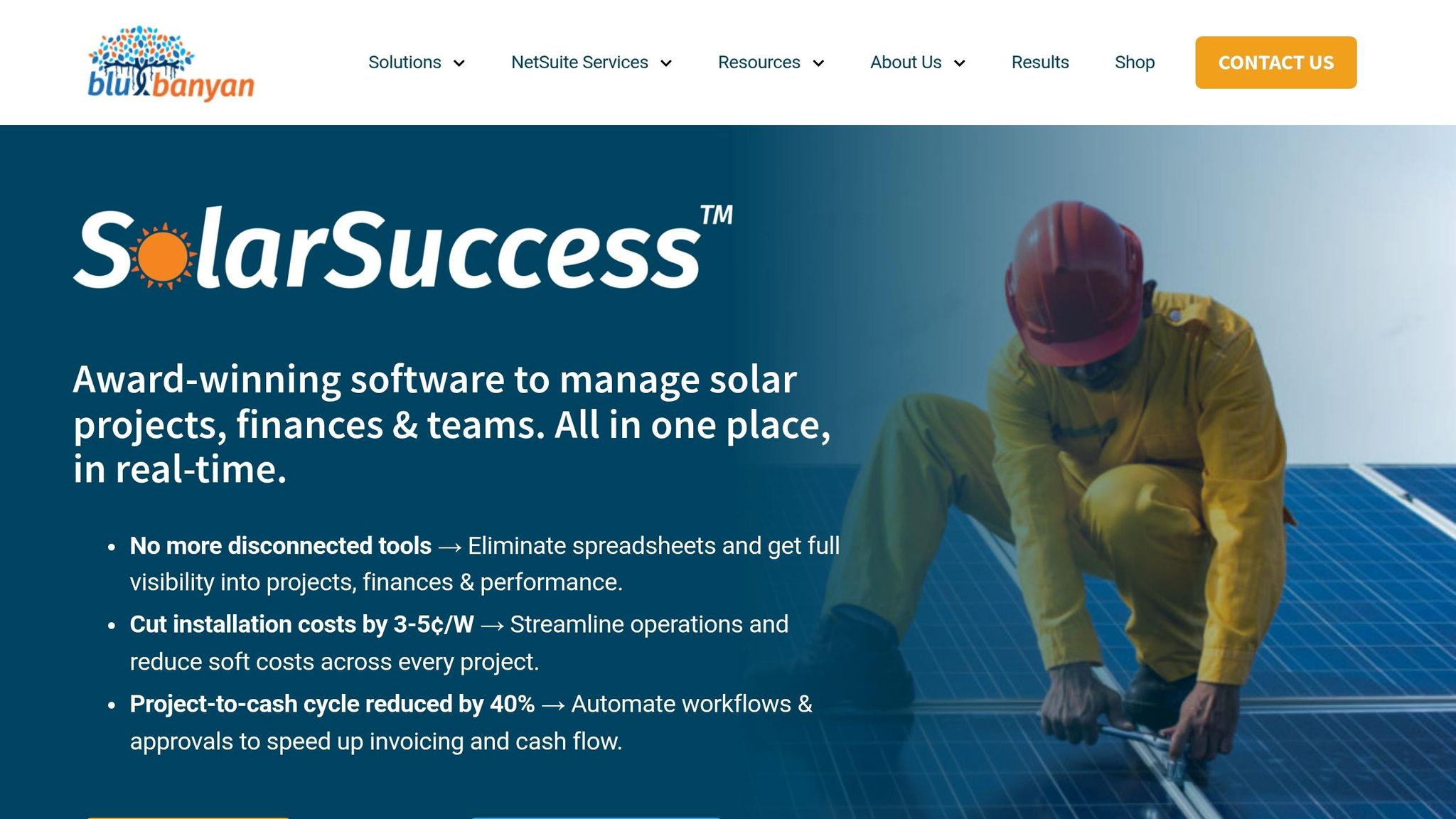
AI monitoring generates a constant flow of alerts, performance metrics, and maintenance triggers. But without a unified system, this data can end up scattered across spreadsheets, SCADA dashboards, and other disconnected tools. That’s where SolarSuccess ERP comes in.
SolarSuccess consolidates accounting, project management, CRM, and field operations into a single database. It integrates with major monitoring platforms, centralizing both technical and financial data [21][22]. This setup simplifies work orders, prioritizes maintenance, and tracks costs, cutting down on operational inefficiencies. This is particularly important given that soft costs – like permitting and ongoing maintenance – can make up 65% of the total cost of a new solar system [21].
Clive Smith, Chief Business Development Officer at Blu Banyan, explained it best:
“The only way to make that happen is with an integrated or unified application suite on a single database.” [21]
Titan Solar Power, one of the top residential solar installers in the U.S., is a great example of this in action. In February 2020, they moved from a fragmented project management system to the NetSuite-SolarSuccess platform. The results? Reduced labor for partner commission payouts, shorter project installation times, and real-time visibility into operational data [21]. Aaron Casillas, Technology and Infrastructure Director at Titan Solar Power, shared:
“Sharing data across these systems was difficult, and in most cases our only way to ‘patch the holes’ was by adding labor. We wanted to get everything on one system.” [21]
Blu Banyan’s SuiteApps – like bluDocs for document management and bluTime for field timekeeping – further enhance this ecosystem, streamlining workflows and supporting effective AI monitoring.
Conclusion: The Case for AI in Solar Asset Health
AI-powered monitoring is becoming a game-changer for solar operators. Over the last five years, equipment-related losses have surged from 1–2% to more than 5%, and traditional monitoring methods are struggling to keep pace.
With AI, the landscape changes dramatically. These systems can automatically manage 97% of monitoring events, significantly reducing the burden on engineering teams who would otherwise be overwhelmed by noisy SCADA alerts. The benefits are clear: system availability increases to 99%–99.5%, operations and maintenance (O&M) costs drop by as much as 40%, and portfolios can achieve average savings of $4,500 per MW annually. These results are already being seen in large-scale solar operations and tie back to earlier discussions on predictive maintenance and anomaly detection.
Beyond operational improvements, AI tackles risks that traditional monitoring often misses. From arc faults to fire risks and forecasting challenges, AI’s proactive approach is starting to deliver measurable financial benefits for operators. Francesco Borrelli, Chief AI and Robotics Officer at Nextpower, highlights this shift:
“AI and robotic services are establishing a new standard for how solar assets are monitored, verified and optimized over their lifecycle.”
For solar companies looking to adopt AI, starting small is key. Focus on one workflow, ensure high-quality data, and integrate systems to turn AI insights into actionable outcomes – not just notifications. As discussed earlier, strong data practices and system integration are essential for unlocking these benefits. With AI, solar operators can now directly connect their monitoring efforts to tangible business improvements.
FAQs
What data is required for AI solar monitoring?
AI-driven solar monitoring relies on a combination of electrical and environmental data, usually gathered through IoT sensors. These sensors collect essential inputs such as:
- Terminal current and voltage: Crucial for assessing the system’s electrical performance.
- Temperature and humidity: Environmental factors that can influence energy output.
- Light levels and dust concentration: Key indicators of how external conditions affect solar panel efficiency.
For more advanced diagnostics, additional tools like electroluminescence imaging or infrared thermography may come into play. These techniques provide deeper insights into panel conditions, such as detecting micro-cracks or overheating.
Once collected, this data is fed into machine learning models designed to perform tasks like anomaly detection, fault classification, and power generation forecasting. These processes help optimize performance and ensure the reliability of solar energy systems.
How long does AI take to calibrate for my solar site?
The provided sources don’t mention exactly how long AI calibration takes for a specific solar site. However, they do talk about broader deployment timelines and efficiency gains. For instance, a predictive maintenance project in Arizona took 18 months to fully deploy. Once up and running, it cut response times dramatically – from 72 hours to just 4 hours. For precise calibration details tailored to a site, it’s best to check the study or consult the vendor’s implementation guidelines.
How do I turn AI alerts into work orders and cost tracking?
Integrating solar monitoring data with an ERP system, such as SolarSuccess by Blu Banyan, allows you to automate AI alerts directly into work orders. By setting up specific triggers, the system can automatically generate work orders whenever sensors identify problems like overheating. This approach not only streamlines issue resolution but also tracks labor, parts, and costs in real time. The result? Accurate profitability insights without the need for manual updates.
