
Managing cash flow is a big challenge for U.S. solar companies. High upfront costs, project delays, and milestone-based billing often lead to financial bottlenecks. On top of that, disconnected tools like spreadsheets and standalone apps make tracking revenue, inventory, and commissions prone to errors.
The solution? ERP systems that unify accounting, project management, and inventory into a single platform. For solar businesses, tools like Blu Banyan‘s SolarSuccess, Oracle NetSuite, and Sage Intacct offer unique features to improve financial visibility, automate invoicing, and forecast cash flow.
Here’s a quick rundown of what each offers:
- Blu Banyan SolarSuccess: Tailored for solar companies with features like milestone billing, ITC compliance, and real-time budget adjustments.
- Oracle NetSuite: A general ERP platform with strong automation and financial tools but requires customization for solar-specific needs.
- Sage Intacct: Focused on mid-market businesses, offering automated AR/AP but not solar-specific workflows.
Key takeaway: Blu Banyan SolarSuccess stands out for solar-specific needs, while Oracle NetSuite and Sage Intacct are better suited for broader or mid-market applications.
1. Blu Banyan SolarSuccess

SolarSuccess is a solar-focused ERP system built directly on Oracle NetSuite. Operating on a unified database, it combines accounting, CRM, project management, and inventory management. This integration serves as the backbone for several advanced features, which are detailed below.
Real-Time Financial Visibility
SolarSuccess equips finance teams and project managers with role-specific dashboards that display live data. This real-time insight allows users to track project costs, profitability, and timelines as they unfold. For instance, Norwich Solar leveraged these capabilities to consolidate an unlimited number of subsidiaries, significantly reducing accounting time and enabling more precise pricing decisions [1].
AR/AP and Billing Automation
The platform automates invoicing at key project milestones and manages accounting entries for deferred revenue, work-in-progress (WIP), and commissions. This automation shortens the project-to-cash cycle by 40%, speeding up receivables. Ipsun Solar, for example, integrated SolarSuccess with the Paystand payment portal to streamline its processes [1]. Titan Solar Power, the third-largest residential solar installer in the U.S., also saw impressive results after implementing SolarSuccess in February 2020. Aaron Casillas, Technology and Infrastructure Director at Titan Solar Power, shared:
“With NetSuite, we’ve significantly decreased the amount of labor involved in paying out our partners, and made that process very consistent across the board.” [3]
Project and Inventory Management
The system ensures real-time tracking of inventory levels and automatically creates purchase orders based on Bills of Materials (BOM). This functionality prevents over-ordering and ensures materials align with actual project schedules. The result? A 20% improvement in project material accuracy and a reduction in installation costs by 3–5¢ per watt [1].
Cash Flow Forecasting
SolarSuccess integrates seamlessly with bluBudget, which received an Honorable Mention in Solar Power World’s 2025 Top Products competition. This integration links project timelines directly to cash forecasting for solar installers. When project schedules change, the budget updates automatically. As Blu Banyan explains:
“When project timelines shift – as they often do in solar – budget timing updates automatically… This alignment cuts carrying costs, keeps forecasts grounded in reality, and gives project-based teams a clearer picture of cash needs.” [1]
2. Oracle NetSuite Standard ERP
Oracle NetSuite Standard ERP is a widely used cloud platform that integrates accounting, CRM, project management, and inventory into a single database. Here’s how it provides streamlined financial management.
Real-Time Financial Visibility
NetSuite’s unified database eliminates the hassle of manual reconciliations between separate systems, offering finance teams and project managers a single, reliable source of data. For solar installers, this means they can monitor indirect costs like permitting, financing, and installation, which can make up as much as 65% of total system costs [3]. Customizable dashboards allow project managers to set up role-specific KPIs and alerts, including weather portlets that can highlight potential delays before they disrupt cash flow [3]. These tools help address the challenges of siloed data and delayed decision-making.
AR/AP and Billing Automation
NetSuite simplifies cash management by automating invoicing and payment processes throughout a project’s lifecycle. On the accounts payable side, AI-driven Bill Capture and three-way matching help process invoices efficiently while minimizing errors and overpayments. For collections, the Dunning Letters SuiteApp automates reminder emails, escalating from gentle reminders near the due date to formal notices for accounts overdue by 30+ days. It also supports various billing schedules, including milestone-based, recurring, or subscription contracts, with invoices automatically generated from sales orders.
“Because of NetSuite, we haven’t had to add additional headcount to manage AP and the procurement process.” – Erik Zhou, Chief Accounting Officer, Brex
Project and Inventory Management
NetSuite enables automatic purchase order generation from BOMs (Bills of Materials), facilitating just-in-time ordering and reducing the amount of capital tied up in inventory [2]. Additionally, project milestones automatically trigger accounting events, ensuring that invoicing stays aligned with the actual progress of work. This addresses delays in milestone billing mentioned earlier [3].
Cash Flow Forecasting
The Cash 360 dashboard provides a rolling six-month cash flow forecast based on live AR, AP, and bank balance data. Billing schedules are integrated directly into these forecasts, distributing cash impact according to due dates rather than recording the full amount at once, which helps avoid distortions. Finance teams can also simulate one-time expenses, like major equipment purchases, without altering the general ledger. This continuous cash flow insight is critical for maintaining financial discipline in solar projects.
3. Sage Intacct ERP

Sage Intacct is designed for mid-market companies aiming to simplify cash flow management through automation. This cloud-based financial management platform handles accounting and finance software, making it easier to oversee cash flow while reducing manual effort. Its foundation in automation extends to advanced features for accounts receivable (AR) and accounts payable (AP).
AR/AP and Billing Automation
Sage Intacct leverages AI and machine learning to streamline accounts payable with paperless invoice processing. Features like automated general ledger coding and multi-level approval routing help prevent delays in payments. On the accounts receivable side, it automates tasks such as recurring invoices and dunning notices. It also integrates with payment gateways like Stripe and PayPal, speeding up collections. For businesses with complex billing needs, Sage Intacct supports subscription billing and handles intricate pricing models like usage-based and tiered pricing – making it a great fit for projects like solar energy subscriptions.
Pros and Cons of Each ERP System
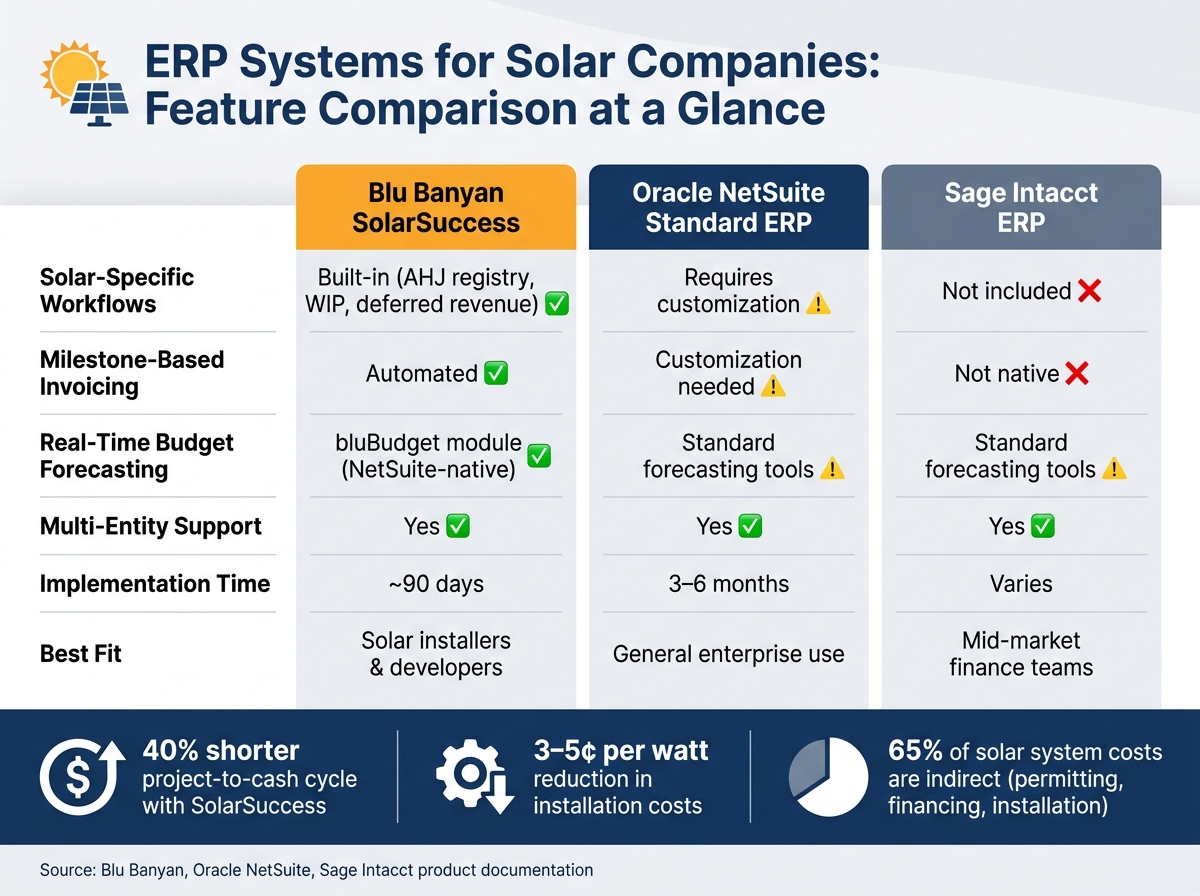
When it comes to cash flow management in solar operations, the right ERP system can make all the difference. Here’s a closer look at the strengths and limitations of three key platforms, each offering unique benefits and challenges for solar businesses.
Blu Banyan SolarSuccess stands out as a system designed specifically for the solar industry. Its standout features include milestone-based invoicing, which triggers accounting events as project stages are completed, and the bluBudget module, which adjusts budget timing in real time as schedules change. Together, these tools improve financial accuracy and help protect margins [1][4]. However, the system’s implementation time – about 90 days – may be a hurdle for companies needing a solution quickly.
Oracle NetSuite Standard ERP offers a comprehensive, unified database that eliminates data silos and ensures real-time financial visibility. Its customization framework is highly flexible, accommodating a wide range of business needs. That said, it lacks built-in solar-specific features. Functions like AHJ tracking, financier document templates, and milestone-based invoicing require additional customization or third-party solutions.
Sage Intacct ERP is a favorite among mid-market finance teams for its strong accounting capabilities. However, it’s not tailored to solar-specific workflows. Teams managing tasks like permit cycles, equipment procurement, or project-based revenue recognition may find themselves relying on workarounds to fill the gaps.
| Feature | Blu Banyan SolarSuccess | Oracle NetSuite Standard ERP | Sage Intacct ERP |
|---|---|---|---|
| Solar-Specific Workflows | Built-in (AHJ registry, WIP, deferred revenue) | Requires customization | Not included |
| Milestone-Based Invoicing | Automated | Customization needed | Not native |
| Real-Time Budget Forecasting | bluBudget module (NetSuite-native) | Standard forecasting tools | Standard forecasting tools |
| Multi-Entity Support | Yes | Yes | Yes |
| Implementation Time | ~90 days | Varies (typically 3–6 months) | Varies |
| Best Fit | Solar installers & developers | General enterprise use | Mid-market finance teams |
This comparison highlights the varying ways these ERP systems address cash flow challenges, helping solar businesses weigh their options based on their specific needs and timelines.
Conclusion
Solar companies in the U.S. often grapple with cash flow challenges caused by delayed invoices, manual budgeting processes, disconnected procurement systems, and postponed revenue recognition. Addressing these issues requires solutions tailored specifically to the solar industry’s needs, as general-purpose systems often fall short.
While platforms like Oracle NetSuite Standard ERP and Sage Intacct offer solid accounting foundations, they frequently require expensive and time-consuming customizations to handle solar-specific requirements like milestone billing, WIP accounting, and financier documentation. These added complexities can strain both time and budgets.
Blu Banyan SolarSuccess, a solution built natively on Oracle NetSuite, bridges this gap by automating milestone-based invoicing and tackling common cash flow issues through its bluBudget module. This solar-specific ERP automation can potentially shorten the project-to-cash cycle by 40% and reduce installation costs by as much as 3–5¢ per watt [1].
“Having a unified system that ties your accounting system to your supply chain, project management, CRM, marketing, and fulfillment systems allows you to see your cash flow and measure efficiencies across multiple areas.” – Blu Banyan [1]
FAQs
Which ERP features improve solar cash flow the most?
When it comes to managing solar projects, certain ERP features can make a big difference in cash flow. Here’s how:
- Real-time data synchronization: This ensures that financial and project data are always up to date, reducing errors and keeping everyone on the same page.
- Automated milestone-based invoicing: By automating invoices tied to project milestones, you can avoid delays and ensure timely payments.
- Integrated workflows: Streamlined workflows speed up billing and approval processes, cutting down on bottlenecks.
These tools work together to simplify invoicing, minimize delays, and provide instant updates across financial and project systems. The result? Faster cash flow and smoother operations.
How does milestone billing speed up collections?
Milestone billing speeds up collections by generating invoices automatically at crucial project phases. This approach cuts down on manual tracking, reduces delays, and ensures invoices align with the agreed contract terms. By simplifying the invoicing process, businesses can boost cash flow and maintain stronger financial oversight.
What should I track to forecast cash flow per project?
To predict cash flow for each project, keep a close eye on project costs, timelines, upcoming expenses, milestone payments, and revenue projections. By integrating real-time financial data with your milestone schedules, you can better anticipate when money will come in and go out. This method helps align cash flow forecasts with your project’s timeline, giving you a clearer financial picture.
