

In solar projects, effective vendor management is essential to avoid delays, faulty equipment, and financial losses. Poor vendor choices can lead to missed deadlines, warranty issues, and increased costs. Here’s what you need to know:
- Vendor Selection: Evaluate financial stability, certifications (e.g., IEC 61215, UL), and references. Include factory audits and traceability clauses in contracts.
- Cost vs. Quality: Focus on long-term value, not just price. Use metrics like Net Present Value (NPV) and enforce penalties for delays or non-compliance.
- Performance Tracking: Monitor KPIs like delivery rates, warranty claims, and equipment availability (target 98-99%+ annually).
- Tools and Technology: Use solar ERP systems like SolarSuccess to centralize data, automate compliance tracking, and integrate vendor communication tools like bluChat and bluConnect.
Key Insight: Strong vendor relationships and structured evaluations reduce risks and improve project outcomes. By combining clear contracts, performance monitoring, and integrated tools, you can maintain a reliable supply chain and ensure long-term success in solar projects.
How to Select the Right Vendors for Solar Projects
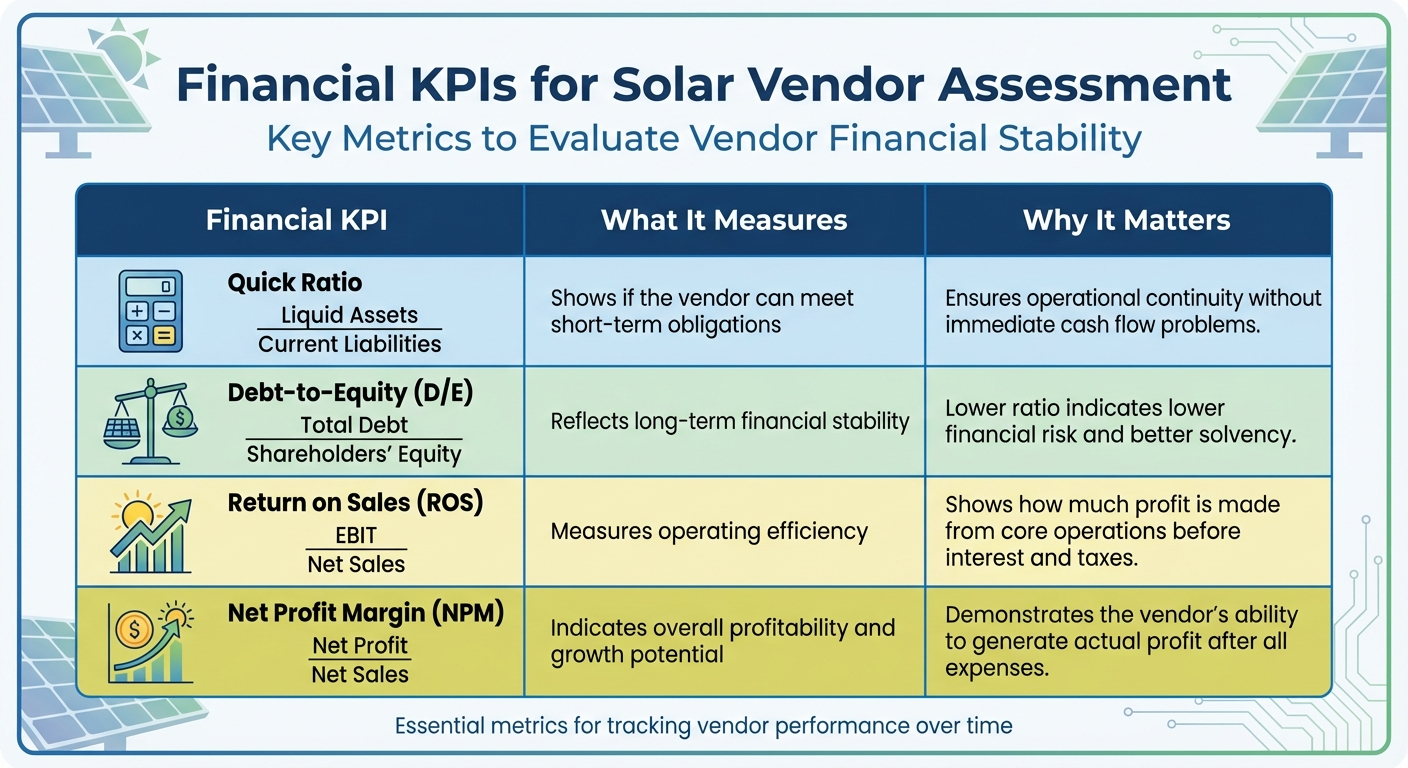
Financial KPIs for Solar Vendor Assessment: Quick Ratio, Debt-to-Equity, ROS, and NPM
Choosing the right vendors for solar projects is crucial. Reliable vendors ensure timely delivery of quality materials and possess the financial stability to uphold 20–25-year warranties. A single oversight can lead to warranty disputes, delays, and revenue loss.
Assessing Vendor Experience and Financial Stability
Start by reviewing the vendor’s financial health. Request audited financial statements from the last two to three years to confirm their ability to honor long-term warranties. Check their order backlog and warranty reserves to ensure they have enough cash flow to support future obligations. While TIER ratings can be helpful, back them up with independent product quality reviews.
Certifications are another critical factor. Look for compliance with standards like IEC 61215 (design qualification), IEC 61730 (safety), and UL certifications. For larger projects, independent lab scorecards from organizations like PVEL, DNV, or TÜV can highlight issues such as Potential Induced Degradation (PID), which internal checks might overlook. Customer references are invaluable – evaluate their performance on similar projects and, if feasible, conduct a pre-production factory audit to assess material checks, production processes, and traceability.
"The module’s weakest part usually determines field life." – Rayzon Solar
To address future defects, include contractual clauses requiring vendors to maintain Bill of Materials records and track serial numbers. This ensures components can be traced if issues arise later. Additionally, confirm that the vendor has local service centers and a defined escalation process for technical support to minimize downtime during operations and maintenance.
Balancing Cost and Quality in Vendor Selection
Avoid focusing solely on upfront costs. While a cheaper module may reduce initial expenses, it could lead to higher operations and maintenance costs if it degrades faster. To get a comprehensive view of costs, use a Net Present Value (NPV) analysis that factors in degradation rates and labor costs.
For quality control, apply ISO 2859 sampling during production and pre-shipment testing. This approach helps balance thorough evaluations with cost efficiency. Protect your investment with contractual safeguards, such as Liquidated Damages for delivery delays, Service Level Agreements (SLAs) for energy yield, and penalties for non-compliance with labor or environmental regulations. Ensure that PAN files used for yield modeling are verified by third-party labs and align with the module datasheet to avoid overestimating revenue potential.
Considering that 87% of organizations have faced disruptions due to vendor issues in the past three years, thorough due diligence is non-negotiable. Segment vendors by risk level and their importance to your operations to allocate oversight resources effectively. This sets the stage for a systematic, data-driven evaluation.
Using Data-Driven Tools to Compare Vendors
A weighted scoring matrix simplifies vendor comparisons by assigning specific importance to each evaluation criterion. For example, you might allocate 30% to financial stability, 40% to product quality, and 30% to delivery time. Limit your criteria to five to ten key factors and establish clear scoring guidelines to ensure consistency.
"A vendor or supplier selection matrix makes it easier to compare suppliers by using criteria that matter most to your organization." – Kali Geldis, Graphite Connect
During the selection process, monitor Ex-Ante KPIs like Internal Rate of Return (IRR), expected Performance Ratio (PR), and financial stability metrics such as the Quick Ratio and Debt-to-Equity Ratio. Research shows that companies with strong procurement practices operate at 21% lower costs than their competitors, highlighting the value of structured evaluations.
| Financial KPI | What It Measures | Why It Matters |
|---|---|---|
| Quick Ratio | Liquid Assets / Current Liabilities | Shows if the vendor can meet short-term obligations |
| Debt-to-Equity (D/E) | Total Debt / Shareholders’ Equity | Reflects long-term financial stability |
| Return on Sales (ROS) | EBIT / Net Sales | Measures operating efficiency |
| Net Profit Margin (NPM) | Net Profit / Net Sales | Indicates overall profitability and growth potential |
These metrics are essential for tracking vendor performance over time. Combine TIER ratings with factory audits, product testing, and third-party technical evaluations accredited to ISO 17020 or ISO 17025. This comprehensive approach helps establish long-term partnerships and reduces vendor-related risks. With a solid evaluation framework in place, you’ll be well-prepared to build lasting relationships with your chosen vendors.
sbb-itb-2560759
Building Long-Term Vendor Relationships
Choosing the right vendors is just the beginning. The true value lies in developing these partnerships into long-term collaborations instead of treating them as one-off transactions. After carefully selecting vendors based on clear criteria, the next step is fostering a relationship built on trust and open communication. Strong vendor relationships can lower costs, encourage new ideas, and bring stability to your supply chain.
"A vendor relationship is like a marriage. Companies need to find people who understand their unique rules and ethics, and nurture that relationship."
– Tom Reid, Consultant, Subcontract Management Institute
Start by taking a hard look at your current vendor relationships. Evaluate their ability to innovate, deliver accurate forecasts, and maintain reliability. Then, set up open discussions to identify any weaknesses and agree on action plans that go beyond the basics of the contract. This approach builds a foundation for partnerships that deliver more value over time. Once vendors are selected with care, strengthening these relationships becomes a key strategy for keeping your supply chain efficient.
Setting Up Clear Communication Channels
Consistent and direct communication is essential for building stronger vendor relationships. Surprisingly, brief and regular phone calls can often create better connections than infrequent emails. Consider setting up monthly calls or in-person meetings to maintain an ongoing dialogue, rather than relying on occasional email updates. From the start, establish clear expectations by defining performance guidelines, response times, and escalation procedures. It’s also helpful to visit a vendor’s facility early in the relationship to gain a better understanding of their operations.
Leverage tools like bluChat for instant messaging and file sharing, or bluConnect to integrate external vendor systems with your NetSuite ERP. These platforms allow real-time collaboration, keeping everyone on the same page about project status, inventory, and delivery schedules.
Address critical operational details early in the relationship. For example, clearly define your Return Material Authorization (RMA) process, including whether the supplier will cover labor costs for diagnosing or replacing defective equipment. Also, ensure your vendor doesn’t compete with your business – such as by deploying their own sales team or limiting your ability to sell other products.
Once communication practices are in place, formalizing them in well-drafted contracts can further solidify the partnership.
Negotiating Contracts That Work for Both Parties
A well-structured contract can transform a simple transaction into a lasting partnership. Poor contract management, on the other hand, can cost companies up to 9% of their profits, making careful negotiation a top priority.
Use Service Level Agreements (SLAs) or Scopes of Work (SOW) to clearly outline expectations, compliance requirements, and penalties for underperformance. For solar EPC projects, a "full‑wrap" contract with a single point of liability and fixed‑price terms ensures accountability and financial predictability. Fairly distributing risks is equally important. For instance, in operations and maintenance contracts, guaranteeing 99%+ availability at the inverter level ties vendor performance directly to revenue goals.
"Whatever field you are in, it’s a small world – you either have a good reputation for dealing with vendors, or a bad one. That’s why being transparent and fair… is so critical."
– Laurie A. Brednich, CEO and Founder, HR Company Store
Avoid automatic renewals for critical services. Instead, set reminders 30–60 days before the contract ends to reassess the market and renegotiate terms if needed. Using standardized solar contract templates can also boost transparency and accountability, speeding up deployment while cutting down on development time and costs. Consider adding bonus structures to reward vendors for exceeding targets, and include a joint exit strategy – aligned with ISO 4401 standards – to protect both parties if termination becomes necessary.
Tracking Vendor Performance and Managing Risks
Once you’ve established strong vendor partnerships, it’s crucial to measure how well they deliver on their commitments. Regular performance tracking and risk assessments can help you catch potential problems early, allowing you to decide whether to retain, coach, or replace a vendor.
Setting Up Key Performance Indicators (KPIs)
Choosing the right KPIs depends on the vendor’s role. For O&M (Operations and Maintenance) service providers, focus on operational responsiveness. A key metric is Response Time, which includes both Acknowledgement Time (how quickly a fault is recognized) and Intervention Time (how long it takes to arrive on-site). Aim for an 80/20 split between preventive and corrective maintenance. If your vendor leans too heavily toward corrective efforts, it may indicate frequent unplanned equipment failures – a red flag for reliability issues.
For EPC (Engineering, Procurement, and Construction) contractors, the project management triangle – time, budget, and quality – serves as a key framework. Monitor metrics like the percentage of missed milestones (indicating time delays) and compare actual versus planned costs to track cost overruns. Set a zero-tolerance KPI for Critical Milestones Missed, such as delays in grid connections or permit approvals, as these can derail an entire project. Additionally, track non-conformities, such as code deviations or safety breaches, and use weighted scoring to calculate an overall quality deviation score.
Another important metric is availability guarantees. Industry standards for Minimum Guaranteed Contractual Availability typically range from 98% to 99%+ annually, measured at the inverter level. This excludes downtime caused by external factors like snow, grid outages, or vandalism. For residential and commercial installers, focus on Installation Cycle Time, which measures the duration from contract signing to Permission to Operate (PTO). Leading vendors complete installations in 60–90 days, significantly faster than the national average. Keep Change Order Rates under 5% to reflect efficient design and sales processes.
These KPIs provide a foundation for deeper analysis through regular audits and risk reviews.
Running Regular Audits and Risk Reviews
While KPIs shed light on performance, audits help uncover process-level issues. Conduct annual risk reviews with key vendors to establish a performance baseline and identify potential threats. These reviews should evaluate aspects like financial stability, operational capacity, and adherence to health and safety standards.
Factory audits are particularly valuable for component suppliers. A pre-production factory inspection ensures that materials, staff training, equipment calibration, and process documentation meet your standards. During production, inspections verify that vendors stick to the agreed manufacturing lines and use the specified Bill of Materials (BOM), reducing the risk of unauthorized substitutions. Before shipment, Factory Acceptance Testing (FAT) checks samples for compliance with visual, electrical, and packaging standards.
For O&M contractors, physical inspections can reveal early warning signs – also called "ex-ante" data – of potential performance or safety issues before they escalate into system failures. During the transition from construction to operations, a Punch List with clear pass/fail criteria for each component helps document existing issues and ensures a shared understanding of the plant’s condition, preventing future disputes.
Integrating ERP systems like SolarSuccess can streamline the entire review process by connecting performance metrics with audit findings. SolarSuccess centralizes contracts, certifications, and performance data, while real-time dashboards monitor KPIs – like Performance Ratio (PR) and Technical Availability – without the need for manual data consolidation. Tools like bluConnect integrate external vendor systems with your NetSuite ERP, keeping inventory levels, delivery schedules, and compliance documents up to date. This level of visibility allows you to spot trends, such as declining on-time delivery rates, and address them before they become major issues.
Using ERP Systems to Manage Vendors
Implementing solar ERP software eliminates the inefficiencies of managing vendor contracts, spreadsheets, and certifications with separate systems. When procurement, accounting, and project management teams rely on disconnected tools, data becomes fragmented and outdated. SolarSuccess solves this by centralizing vendor data, providing real-time visibility into performance, costs, and compliance.
Getting Real-Time Visibility Through Data Integration
SolarSuccess consolidates vendor records, contracts, and performance metrics into one single source of truth. This seamless integration ensures that when your sales team closes a deal, procurement teams instantly see updated inventory requirements, and accounting can track vendor invoices against approved purchase orders – no manual data entry needed.
With real-time dashboards, you gain insights into vendor activity and spending trends. For example, Jennifer Heitt, Financial Controller at Platinum Stairlifts, describes how NetSuite (the backbone of SolarSuccess) supports their operations:
"We use NetSuite for absolutely everything: for assisting sales teams and providing personalized quotes to customers, for driving materials requirements, communicating with suppliers, processing production orders and delivery notes".
This level of integration allows solar companies to identify trends – like declining on-time delivery rates or rising costs – before they cause project delays.
Additionally, the system automates compliance tracking, monitoring vendor certifications, insurance policies, and regulatory requirements. With 49% of organizations experiencing vendor-related cyber incidents in 2024, automated alerts for expiring credentials help mitigate risks before they lead to liabilities. Vendor scorecards track key metrics like lead times, defect rates, and on-time delivery rates, providing objective data to guide renewal decisions or performance improvement discussions. By linking analytics directly to actionable communication, SolarSuccess strengthens vendor management across operations.
Effective communication tools further enhance these benefits by streamlining vendor coordination.
Improving Collaboration with bluChat and bluConnect
While real-time data improves oversight, effective communication tools ensure updates are acted on promptly. Scattered email threads often make it hard to maintain a clear audit trail of vendor communications. bluChat solves this by integrating discussions directly into the ERP system, linking conversations to specific vendor records and project milestones. This means that if a procurement manager needs to reference a past discussion about delivery schedules or material specs, the entire history is readily available – not lost in someone’s inbox.
bluConnect takes this a step further by synchronizing external supplier data with your NetSuite ERP. Inventory levels, delivery schedules, and compliance documents update automatically. For instance, if a panel supplier adjusts their stock availability, that change flows directly into your procurement module, enabling quicker purchasing decisions without manual effort. Jan Rippingale, CEO of Blu Banyan, highlights why this integration matters:
"When you’re working with incompatible, incomplete, out-of-date data, it can turn into a nightmare pretty quickly. To improve efficiency and profitability, solar installers must have real-time visibility into their entire end-to-end businesses".
Conclusion
Managing vendors effectively in the solar industry revolves around reducing risks, improving efficiency, and ensuring the success of long-term projects.
"Vendor selection isn’t just procurement – it’s risk management. One bad choice can cost months of delays, warranty headaches, reduced energy yield, and real financial loss".
Top-performing companies take a structured approach by independently verifying certifications, conducting factory audits before production, defining clear Division of Responsibility matrices, and tracking critical KPIs like 99%+ availability. They also rely on standardized contracts with transparent pricing to ensure all parties are aligned. This meticulous process creates a solid foundation for introducing technology to optimize operations further.
Enterprise Resource Planning (ERP) solutions play a pivotal role in this transformation. By automating compliance tracking and providing real-time data insights, ERP systems shift vendor management from being reactive to proactive. For example, SolarSuccess consolidates vendor data, automates workflows, and serves as a centralized hub for procurement, project management, and accounting teams. In an environment where vendor-related risks are on the rise, tools that monitor certifications and performance metrics automatically are becoming indispensable.
Additional tools like bluApps like bluChat and bluConnect enhance collaboration and efficiency. bluChat ties conversations directly to vendor records, ensuring seamless communication, while bluConnect keeps inventory levels, delivery schedules, and compliance documents up to date by syncing data from external suppliers. Together, these tools streamline operations and improve coordination across teams.
FAQs
What contract clauses best protect my solar project from vendor failures?
To protect your solar project from potential vendor setbacks, it’s crucial to include specific contract clauses like performance guarantees, liquidated damages, and termination provisions.
- Performance guarantees ensure that vendors deliver work that meets agreed-upon standards, giving you a layer of assurance.
- Liquidated damages provide financial recourse in cases of delays or subpar work, helping to offset any losses you might face.
- Termination provisions give you the ability to exit the contract if the vendor defaults or fails to resolve critical issues.
These clauses promote accountability and reduce the risks associated with vendor performance.
Which KPIs matter most for solar vendors, and how often should I review them?
Key performance indicators (KPIs) for solar vendors focus on vendor performance, cost management, and reliability metrics. Conducting regular reviews – whether monthly or quarterly – is crucial for maintaining efficiency and ensuring vendors consistently meet expectations. By keeping a close eye on these metrics, you can fine-tune operations and ensure both performance and cost remain on track.
How can an ERP like SolarSuccess simplify vendor compliance and communication?
An ERP system like SolarSuccess makes managing vendor compliance and communication much easier by bringing everything into one central hub. It keeps contracts, certifications, and performance metrics all in one place, which helps cut down on compliance risks. Automated workflows take care of tasks like invoice processing, approvals, and procurement, reducing the chances of errors along the way. Plus, real-time tracking helps you keep a closer eye on vendor performance and delivery schedules. This not only boosts efficiency and transparency but also ensures everything stays aligned with regulations and contracts.
