
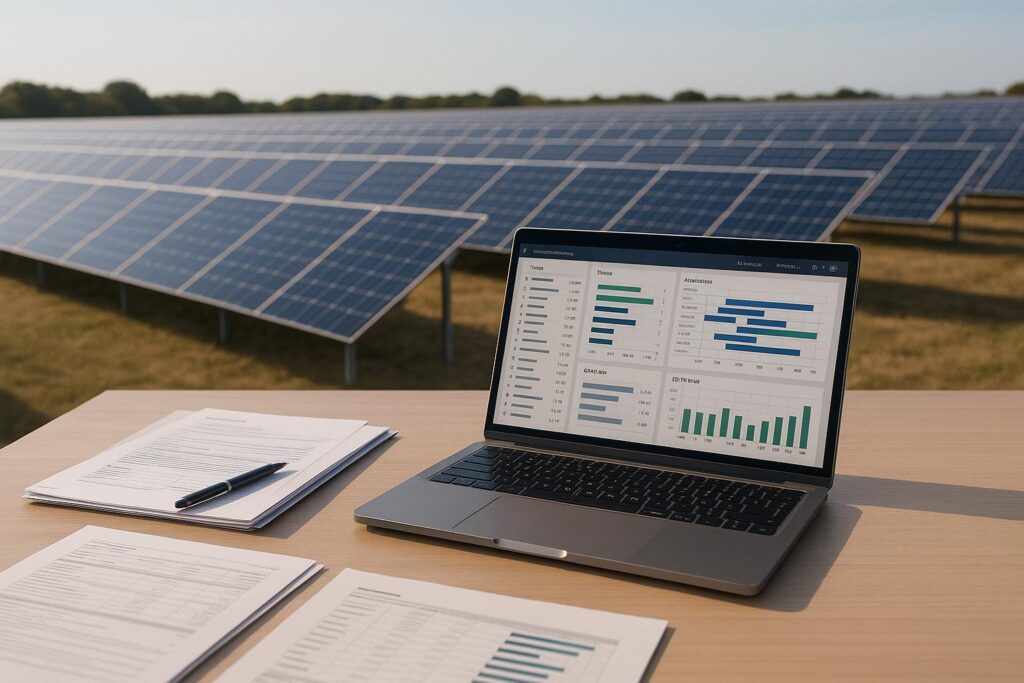
Managing solar projects effectively requires two key systems: document control and project management tools. Document control ensures accurate, secure, and compliant handling of critical documents like permits, contracts, and blueprints. Project management tools focus on task coordination, timelines, and resource allocation to keep projects on schedule and within budget.
When these systems are disconnected, teams face issues like data silos, outdated documents, and miscommunication. Integration solves these problems by centralizing data, automating workflows, and ensuring real-time updates. This improves efficiency, reduces errors, and supports compliance with regulations.
Key takeaways:
- Document Control Systems: Manage document versions, approvals, and compliance (e.g., permits, designs).
- Project Management Tools: Coordinate tasks, track progress, and manage budgets.
- Integration Benefits: Centralized data, automated processes, and fewer delays.
For solar companies, industry-specific solutions like SolarSuccess ERP integrate both systems, streamlining operations and reducing manual work. This approach allows teams to focus on delivering projects successfully while avoiding costly delays and compliance risks.
Document Control Systems in Solar Projects
Managing documentation effectively is a cornerstone of success in solar projects. Document control systems go beyond basic file storage, offering tools tailored for industries where regulatory compliance and document accuracy are non-negotiable.
Main Features of Document Control Systems
Document control systems are packed with features that set them apart from standard file management tools. One standout is version control, which ensures there’s always a single master version of a document with all edits tracked. This avoids the chaos that can arise when multiple team members use outdated versions of contracts, blueprints, or permits.
Another critical feature is secure, structured storage. These systems use encryption and role-based access controls to protect sensitive information, such as proprietary designs or financial data, while organizing files by project phase, document type, or regulatory category. This makes finding the right file quick and easy, even for complex projects.
Automated workflows simplify the review and approval process by automatically routing documents to the right people, sending notifications, and keeping track of approval statuses. This cuts down on delays caused by manual processes. In addition, granular access controls restrict document visibility to only those who need it, while audit trails log every interaction with a document, from its creation to its final approval. These features ensure accountability and traceability throughout the project.
To further eliminate confusion, digital watermarking clearly identifies the master version of a document, making it easy to distinguish from outdated copies. Together, these features meet the unique needs of solar projects, as explained below.
How Solar Projects Use Document Control
Solar projects rely on document control systems to manage contracts, permits, and design updates with precision and efficiency. These tools ensure that critical documents are always accurate, secure, and accessible.
Contracts are the backbone of any solar project, requiring multiple revisions and approvals from legal teams, project managers, and clients. A document control system ensures everyone is working from the same version while maintaining a complete record of all changes.
Permits and regulatory filings are another area where document control proves invaluable. Solar installations must comply with a web of federal, state, and local regulations, often requiring dozens of permits and certificates. These systems ensure that all permits are up-to-date, approved, and easily retrievable during audits or inspections.
Engineering drawings and blueprints frequently change as projects progress. Document control systems prevent costly errors by ensuring construction teams always have access to the latest approved designs. When changes are made, automated workflows ensure updated drawings go through the proper approval channels before being distributed to field teams.
Other critical documents, like inspection reports and change orders, are also managed seamlessly. These systems organize files chronologically and link them to specific project phases, making it easier to monitor progress and spot potential issues.
One of the biggest advantages of these systems is their audit readiness. During regulatory inspections, project teams can quickly retrieve permits, compliance certificates, or approval records along with their full approval history. This level of organization demonstrates compliance and helps projects avoid delays.
For example, Blu Banyan’s bluDocs Advanced Document Management SuiteApp integrates directly with their SolarSuccess ERP platform. This integration eliminates the fragmented systems that Aaron Casillas described, where teams previously juggled separate tools for project management, file storage, and accounting. By consolidating everything into one platform, solar companies can manage all project documentation seamlessly while meeting regulatory requirements and staying prepared for audits.
Project Management Tools in Solar Projects
Document control systems handle file storage and approval, but project management tools are the backbone of coordinating people, tasks, and resources in solar projects. These tools guide the process from initial site assessments all the way to system commissioning.
Main Features of Project Management Tools
Project management tools break down solar installations into clear, actionable tasks, ensuring everyone stays on the same page. Features like task assignment and tracking allow managers to delegate responsibilities, set deadlines, and monitor progress in real time. This level of visibility helps keep the project on track and ensures accountability.
Gantt charts are another key feature, mapping out project phases and showing how delays – like permitting issues or bad weather – can affect equipment delivery and installation timelines. With this overview, project managers can quickly spot bottlenecks and adjust schedules as needed.
Budgeting tools monitor expenses, including equipment, labor, and permitting fees. These systems can send alerts when spending approaches set limits, helping teams stay within budget. KPI dashboards complement this by displaying critical metrics such as task completion rates, budget adherence, and overall timeline progress, enabling informed, data-driven decisions.
Collaboration features are crucial for solar teams working across multiple locations. Tools like instant messaging, shared calendars, and collaborative document editing allow seamless communication between field technicians, engineers, and office staff. For instance, if a field team encounters an unexpected site condition, they can immediately share updates with engineers, enabling quicker problem-solving.
Platforms like Blu Banyan’s integrated solution take this further by eliminating the inefficiencies of juggling multiple tools. Their platform combines project management, accounting, and inventory tracking into a single system, ensuring all operations are aligned and data remains consistent.
Solar-Specific Uses
Beyond general project management features, solar projects require specialized tools tailored to the industry’s unique demands. Automated permitting workflows help navigate the maze of federal, state, and local regulations. These workflows ensure permits are applied for in the correct order, track approval statuses, and send reminders for renewals or inspections.
Installation tracking modules provide detailed progress updates for each solar site, logging milestones like foundation work, panel installation, and electrical connections. This level of detail allows project managers to identify efficient crews and pinpoint sites that may need additional support. It also feeds into customer communication systems, allowing sales teams to keep clients informed with accurate updates on their installation status.
CAD integrations are another critical feature, ensuring field teams always work from the latest approved designs. When engineers make changes to a design, these updates sync directly into the project management system, reducing errors and rework.
Financial tracking goes beyond basic budgeting with milestone-based invoicing automation. As construction phases are completed and logged, invoices can be automatically generated and sent to customers. This streamlines cash flow and cuts down on administrative tasks.
Blu Banyan’s SolarSuccess ERP solution showcases how industry-specific tools address solar project challenges. It includes features like permitting workflows and installation tracking, while also integrating with productivity tools like bluDocs and bluConnect. This unified approach bridges the gap between field teams and office staff, tackling the complexities of solar installations while reducing the soft costs that can impact profitability.
The biggest advantage of these tools is their ability to provide a single, unified view of all aspects of a solar business. Instead of relying on disconnected systems that create data silos, integrated project management solutions ensure everyone – from installation crews to office staff – is working with the same real-time data. Whether it’s tracking installation milestones, managing inventory, or processing payments, these tools streamline operations and complement document control systems, delivering comprehensive project oversight.
How Document Control and Project Management Systems Work Together
When document control and project management tools operate separately, they often create a host of problems – data silos, version conflicts, and miscommunication being the most common. Integrating these systems brings everything together, improving operations and reducing errors.
Benefits of Integration
The biggest advantage of integration is centralized data access. Instead of juggling multiple platforms with overlapping but inconsistent information, teams can work from a single, unified system. This eliminates the confusion that arises when, for example, field technicians use outdated installation plans while project managers rely on updated versions.
Integration also ensures a synchronized workflow for updates and approvals. Aaron Casillas, Technology & Infrastructure Director, highlights how unified systems solve operational challenges:
"Solar installation has many moving parts, all generating soft costs, and there is no single application that solves them all, because you have to address inefficiencies across all functions of the entire company. We looked at other solutions, but NetSuite worked out best for us because it handles accounting and operational logistics items in tandem with project management really well. SolarSuccess streamlined things even further and allowed us to add our own customizations on top of NetSuite. Blu Banyan’s expertise was critical. Our strategic partnership with Blu Banyan enables us to identify and prioritize specific features for development that will increase our productivity."
By cutting manual data entry, integration reduces project delays by up to 30% and document errors by 25%. For instance, when a permit is updated in the document control system, that change is instantly reflected in the project management timeline. This prevents teams from unknowingly working with outdated information.
Another key improvement is streamlined communication. With real-time data accessible to everyone – field crews, engineers, and office staff – there’s no need to chase down the latest versions of documents or worry about outdated specifications.
Integrated systems also offer audit trail capabilities, tracking who accessed which documents, when, and what changes were made. This transparency becomes invaluable during regulatory inspections or when resolving project issues. According to a survey by Cognidox, 78% of companies using document control systems reported better compliance and audit readiness.
These benefits naturally extend into automated workflows that align every phase of a project.
Integration Workflows
Automated workflows significantly simplify document approvals in solar projects. Instead of emails bouncing between team members, integrated systems route documents through predefined approval chains. For example, when an engineer submits a revised electrical plan, it’s automatically sent to the appropriate reviewers based on the project type and regulatory requirements.
These workflows are tied directly to project milestones, ensuring that document approvals don’t become bottlenecks. For instance, when a project hits the "foundation complete" milestone, the system can automatically trigger approval processes for the next phase’s installation documents.
Version updates are another area where integration shines. When the document control system receives an updated site plan, the project management tool immediately reflects this change in task assignments and resource planning.
Joe Marhamati, Co-Founder & VP, shares the impact of automation:
"We’ve been able to automate most of our residential invoices. When a deal moves to a particular stage of construction, for example, SolarSuccess generates invoices based on that specific milestone. That has been the biggest advantage and has definitely helped us out a lot. We’re doing more with the same number of people and we have a system that’s more reliable and less stressful than tracking a million different spreadsheets. Blu Banyan was very flexible. Whether we wanted to integrate systems or take advantage of out-of-the-box automation, Blu Banyan handled it for us. I think their MO is ‘basically anything is possible.’"
With integration, version changes are automatically updated across platforms, and stakeholders are promptly notified. Beyond basic alerts, these updates can trigger task reassignments, schedule adjustments, and resource reallocations. For example, if a permit approval is delayed, the system can automatically adjust installation schedules and notify affected teams.
Blu Banyan’s SolarSuccess ERP demonstrates these integration benefits by combining document control through bluDocs with robust project management features. This eliminates the inefficiencies of managing separate systems while delivering the specialized tools solar companies need.
The result? Document control and project management no longer compete for attention. Instead, they function as complementary parts of a unified system, allowing teams to focus less on managing tools and more on executing projects successfully.
sbb-itb-2560759
Document Control vs Project Management: Side-by-Side Comparison
Let’s break down the distinct roles of document control systems and project management tools. While both are critical for the success of solar projects, they serve different purposes and excel in unique areas. Understanding their differences can help teams maximize their effectiveness.
Document control systems focus on maintaining regulatory compliance by managing the entire lifecycle of documents. They use tools like version control, digital watermarking, and detailed audit trails to ensure every change is tracked and documented.
On the other hand, project management tools are all about execution. They help plan timelines, allocate resources, manage budgets, and streamline communication among stakeholders. Although they may include basic version control features, their real strength lies in driving project delivery rather than ensuring the integrity of documents.
Even their organizational roles are structured differently. Document control often functions as a support role, with Document Control Managers typically reporting to Project Managers. However, in larger solar companies, independent document control teams may exist, often including cost estimators, planners, and compliance specialists. Meanwhile, project management teams lead the charge in execution, leaving document control to handle compliance and technical analysis.
Comparison of Key Features
| Aspect | Document Control Systems | Project Management Tools |
|---|---|---|
| Primary Function | Document lifecycle management and regulatory compliance | Project planning, execution, and delivery oversight |
| Version Control | Automatic version numbering, full history tracking, and audit trails | Basic version control with limited historical tracking |
| Workflow Capabilities | Complex approval workflows with detailed access control | Task-based workflows for team coordination and execution |
| Security & Access | Role-based access controls meeting ISO 9001 and ISO 13485 standards | Standard user permissions and basic security features |
| Compliance Impact | Ensures regulatory compliance with full audit trails | Tracks schedule compliance, budget variances, and risks |
| Efficiency Metrics | Reduces duplicate versions, streamlines searches, automates approvals | Prevents delays through schedule monitoring and resource optimization |
| Solar-Specific Uses | Manages permits, schematics, safety certifications, and inspections | Tracks installation timelines, labor, procurement, and milestones |
| Integration | Links to CAD systems, regulatory databases, and engineering tools | Connects with financial systems, CRM platforms, and resource tools |
| Collaboration Model | Document-focused with structured review and approval chains | Team-focused with real-time communication and task assignments |
| Data Tracking | Tracks all document changes, user access, and approvals | Monitors task progress, resource allocation, and budget performance |
| Decision Authority | Advisory role on compliance and document readiness | Final authority over project scope, quality, and delivery |
| Reporting Structure | Reports to project management while maintaining compliance independence | Leads project execution with authority over timelines and resources |
According to surveys by Cognidox, document control systems achieve a 78% audit readiness rate. Meanwhile, project management tools improve efficiency by keeping schedules on track and controlling costs. When these systems are integrated – like in Blu Banyan’s SolarSuccess ERP with bluDocs – they combine compliance assurance with operational efficiency, creating a powerful synergy for solar projects.
Solar Industry Case Study: SolarSuccess ERP Solutions

The integration of advanced document control and project management systems has brought noticeable improvements to solar project efficiency. Blu Banyan’s SolarSuccess ERP solution stands out as a prime example of how tailored platforms can reshape operations for solar companies across the United States. This case study highlights how SolarSuccess ERP enhances efficiency in solar installations.
SolarSuccess and SuiteApps Overview
SolarSuccess, a Built for NetSuite verified solution, is trusted by leading residential and commercial solar installers, supporting nearly one-third of all U.S. rooftop solar installations. By consolidating data into a single, unified system, SolarSuccess eliminates information silos and integrates key functions like document control, project management, accounting, and CRM.
The platform also leverages specialized SuiteApps to expand NetSuite’s capabilities. These include bluDocs for document management, bluChat for real-time collaboration, bluTime for time tracking, and bluConnect for third-party integrations. Together, these tools ensure consistency and compliance throughout solar projects, seamlessly connecting document control with project management.
Results and Efficiency Improvements
SolarSuccess has delivered tangible improvements for solar companies, streamlining operations and boosting efficiency. By implementing this integrated system, companies have reduced manual data entry by up to 80% and shortened project delivery times by 20–30%.
Automated workflows have been key to these gains. For example, document approvals are now faster, cutting approval times by up to 30% and reducing project delays by 25%. This ensures that permits, schematics, and certifications move through the process without unnecessary bottlenecks.
Joe Marhamati, Co-Founder & VP at a solar company, shared how automation transformed their invoicing process:
"We automated most of our residential invoices using SolarSuccess. Invoices are now generated automatically based on specific construction milestones. This automation allowed us to accomplish ‘more with the same number of people’ and resulted in a more reliable system compared to tracking information across ‘a million different spreadsheets.’"
The platform’s integrated dashboards offer real-time visibility, allowing project managers to track document statuses and milestones instantly. This has led to quicker, more informed decision-making.
Financial operations have also seen significant improvements. Companies managing multiple subsidiaries have reported fewer errors during financial closes and have simplified their financial planning with consolidated reporting. The system’s ability to connect document control with project management ensures that all costs, from permits to final inspections, are accurately tracked and reported.
Beyond internal operations, SolarSuccess improves collaboration between teams in the field and the office. Field crews can access updated project documents directly from their mobile devices, while office staff monitor installation progress and document updates in real time. This seamless flow of information eliminates the disconnect that often slowed down solar installations in the past.
Blu Banyan’s achievements, including being named NetSuite’s top Micro-vertical Solution Provider Partner of the Year for three consecutive years and winning the Spring 2025 Solution Provider Spotlight award in Energy, underscore the transformative impact SolarSuccess has had on the solar industry.
Best Practices for Integration in Solar ERP Systems
When it comes to integrating document control and project management systems in solar ERP environments, careful planning and execution are key. By adopting proven strategies, solar companies can sidestep common challenges and make the most of their ERP systems.
Steps for Effective Integration
Stakeholder Alignment
Bring together project managers, document controllers, IT teams, and end users to establish clear integration goals. Regular meetings and cross-functional workshops can help map out document workflows and project milestones, ensuring everyone is on the same page.
Conduct a Thorough Needs Assessment
Before choosing systems, take a close look at your current workflows and identify inefficiencies. Many solar companies discover that generic ERP solutions lack critical features, such as permit tracking, regulatory documentation management, and milestone tracking tailored to the solar industry.
Phased Implementation
Break the integration process into smaller, manageable stages to minimize disruptions. Start with core features like version control and access management for documents. Then, move on to connecting project schedules and workflows, and finally, automate reporting and compliance checks. This step-by-step approach allows for early feedback and smoother transitions.
Comprehensive Training
Provide role-specific, hands-on training that covers both software navigation and solar-focused workflows. Ongoing support ensures that employees can effectively use the system in their daily tasks.
Establish Standardized Workflows
Create clear and documented procedures for tasks like document creation, review, approval, and distribution. These workflows act as a foundation for automating processes within the integrated ERP system.
Continuous Monitoring and Process Optimization
Keep an eye on metrics like document retrieval times, user adoption rates, and error frequencies. Regular system reviews, updates, and feedback loops ensure the integration continues to meet business goals and adapts to changing regulatory demands.
Why Industry-Specific Solutions Matter
To fully unlock the advantages of integration, solar companies benefit from adopting ERP systems designed specifically for their industry. Generic ERP solutions often fail to address the unique complexities of solar projects, leading to inefficiencies and additional customization costs.
Solar projects, for instance, come with stringent regulatory requirements – from the initial permitting process to final inspections. Industry-specific ERP solutions come equipped with pre-built templates, compliance tools, and features tailored to the solar project lifecycle. This eliminates the need to build custom workflows from scratch, saving both time and resources.
Generic systems also risk creating data silos and manual bottlenecks. In contrast, integrated solar ERP solutions address these challenges directly. Companies that combine document control with project management often report improved schedule accuracy and cost efficiency.
Automation and real-time data sharing are particularly critical for solar companies managing multiple projects simultaneously. For example, automated notifications and reminders in document control systems can reduce approval delays by up to 30%, helping projects stay on track. These advanced features are typically found in industry-specific ERP platforms that understand the nuances of solar project management.
Solutions like SolarSuccess ERP, which integrates tools like bluDocs and bluConnect, are excellent examples of how tailored systems can streamline document control and project management for solar companies.
Key Takeaways
Bringing together document control and project management systems can revolutionize operations for solar companies. This integration doesn’t just streamline workflows – it also boosts efficiency, ensures compliance, and strengthens collaboration. By enabling real-time data sharing, project managers gain the insights they need to make timely decisions, while document controllers can focus on maintaining compliance with regulations. This dual approach helps avoid costly delays and lowers project risks. Financially, it translates to improved schedule accuracy and cost management, thanks to real-time tracking capabilities. Automation in document control further minimizes approval delays, keeping projects on schedule while maintaining the vital audit trails needed for regulatory requirements, such as interconnection approvals and permitting.
These operational and financial benefits highlight the importance of ERP solutions tailored for the solar industry. Unlike generic systems, industry-specific ERP platforms address the unique challenges posed by disconnected tools. Aaron Casillas, Technology & Infrastructure Director, pointed out how managing separate systems for project management, file storage, and accounting led to inefficiencies that demanded additional labor to resolve.
Blu Banyan’s SolarSuccess ERP serves as a prime example of a centralized solution. By eliminating data silos and automating solar-specific tasks – like milestone-based invoicing – it enhances productivity without the need for extra staffing.
Collaboration between project management and document control teams is crucial for achieving success. Integrated workflows not only help mitigate risks proactively but also build stakeholder confidence and ensure warranty compliance through comprehensive audit trails. Understanding the role of document control in supporting project management ensures projects are not only well-planned but also efficiently executed, with unified workflows driving overall success.
FAQs
What are the benefits of integrating document control and project management systems for solar companies, especially in terms of compliance and efficiency?
Integrating document control with project management systems helps solar companies centralize vital information and workflows, making operations more efficient. With this setup, project teams can easily access the latest documents, track tasks, and stay on top of deadlines. This reduces the chances of delays and miscommunication, keeping projects on track.
On the compliance side, integration simplifies record-keeping by ensuring all necessary documents are organized and readily accessible for audits or regulatory checks. This approach lowers the risk of non-compliance while improving transparency and accountability. The result? Smoother operations and more successful project outcomes.
What makes a document control system essential for effectively managing solar projects?
A document control system plays a key role in solar project management by providing centralized access to project documents, improving version tracking, and enabling smooth collaboration across teams. These capabilities help simplify workflows, minimize mistakes, and ensure adherence to industry regulations.
When paired with a solar-focused ERP solution like SolarSuccess, a document control system offers even greater benefits. It enhances real-time project visibility and ensures stakeholders always have the most accurate and current information at their fingertips. This combination not only increases efficiency but also supports smarter decision-making throughout every stage of the project.
Why should solar companies choose industry-specific ERP systems like SolarSuccess over generic solutions?
Industry-specific ERP systems like SolarSuccess are crafted specifically to address the unique demands of solar companies. These systems simplify operations, improve team collaboration, and offer real-time insights into essential processes.
What sets SolarSuccess apart from generic ERP solutions is its focus on the challenges unique to the solar industry. It provides tools and features tailored to boost efficiency and support better decision-making. With a system designed for their specific needs, solar companies can save time, minimize mistakes, and streamline their workflows with greater precision.
