

Energy storage systems are transforming the residential solar market, but soft costs – like labor, permitting, and project management – still account for up to 58% of total costs. ERP systems can help by improving efficiency and cutting waste. Here’s how:
- Automated Workflows: Streamline tasks like scheduling, procurement, and invoicing to reduce delays and errors.
- Inventory Control: Real-time tracking prevents overstocking and ensures materials are available when needed.
- Procurement Coordination: Centralized vendor management helps secure better pricing and avoid delays.
- Labor Scheduling: Smarter scheduling reduces idle time, overtime, and unnecessary trips.
- Financial Tracking: Real-time cost tracking helps prevent budget overruns.
1. Automated Project Workflows
Energy storage installations involve numerous steps – sales handoffs, permitting, equipment ordering, scheduling, and invoicing. When these processes are handled with separate tools, it often leads to data gaps, manual re-entry, and unnecessary delays. An ERP system simplifies this by connecting all stages on a single platform, allowing tasks to transition seamlessly from one phase to the next without manual input.
Take automated purchase order creation, for example. Once a project’s Bill of Materials (BOM) is finalized, the ERP system can instantly generate and route purchase orders. This eliminates the need for manual data entry, speeding up procurement and reducing the chance of errors that could delay installation.
Field operations also see major improvements. With mobile-friendly ERP tools, technicians can log hours, track parts used, and submit expenses directly from the job site. This real-time data entry ensures project budgets and timelines stay up to date. Plus, it helps avoid costly “truck rolls” – those frustrating second trips caused by missing components. By automatically tracking truck stock, the ERP ensures crews arrive fully prepared the first time.
These automated project management workflows free project managers from chasing updates, allowing them to focus on delivering results. For energy storage installers, where soft costs already account for a large portion of project budgets, this efficiency boost helps protect profit margins.
2. Inventory and Materials Control
Efficient inventory management plays a key role in keeping installation costs under control. Poorly managed inventories can quietly drain resources, leading to emergency purchases, excess stock, and outdated materials – especially in an industry where battery technology evolves at lightning speed.
An ERP system offers a solution by giving teams access to real-time inventory data. With everyone working from the same data, procurement teams can see exactly what’s in stock, what’s already allocated to projects, and what’s on order. This clarity allows installers to group orders across multiple projects to secure better volume discounts. Blu Banyan highlights the importance of this approach: “With a huge portion of your project costs sitting in the inventory and materials that go into the project, even modest discounts (5%) to your inventory costs can have huge impacts on project profitability.” [2]
But the advantages go beyond just saving on unit costs. Faster inventory turnover ensures materials arrive at job sites promptly, reducing the need for excessive storage and freeing up cash by minimizing how long materials sit in inventory.
This approach is especially crucial in the energy storage sector, where outdated components can quickly lose relevance. By aligning material orders with actual project timelines, companies can avoid overstocking and reduce the risk of holding obsolete inventory while still meeting project deadlines.
Specialized platforms like SolarSuccess are designed to tackle these challenges head-on. They integrate inventory tracking with project management and job costing, ensuring materials are allocated precisely when and where they’re needed. This tight coordination not only streamlines procurement but also enhances scheduling efficiency, setting the stage for smoother operations overall.
3. Procurement and Vendor Coordination
ERP systems go beyond inventory control by simplifying procurement and vendor coordination, which are critical for avoiding schedule disruptions. Timely procurement of materials can be a tough balancing act, especially when it affects installation costs. Components like battery modules, inverters, switchgear, and power conversion systems often come with long and unpredictable lead times. A single delayed part can bring the entire installation to a standstill. ERP helps solve this by centralizing procurement data – vendor information, contracts, pricing, purchase orders, and delivery schedules – into one platform that updates in real time.
Without ERP, procurement often depends on scattered spreadsheets and email threads, making it easy to overlook price changes, miss approvals, or order from the wrong supplier. ERP systems eliminate this chaos with automated workflows that ensure purchase requisitions go through the correct approval steps, generate purchase orders, and track order statuses. According to Hackett Group benchmark data, organizations using automated procurement processes experience 30–50% lower transaction processing costs per purchase order and invoice, with cycle times that are 30–40% faster from requisition to order placement.
For energy storage projects, this speed is invaluable. If an ERP system flags that a critical inverter is backordered, the team can quickly pivot to an approved alternate vendor, avoiding delays that might otherwise derail the installation schedule. By linking every purchase order to specific projects, ERP systems provide instant visibility into risks tied to pending or delayed orders. This efficiency builds directly on earlier workflow automation and inventory management improvements.
The benefits extend even further, as highlighted in this quote:
“By using technology to automate manual processes your team will have more time to work on higher value tasks, such as vendor and supplier relationship management and researching alternative products and components that may be of higher quality or lower costs.” – Blu Banyan [2]
Better procurement visibility also translates into cost savings. With a consolidated view of spending across multiple projects, buyers can negotiate volume discounts and enforce preferred-vendor policies, avoiding the higher costs of one-off purchases. Deloitte’s Global CPO survey reveals that digitally enabled procurement functions achieve 7–12% savings on total procurement spend. Considering that materials often account for 40–60% of a project’s total cost, these savings can significantly impact the bottom line. For energy storage installers managing high-value components across various jobs, even small improvements in procurement processes can lead to substantial financial benefits.
4. Labor Scheduling and Field Productivity
Labor costs are one of the biggest expenses in energy storage installations. Soft costs – such as installation labor, permitting, and customer acquisition – can make up as much as 64% of the total cost of a new energy system. Despite advancements in other areas, labor costs have remained stubbornly high. This is where ERP systems step in to tackle these challenges head-on.
By leveraging automated workflows, ERP systems help cut down inefficiencies through smarter labor scheduling. Without these systems, dispatchers often rely on phone calls and spreadsheets to figure out technician availability, certifications, and proximity. This outdated method leads to common problems: crews sitting idle waiting for delayed equipment, unqualified technicians being sent to specialized tasks, or overtime costs piling up when jobs take longer than expected. ERP systems with integrated Field Service Management (FSM) simplify this process. They use intuitive scheduling boards and smart filters to match technicians based on their skills, location, and the job’s urgency. For example, a certified high-voltage electrician won’t be left waiting while a critical battery wiring task is delayed.
Real-time communication between the field and back office is another game-changer. If a crew finishes early or encounters a delay, dispatchers can immediately reassign nearby qualified technicians, ensuring no time is wasted. Field teams also benefit from mobile tools that let them log hours, track parts, and record expenses, feeding this data directly into project management software for better budget oversight.
“To improve efficiency and profitability, solar installers must have real-time visibility into their entire end-to-end businesses.” – Jan Rippingale, CEO, Blu Banyan
Another costly issue ERP systems address is secondary truck rolls – those frustrating return trips caused by missing parts. By confirming that all necessary components are loaded before dispatch, these systems help avoid wasted labor time and fuel costs. Together with earlier workflow automation, these scheduling enhancements significantly streamline on-site operations and reduce overall project costs.
5. Financial Visibility and Job Cost Tracking
ERP systems not only streamline operations but also provide much-needed clarity into financial management for energy storage projects. Even with tight control over labor and materials, financial mismanagement can derail a project. Without a centralized system, project managers often rely on end-of-month reports to identify budget overruns – when it’s already too late to make adjustments. A unified ERP system changes this by offering real-time financial insights, especially when combined with tools like automated workflows, inventory management, and labor scheduling. By capturing every cost in real time, these systems can alert managers immediately to any financial discrepancies.
Here’s how it works: ERP platforms track every expense – whether it’s parts, mileage, or labor hours – and feed that data directly into the project budget. Live dashboards let project managers see how the project is progressing against its budget at any given moment. Automated job costing reduces the chances of manual errors and flags issues as soon as they arise.
A particularly useful feature is milestone-triggered accounting. This method automatically records financial events as specific project milestones are completed, syncing financial records with actual on-site progress. This eliminates the need for manual updates and ensures that subcontractor costs are tracked in real time, avoiding unexpected budget surprises.
A real-world example of this is Titan Solar Power, which adopted the NetSuite-based SolarSuccess ERP in February 2020. Before this, the company relied on disconnected tools for project management and accounting. Under the leadership of Technology and Infrastructure Director Aaron Casillas, Titan Solar Power integrated its design, permitting, and financing workflows into a single platform. The results? Improved operational visibility, reduced labor for partner commission payouts, and shorter project completion times [4].
“When you’re aggregating a group of point applications – regardless of how good each of those programs is individually – you really need them to be able to talk to one another. The only way to make that happen is with an integrated or unified application suite on a single database.” – Clive Smith, Chief Business Development Officer, Blu Banyan [4]
Together, these financial tools amplify the cost savings achieved across inventory, procurement, and labor management, making the benefits of ERP systems even more apparent.
Comparison Table
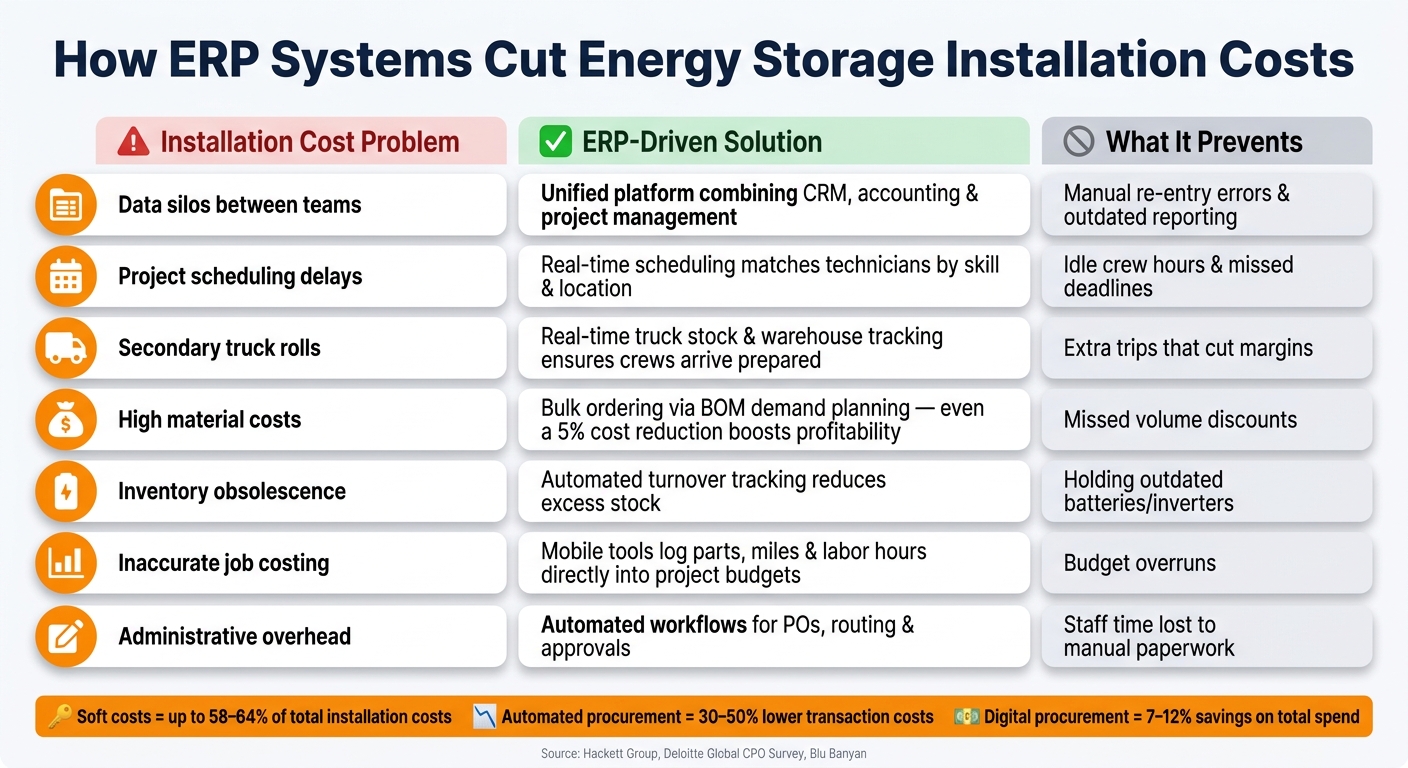
Energy storage installations often encounter predictable cost challenges stemming from fragmented systems and outdated manual processes. The table below highlights these common issues and how ERP solutions can address them effectively.
| Installation Cost Problem | ERP-Driven Fix | What It Prevents |
|---|---|---|
| Data silos between teams | A unified platform combines CRM, accounting, and project management into one reliable source | Eliminates manual data re-entry, reporting errors, and outdated information |
| Project scheduling delays | Real-time scheduling tools match technicians to jobs based on skills and location [3] | Avoids backlogs, missed deadlines, and idle crew hours |
| Secondary truck rolls | Real-time tracking of truck stock and warehouse inventory ensures technicians arrive fully prepared [3] | Reduces extra trips that cut into margins and delay project timelines |
| High material costs | Demand and supply planning evaluates upcoming project BOMs for bulk ordering [2] | Prevents missed volume discounts – just a 5% inventory cost reduction can significantly boost profitability [2] |
| Inventory obsolescence | Automated tracking of inventory turnover reduces excess stock and inventory costs [2] | Avoids holding outdated batteries or inverters that lose value over time |
| Inaccurate job costing | Mobile tools log every part, mile, and labor hour directly into project budgets in real time [3] | Helps detect and prevent budget overruns before they escalate |
| Administrative overhead | Automated workflows for purchase orders, routing, and approvals [2] | Frees up staff to focus on vendor management instead of manual paperwork |
These challenges represent major areas where costs can spiral out of control. As Jan Rippingale aptly stated:
“The only way to… effectively reduce the soft costs identified by the DOE, is with an integrated application suite that provides reliable data and a common interface across all functions.”
This reinforces the value of a unified ERP platform in streamlining operations and addressing inefficiencies across the board.
Conclusion
ERP strategies like automated workflows, inventory management, procurement coordination, labor scheduling, and real-time financial tracking directly address areas of waste to help reduce energy storage installation soft costs. These soft costs remain a persistent challenge that hardware price drops alone can’t solve, making operational efficiency a critical factor. By streamlining processes, this approach creates opportunities for long-term improvements across operations.
A centralized data platform enhances scheduling, cuts down on unnecessary trips, secures volume discounts, and ensures real-time visibility into job costs. As Jan Rippingale, CEO of Blu Banyan, explains:
“To improve efficiency and profitability, solar installers must have real-time visibility into their entire end-to-end businesses.”
Consider implementing these strategies with Blu Banyan’s SolarSuccess. This solar business management software supports every phase of a project – from the initial sale to installation and beyond – allowing your team to grow efficiently without adding extra overhead.
FAQs
What ERP features cut truck rolls?
ERP systems help cut down on unnecessary truck rolls by making sure technicians show up on-site with the right parts and information. Some key features include real-time inventory tracking, which keeps tabs on parts in both warehouses and trucks, and Bill of Materials (BOM) synchronization, ensuring the correct components are ready to go. Additional tools like location-based scheduling assign technicians based on proximity, while mobile integration gives them instant access to project details, manuals, and updates directly from their devices.
How does ERP prevent inventory obsolescence?
ERP systems play a key role in avoiding inventory obsolescence by streamlining processes like just-in-time delivery and automating purchase orders to cut down on surplus stock. By tapping into data analytics, these systems can predict material requirements using historical data, seasonal trends, and sales forecasts. This approach ensures inventory stays aligned with the latest advancements in solar technology, helping businesses minimize outdated equipment. The result? Lower financial losses, reduced waste, and the ability to consistently provide customers with the most current solutions.
How fast can ERP ROI show up on installs?
Achieving a return on investment (ROI) with an ERP system doesn’t have to take years. By implementing systems that drive operational improvements, solar companies can see results much faster. For example, it’s possible to reduce the project-to-cash cycle by 40% and even triple project throughput – all without needing to expand office staff.
Take integrated platforms like SolarSuccess by Blu Banyan. These systems can help solar installers cut costs by up to 10% while slashing project timelines from six months to just two. These kinds of efficiencies not only streamline operations but also make it easier to track critical metrics. This, in turn, allows companies to clearly demonstrate measurable ROI to their stakeholders.
