
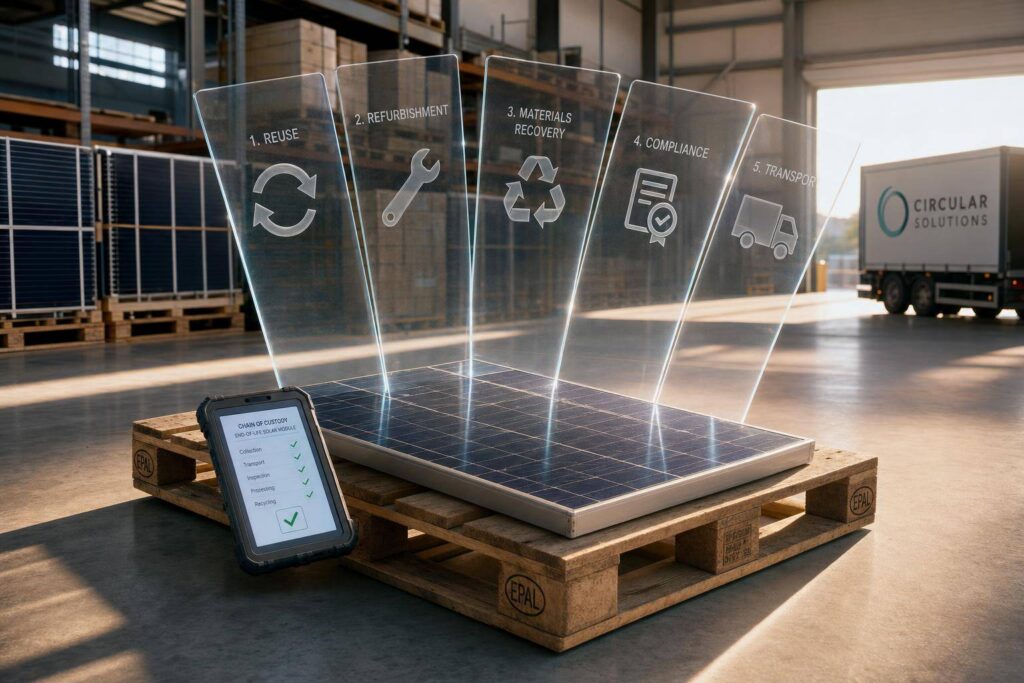
The short answer: the best reverse-logistics model is the one that sends each retired solar asset to its highest-value compliant destination while keeping cost, custody, and final records in one system.
Here’s the core idea in plain English:
- Recycling every panel right away can waste money.
- DOE/NREL put PV module recycling at $15 to $45 per module, while nonhazardous landfill disposal can be under $1 per module.
- That gap means your first decision should be: reuse, repair, parts recovery, recycling, or disposal?
- Your best-fit model depends on return volume, site spread, equipment condition, freight distance, and state rules.
- You also need clean ERP status changes from removal to final disposition.
The five models are:
- Take-back programs for covered products, warranty returns, or producer-run channels
- Regional return hubs for scattered returns that need consolidation
- Installer-led collection when crews can backhaul removed equipment
- Recycler-direct routing for dense loads going straight to a qualified recycler
- Parts recovery loops for gear that still has reuse or repair value
My takeaway: if an item still has resale, repair, or spare-parts value, I’d check that path first. If not, I’d choose the lowest-cost compliant route and make sure every handoff is logged.
Quick Comparison
| Model | Best for | Main cost pressure | Main record to lock down |
|---|---|---|---|
| Take-Back Programs | Covered products and warranty returns | Packaging, freight, program rules | Return authorization tied to asset |
| Regional Return Hubs | Small returns from many places | Storage, labor, handling, line-haul | Hub receipt, sort status, outbound match |
| Installer-Led Collection | Service networks already visiting sites | Crew time, route deviation, packaging | Work order and custody transfer |
| Recycler-Direct Routing | Large or dense loads | Freight, palletizing, recycler fees | Receipt plus processing certificate |
| Parts Recovery Loops | Inverters, modules, racking, and parts with reuse potential | Testing, repair labor, carrying cost | Inspection grade and inventory disposition |
If you’re picking one model, I’d keep it simple: scattered returns lean toward take-back or direct routing; clustered returns lean toward hubs; repairable gear leans toward parts recovery.
What Reverse Logistics Teams Need to Track From Day One
Build the removal record before pickup. That first record sets up every choice that comes later.
Core Asset and Shipment Data
For each piece of equipment removed, record the basics that will follow it through the whole process: serial number or asset ID, item type, manufacturer, model, ownership, project/site ID, removal date, condition grade, quantity, weight, packaging status, current custodian, receiving destination, and final disposition. For materials that don’t have serial numbers, like racking or wiring, use an item number along with a pallet or container ID.
Use a simple four-level grading system:
- A = reusable
- B = repairable
- C = uncertain or test-needed
- D = recycle or dispose
That consistency matters. A Grade A item can move straight into a reuse or resale workflow in the ERP. A Grade D item can trigger a recycling shipment plus an environmental-compliance checklist.
Teams also need to track every handoff. That means logging the release party, date/time, carrier, bill of lading, pickup condition, receiving party, received quantity, and any discrepancies. At each transfer, reconcile removed, shipped, and received counts.
Those fields decide where equipment goes next: reuse, refurbishment, recycling, or disposal.
U.S. Operating Constraints That Affect Returns
In the U.S., solar panel disposal does not follow one national rule. Discarded panels are regulated under RCRA Subtitle D and may also fall under Subtitle C if they contain enough lead to meet the hazardous-waste definition[3][4]. Solar panels are not currently a federally designated universal waste, though EPA announced on October 23, 2023, that it was developing a proposal to add them to federal universal-waste regulations[3].
State rules add another layer. California has managed photovoltaic modules as state universal waste since January 1, 2021. Washington was the first U.S. jurisdiction to require PV-module recycling, with a stewardship law dating to 2017 that requires manufacturers to submit plans covering take-back financing, collection, management, and recycling[6]. Those differences shape whether an asset can move through reuse, refurbishment, direct recycling, or disposal.
Freight distance can change the math fast. A recycler with a lower quoted rate but located several hundred miles away may end up costing more once transportation, fuel or accessorial charges, and handling are added in. So don’t track cost as one blended figure. Break it out in U.S. dollars by category:
- field labor
- packaging and pallets
- freight
- temporary storage
- testing
- compliance administration
- recycling or disposal fees
- credits from recovered parts or resale
Warehouse space matters too. It affects whether you can consolidate into a full truckload or whether you have to ship in smaller, more expensive loads.
Before routing any return, check waste status in the removal state, the transit state, and the destination state. Then record the jurisdiction and the compliance review date in the ERP. That step helps determine which return model fits the shipment.
Baseline ERP Records and Status Changes
A solar operation’s ERP should connect the decommissioning work order to the removed asset, inspection result, inventory adjustment, transfer order, freight cost, recycler receipt, and final disposition in one linked record, not across separate spreadsheets. Blu Banyan‘s SolarSuccess for NetSuite can tie removal work orders, inventory, costing, and project records in one system [7].
The status flow should match what happens in the field and in transit. Useful statuses include Scheduled for Removal, Removed, Awaiting Inspection, Quarantined, Approved for Reuse, Awaiting Consolidation, In Transit, Received, Sent for Refurbishment, Sent for Recycling, Disposed, and Closed.
Each status should have four things attached to it: an owner, a timestamp, a location, and the required proof before the record can move forward. That’s a key point. A recycler shipment does not prove final recycling.
Accounting entries should also log every cost and every credit in U.S. dollars. That’s how teams figure out the actual net recovery value for each asset.
Those records make the five models below easier to compare on cost, compliance, and recovery value.
Quick Comparison of the 5 Reverse Logistics Models
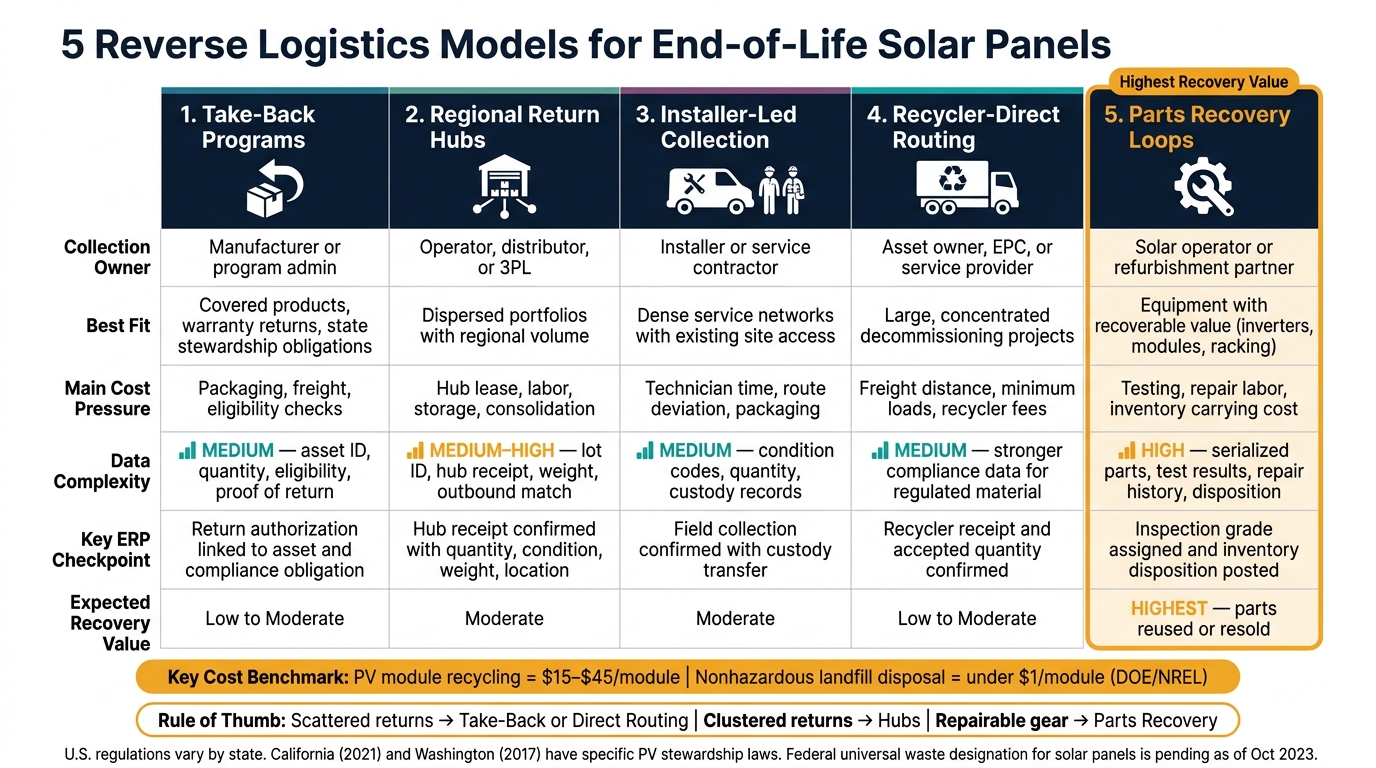
Once your asset management software records are set up, use the table below to line up each model with how your operation works.
This side-by-side view helps you compare the five models by operating fit, cost pressure, data requirements, and ERP checkpoints.
| Model | Collection Owner | Best-Fit Operating Environment | Typical Transportation Pattern | Main Cost Exposure | Data Needed | Key ERP Checkpoint |
|---|---|---|---|---|---|---|
| Take-Back Programs | Manufacturer, producer, or program administrator | Standardized equipment fleets with producer agreements or state take-back obligations | Program-approved pickup or return to a contracted recycler or processor | Program administration, packaging, eligibility checks, and reverse freight | Medium: asset identity, quantity, location, eligibility, and proof of return | Return authorization issued and linked to the asset and compliance obligation |
| Regional Return Hubs | Solar operator, distributor, or third-party logistics provider | Dispersed residential/commercial portfolios with enough regional volume | Local pickups or installer backhauls to a hub, then consolidated LTL or truckload to the recycler | Hub lease, labor, handling, storage, sorting, and outbound consolidation | Medium to high: item or lot identity, hub receipt, weight, packaging, location, and outbound consolidation | Hub receipt confirmed with quantity, condition, weight, and storage location |
| Installer-Led Collection | Installer or service contractor | Residential and small-commercial networks with existing site access and customer relationships | Backhaul in installer vehicle to a branch or warehouse, then periodic consolidated shipment | Technician time, vehicle capacity, route deviation, and field packaging | Medium: standardized condition codes, quantity, location, and custody records | Field collection confirmed with custody transfer |
| Recycler-Direct Routing | Asset owner, EPC, or service provider | Large, concentrated decommissioning projects where a qualified recycler destination is already known | Site pickup or drop-trailer service directly to the recycler, often palletized LTL or truckload | Freight distance, minimum shipment quantities, loading labor, compliance documentation, and recycler charges | Medium, with stronger compliance data when material is regulated | Recycler receipt and accepted quantity confirmed |
| Parts Recovery Loops | Solar operator, service warehouse or refurbishment partner | Equipment with recoverable value: inverters, optimizers, racking, combiner components, cables, and modules suitable for testing or secondary use | Site to service warehouse, then internal transfer to a project, resale channel, repair center, or recycler | Testing, grading, repair labor, inventory carrying cost, warranty risk, and disposition of nonrecoverable material | High: serialized parts, test results, condition grades, repair history, inventory status, and redeployment outcomes | Inspection grade assigned and inventory disposition posted |
Data levels used in the table:
- Low: basic asset and shipment data.
- Medium: serialized records, chain of custody, and shipment milestones.
- High: integrated inventory, transport, compliance, and financial data.
There’s a simple pattern here: dense, full-load returns usually cost less per unit than scattered residential pickups. Why? Because transportation and handling tend to drive the bill on smaller collections.
For every load, record the waste status, transporter, destination, and any shipment documents required.
That sets up the model-by-model breakdown in the next section.
1. Take-Back Programs
A take-back program is a return channel run by a manufacturer, distributor, or industry group. It comes with set rules for which products qualify, how they must be packed, how pickup works, and what happens at the end. Because the sponsor controls routing and final disposition, this setup is easiest to run when the manufacturer already controls the return path.
This model works well for covered products, warranty returns, state stewardship requirements, and large commercial or utility-scale returns. First Solar’s program covers manufacturing scrap, warranty returns, and end-of-life modules through a dedicated recycling process for its thin-film cadmium-telluride technology.[8] Washington was the first U.S. state to enact a dedicated solar stewardship law, requiring manufacturers to finance take-back and recycling for covered modules at no cost to the owner.
Use the baseline asset and custody fields to route each approved return through the sponsor’s process. In practice, RA/RMA approval should be the shipment gate, tied to the asset serial number, warranty case, and destination. At intake, capture:
- manufacturer and model
- serial numbers
- quantity and weight
- site and state
- owner and installer
- carrier and tracking number
- intended disposition
For warranty-eligible units, route them to replacement or credit. If they don’t qualify, route them to reuse, parts recovery, recycling, or disposal. The ERP and inventory management software should keep the inspection photos, test results, sponsor decision, and any credit or replacement issued, so the full handoff is on record.
Costs usually come down to freight, packaging, labor, inspection, and eligibility checks. The biggest risk is a non-eligible return: the wrong product generation, missing proof of purchase, or a shipment coming from a state where the stewardship plan doesn’t apply. A state eligibility matrix in the ERP, along with manufacturer participation status and effective dates, helps stop shipments from being sent to a program that won’t accept them. If returns need to be grouped locally before the final shipment, regional return hubs can manage that handoff.
2. Regional Return Hubs
Regional return hubs work well for spread-out portfolios where returns come in small batches and need to be combined before final processing. In plain English, a regional return hub is a warehouse or satellite site that gathers retired modules and balance-of-system equipment from many places – project sites, installers, service crews, or customer locations – and then sends out larger, lower-cost loads to approved recyclers, refurbishers, or disposal facilities.
That matters because module-processing costs run $15–$45 per module. So the math has to pencil out. Compare hub handling and storage costs with the freight savings you get from consolidation. If returns are too scattered for direct recycler shipments, this model usually makes more sense.
Hub location has a big effect on cost and flow. The best sites are close to dense solar deployment, major highways, freight terminals, and qualified downstream processors. In practice, that often means:
- One hub for each major service territory
- Several hubs near high-volume solar markets instead of one national facility
Inbound material also needs to be sorted the right way: reuse, recycle, hold, or regulated waste. That split isn’t just for neatness. Each category can come with its own packaging rules, carrier needs, and processor acceptance standards. Mix everything into one outbound shipment, and you create routing headaches and compliance issues. State-specific rules should guide classification, accumulation, packaging, and shipment.
The hub should function as a controlled handoff point, not a place where inventory goes to sit. The ERP workflow should use two transfer-order legs. The first moves equipment from the original site to the hub. The second moves the consolidated load from the hub to the final processor.
At hub receipt, the system should record:
- Actual quantity
- Serial numbers
- Condition
- Packaging units
- Photos
- Weights
- Damage exceptions
- Chain-of-custody documentation
From there, inventory should sit in a status such as awaiting disposition, reuse, recycle, hold, or regulated waste until release conditions are met. The main hub checkpoints are hub receipt, disposition approval, shipment release, and processor receipt.
A shipment should be released only after processor acceptance, document checks, and ERP quantity-to-weight reconciliation are complete. The ERP should block release if required documents or approvals are missing. That way, each load moves only to its next compliant destination and keeps its full recovery value.
One metric tends to get missed: dwell time, or the number of days material stays in hub storage. Track the average dwell time, maximum dwell time, the share of inventory above target, and the oldest item still on hand. Set escalation rules so aging inventory gets reviewed before it turns into a compliance issue or a space problem.
3. Installer-Led Collection
Installer-led collection keeps returns on the crew’s current route instead of sending in a separate carrier. If a service team is already heading to a site for a warranty replacement, repowering job, or decommissioning, they bring the removed equipment back with them on the return trip.
This setup works best in dense service areas with planned jobs. The math is pretty simple: adding a return load to an existing trip can cost far less than booking a dedicated pickup. You’re usually dealing with extra loading time, a few more miles, fuel, tolls, and some handling, not a whole new move. For example, two technicians handling a planned inverter replacement might spend an extra 45 minutes loading six pallets and drive 28 more miles to bring them back to a warehouse [13].
The return should tie back to the original work order. That way, dispatch, inventory, freight, and receiving all post to one record. In practice, the work order becomes the control point for both the service job and the return flow.
That record should include:
- Vehicle
- Crew
- Destination
- Container ID
- Serials
- Intended disposition
If a serial number can’t be read, the system shouldn’t let an untracked receipt slide through. It should require a photo, a replacement asset ID, and supervisor approval.
When the material arrives, the receiving team needs to verify quantity, scan the container, document any damage, and assign disposition before anything gets reused or resold.
Because this model crosses field service, inventory, and transport, one shared record matters a lot. A solar ERP can connect dispatch, mileage, labor, inventory changes, and attached documents to that same work order. Tools like bluChat can also help field technicians and office staff stay in sync inside the same work order record, cutting down on the back-and-forth that often leads to receiving mistakes or missing serial numbers.
4. Recycler-Direct Routing
Recycler-direct routing sends equipment straight from the site to an approved recycler. It works best when the load is dense enough to skip a consolidation hub and still meet the recycler’s intake minimum. This route fits returns that are too large for backhaul, but not worth sending through a hub first.
The main appeal is simple: fewer touches, fewer miles, fewer chances for damage. Direct routing makes sense when cutting out an extra handling step saves more on freight than you give up in higher processing fees. NREL estimates that trucking a 1-megawatt fixed-tilt system to a recycling center costs about $5,000, while removing and palletizing the modules costs around $25,000.[2] Every extra touch adds cost and damage risk, so a direct route can help protect margin.
Before anything ships, get the recycler’s acceptance criteria in writing. Don’t rely on assumptions. Confirm:
- which module chemistries and equipment types they accept
- the maximum allowed breakage or contamination level
- pallet specs and labeling rules
- whether they will take inverters or racking with PV modules
Lower handling cost doesn’t reduce compliance risk. You still need to confirm whether the load includes any regulated modules and what paperwork the recycler requires. State rules may be stricter than federal rules, so the review should cover every state the load passes through, not just the final destination.[1][8]
If the recycler rejects the load, the ERP should stop the shipment from closing. That control matters. Once a rejected load slips through as “complete”, fixing the paper trail gets messy fast.
Document the rejection with photos before the load leaves the site. Record the affected pallets and serial ranges. Then move those units into quarantine or rejected status right away, and block automatic payment and inventory closure until someone approves a corrective action. That action may involve:
- repackaging
- routing to another recycler
- compliant disposal
You should also require a certificate of receipt and processing. That document needs to identify the recycler, shipment or purchase-order number, receipt date, material type, quantity or weight, and final disposition. Then match that certificate against the bill of lading, ERP shipment quantity, and any required manifest.
Don’t close the shipment until those records line up. A load arriving at the recycler is not the same thing as confirmed final recycling. The certificate is the proof of disposition.
Blu Banyan’s SolarSuccess can tie together site-level asset records, transportation documents, vendor bills, and certificate status in one place, so operations, compliance, and finance all see the same shipment record.
5. Parts Recovery Loops
When returned equipment still has usable value, send it through recovery before recycling. A parts recovery loop keeps solar equipment in service for as long as it makes sense. The workflow is pretty straightforward: intake, inspection, testing, repair or refurbishment, quality approval, and then movement into spare-parts inventory, resale, or internal redeployment.
Inspection is the starting point. Every returned item should have a record with the asset ID, serial number, model, removal date, damage notes, and photos. Then assign a disposition grade: usable, repairable, parts-only, or scrap. That grade sets the highest-value compliant path. It also supports warranty files, resale records, and compliance documentation. Just as important, it decides whether the item goes to testing, repair, or recycling. Automated testing can make second-life reuse more dependable.
Testing looks different depending on the component. For PV modules, check insulation, maximum-power output, voltage and current, connector condition, and signs of hot spots, cracking, or delamination. For inverters, record diagnostic codes, startup behavior, firmware version, and output test results. NREL estimates refurbishment costs at about $500 per kilowatt for systems that need detailed physical and electrical inspections plus needed repairs, with costs climbing above $750 per kilowatt for storm-damaged equipment. That number needs to be compared with the avoided cost of buying a new replacement. IEA PVPS research also indicates that extending module service life to about 30 years through repair and reuse may be better from an environmental standpoint than early replacement, since making new modules carries its own environmental cost.
After testing, move the unit either to repair or to quality approval. The repair order should connect back to the inspection record, failure mode, labor, replacement parts, and any serial-number substitutions. Once repair is done, an independent quality reviewer needs to confirm that all required tests passed, safety checks were recorded, and the item meets the required spec. Don’t release the item into inventory until that quality approval is on file. The status path for this model is: inspection → repair → quality approval → released.
For resale, keep a test certificate, condition disclosure, and traceable serial number. For internal redeployment, confirm electrical, mechanical, and code compatibility before issuing the item to a project.
Only residuals that fail recovery should move to recycling or disposal. That final branch can include frames, wire, junction boxes, glass, electronics, damaged cells, batteries, and mixed waste. Weigh or estimate quantities, assign the right waste or recycling classification, and keep manifests plus proof of transfer. The EPA notes that discarded solar panels may fall under federal hazardous-waste rules if they show characteristics such as toxicity; a legitimate direct reuse may keep the panel from being treated as solid waste, but recycling or disposal still requires the proper regulatory determination.[1][3]
Blu Banyan’s SolarSuccess can tie serialized asset records, repair work orders, parts consumption, quality approvals, inventory status, and residual recycling documentation into one system. That way, operations, finance, and compliance are all working from the same record.
How to Pick the Right Model for Your Solar Operation
Pick the model your ERP can track cleanly from removal through final disposition. The comparison above should help narrow your options before you score each one against your own return data.
Start with volume and geography. If return volume is low or uneven across many states, a take-back program or recycler-direct routing usually makes more sense. Both avoid the fixed cost of running dedicated collection infrastructure. If volume is high and concentrated in a few areas, regional return hubs become a stronger option. Put simply: dense regional flow leans toward hubs, while scattered returns lean toward take-back or direct routing.
Equipment condition and recovery value matter just as much as logistics. When incoming equipment is mixed or the condition is unclear, a take-back program or regional hub gives you the intake controls needed to sort it the right way. If the equipment is clearly repairable or has resale value – for example, tested inverters or undamaged racking – a parts recovery loop can return more value than sending everything straight to a recycler. When repair or resale value is there, recovery should come first.
You also need to treat contract and compliance rules as hard limits. The model you choose should support jurisdiction-specific routing, documentation, and reporting from day one.
Use the matrix below to compare overall fit, not just price. The ratings are meant as planning guidance. Before you commit, check them against your own freight, labor, compliance, and recovery data.
| Selection Factor | Take-Back Programs | Regional Return Hubs | Installer-Led Collection | Recycler-Direct Routing | Parts Recovery Loops |
|---|---|---|---|---|---|
| Annual return volume | Low to medium | Medium to very high | Low to medium per installer; high across a network | Medium to very high when loads are homogeneous | Low to medium, limited by testing capacity |
| Geographic dispersion | Strong for nationwide or scattered returns | Best when returns cluster around defined regions | Strong for distributed service territories | Best when sites are near approved recyclers or freight lanes | Best when service and inventory networks are centralized |
| Equipment condition | Mixed or unknown | Mixed loads can be inspected and sorted | Best when condition is assessed at removal | Best for known recycling-grade material | Best for intact, repairable, or high-value equipment |
| Warehouse and fleet capacity | Low internal capacity required | Requires hub space, handling equipment, and line-haul planning | Moderate field staging; limited central capacity | Low warehouse demand; stronger freight coordination | High warehouse, testing, and inventory capacity |
| Recycler proximity | Less critical; provider manages routing | Useful for consolidating shipments to distant recyclers | Depends on pickup frequency and installer storage | Critical; short or economical routes improve the model | Secondary; recovered items often go to reuse channels first |
| Serial-level traceability | Achievable through provider portals and scans | Strong if intake and outbound scans are enforced | Strong at source with mobile scanning | Strong only with pre-shipment serialization and receipt confirmation | Highest need; each item requires testing, status, and disposition history |
| Refurbishment capability | Usually limited or outsourced | Moderate if hubs include inspection and triage | Limited unless installers are trained and equipped | Usually low because material bypasses internal inspection | Essential; requires testing, repair, grading, and warranty controls |
| Contractual or regulatory obligations | Strong when an approved manufacturer or recycling network is used | Strong when the hub maintains controlled chain of custody | Depends on installer training and documentation discipline | Strong when the recycler is prequalified and documentation is complete | Strong for asset ownership, warranty, resale, and audit requirements |
| Expected recovery value | Low to moderate; optimized for convenient disposition | Moderate; consolidation can improve economics | Moderate where avoided pickup cost is significant | Low to moderate for commodity recycling; can be high for direct reuse agreements | Highest potential when parts can be reused or resold |
| Reporting detail | Moderate to high, depending on provider integration | High if every receipt and shipment is scanned | Moderate to high with standardized mobile workflows | High for quantity, weight, destination, and certificates | Very high; requires item-level repair and disposition history |
| Primary cost drivers | Program fees, packaging, freight, and provider charges | Lease or labor, handling, storage, consolidation, and line-haul | Installer labor, training, packaging, staging, and incentives | Freight, minimum loads, packaging, and recycler fees | Inspection, testing, repairs, inventory carrying cost, and warranty risk |
After you choose a model, test it in one region before you roll it out more broadly. Run the pilot for 60–90 days, then move forward only if cost per module, cycle time, serial completeness, and certificate rate stay where you need them.
Conclusion
No reverse logistics model works for every solar operation. The right fit comes down to your service network, the condition of the equipment, shipment density, and how mature your ERP setup is.
In many cases, the main call is simple: does the equipment still have recovery value? That matters more than it might seem, because many decommissioned panels still end up in landfills[17]. If you classify each unit before routing it, reusable assets are far less likely to get sent down the wrong path.
That kind of triage falls apart if handoffs aren’t tracked. You need one ERP record that shows removal authorization, asset ID, custody transfer, inspection, shipment, and final disposition. Blu Banyan’s SolarSuccess and SuiteApps can tie asset records, warehouse activity, shipment milestones, and documentation together in one system.
Those same records also help with state-by-state routing and audit prep. U.S. end-of-life solar rules still differ by state, and there isn’t one federal collection rule built just for solar panels. So verified recycler qualifications and complete ERP records aren’t optional – they’re what keep the process clean and defensible.
FAQs
How do I choose the right reverse logistics model?
Choose based on your business model, who owns the assets, and where logistics tend to jam up.
- Residential installers: use careful removal when panels may be resold or donated
- Commercial EPCs: plan for deconstruction early and set recycling terms upfront
- Asset owners/operators: use exclusive recycler agreements and mass-balance auditing
Across all of these, ERP serial tracking helps support chain of custody and regulatory compliance.
When should solar equipment be reused instead of recycled?
Solar equipment should be reused or repurposed before recycling when parts still work or can be fixed. That matters more than many teams think: experts estimate that 45% to 65% of failed solar modules could be repaired or put to use elsewhere instead of being sent into the recycling stream.
For that to happen, companies need solid chain-of-custody data in their ERP system. Without it, equipment can get damaged during decommissioning, and barcodes or serial numbers may be lost along the way. With clean records, it’s much easier to protect those identifiers and move assets into secondary markets or donation programs.
What records should I track from removal to final disposition?
Track serial numbers and asset records through the full decommissioning process so you can maintain a certified chain of custody. Your ERP should log each step, from protected removal and transport to recycler receipt.
It should also keep mass balance audit data, segregation, sorting, and storage records, service history, disposal transactions, and compliance certifications in one audit-ready trail.
