

Solar installation quality control (QA/QC) ensures systems are safe, reliable, and perform as expected. With global solar investments reaching $100 billion annually, maintaining high standards is critical. Standardizing QA/QC processes reduces errors, lowers costs, and improves project timelines. Here’s how to achieve this:
- Create a Quality Management Plan: Use automated workflows, checklists, and KPI tracking to align teams and minimize errors.
- Set Clear Policies: Establish benchmarks using past performance data and implement oversight systems for consistency.
- Define Equipment Standards: Inspect components like modules, inverters, and batteries for compatibility and safety.
- Use Multi-Stage Inspections: Conduct pre-production, installation, and post-production checks to verify compliance.
- Leverage Technology: Tools like SolarSuccess ERP and mobile apps help track progress, manage inventory, and document inspections.
- Train Teams: Ensure staff understand national codes, safety protocols, and IEC standards to maintain compliance.
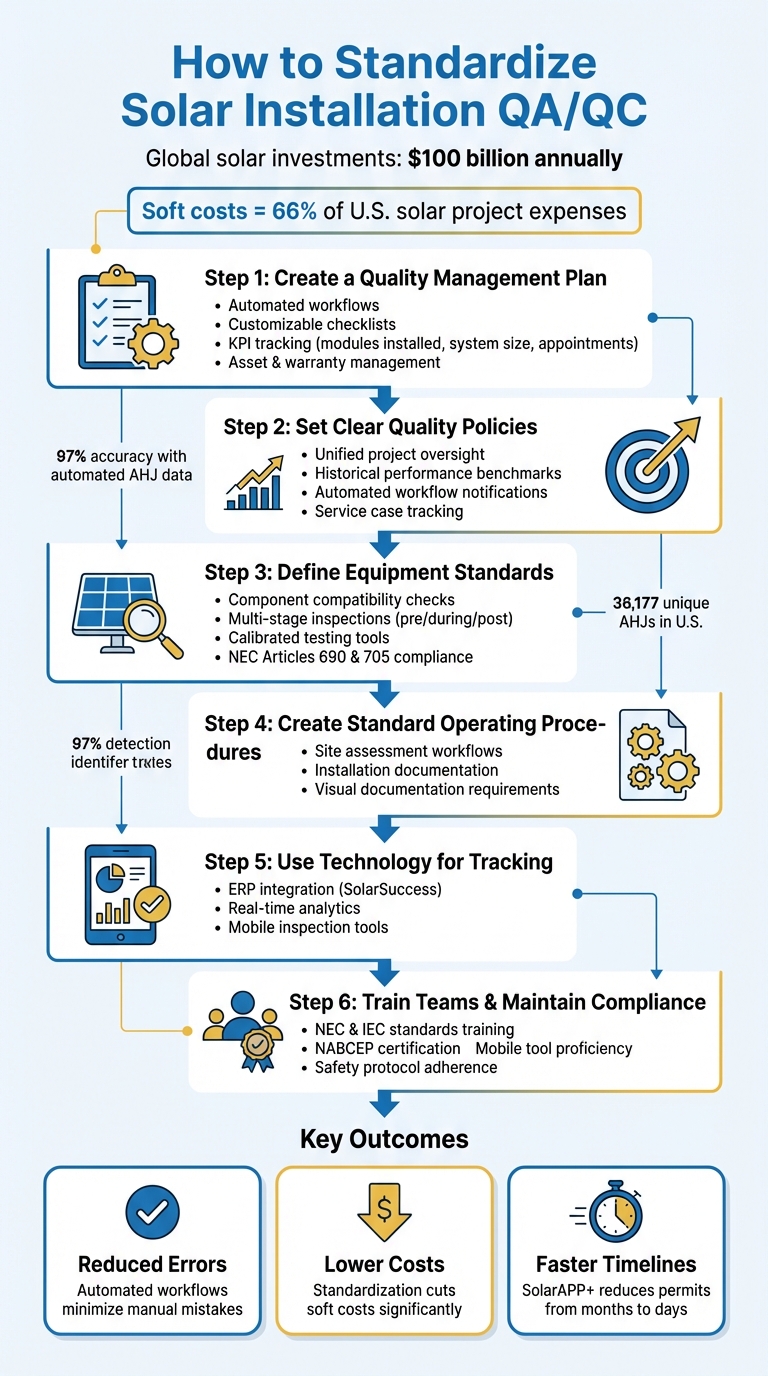
6-Step Framework for Standardizing Solar Installation Quality Control
How to Build a Quality Management Plan
A quality management plan ensures consistency in QA/QC processes across all solar installation projects. Without one, teams can experience misalignments that lead to increased costs and project delays. The goal is to create a framework that aligns everyone – from design engineers to field technicians – around the same quality standards and project requirements.
To minimize manual errors and miscommunication, establish standardized, automated workflows that span from design to commissioning. Include customizable checklists tailored to specific service types or project categories, supported by on-site photo documentation to confirm installation quality. For instance, the verification steps for a residential rooftop installation will differ from those for a commercial ground-mount system.
Integrate asset and warranty management into your quality plan. This allows for tracking component details and manufacturer warranties, ensuring that defects are identified and addressed during the QA/QC process.
Incorporate data-driven KPIs to monitor performance in real time. Metrics like total modules installed, system size, and completed appointments can help identify trends and address challenges early. As Blu Banyan highlights:
"Project managers play a vital role in making sure solar installation projects are completed on time, within budget, and to the highest quality standards".
A centralized view of active projects helps managers pinpoint bottlenecks and dependencies, ensuring tasks align with broader quality goals. This foundation sets the stage for defining clear policies and technical standards in the next steps.
Set Clear Quality Policies and Goals
Clear policies are essential to avoid fragmented operations and inconsistent standards. Start by implementing a unified project oversight system that provides managers with a single workspace to monitor all active projects, ensuring alignment with broader goals and timelines.
Use historical performance data to establish realistic quality benchmarks. Compare current monthly metrics – such as the number of residential installs, total modules installed, and completed appointments – to the same period in prior years. Automated workflows can further reduce manual errors by notifying team members of the next required action, ensuring quality checks are completed.
Develop customizable checklists based on service type or project category to meet specific quality requirements for every installation. For example, a ground-mount commercial project will have different verification needs than a residential rooftop system, and your checklists should reflect these distinctions.
Finally, maintain a comprehensive view of service and project data to track performance over time. Link service cases back to their original installation projects to identify recurring quality issues. If multiple service calls are tied to a specific installer or equipment batch, you can address the root cause before it impacts additional projects. Some teams even automate service orders by integrating energy production monitoring data – triggering service orders automatically when systems underperform to ensure compliance with performance guarantees.
Define Equipment Requirements and Inspection Steps
The technical foundation of your quality management plan lies in clearly defined equipment requirements and inspection protocols. Establish standards for all system components, including solar modules, racking, charge controllers, batteries, and inverters. Pay close attention to compatibility – for example, charge controllers and inverters must match specific battery chemistries to avoid performance issues or safety risks. For lithium-ion batteries in off-grid systems, consider a Watt-hour (Wh) efficiency value of 90%–95% during design and inspection phases.
Calibrate tools like digital multimeters, clamp-on ammeters, and thermal imaging devices to identify electrical issues and thermal hot spots. Conduct performance testing for string voltage and current during optimal sunlight hours, typically between 10 AM and 2 PM on clear days, for accurate readings.
Adopt a multi-stage inspection process that spans the project lifecycle. Pre-production inspections should verify project plans, material availability, and compliance with local building codes before construction begins. During installation, visual inspections should assess module alignment, fastener torque, grounding continuity, and weatherproofing. Post-production audits – conducted after installation but before commissioning – can catch safety hazards or installation defects that might otherwise be overlooked.
| Inspection Category | Key Procedure / Requirement | Relevant Standard/Tool |
|---|---|---|
| Mechanical | Verify module alignment and fastener torque values | Manufacturer Specs |
| Electrical | Test string Voc and operating current | Calibrated Multimeter |
| Safety | Verify rapid shutdown and anti-islanding protection | NEC Article 690 |
| Structural | Check roof penetrations and flashing integrity | Local Building Codes |
| Inverter | Monitor grid synchronization and MPPT effectiveness | Data Logging Systems |
Electrical protocols require particular attention. Ensure all wiring and connections comply with National Electrical Code (NEC) requirements, specifically Articles 690 and 705. When calculating current ratings for inverters, apply a safety factor to the Standard Test Conditions (STC) short-circuit current. Use calibrated torque tools for all electrical terminations and mounting hardware to prevent loose connections and mechanical stress.
Documentation standards should mandate detailed inspection reports that include serial numbers, photographic evidence of workmanship, and performance data such as irradiance and voltage readings. As Ed Caldeira from FTQ360 explains:
"A well-run QAQC program, which includes quality criteria that align with customer expectations, improves the quality of a solar energy project, reduces rework costs, and decreases the likelihood of warranty claims".
Digital checklists, accessible through mobile-based inspection tools, enable real-time reporting, automated punch lists, and better communication between quality managers and field teams. These technical standards ensure every installation meets defined quality benchmarks.
Prepare for Corrective Actions
Despite thorough planning, non-conformities can still occur. The key is having a structured approach to identify and resolve issues before they affect timelines or system performance. Your quality management plan should outline clear escalation paths and response protocols for various defect types.
Automated monitoring can enhance your corrective action process. Energy production monitoring tools can automatically trigger service orders when performance drops below expected levels. This proactive approach addresses issues before customers even notice. Mobile inspection tools are also essential – field technicians equipped with mobile-friendly tools can access job details, log work, and submit inspection forms directly from the site. When a defect is identified, such as improper torque on electrical connections or misaligned modules, technicians can document it immediately with photos and notes, initiating the corrective workflow.
Intelligent scheduling tools help enforce timelines by assigning jobs to technicians based on skills and location. Assign corrective actions to qualified technicians to ensure issues are resolved correctly the first time, avoiding repeated service calls that can hurt profitability and customer satisfaction.
Maintain a complete historical record by linking all service cases back to the original project. This audit trail can reveal patterns – if specific equipment types or installation methods frequently require corrective actions, you can refine your quality management plan to prevent recurring issues. The ultimate goal is not just to fix individual problems but to create a feedback loop that drives continuous improvement, strengthening the overall effectiveness of your quality management plan.
Create Standard Operating Procedures (SOPs)
Standard operating procedures (SOPs) are essential for maintaining consistent quality across projects, no matter the size or location. By standardizing workflows, SOPs help reduce errors, improve team coordination, and ensure everyone operates on the same page. As Jan Rippingale, CEO of Blu Banyan, explains:
"When you’re working with incompatible, incomplete or out-of-date data, it can turn into a nightmare pretty quickly. To improve efficiency, productivity and profitability, solar installers must have reliable visibility into their entire end-to-end businesses".
These procedures act as a bridge between planning and execution, ensuring each step – from site assessment to final commissioning – is documented and followed, keeping quality consistent across all projects.
Document Site Assessment and Installation Workflows
Develop clear, step-by-step guides for every stage of the process. For instance, site assessments should include plan approval, material verification, and building code reviews. During installation, document procedures like mounting verification, wiring management, and grounding continuity checks. Post-installation workflows should cover tasks such as voltage and current testing, inverter performance checks, and thermal imaging inspections.
Tailor checklists to fit the needs of specific project types. A residential rooftop installation, for example, involves different steps compared to a commercial ground-mount system. Incorporate visual documentation into your SOPs by specifying when and where technicians should take photos. These images should be stored alongside service cases and project records for quality assurance and historical reference.
Automating workflow handoffs can also help eliminate unnecessary delays. For example, once a site assessment is completed, the system can automatically notify the engineering team to begin design work, bypassing the need for manual communication like emails or phone calls. To streamline training, use industry-specific templates for SOPs, allowing new team members to quickly adapt to standardized processes.
Reduce Delays with Standardized Processes
Delays often stem from unclear handoffs, missing information, or inconsistent procedures. Standardized workflows address these pain points, creating a unified approach that minimizes confusion. It’s worth noting that soft costs make up about 66% of solar project expenses in the United States, much of which is due to inefficiencies and poor coordination.
Centralizing project oversight in a single workspace is a game changer. With a unified view of all active projects, managers can quickly spot bottlenecks and dependencies, allowing for timely interventions before delays escalate. This centralized approach ties SOPs directly into broader project management goals. For instance, you can track monthly metrics like completed installations, total modules installed, and the number of appointments. Comparing these figures year-over-year can reveal patterns and highlight areas for improvement.
Streamlined permitting processes also play a critical role in reducing delays. Tools like SolarAPP+ provide access to standardized permit templates, cutting the permitting timeline from months to just days. Additionally, the SolarAPP+ Prize offers up to $15,000 to jurisdictions that adopt automated permitting, lowering costs and speeding up implementation. Blu Banyan emphasizes the importance of this approach:
"The standardization of the solar industry is crucial to its success… ensuring a common data standard for all participants will allow the solar industry to achieve its potential".
Another way to improve efficiency is by automating service order creation. Integrated energy production monitoring systems can flag underperforming systems and automatically generate service orders. This proactive approach ensures maintenance happens without the need for manual oversight, keeping operations running smoothly and efficiently.
Perform Inspections at Every Stage
Breaking inspections into pre-production, post-production, and audit phases creates a structured and thorough quality control process. Here’s how each stage works.
Pre-Production Inspections
Pre-production inspections ensure everything is in place before crews start work on-site. This stage focuses on code compliance, material checks, and resource readiness. In the U.S., with 36,177 unique authorities having jurisdiction (AHJs), understanding local regulations upfront is critical to avoiding costly redesigns or cancellations.
Start by reviewing permit applications to confirm they meet solar-specific code requirements, such as structural and electrical standards. Tools like centralized registries can help identify local permitting rules and key contacts. For example, automated AHJ registries have significantly reduced errors and improved efficiency – 97% of automated data matched human-assigned AHJs, cutting delays and speeding up installation timelines.
It’s also essential to verify inventory in real-time to ensure technicians have all necessary components on hand. This step reduces the need for extra trips and prevents delays that can eat into profits. As Andrew Spalding, Enterprise Account Executive at Aurora Solar, explains:
"The lack of a single source of AHJ truth is driving up soft costs. I’ve observed firsthand how the improper assignment of AHJs can result in a myriad of downstream problems, including project cancellations, change orders, and redesigns".
Once pre-production inspections are complete, the focus shifts to ensuring the constructed system complies with all quality standards.
Post-Production and Final Inspections
Final inspections confirm that the system meets all safety and quality requirements before it’s handed over. Key areas include electrical verification, structural integrity, fire safety compliance, and system performance testing. Using standardized checklists, like those from SolarAPP+ or IREC, helps streamline this process and eliminates the need for on-site manual calculations.
| Inspection Category | Key Items to Verify |
|---|---|
| Electrical | Interconnection method, Main Service Panel equipment, inverter settings and installation details |
| Safety | Fire safety code requirements, signs, placards, and markings |
| Structural | Roof requirements and structural code compliance |
| Operational | Energy production monitoring and component performance |
During this stage, verify that the interconnection method, Main Service Panel, and inverter settings meet code requirements. Check that the installation adheres to roof and structural standards. Additionally, confirm that all safety signs, placards, and markings are properly installed and easily visible for emergency responders and utility crews.
Equip technicians with mobile tools to document their work and capture high-resolution photos for real-time updates and records. Review manufacturer warranties for all components during the final inspection to address potential defects before handing over the project.
Conduct Audits and Monitor for Improvement
Even after the system is handed over, audits play a vital role in maintaining and improving quality. By using detailed inspection data, audits provide valuable feedback to refine installation practices. Link post-installation service cases back to the original project to build a complete history of system performance and quality. This historical data can uncover trends and guide improvements for future projects.
Create service checklists tailored to specific categories or service types. Use data from energy production monitoring systems to automatically generate service orders when systems underperform. This proactive approach helps resolve issues early, reducing customer complaints and warranty claims.
Track customer assets throughout their lifecycle, including performance metrics, warranties, and maintenance records. This long-term perspective is essential for quality assurance, as it reveals how installation practices impact system performance over time. Blu Banyan highlights the importance of precision in field operations:
"Successful field service operations rely on your team’s ability to manage every detail precisely".
Analyze monthly metrics like completed installations, total modules installed, and service calls. Comparing these figures year-over-year can identify trends and spotlight areas for improvement. With this data-driven approach, audits go beyond compliance checks, becoming a strategic tool for achieving operational excellence.
sbb-itb-2560759
Use Technology to Track QA/QC
Technology has revolutionized quality control, turning what was once a manual, paper-heavy process into a more efficient, automated system. With the right tools, you can track progress in real time, catch potential issues early, and reduce costly mistakes. This approach builds on the standardization methods already discussed, pushing solar QA/QC processes to new levels of efficiency.
Manage QA/QC with SolarSuccess ERP

SolarSuccess ERP serves as a unified platform that brings together accounting, inventory, project management, and CRM functions. By eliminating the chaos of disconnected applications, it reduces the need for manual data entry and patchwork fixes.
The platform ensures consistent quality by defining specific quality specifications – groups of related inspections that apply from the moment shipments arrive to the final stages of production. For example, when a technician logs an inspection in the field, the data is instantly updated on project dashboards, providing real-time insights.
Aaron Casillas, Technology & Infrastructure Director at Big Sun Solar, highlights the benefits of this integration:
"Sharing data across these systems was difficult, and in most cases our only way to ‘patch the holes’ was by adding labor… SolarSuccess streamlined things even further and allowed us to add our own customizations on top of NetSuite".
The system also automates workflows triggered by quality events. For instance, it can prompt inspections when inventory is received or when a production process is completed. Purchase orders are automatically generated from bills of materials, and real-time truck stock tracking ensures technicians have the right parts on hand for first-time fixes. This synchronization between field and office ensures tasks align with project timelines, reducing the need for costly follow-up visits.
Improve Team Communication with bluChat and bluDocs
Clear communication is crucial to preventing minor quality issues from snowballing into major project delays. bluChat offers team chat and SMS capabilities directly within the project management system. This means field technicians can instantly alert project managers, with all messages automatically linked to the relevant project record.
bluDocs, on the other hand, centralizes all project-related files and quality records in one place. Field teams can access everything they need – installation drawings, inspection checklists, manufacturer specs – right from their mobile devices. Photos taken on-site are also automatically linked to the appropriate project record, solving the common problem of scattered documentation.
Joe Marhamati, Co-Founder and VP at Ipsun Solar, explains how this approach has streamlined their operations:
"We’re doing more with the same number of people and we have a system that’s more reliable and less stressful than tracking a million different spreadsheets".
In Spring 2025, Big Sun Solar implemented SolarSuccess and bluActions, creating a seamless project execution process. This integration allowed for real-time costing, eliminated data silos, and earned the company NetSuite’s Solution Provider Spotlight Award. Similarly, Ipsun Solar automated their residential invoicing process, enabling invoices to be generated automatically as projects hit specific milestones – boosting productivity without increasing staff.
Strong communication and organized documentation naturally lead to better performance tracking.
Track KPIs with Real-Time Analytics
Real-time analytics turn quality data into actionable insights. Custom dashboards monitor key metrics like inspection rates, defect occurrences, and rework costs across projects. This instant feedback helps managers spot trends and address issues immediately, rather than waiting for periodic reports.
Using Statistical Process Control (SPC) tools, such as R-charts and capacity testing, underperformance can be detected even when installations seem flawless. This data-driven approach is particularly valuable, as soft costs like labor and quality issues can make up as much as 64% of the total cost of a new solar system.
The system tracks every part used, every mile driven, and every hour worked, feeding this information into project budgets to maintain clear visibility of margins. When quality problems arise, managers can quickly assess their financial impact and take corrective action.
Jan Rippingale, CEO of Blu Banyan, underscores the importance of this transparency:
"To improve efficiency and profitability, solar installers must have real-time visibility into their entire end-to-end businesses".
Automated milestone tracking further aligns quality checkpoints with financial events. For example, when a project passes its final inspection, the system can automatically trigger invoice generation or warranty registration. This ensures that billing and documentation are handled promptly, reducing administrative delays and improving cash flow.
Train Teams and Maintain Compliance
Effective training is the backbone of quality assurance and quality control (QA/QC) in solar installations. Even the most advanced systems can’t succeed without a well-trained team. Solar professionals need to be proficient in electrical, structural, and safety protocols to meet NEC and IEC standards. Just like standardized operating procedures (SOPs) and integrated ERP systems, thorough training ensures these processes are carried out as intended. Key training topics include interconnection methods, Main Service Panel (MSP) equipment, inverter specifications, roof requirements, and fire safety codes. Additionally, teams must be capable of reviewing permit applications and adhering to state and local code requirements.
| Inspection Category | Key Training Topics |
|---|---|
| Electrical | Interconnection methods, MSP equipment, inverter installation |
| Structural | Roof requirements and installation details |
| Safety | Fire safety codes, signs, placards, and markings |
| Administrative | Plan review, permit application, and site information |
Certification programs, such as those offered by the North American Board of Certified Energy Practitioners (NABCEP), play a key role in validating skills and maintaining industry credibility. With nearly half (44%) of consumers struggling to gauge the trustworthiness of solar companies, proper training and certifications become essential. Certification verification tools now allow customers to confirm installer credentials, adding an extra layer of trust and accountability.
Train Teams on National Codes and IEC Standards
Training should include step-by-step inspection workflows and standardized checklists to ensure code compliance. For instance, the SolarAPP+ inspection checklist provides clear, actionable guidance on verifying PV system compliance, simplifying the job for both contractors and inspectors.
International standards like IEC 61215 and IEC 61730 ensure that PV modules meet stringent design and safety requirements. Meanwhile, SEIA 401 Standards establish clear industry terms and training schedules for areas such as energy storage systems, EV charging, and utility programs. Regular training on safety measures – like personal protective equipment, lockout/tagout procedures, and fall protection – helps foster a culture of safety across all job sites.
Use Mobile Tools for On-Site Inspections
Mobile tools are a game-changer for on-site compliance and documentation. These tools allow technicians to access job details, log tasks, and capture high-resolution photos of completed work. Photos are then stored alongside specific service cases, ensuring quality checks are tied directly to projects. Mobile inspection checklists further streamline compliance checks in electrical, structural, and fire safety areas.
Customizing service checklists for different job types ensures that QA/QC standards are met consistently. Smart filters in mobile dispatch tools can match technicians with jobs based on their skills, location, and priority, while real-time inventory tracking ensures the necessary parts are on hand for first-time fixes – reducing expensive follow-up visits.
When selecting mobile tools, prioritize platforms with user-friendly interfaces and industry-specific templates. This makes it easier for staff to get up to speed quickly with minimal training. Linking mobile service cases back to the original project record creates a complete historical view of an asset’s lifecycle and maintenance. This approach not only simplifies compliance but also transforms it into a seamless process that protects both the company and the customer.
Conclusion
Streamlining QA/QC processes lays the groundwork for consistent growth and operational efficiency. By integrating well-defined quality management plans, documented SOPs, and thorough stage-by-stage inspections with advanced technology, companies can create systems that minimize errors, lower costs, and speed up project timelines. Notably, soft costs make up around 66% of solar project expenses in the United States. Establishing these processes also paves the way for utilizing technology to improve operational transparency.
Technology is a key enabler of large-scale standardization. Solar-specific ERP systems like SolarSuccess provide a centralized hub for operational oversight, while mobile tools empower field teams to document work quality in real time.
However, technology alone isn’t enough. Teams need comprehensive training on national codes, IEC standards, and safety protocols to effectively implement these standardized processes.
The solar industry is steadily embracing standardization, driven by initiatives such as the Orange Button Working Group and mandated tools like SolarAPP+. Companies that adopt these measures early position themselves to scale efficiently while maintaining high standards of quality and compliance. By aligning quality management plans, consistent procedures, and ongoing training, QA/QC evolves from a reactive obligation into a proactive advantage in a competitive market.
FAQs
How does technology enhance QA/QC for solar installations?
Technology is reshaping how solar installation quality assurance (QA) and quality control (QC) are carried out, replacing outdated manual processes with smarter, data-driven approaches. Tools like multimeters, clamp meters, and thermal imaging cameras now play a key role in ensuring precise measurements of voltage, current, and identifying hotspots. These tools help confirm that every component meets critical safety and performance standards before the system goes live.
Cloud-based platforms are also making QA/QC processes more efficient by centralizing inspection data, automating workflows, and seamlessly integrating with project management systems. Take Blu Banyan’s SolarSuccess, for example. This solution allows field technicians to use digital checklists, capture live data, and sync it directly to dashboards for easy monitoring and reporting. The result? Fewer errors, better consistency, and early detection of potential problems – all of which lead to more reliable systems and increased investor confidence.
By leveraging advanced tools, mobile apps, and cloud-based solutions, solar installers can streamline operations, reduce costs, and ensure solar systems are not only high-performing but also delivered on time.
What are the advantages of using a multi-stage inspection process for solar installations?
A thorough, multi-stage inspection process ensures that quality is monitored at every key phase – design, pre-installation, on-site construction, and post-commissioning. This method helps spot and address potential issues early on, cutting down on expensive rework and ensuring adherence to safety and structural standards. Catching problems at the start not only boosts system performance but also increases the lifespan of energy production systems.
Each inspection generates detailed documentation, offering project managers real-time insights into progress. With tools like Blu Banyan’s mobile checklists, teams can effortlessly capture inspection data, sync it with the ERP system, and maintain a dependable record for warranties and compliance. This approach simplifies permitting, accelerates project approvals, and ensures accurate invoicing.
What’s more, this staged process encourages ongoing improvement. Insights from inspections and audits guide better practices for future installations, helping to lower soft costs while building long-term customer trust.
Why is it important for solar teams to be trained on national codes and IEC standards?
Training solar teams on national codes and IEC standards plays a key role in ensuring safety, reliability, and compliance with industry regulations. This approach helps minimize risks, avoid expensive mistakes, and uphold consistent quality across solar installations.
Following these standards enables solar systems to deliver peak performance and extended lifespan, which can significantly reduce overall lifecycle costs while boosting customer satisfaction. Additionally, thorough training prepares teams to adapt to changing regulations, ensuring projects align with both present and future industry demands.
