
Solar projects are expensive, but integrating suppliers into a single ERP system can cut costs by up to 20%. While hardware prices have dropped significantly since 2008, soft costs – like permitting, labor, and administration – still account for 64-65% of total project expenses. Supplier integration addresses this by centralizing data, automating processes, and improving efficiency across supply chains.
Key Benefits of Supplier Integration:
- Lower Administrative Costs: Automation reduces manual data entry and reconciliation, saving time and money.
- Improved Supply Chain Efficiency: Real-time access to inventory and pricing avoids delays and costly errors.
- Reduced Labor Costs: Streamlined communication and scheduling minimize wasted trips and rework.
For example, companies like Skyline Smart Energy cut overall costs by 10% and reduced financial close time from six weeks to two after implementing integrated ERP systems. By unifying operations, solar businesses can handle growing demand while keeping expenses under control.
How Supplier Integration Reduces Solar Project Costs
Supplier integration helps trim inefficiencies in the supply chain, reduces administrative burdens, and lowers labor expenses. By connecting suppliers directly to your ERP system, data flows seamlessly between your team and distributors, cutting out much of the manual work that drives up soft costs. Let’s break down how this integration improves supply chain management, reduces administrative overhead, and minimizes labor costs.
Supply Chain Efficiency and Bulk Purchasing Savings
When your ERP system integrates with major distributors like BayWa r.e., you gain instant access to real-time inventory levels and pricing – all without leaving the platform. This level of visibility ensures you avoid delays caused by missing components and make smarter decisions when purchasing in bulk. For example, syncing your bill of materials with sales and material orders ensures your team procures the correct equipment the first time around, eliminating costly errors and unnecessary reorders.
Lower Administrative and Overhead Costs
Integration doesn’t just enhance inventory management; it also streamlines administrative processes. Manual data entry across disconnected systems can be a major drain on resources. By consolidating outdated systems, companies like Skyline Smart Energy have seen dramatic improvements. They reduced their financial close process from six weeks to just two and achieved 10% overall cost savings by cutting down on reconciliation work. Additionally, automated accounting tied to project milestones simplifies supplier payments and customer invoicing, further reducing overhead. Real-time synchronization also minimizes waste in field operations, saving both time and money.
Reduced Labor and Installation Costs
Integrated systems keep field crews and office teams on the same page by syncing data in real time. This prevents wasted trips and ensures resources are allocated efficiently. For instance, Titan Solar Power implemented a weather portlet to optimize site visits. As Jan Rippingale, CEO of Blu Banyan, shared:
"Attentive discussions with early solar customers about the costs of multiple site visits due to bad weather, led to addition of a basic weather portlet to the project manager’s dashboard… In four hours we built a portlet that wows and benefits our customers."
This simple addition reduced unnecessary site visits and lowered labor costs. By connecting field service solutions to your ERP system, installation teams gain access to precise materials, schedules, and project specifications – cutting down on errors and avoiding costly rework.
sbb-itb-2560759
How to Integrate Suppliers into Your ERP System
Bringing suppliers into your ERP system requires a structured approach to unify your data and streamline operations. The process involves identifying inefficiencies, setting up modules for real-time data sharing, and using communication tools to keep everyone on the same page. These steps take you from initial assessment to full implementation, ensuring a smoother supplier integration process.
Step 1: Review Your Supply Chain and Pinpoint Integration Needs
Start by analyzing your supply chain to uncover where manual data entry is causing delays. For instance, transferring data between spreadsheets, accounting tools, and email threads often leads to errors and inefficiencies. These gaps can contribute significantly to operational costs – soft costs alone can make up as much as 64% of total project expenses. Identify your key supplier relationships, focusing on those handling the largest order volumes. Prioritizing these suppliers for integration will deliver the biggest impact.
Step 2: Choose an ERP System with Built-In Integration Features
Select an ERP platform tailored to your industry. For example, SolarSuccess is specifically designed for solar workflows and offers built-in integration capabilities with major distributors. Clive Smith, Chief Business Development Officer at Blu Banyan, highlights the importance of such systems:
"When you’re aggregating a group of point applications – regardless of how good each of those programs is individually – you really need them to be able to talk to one another. The only way to make that happen is with an integrated or unified application suite on a single database."
Using an industry-specific ERP saves time and effort by eliminating the need to adapt generic software to specialized processes, reducing both implementation challenges and costs.
Step 3: Configure Supplier Data in Your ERP
Set up your ERP system to sync your Bill of Materials (BOM) with sales orders. Automate the creation of purchase orders based on BOMs and demand planning data. For example, connect your system to supplier catalogs like BayWa r.e. to access real-time stock availability and pricing directly within your ERP. This setup ensures your team orders the right equipment when needed, cutting down on inventory holding costs and minimizing project delays.
Step 4: Leverage SuiteApps to Enhance Supplier Collaboration
Once your supplier data is configured, focus on improving communication. Tools like bluConnect and bluChat can make a big difference. bluConnect links directly with major distributors, giving you access to live catalog updates and enabling automatic purchase order transmissions. Meanwhile, bluChat integrates messaging into your ERP, keeping both internal teams and external suppliers aligned on order statuses and project updates. These tools also simplify processes like commission payouts, reducing the labor involved in managing partner transactions during periods of rapid growth.
Step 5: Test and Monitor Integration Effectiveness
Begin with pilot tests involving one or two key distributors. Track key performance indicators (KPIs) like procurement times and inventory turnover, comparing them to your baseline metrics. Monitor how quickly inventory moves from the warehouse to project sites and measure reductions in manual tasks like creating purchase orders. Use these insights to fine-tune your workflows and demonstrate ROI to stakeholders, ensuring the integration delivers measurable value.
Cost Savings from ERP Supplier Integration
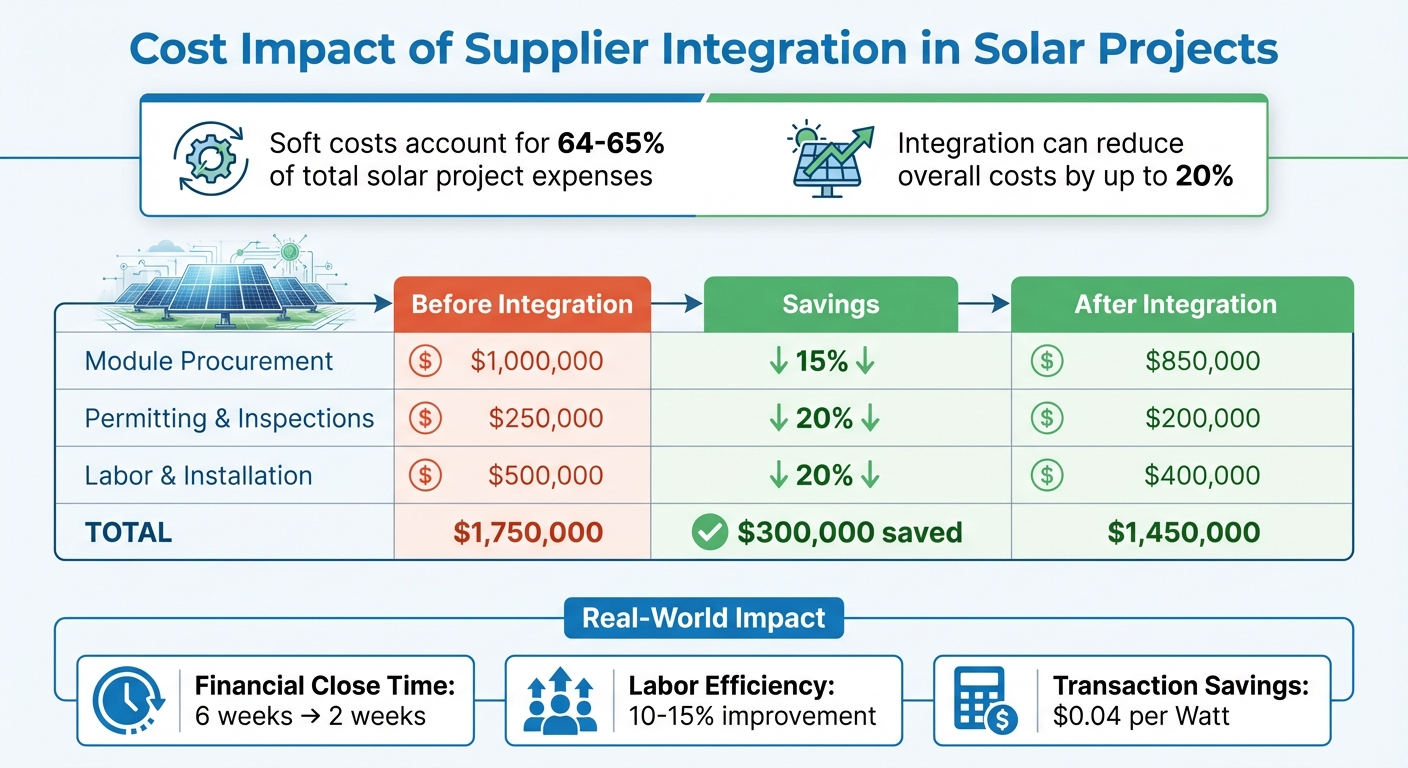
Solar Project Cost Reduction Through ERP Supplier Integration
Bringing suppliers into your ERP system isn’t just about convenience – it’s about cutting costs where it matters most. According to the Department of Energy, soft costs – which include procurement, permitting, and labor – can account for a staggering 64% of the total cost of a new solar system. By integrating suppliers, solar companies can tackle inefficiencies head-on and significantly reduce project expenses.
The impact of integration is already evident. Many solar companies have reported noticeable improvements in both cost and process efficiency after implementing solar ERP software. This shift highlights the real-world value of replacing disconnected platforms with a unified approach.
Aaron Casillas, Technology & Infrastructure Director, sheds light on the complexity of solar installations:
"Solar installation has many moving parts, all generating soft costs, and there is no single application that solves them all, because you have to address inefficiencies across all functions of the entire company."
By streamlining operations, integration reduces the need for repetitive manual data entry, optimizes storage through just-in-time ordering, and avoids costly mistakes like double-ordering. With real-time distributor data and automated ordering, teams can redirect their efforts toward revenue-generating activities. The table below illustrates the financial impact of these changes across key cost areas.
Before and After Integration Cost Comparison
Here’s a breakdown of typical cost reductions solar companies experience after integrating suppliers into their ERP systems:
| Cost Category | Pre-Integration Cost ($) | Post-Integration Cost ($) | Savings (%) |
|---|---|---|---|
| Module Procurement | 1,000,000 | 850,000 | 15% |
| Permitting and Inspections | 250,000 | 200,000 | 20% |
| Labor and Installation | 500,000 | 400,000 | 20% |
These figures represent industry averages based on companies that have transitioned to integrated ERP platforms. Of course, the exact savings will vary depending on your current processes, project scale, and supplier relationships.
Solutions like Blu Banyan’s SolarSuccess take this integration a step further by combining real-time data with automation. This not only drives cost reductions but also simplifies operations, making it easier for solar companies to manage their resources effectively.
Best Practices for Supplier Integration in Solar ERP
Integrating suppliers effectively into your Solar ERP system isn’t just about technology – it’s about creating a well-structured supply chain, adopting standardized processes, and making decisions based on accurate data. Companies that treat supplier integration as an ongoing strategy, rather than a one-off project, are the ones reaping the most benefits. Below are some key practices that help ensure smooth data flow and optimal supplier collaboration.
Build a Diverse Supplier Network
Relying on a single supplier can leave your projects vulnerable to delays or shortages, which can disrupt timelines and inflate costs. By cultivating relationships with multiple suppliers across different regions, you build flexibility into your supply chain. This approach ensures that disruptions in one area don’t completely derail your operations.
An ERP system plays a crucial role here – it can track and analyze supplier performance metrics like delivery speeds, quality consistency, and pricing trends. Armed with this data, you can make smarter decisions about which vendors are best suited for specific projects.
As Blu Banyan highlights, "The only way to overcome conflicting data from incompatible applications is a single platform for all business operations, from accounting and inventory, to project management and CRM". When all supplier information is centralized in one system, you can seamlessly switch between vendors without losing sight of costs or deadlines.
Standardize Workflows with bluDocs and bluTime
A lack of consistency in documentation and time tracking can create chaos when working with suppliers. Tools like bluDocs help by consolidating all contracts, permits, and project files into a single, secure location that integrates directly with your ERP system. This eliminates the hassle of digging through countless emails or scattered file systems to find critical documents.
On the labor side, bluTime simplifies time tracking by capturing real-time data on hours spent during each project phase. This information is invaluable for coordinating with subcontractors and suppliers who rely on precise project schedules. For example, Big Sun Solar adopted these tools within SolarSuccess in early 2025, enabling real-time costing and streamlined execution. Their efforts earned them NetSuite‘s Spring 2025 Solution Provider Spotlight Award.
Joe Marhamati, Co-Founder & VP, described the impact: "We’re doing more with the same number of people and we have a system that’s more reliable and less stressful than tracking a million different spreadsheets". Automated invoicing at key construction milestones saves time for both your team and your suppliers, reducing administrative headaches and ensuring smoother collaboration.
Use Real-Time Data for Better Decision Making
Real-time data is a game-changer when it comes to supplier management. With live updates from your ERP system, you can implement just-in-time ordering, avoiding both inventory shortages and the costs of overstocking. Automated alerts further enhance efficiency by flagging potential issues, such as delayed shipments or sudden price hikes in components.
Dashboards equipped with smart analytics provide a clear view of trends and anomalies. AI-powered inventory management can even forecast material needs with impressive accuracy, potentially cutting inventory costs by 10–20%. However, this level of precision is only possible when your supplier data integrates seamlessly into your ERP, offering a complete picture for making informed decisions about resources and vendor partnerships.
Calculating ROI from Supplier Integration
Measuring ROI from supplier integration involves tracking specific metrics tied to procurement, labor efficiency, and financial processes. Solar companies that integrate their suppliers into ERP systems can clearly quantify improvements in these areas. The trick lies in identifying the right metrics and understanding what realistic savings look like in practice. Below, we explore key metrics and real-world examples that highlight these benefits.
Metrics for Measuring ROI
One of the most straightforward metrics to track is transaction automation. When your ERP system automatically generates purchase orders from the bill of materials, it eliminates manual data entry errors. According to industry data, this automation can save about $0.04 per Watt. For a company installing 10 megawatts annually, this adds up to $400,000 in administrative savings.
Another critical measure is labor efficiency, which reflects how much more your team can accomplish without increasing headcount. Integrated ERP systems often deliver labor savings of 10% to 15%. This doesn’t necessarily mean cutting staff – it means your team can handle a larger workload more effectively.
Financial close time is also a key indicator of integration success. Consolidating finances becomes much simpler, with many multi-entity solar companies reducing their close time from six weeks to just two weeks. Spencer Newman, CFO at Norwich Solar Technologies, highlighted this transformation:
Our financial close was incredibly complicated and fraught with errors because we have so many subsidiaries consolidating together. That problem has almost gone away completely.
Lastly, days-to-payment measures how quickly revenue is collected. Automated invoicing triggered by construction milestones, like system inspections, speeds up receivables and improves cash flow.
Example Cost Savings Scenarios
Here are some real-world examples that illustrate the ROI of supplier integration:
Skyline Smart Energy provides a clear example of integration benefits. Under CFO Kevin Burke’s leadership, the company adopted SolarSuccess on NetSuite, replacing four outdated systems. The impact was significant: a 10% overall cost reduction, 10% to 15% labor savings, and a financial close process that went from six weeks to just two weeks. These results highlight the measurable impact of integration.
Titan Solar Power, the third-largest U.S. residential installer at the time of its SolarSuccess implementation in February 2020, focused on automating commission calculations and supplier coordination. Aaron Casillas, Technology and Infrastructure Director, shared:
Sharing data across these systems was difficult, and in most cases, our only way to ‘patch the holes’ was by adding labor… With NetSuite, we’ve significantly decreased the amount of labor involved in paying out our partners.
This integration achieved the $0.04 per Watt savings standard through transaction automation.
Ipsun Solar showcases the power of milestone-based invoicing. Co-Founder and VP Joe Marhamati explained how automation changed their workflow:
We’ve been able to automate most of our residential invoices. When a deal moves to a particular stage of construction, for example, SolarSuccess generates invoices based on that specific milestone… We’re doing more with the same number of people.
By automating invoicing, Ipsun Solar scaled its operations without needing to expand its back-office team.
Tick Tock Energy experienced significant gains in data accuracy and decision-making speed. Vice President and Founder Craig Pals noted:
Reconciliation time decreased substantially, and data was much more accurate, giving leadership confidence in making better business decisions.
Although these improvements are harder to quantify than direct cost savings, better financial visibility allowed the company to make faster, more informed decisions about supplier relationships and project bids.
Conclusion
Bringing suppliers into your ERP system is the key to simplifying operations and improving solar project efficiency. Supplier integration in solar ERP systems plays a major role in reducing soft costs, which make up 64%–65% of total project expenses. By linking distributors, financiers, and vendors on a single platform, solar companies can streamline their processes and improve overall performance.
Steps like analyzing your supply chain, choosing an ERP tailored to the solar industry, and utilizing real-time data tools allow solar businesses to cut costs and speed up financial processes. A great example is POWERHOME Solar, which slashed its monthly financial close time from 28 days to just 5 while scaling to over $600 million in revenue – all with a finance team of only six people.
Features like real-time data access, automated order creation, and milestone-based invoicing revolutionize procurement and cash flow management. As Jan Rippingale, CEO of Blu Banyan, puts it:
When you’re working with incompatible, incomplete, out-of-date data, it can turn into a nightmare pretty quickly. To improve efficiency and profitability, solar installers must have real-time visibility into their entire end-to-end businesses.
Integrating suppliers doesn’t just cut costs – it accelerates financial workflows and enables growth without adding to your team size. The benefits of consolidating separate systems into a unified ERP are clear. With the solar industry expanding by 43% in 2020, adopting supplier integration is crucial for staying competitive and achieving sustainable growth.
FAQs
How does integrating suppliers into an ERP system help lower solar project costs?
Integrating third-party suppliers into a unified ERP system makes managing procurement, invoicing, and inventory much easier. By automating workflows and bringing all data together in one place, it cuts down on manual data entry, avoids delays, and eliminates data silos. This can lead to considerable savings on labor, administrative tasks, and financing – key drivers of solar soft costs.
With these processes streamlined, businesses can work more efficiently, enhance collaboration, and redirect resources toward completing projects faster and at a lower cost.
How can integrating suppliers into an ERP system help reduce solar project costs?
Integrating suppliers into your ERP system can simplify solar project management, cut down on errors, and reduce hidden costs. To make this work smoothly, start by mapping out every interaction with your suppliers and ensuring their systems can connect effortlessly with your ERP. Solutions like Blu Banyan’s SolarSuccess offer a strong integration framework, bringing together critical data such as pricing, inventory, and delivery schedules into one centralized hub. This creates a reliable, consistent reference point for your team.
Real-time data syncing is a game changer – it ensures updates like shipment tracking or order statuses are immediately visible in the system, helping to avoid unnecessary delays. After the integration is in place, thorough testing of workflows and training your team on the updated processes are essential steps to ensure everything runs smoothly. Ongoing monitoring is equally important; it allows you to fine-tune the system over time, driving further cost savings and boosting efficiency.
How does integrating suppliers into an ERP system help reduce solar project costs?
Integrating third-party suppliers into a centralized ERP system, such as SolarSuccess, can help solar companies cut down on soft costs. By automating tasks like syncing supplier quotes, managing delivery schedules, and processing invoices, businesses can eliminate duplicate data entry, reduce manual errors, and make procurement workflows more efficient. The result? Noticeable savings in both administrative labor and operational expenses.
Take Norwich Solar Technologies, for instance. They transitioned from manual, spreadsheet-based purchasing to an integrated ERP solution. This shift not only reduced errors but also gave them better insight into project margins. Ipsun Solar took a similar approach, automating purchase orders and inventory updates, which allowed them to allocate more resources toward installations. On a larger scale, Titan Solar Power used real-time supplier data to fine-tune material ordering, avoid costly last-minute shipping, and increase overall productivity.
These examples highlight how integrating suppliers into an ERP system can save time, reduce mistakes, and improve operational efficiency – all of which contribute to lowering project costs in the solar industry.
