
Managing solar project costs is challenging, especially with 64% of expenses tied to non-hardware factors like permitting, financing, and labor. Many solar companies use disconnected tools like QuickBooks and Salesforce, which create inefficiencies and data silos. This makes it hard to track costs, profitability, or manage project changes effectively.
Solar-specific ERP systems, such as SolarSuccess, solve these problems by integrating accounting, project management, inventory, and sales into one platform. These tools provide real-time data, automated alerts, and dashboards to monitor key performance indicators (KPIs), identify cost overruns, and improve decision-making. Companies using these systems report better cash flow, reduced administrative labor, and improved cost tracking.
Key benefits include:
- Unified data integration: Combines accounting, CRM, and inventory for seamless operations.
- Real-time dashboards: Tracks costs, profitability, and inventory instantly.
- Automated alerts: Flags budget or schedule issues early.
- Cost savings: Saves approximately $0.04 per watt through automation.
Solar ERPs are essential for scaling solar businesses efficiently while reducing the administrative burden and improving profitability.
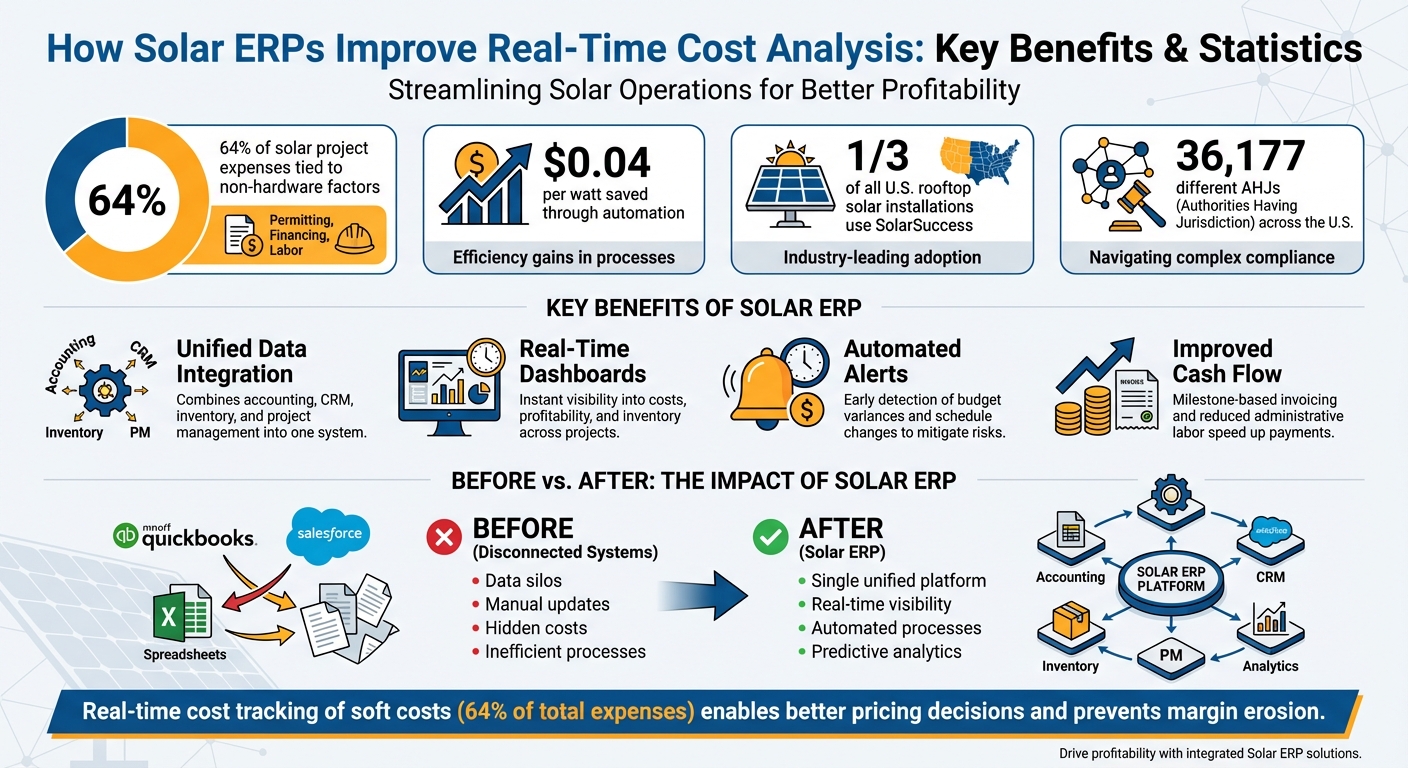
Solar ERP Benefits: Key Statistics and Cost Savings
Key Features of Solar ERPs for Real-Time Cost Analysis
Unified Data Integration
Solar ERPs like SolarSuccess bring together accounting, inventory, project management, CRM, and design-bid functions into one streamlined platform. Instead of juggling separate systems, all data is stored in a single database. This means updates – like changes to system parameters or construction milestones – are instantly visible across all departments, eliminating the need for manual updates.
Aaron Casillas, Technology & Infrastructure Director at Titan Solar Power, highlighted the challenges of using disconnected systems in February 2020:
"Sharing data across these systems was difficult, and in most cases our only way to ‘patch the holes’ was by adding labor. We wanted to get everything on one system."
After adopting NetSuite and SolarSuccess, Titan Solar Power captured a 1% share of the U.S. residential solar market, installing 153.5 MW in a single fiscal year. At the same time, they simplified commission payouts and reduced transaction-related labor. This platform also allows companies to consolidate financials across multiple subsidiaries, cutting down on accounting time for complex operations. By integrating everything into one system, Solar ERPs provide the foundation for real-time, dynamic analytics.
Real-Time Dashboards and Performance Metrics
With seamless data integration, customizable dashboards give users immediate insights into key project metrics like status, costs, profitability, and inventory availability. Finance teams can quickly identify budget changes or hidden costs – such as errors in the Bill of Materials or excess overhead – helping to prevent profit loss.
Aaron Casillas from Norwich Solar shared how this transformation played out for their company:
"With NetSuite and Blu Banyan, we finally had a unified view of data across the company including real-time insights into project status, costs, inventory, pricing, purchasing, and profitability."
This level of visibility enables swift adjustments to project schedules, reducing carrying costs and removing the guesswork from procurement. For instance, if an installation is delayed, managers can hold off on ordering materials, avoiding unnecessary storage fees. Automated milestone-based invoicing further improves cash flow by triggering invoices as soon as specific construction stages are completed.
Automated Alerts and Predictive Analytics
Building on unified data and real-time dashboards, automated alerts enhance project cost management. Notifications flag budget variances and schedule changes early, allowing managers to act before minor issues escalate. If a delay risks increasing carrying costs, alerts prompt procurement adjustments immediately. These systems also monitor margins closely, identifying soft cost overruns in real time.
In Spring 2025, Big Sun Solar implemented SolarSuccess through Blu Banyan to improve real-time cost tracking. Using the platform’s bluActions™ feature, the company streamlined operations and earned Blu Banyan the NetSuite Spring 2025 Solution Provider Spotlight Award. Modern Solar ERPs now integrate AI to analyze operational data more efficiently, uncovering insights into productivity and potential cost overruns. Predictive tools also aid inventory forecasting, ensuring installers have the right components without overstocking.
Joe Marhamati, Co-Founder & VP at Ipsun Solar, described the benefits:
"We’re doing more with the same number of people and we have a system that’s more reliable and less stressful than tracking a million different spreadsheets."
Automating transactions through a solar ERP can save approximately $0.04 per watt, which adds up quickly. In fact, SolarSuccess supports nearly one-third of all rooftop solar installations in the United States.
sbb-itb-2560759
How to Use Solar ERPs for Real-Time Cost Analysis
Step 1: Connect Your Data Sources
Start by moving away from disconnected systems – like using QuickBooks for accounting and Salesforce for CRM – and adopt a unified, cloud-based ERP platform. This shift creates a single, reliable source of information across all departments. Tools like SolarSuccess SuiteApps can help integrate industry-specific functions seamlessly.
Bring together internal and external data sources, such as CRM platforms (like HubSpot), communication tools (Zoom, SMS), and databases like the AHJ (Authority Having Jurisdiction) Registry. This integration automates processes like inspections and approvals for installations. Additionally, syncing your Bill of Materials with sales orders ensures real-time updates on inventory and purchasing. Universal financier connectivity also allows you to track loans and leases efficiently.
For instance, businesses have improved multi-department workflows by adopting unified ERP systems. Clive Smith, Chief Business Development Officer at Blu Banyan, highlights the importance of integration:
The only way to make that happen is with an integrated or unified application suite on a single database.
Once your data is unified, the next step is to focus on creating dashboards and notifications that provide actionable insights.
Step 2: Configure Dashboards and Notifications
After connecting your data, customize dashboards to track performance in real time. Design dashboards tailored to specific roles – like accounting, inventory, or project management – so each team can monitor the metrics that matter most to them. Set up KPIs specific to the solar industry, such as project profitability, commission reports, and sales pipelines, and create project milestones that automatically trigger actions like invoicing or budget updates.
You can also configure automated alerts to monitor budget changes, cost spikes, or project delays. Keeping a close eye on Bill of Materials costs helps prevent unexpected expenses that could impact your margins. These alerts are essential for maintaining accurate, real-time cost analysis.
Step 3: Generate Reports and Create Forecasts
With all your data in one place and dashboards in place, generating reports becomes much simpler. Solar ERPs consolidate data to deliver consistent and reliable reporting. Use milestone-based reporting to automate invoicing and financial tracking during key construction phases. Financial teams can also view subsidiaries as independent units or consolidate them for broader financial planning.
Take advantage of tools like bluBudget to refine schedules and improve forecasts. Many modern solar ERPs now include artificial intelligence to analyze data faster and provide deeper insights for forecasting. These accurate reports and forecasts enable better cost management and help businesses stay agile. Spencer Newman, CFO, shares how this transformation has impacted operations:
Our financial close was incredibly complicated and fraught with errors because we have so many subsidiaries consolidating together. That problem has almost gone away completely.
Scaling Operations with Cloud-Based Solutions and SuiteApps
Advantages of Cloud-Based ERPs
For many solar companies, juggling multiple software systems like QuickBooks for accounting, Salesforce for sales, and spreadsheets for everything else creates chaos. These disconnected tools lead to data silos and force teams to waste hours manually syncing information. A cloud-based ERP wipes out these inefficiencies by offering a single source of truth – a unified platform where accounting, sales, and project management teams can access real-time data together.
This integration doesn’t just streamline the installation process; it also makes scaling much easier. As your solar business grows, a cloud-based ERP can handle higher transaction volumes without needing to add more office staff. And by keeping everyone on the same page, it fosters better collaboration across all teams.
Using SuiteApps for Team Collaboration
SuiteApps like bluChat, bluDocs, and bluTime – designed to work seamlessly within SolarSuccess – replace fragmented systems and make teamwork smoother. Take bluChat, for example. It centralizes project communication, including SMS, directly within NetSuite. This eliminates those "invisible conversations" buried in private emails or third-party apps. Instead, every update and message is documented, searchable, and accessible, helping projects stay on track.
bluDocs simplifies document management with project-specific storage and version control – essential for handling varying requirements from different Authorities Having Jurisdiction (AHJs). Meanwhile, bluTime ensures precise timekeeping, preventing labor costs from spiraling out of control. Joe Marhamati, Co-Founder and VP at Ipsun Solar, highlights the value of these tools:
We’re doing more with the same number of people and we have a system that’s more reliable and less stressful than tracking a million different spreadsheets.
Together with the scalability of cloud platforms, these SuiteApps help teams work smarter, not harder.
Maintaining Long-Term Efficiency
Sustained efficiency hinges on real-time cost analysis, which cloud-based systems like SolarSuccess make possible. For instance, solar companies using this platform often save about $0.04 per watt thanks to automated transaction processing. Features like milestone-based invoicing speed up payments, while real-time dashboards let teams monitor project margins and adjust pricing instantly. This level of precision reinforces the importance of accurate cost tracking.
As solar companies grow – whether by adding subsidiaries or expanding into new regions – cloud-based ERPs offer even greater advantages. They can consolidate financial data across multiple entities, simplifying planning and drastically cutting the time needed for monthly financial closes. These tools enable solar businesses to maintain agility and stay efficient, even as they scale.
Conclusion
Key Takeaways
Real-time cost analysis eliminates the guesswork of outdated spreadsheets and disjointed software. With this kind of visibility, solar companies can make quicker, smarter decisions about pricing and scheduling. By consolidating core functions into a single platform, teams can access the same data – no more hunting for scattered information or adding unnecessary labor.
The financial benefits are clear. Solar companies using SolarSuccess save approximately $0.04 per watt through automated transaction processing. Features like milestone-based invoicing speed up cash flow, while real-time dashboards help prevent margin erosion before it becomes an issue. These efficiencies can mean the difference between scaling successfully and being bogged down by administrative overload.
Tracking soft costs, which can account for up to 64% of total system expenses, in real time gives solar companies the tools to make better pricing decisions and adjust project timelines before problems arise. As Jan Rippingale, CEO of Blu Banyan, explains:
To improve efficiency and profitability, solar installers must have real-time visibility into their entire end-to-end businesses.
This level of integration demonstrates how the solar industry benefits from ERP software, setting the stage for scalable and efficient operations.
Why Choose Blu Banyan‘s SolarSuccess

SolarSuccess takes these real-time savings a step further by addressing the specific challenges of solar operations. Designed for solar installers, the platform simplifies the complexities of managing 36,177 different AHJs across the U.S., handling intricate commission structures, and navigating deferred revenue calculations. Unlike generic business software, SolarSuccess is tailored to meet the day-to-day needs of solar businesses with features like AHJ registries, universal financier connectivity, and solar-specific KPIs.
Thanks to its cloud-based design, SolarSuccess allows businesses to manage unlimited subsidiaries and scale operations without adding more office staff. Paired with productivity SuiteApps like bluChat, bluDocs, and bluTime, the platform creates a cohesive system where every project detail, conversation, and cost is seamlessly captured. This unified approach gives solar companies the real-time insights they need to stay competitive in a fast-growing industry.
FAQs
What costs should a solar ERP track in real time?
A solar ERP system needs to monitor essential costs such as resource management, procurement, inventory, project expenses, vendor performance, and financial metrics. Keeping tabs on these areas in real time ensures smoother operations and can significantly improve profitability.
How long does it take to implement SolarSuccess?
The process of implementing SolarSuccess is carefully tailored to fit each company’s specific needs and existing systems. Timelines can differ depending on the situation, but the approach ensures a seamless transition that aligns with your business requirements.
What KPIs best show project profitability day to day?
When it comes to measuring daily project profitability, there are three critical metrics to keep an eye on:
- Gross Margin: This is calculated by subtracting direct costs from revenue. It gives a clear picture of how much is left after covering the direct expenses tied to the project.
- Net Margin: By taking the gross margin and subtracting indirect costs, you get the net margin, which reflects the overall profitability after all expenses.
- Cost per Watt: A crucial metric in industries like solar energy, this measures the efficiency of costs relative to energy output.
Using ERP systems such as SolarSuccess can make tracking these KPIs much easier. These platforms automate invoicing and provide real-time dashboards, helping you monitor costs and revenue continuously. This kind of real-time analysis ensures you’re always aware of where your project stands financially.
