

NetSuite, especially with its SolarSuccess extension, is a powerful ERP solution tailored for solar companies. It integrates accounting, CRM, inventory, and project management into one system, helping solar businesses reduce inefficiencies and soft costs, which can account for up to 65% of installation expenses. Unlike competitors like SAP S/4HANA, Oracle ERP Cloud, Microsoft Dynamics 365, and Epicor ERP, NetSuite stands out with features specifically designed for solar workflows, such as milestone-triggered billing, serialized inventory tracking, and a registry for navigating U.S. permitting codes. Its cloud-based architecture ensures real-time data access and faster implementation compared to enterprise-grade alternatives.
Quick Comparison
| Feature | NetSuite (SolarSuccess) | SAP S/4HANA | Microsoft Dynamics 365 | Oracle ERP Cloud | Epicor ERP |
|---|---|---|---|---|---|
| Target Market | Mid-sized to large solar companies | Large enterprises | Small to mid-sized | Mid-market to enterprise | Manufacturing-focused |
| Solar-Specific Features | High (SolarSuccess module) | Limited (customization needed) | Limited (general workflows) | Limited (customization needed) | Limited |
| Implementation Time | 3–6 months | 6–18 months | 3–6 months | 4–9 months | 4–8 months |
| Cost | $25k–$100k setup; $129/user/month | $75k–$500k+ setup | $70–$100/user/month | $625/user/month (20 user min) | Moderate setup costs |
NetSuite simplifies solar operations by unifying data, automating tasks, and reducing manual work, making it a top choice for solar companies looking to scale efficiently.
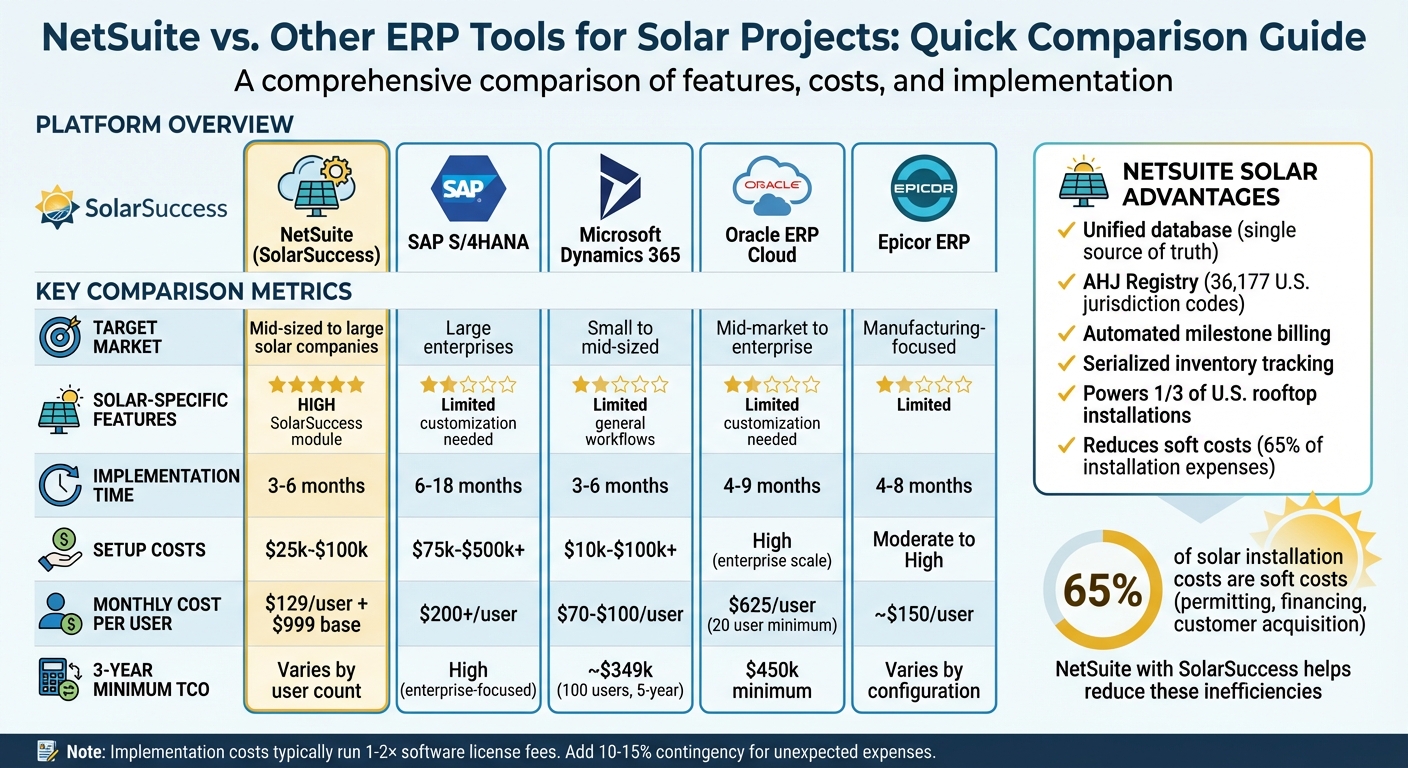
NetSuite vs Top ERP Platforms for Solar Companies: Feature and Cost Comparison
NetSuite for Solar Projects: An Overview
NetSuite is a cloud-based ERP system that brings together accounting, inventory management, project tracking, and CRM into a single, unified platform. For solar companies, this integration replaces the need for separate tools to manage accounting and CRM functions. As Jan Rippingale, CEO of Blu Banyan, explains: "Because of its CRM market presence, we did evaluate Salesforce, but quickly realized we would have had to use the Salesforce CRM plus FinancialForce; it’s two different databases, with all the headaches that brings".
The platform’s ability to grow with a business is crucial for solar companies, especially those working on utility-scale projects. NetSuite supports unlimited legal entities and handles complex financial consolidations. This is particularly important for large-scale solar projects, which often exceed 5 MW and involve over 125,000 solar modules. Additionally, its cloud-based setup allows teams to access tools and data from anywhere, ensuring smooth collaboration between office staff and field teams. These strengths set the stage for the detailed features outlined below.
Core NetSuite Features
NetSuite offers a range of features designed to streamline project management, inventory control, and field operations:
- Project Management: NetSuite tracks project costs and profitability down to the milestone level. Milestones can automatically trigger accounting actions, like invoicing. Joe Marhamati, Co-Founder & VP at Ipsun Solar, highlights this benefit: "When a deal moves to a particular stage of construction, for example, SolarSuccess generates invoices based on that specific milestone. That has been the biggest advantage".
- Inventory and Supply Chain Management: The platform provides real-time visibility into component availability and pricing across multiple locations. It even tracks "truck stock" – the parts carried by field technicians – to ensure high first-time fix rates and reduce unnecessary return trips. For serialized components like solar panels and inverters, NetSuite maintains detailed records synced with sales orders and bills of materials.
- Field Service Management: This feature includes a drag-and-drop scheduler to assign jobs based on technician skills and location. Field workers can use mobile tools to log completed tasks, enter data, and submit expenses directly into the system. This real-time integration between field and back-office operations eliminates delays caused by manual data entry.
SolarSuccess: NetSuite Extension for Solar Companies
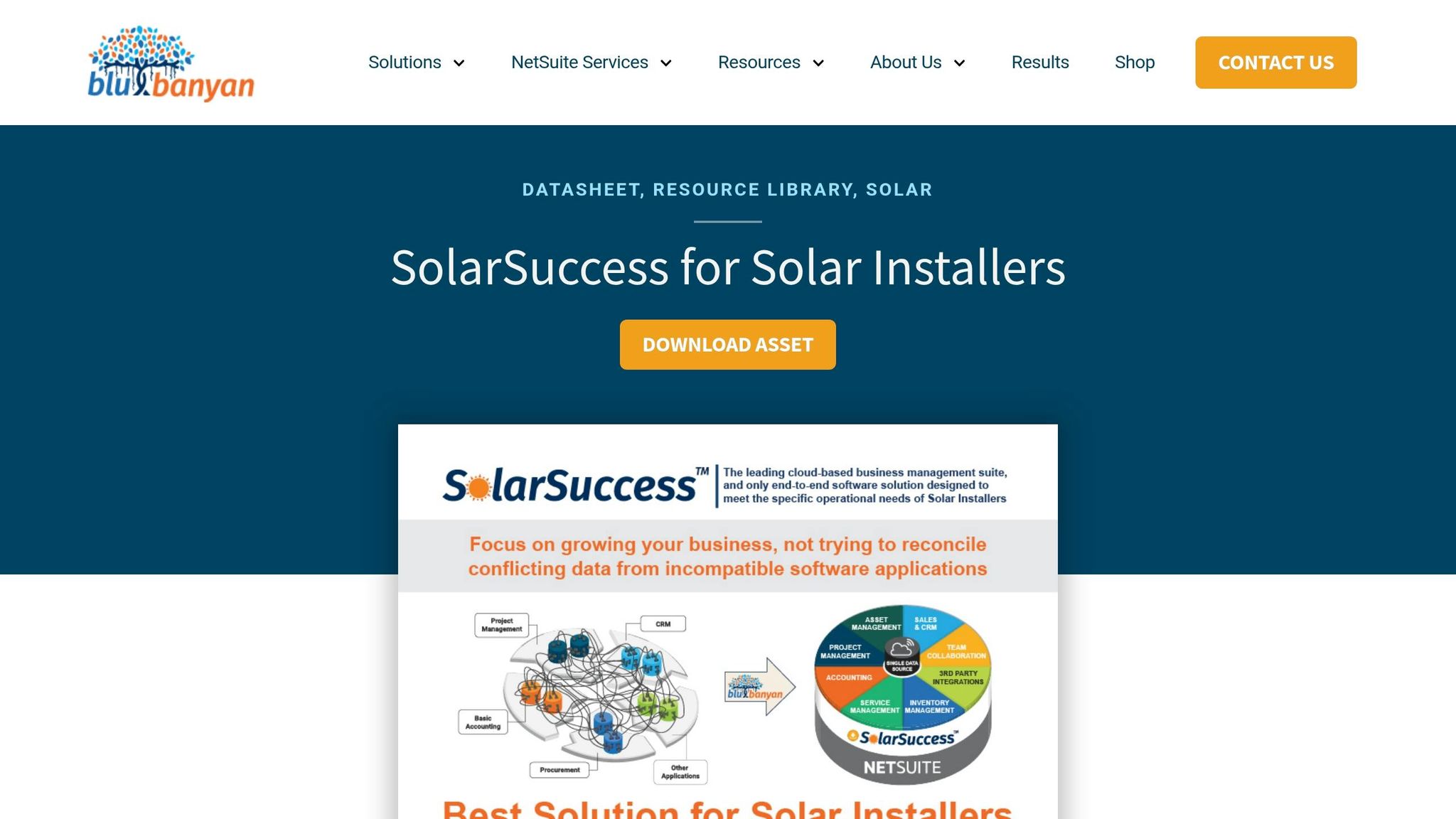
SolarSuccess builds on NetSuite’s core capabilities, tailoring the platform to meet the unique needs of solar companies. Developed by Blu Banyan, this SuiteApp addresses industry-specific challenges like financier connectivity and project-focused document management. SolarSuccess plays a major role in the U.S. solar market, powering nearly one-third of all rooftop installations. Blu Banyan’s efforts have earned them the title of NetSuite’s Micro-Vertical Solution Provider Partner of the Year for three consecutive years.
The extension connects project bills of materials directly with sales orders and offers advanced document management with revision tracking. Solar companies can also leverage customizable dashboards that display key metrics, weather updates, and an AHJ (Authorities Having Jurisdiction) Registry to navigate the 36,177 inspection and approval codes across the U.S..
Aaron Casillas, Technology & Infrastructure Director at Titan Solar Power, shared how SolarSuccess has enhanced their operations: "SolarSuccess streamlined things even further and allowed us to add our own customizations on top of NetSuite. … Our strategic partnership with Blu Banyan enables us to identify and prioritize specific features for development that will increase our productivity". Thanks to these capabilities, Titan Solar Power managed 153.5 megawatts of capacity while significantly reducing labor for partner commission payouts.
| Feature Category | NetSuite Core Capability | SolarSuccess Enhancement |
|---|---|---|
| Project Management | Milestone tracking & task assignment | Solar-specific KPIs and automated milestone invoicing |
| Financials | General ledger & accounts payable | Per-project profitability and financier connectivity |
| Inventory | Multi-location tracking | Real-time truck stock and BOM synchronization |
| Field Service | Mobile access & scheduling | Intelligent filters for technician skills and job priority |
| Collaboration | Native communication tools | bluChat for SMS and team collaboration inside records |
sbb-itb-2560759
NetSuite vs. Other ERP Platforms
Main Competitors: Oracle ERP Cloud, SAP S/4HANA, Microsoft Dynamics 365 Business Central, and Epicor ERP
When it comes to solar projects, having real-time data integration and smooth workflows can make or break a project’s success. Solar companies exploring ERP systems often compare NetSuite with four primary alternatives: Oracle ERP Cloud, SAP S/4HANA, Microsoft Dynamics 365 Business Central, and Epicor ERP. While each of these platforms has its strengths, their ability to handle solar-specific workflows varies widely.
SAP S/4HANA, for example, is built around its in-memory HANA database, making it a better fit for large, global enterprises rather than mid-sized solar firms. Microsoft Dynamics 365 Business Central, on the other hand, focuses on small to mid-sized businesses and integrates closely with the Microsoft ecosystem. Meanwhile, Oracle ERP Cloud and Epicor ERP excel in financial management but often require extensive customization to meet the unique needs of solar companies.
What sets NetSuite apart is its unified database, which integrates CRM, finance, and project management into a single system. This unified approach is especially critical for solar installers. For instance, even minor adjustments during the design phase – like changes to system wattage – can immediately impact procurement and accounting. Unlike platforms that rely on separate databases for CRM and finance, NetSuite ensures all data is connected and accessible in real time.
Implementation timelines are another area where these platforms differ significantly. NetSuite implementations typically take 3–6 months, while enterprise-grade systems like SAP S/4HANA can stretch to 6–18 months. NetSuite’s cloud-native, multi-tenant architecture also provides automatic biannual updates that preserve customizations. In contrast, SAP S/4HANA and Microsoft Dynamics 365, which offer hybrid or private cloud options, allow more control over updates but can lead to issues like "version lock" or broken integrations during upgrades.
Now, let’s dive into a feature-by-feature comparison to see how these platforms stack up.
Feature Comparison
| Feature | NetSuite (with SolarSuccess) | SAP S/4HANA | Microsoft Dynamics 365 Business Central | Oracle ERP Cloud | Epicor ERP |
|---|---|---|---|---|---|
| Target Market | Mid-market to fast-growing solar firms | Large, complex global enterprises | Small to mid-sized companies | Mid-market to enterprise | Manufacturing-focused mid-market |
| Database Architecture | Unified (Single Source of Truth) | In-memory (HANA) | Often disparate (requires Dataverse) | Unified | Unified |
| Solar-Specific Features | High (Native SolarSuccess app with AHJ registry, financier connectivity) | General (Requires heavy customization) | General (Strong MS ecosystem integration) | General (Requires customization) | General (Industry add-ons available) |
| Project Milestone Automation | Automatic billing triggers at permit approval or commissioning | Manual or custom workflows | Manual or custom workflows | Manual or custom workflows | Manual or custom workflows |
| Updates | Automatic (Multi-tenant, twice yearly) | Manual (Private/Hybrid) | Manual | Automatic (Cloud version) | Manual |
| Customization Platform | SuiteScript (JavaScript-based) | ABAP / Extensive | AL Programming / Power Platform | Oracle APEX / PL/SQL | Epicor Functions / C# |
| Avg. Implementation Time | 3–6 months | 6–18 months | 3–6 months | 4–9 months | 4–8 months |
| Customer Retention Rate | – | 78% | 91% | – | – |
NetSuite stands out for solar companies largely because of its SolarSuccess module, which is designed to tackle industry-specific challenges right out of the box. Features like the AHJ registry help manage the 36,177 inspection and approval codes across the U.S.. It also offers automated milestone billing tied to construction phases and serialized inventory tracking for equipment like panels and inverters. Competing platforms often need significant custom development to achieve similar functionality, which can drive up both implementation costs and long-term maintenance efforts.
Cost and Implementation Factors
Cost and Implementation Comparison
Choosing an ERP system requires balancing features with costs. On average, companies allocate 1% to 3% of their annual revenue to ERP projects, though nearly 50% of organizations exceed their budgets during implementation. For solar companies, where margins can be tight, having a clear understanding of the financial commitment is crucial.
Here’s a breakdown of how NetSuite stacks up against other platforms in terms of setup costs, subscription pricing, implementation timelines, and total cost of ownership over three years:
| Platform | Setup / Implementation Costs | Subscription Pricing (Cloud) | Implementation Timeline | 3-Year Software TCO (Minimum) |
|---|---|---|---|---|
| NetSuite | $25,000 – $100,000 (SuiteSuccess) | ~$999 base + $129/user/month | 3–6 months | Varies by user count |
| Oracle ERP Cloud | High (Enterprise scale) | ~$625/user/month (20 user min) | 4–9 months | $450,00 |
| SAP S/4HANA | $75,000 – $500,000+ | $200+ per user/month | 6–18 months | High (enterprise-focused) |
| Microsoft Dynamics 365 BC | $10,000 – $100,000+ | $70–$100/user/month | 3–6 months | ~$349,000 (100 users, 5‑year estimate) |
| Epicor ERP | Moderate to High | ~$150/user/month | 4–8 months | Varies by configuration |
NetSuite’s SuiteSuccess methodology stands out for its fixed-price implementations ranging from $25,000 to $100,000, offering more predictable budgeting. In contrast, Oracle ERP Cloud requires a minimum of 20 users and a three-year contract, leading to a minimum software cost of $450,000 over three years. Meanwhile, SAP S/4HANA setup costs can range anywhere from $75,000 to over $500,000.
Additional Costs to Consider
Beyond initial setup fees, companies must also plan for ongoing expenses. Implementation services typically cost 1× to 2× the software license fees, but more complex projects can climb to 3× the software cost. Customization costs vary widely, with basic changes adding 10%–15% and heavy development reaching up to 200% of the software cost. A 10%–15% contingency is recommended for unexpected expenses, while training and change management can add another 10% to 20% of the total ERP budget.
For solar companies, the financial equation extends beyond software. Soft costs – such as permitting, financing, installation, and customer acquisition – can make up as much as 65% of the total cost of a new solar system. A unified ERP like NetSuite with SolarSuccess can help reduce these by eliminating the inefficiencies of managing disconnected tools like QuickBooks and Salesforce. To get a clearer picture of long-term costs, it’s wise to request a 5‑year or 10‑year TCO estimate from vendors, factoring in subscription price increases and maintenance costs.
"Sharing data across these systems was difficult, and in most cases our only way to ‘patch the holes’ was by adding labor. We wanted to get everything on one system."
- Aaron Casillas, Technology and Infrastructure Director, Titan Solar Power
Cloud-Native Advantages
NetSuite’s cloud-native design further enhances its appeal. By transitioning from on-premises systems to cloud-based ERPs, companies can shift capital expenditures (CapEx) for servers into operating expenses (OpEx), eliminating hardware maintenance and power costs. This move can save approximately $283,000 per year in maintenance compared to legacy systems. Additionally, cloud ERP implementations are estimated to be up to 50% faster than traditional on-premises deployments, leading to quicker results and reduced consulting fees. For solar companies, this means they can streamline operations and cut soft costs sooner, accelerating their return on investment.
What Makes NetSuite Different for Solar Projects
NetSuite stands out because it was designed as a unified database, not a collection of separate tools. For solar companies that have struggled with disconnected systems, the difference is clear: syncing multiple platforms can be a logistical nightmare. NetSuite’s seamless integration eliminates that issue, forming the foundation of its capabilities tailored for solar projects. Jan Rippingale, CEO of Blu Banyan, highlights this advantage:
"Having everything connected makes a tremendous difference. Because of its CRM market presence, we did evaluate Salesforce, but quickly realized we would have had to use the Salesforce CRM plus FinancialForce; it’s two different databases, with all the headaches that brings".
NetSuite builds on its core features with SolarSuccess, an extension specifically designed for solar project needs. Some standout features include:
- A drag-and-drop Enhanced Scheduler for task allocation
- Automated approval workflows
- Task-triggered action automation
These tools are essential for managing the intricate sequencing required in solar installations, where even a small delay – like a missed permit or inspection – can throw off an entire project timeline.
Another major advantage is NetSuite’s item-level tracking. It can monitor every solar panel, inverter, and battery by serial number, which is critical for warranty management and field service. When paired with AIA progress billing, including G702/G703-style invoicing and retainage tracking, solar contractors gain the precision they need for large-scale projects.
NetSuite also simplifies financial management for utility-scale solar projects. Its tools allow for consolidation of unlimited SPEs, support for FERC accounting, and automated revenue recognition under ASC 606 and IFRS 15. These capabilities are essential for multi-year projects (often spanning 2–5 years) and smooth transitions of ownership.
Reducing soft costs – such as permitting, financing, and customer acquisition, which make up 64% to 65% of total costs – is another area where NetSuite excels. By eliminating inefficiencies from disconnected systems, it helps solar companies save time and resources. For example, Titan Solar Power leveraged NetSuite to streamline partner payouts and manage 153.5 MW of annual capacity. Aaron Casillas, Technology and Infrastructure Director, shared:
"With NetSuite, we’ve significantly decreased the amount of labor involved in paying out our partners and made that process very consistent across the board".
Conclusion: Selecting an ERP for Solar Projects
Picking the right ERP for solar projects is all about addressing two key challenges: eliminating data silos and cutting down on soft costs. With permitting, financing, and customer acquisition accounting for a staggering 64%-65% of installation expenses, your ERP needs to go beyond standard accounting functions and streamline specialized solar workflows.
A unified database is non-negotiable. Relying on disconnected tools like QuickBooks and Salesforce often leads to extra manual work and inefficiencies. As Clive Smith, Chief Business Development Officer at Blu Banyan, puts it:
"The only way to make that happen [reducing soft costs] is with an integrated or unified application suite on a single database".
NetSuite, combined with SolarSuccess, takes this integration to the next level by offering solar-specific automation. Features such as milestone-triggered invoicing and seamless integration with the AHJ registry (which covers all 36,177 U.S. jurisdictions) provide capabilities that generic ERPs simply can’t match. For utility-scale developers handling multi-year projects and complex financial structures, NetSuite’s ability to consolidate unlimited entities is a game-changer.
The solar industry saw an impressive 43% growth in 2020, with over 19 gigawatts of installations. To sustain this momentum, solar companies need real-time insights into profit and loss, inventory, and field operations. This level of efficiency is what separates thriving installers from those bogged down by disconnected systems. With NetSuite and SolarSuccess, solar businesses gain a solid operational framework, allowing them to focus on what matters most – getting panels installed, not managing software.
FAQs
Do I need SolarSuccess, or is NetSuite alone enough for a solar installer?
NetSuite provides a solid ERP platform with real-time data and integration features. However, it might not cover all the unique requirements of solar installers. That’s where SolarSuccess steps in, offering specialized tools like automated invoicing, compliance tracking, and milestone-based revenue recognition. When combined with NetSuite, SolarSuccess helps solar installers simplify workflows, enhance financial precision, and tackle the complex challenges specific to the solar industry more efficiently.
What solar workflows can milestone billing automate in NetSuite?
Milestone billing in NetSuite simplifies solar project management by tying billing directly to defined project milestones, like foundation pouring, installation stages, or inspections. With this system, invoices are automatically generated as each milestone is completed, cutting down on manual tasks. This approach helps align cash flow with project progress, ensures revenue is recognized at the right time, and makes it easier to track project status by linking financial activities to verified achievements.
How can serialized inventory tracking reduce warranty and service issues?
Serialized inventory tracking helps tackle warranty and service issues by providing detailed, real-time insights into inventory and product history. With each item tracked individually throughout its lifecycle, it becomes easier to quickly pinpoint products involved in warranty claims. Comprehensive records of manufacturing, installation, and maintenance ensure faster warranty validation, early detection of quality problems, and prevention of defective parts being reused. This reduces errors, boosts product reliability, and improves customer satisfaction.
