

NetSuite and generic solar tools serve different needs for solar companies. NetSuite offers an all-in-one solution by integrating accounting, CRM, project management, and inventory in a unified database. This eliminates manual data transfers, provides real-time insights, and automates processes like milestone-based invoicing and compliance tracking. It’s designed to scale with growing businesses while addressing solar-specific challenges, such as managing 36,177 U.S. jurisdictions and tracking installation costs.
Generic solar tools, on the other hand, are standalone software options that handle specific tasks like sales, accounting, or project management. While suitable for smaller businesses, they often lack integration, require manual data reconciliation, and struggle with scalability as project volumes grow. These tools fall short in tracking solar-specific metrics and automating complex processes.
Quick Comparison:
| Feature | NetSuite (with SolarSuccess) | Generic Solar Tools |
|---|---|---|
| Integration | Unified database; seamless across CRM, accounting, and project management | Disconnected systems requiring manual data transfers |
| Solar-Specific Tools | AHJ Registry integration, solar KPIs, automated bills of materials | Basic task management; lacks solar-specific features |
| Scalability | Supports growth with automation and multi-subsidiary tools | Limited scalability; manual processes increase as business grows |
| Compliance | Automated regulatory tracking and audit trails | Manual tracking; prone to errors |
| Real-Time Insights | Role-based dashboards with live updates | Basic charts needing manual updates |
For solar companies, choosing the right platform depends on their size, growth goals, and need for automation. NetSuite is ideal for scaling businesses aiming to streamline operations, while generic tools may suffice for smaller teams with simpler needs.
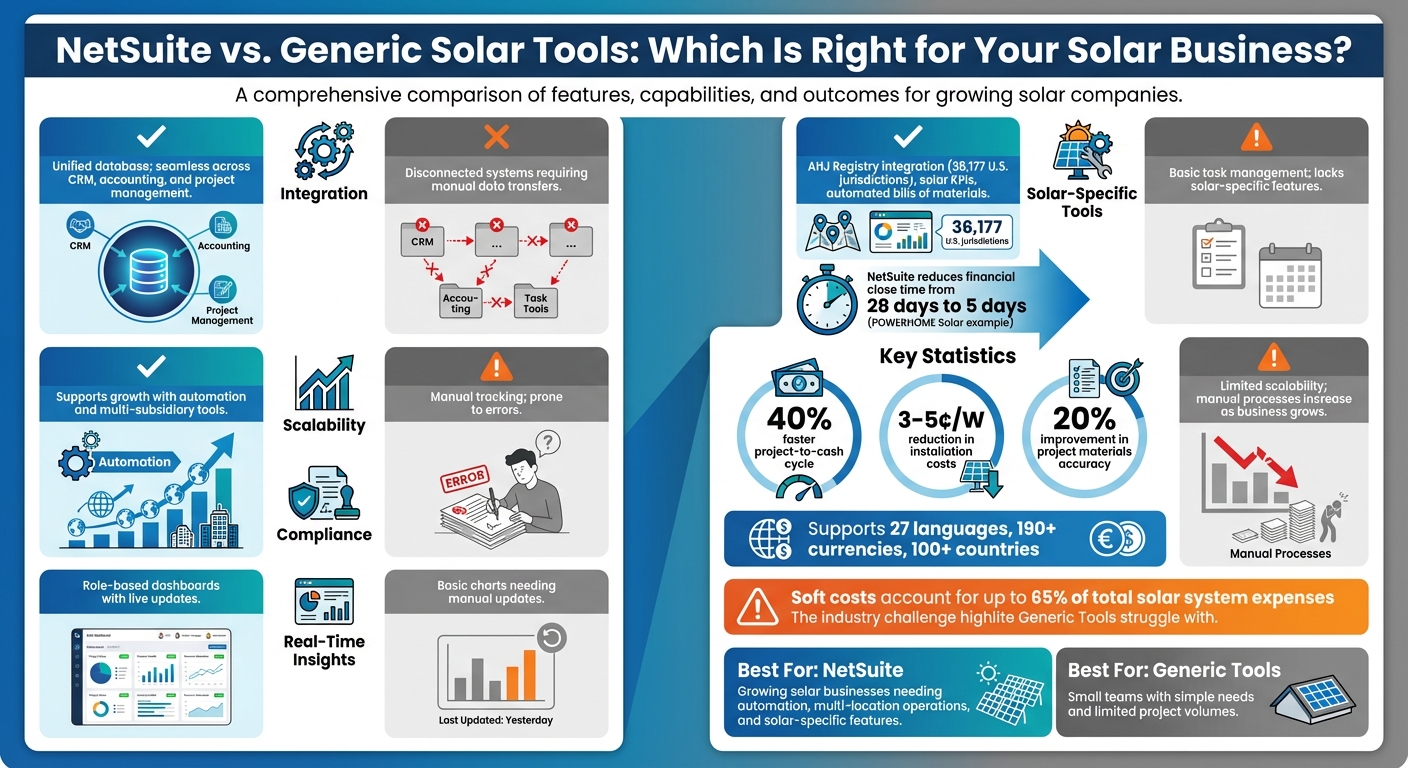
NetSuite vs Generic Solar Tools: Feature Comparison for Solar Companies
NetSuite Reporting: Features and Capabilities
Core Reporting Features
NetSuite’s reporting is built on a single, unified database that ties together accounting, CRM, project management, and inventory. This integration eliminates the hassle of reconciling data across multiple systems. For example, when a field technician marks a project milestone as complete, the system automatically updates accounting entries and triggers invoicing – no manual input required.
The platform provides real-time insights into project profitability, giving managers up-to-the-minute updates on costs, timelines, and margins. This helps teams avoid budget overruns. Role-based dashboards ensure that users see only the metrics relevant to their roles: finance teams monitor cash flow and receivables, while project managers focus on installation progress and material costs.
For leadership, NetSuite offers portfolio-wide reporting, delivering a comprehensive view across multiple projects, regions, and teams – all from a single dashboard. This helps identify both high-performing projects and those requiring attention. Additionally, the system shortens the project-to-cash cycle by as much as 40%, thanks to automated milestone invoicing that ties field progress directly to billing.
These capabilities address common operational challenges, particularly in industries like solar energy where efficiency is critical.
Solar-Specific Reporting Features
NetSuite extends its ERP functionality to meet the unique needs of solar operations by tracking solar-specific KPIs, such as installation soft costs. These costs can account for up to 65% of total system expenses. The platform also offers detailed procurement tracking to ensure materials are delivered on time.
One standout feature is the AHJ Registry integration, which tackles a significant challenge for solar installers. Across the U.S., there are 36,177 different Authorities Having Jurisdiction (AHJ), each with its own building, electrical, and fire codes. Managing these varying requirements can be overwhelming. NetSuite simplifies this by identifying the specific inspection and approval needs for each jurisdiction, helping teams stay compliant and avoid delays.
The system also automates synchronization of Bills of Materials, ensuring that what’s sold aligns with what’s installed. Custom dashboards, complete with weather portlets, allow project managers to anticipate delays and adjust schedules accordingly. Solar contractors using these features have reported cutting installation costs by 3–5¢/W and improving project material accuracy by 20%.
sbb-itb-2560759
Generic Solar Tools: Features and Limitations
Common Features of Generic Solar Tools
Many solar businesses rely on a patchwork of disconnected tools rather than integrated systems like NetSuite. These typically include platforms such as Salesforce for managing sales pipelines, QuickBooks for invoicing and expense tracking, specialized software for solar design and bidding, and fragmented storage solutions for contracts, permits, and compliance documents.
For smaller operations, this setup can get the job done, but it comes with a major drawback: manual data transfers between systems. For example, in February 2020, Titan Solar Power – the third-largest residential solar installer in the U.S. at the time – was using a homegrown project management system alongside separate tools for file storage and accounting.
While these tools handle basic tasks, they reveal significant challenges when businesses try to grow or streamline operations.
Main Limitations
The most glaring issue with generic tools is their inability to integrate. When your CRM, accounting software, and project management system operate on separate databases, it creates a "siloed" environment. Teams often spend hours manually reconciling data across spreadsheets, a process that can be both time-consuming and error-prone.
As project volumes increase, scalability becomes another hurdle. Systems that work for small-scale operations often falter under the demands of rapid growth. Companies frequently address this by hiring more administrative staff to handle manual data entry. Jan Rippingale, CEO of Blu Banyan, highlighted this issue:
Because of its CRM market presence, we did evaluate Salesforce, but quickly realized we would have had to use the Salesforce CRM plus FinancialForce; it’s two different databases, with all the headaches that brings.
Another major limitation is the lack of solar-specific functionality. Generic tools can’t automatically handle tasks like looking up permitting requirements for the 36,177 different Authorities Having Jurisdiction in the U.S., tracking installation costs by project phase, or syncing bills of materials with actual field installations. Without real-time visibility, leadership teams often miss early warnings of budget overruns or underperforming projects. This shortfall impacts reporting accuracy and makes it harder to provide meaningful analytics to stakeholders – an essential need for managing complex, multi-phase solar projects.
NetSuite vs. Generic Solar Tools: Side-by-Side Comparison
Solar companies face a clear choice when comparing NetSuite to generic tools. The decision often hinges on features, scalability, and ease of use – all of which directly affect the efficiency of daily operations and long-term project success.
Feature Comparison
NetSuite stands out with its unified database that seamlessly connects financials, project management, and CRM in real time. Generic tools, on the other hand, often rely on disconnected systems that demand manual data transfers. This difference impacts everything from data analysis to tracking solar-specific metrics.
| Feature | NetSuite (with SuiteApps) | Generic Solar Tools |
|---|---|---|
| Data Visualization | Advanced dashboards with real-time ERP insights | Basic charts requiring manual updates or exports |
| Customization | Extensive, including tools like Report Builder for tailored reporting | Limited to pre-set templates |
| Solar Metrics | Tracks profitability, WIP, and installation cost savings | Focuses on surface-level tasks without deep financial tracking |
| Integration | Built-in connections across CRM, inventory, and finance; API-ready | Systems operate in silos |
The benefits of ERP for solar companies using NetSuite’s approach are tangible. For example, POWERHOME Solar (Pink Energy) replaced QuickBooks with NetSuite in 2021, cutting their monthly financial close time from 28 days to just 5 days. Despite scaling to over $600 million in revenue, they managed this with a finance team of only six people, thanks to automated processes like order-to-cash and revenue recognition.
Scalability Comparison
When it comes to growth, generic tools often hit their limits quickly. NetSuite, however, is built to handle the demands of expanding companies, whether that means managing multiple locations or navigating international operations.
| Capability | NetSuite (OneWorld) | Generic Solar Tools |
|---|---|---|
| User Limits | Supports thousands of users with role-based access | Performance drops as user count rises |
| Data Volume | Manages high data loads via Data Warehouse solutions like Azure or Snowflake | Struggles with large transaction volumes and historical data storage |
| Enterprise Expansion | Includes multi-subsidiary, multi-currency, and global tax compliance | Optimized for single-entity, local operations |
NetSuite supports 27 languages, over 190 currencies, and tax compliance across 100+ countries. Generic tools often fall short in these areas, forcing growing companies to overhaul their systems entirely instead of scaling up.
While scalability is critical, how teams interact with these tools can also make or break their effectiveness.
Ease of Use Comparison
The balance between simplicity and capability becomes evident when comparing user experience. Generic tools might feel easier at first, but NetSuite’s complexity pays off in the long run with automation and efficiency.
| Factor | NetSuite | Generic Solar Tools |
|---|---|---|
| User Interface | Role-based dashboards; initially complex but highly customizable | Straightforward for single tasks but fragmented across multiple apps |
| Training | Structured onboarding (about 90 days for SolarSuccess) | Minimal training upfront but leads to heavy manual work later |
| Workflow Adaptability | SuiteFlow enables automated workflows (e.g., CFO sign-off for approvals over $50,000) | Rigid workflows requiring manual adjustments |
Titan Solar Power’s experience highlights this difference. After adopting NetSuite’s SolarSuccess platform, they tripled their project throughput without adding office staff. Additionally, they saw a 20% improvement in project materials accuracy, thanks to automated workflows that eliminated the need for manual fixes. While the initial training required time and effort, the efficiency gains far outweighed the upfront investment.
How Each Platform Performs in Solar Reporting Scenarios
The performance of NetSuite versus generic solar tools becomes especially clear when companies tackle challenges like managing stakeholder data, forecasting budgets, or meeting regulatory standards.
Project Stakeholder Analytics
NetSuite’s unified database eliminates the data silos that often plague generic tools by integrating CRM, accounting, and project management into a single system. This is particularly important in the solar industry, where soft costs – such as permitting, financing, and customer acquisition – can make up as much as 65% of the total cost of a new solar system. When information is scattered across different applications, sharing it becomes cumbersome and costly.
In February 2020, Titan Solar Power, then the third-largest residential solar installer in the U.S., replaced its homegrown project management system with NetSuite-SolarSuccess. Under the leadership of Aaron Casillas, Director of Technology and Infrastructure, the company merged its accounting, file storage, and project systems into one platform. This integration eliminated the need for manual labor to fill data gaps, enabling Titan Solar Power to install 153.5 MW of capacity in a single fiscal year – capturing about 1% of the U.S. residential solar market.
Unlike generic tools that require manual data aggregation and often result in inconsistencies, NetSuite automates accounting events based on project milestones, ensuring accuracy without the need for manual reconciliation. Stakeholders gain real-time visibility through portals and dashboards, avoiding the delays associated with piecing together reports from disconnected systems. This streamlined data management not only enhances transparency but also lays the groundwork for more precise financial forecasting.
Financial Forecasting and Budget Management
Budget management is another area where NetSuite stands out. Solar projects often face shifting timelines, and NetSuite’s bluBudget tool automatically adjusts budget timing to align with schedule changes, eliminating the manual tracking required by generic tools and spreadsheets.
NetSuite provides live insights into project costs, Work in Progress (WIP), and deferred revenue across an entire portfolio, helping companies avoid budget overruns. SolarSuccess users have reported reducing installation costs by 3–5¢/W thanks to more efficient operations. For instance, Norwich Solar used SolarSuccess to consolidate its subsidiaries, significantly cutting down the time spent on accounting for multi-entity operations.
In contrast, generic tools lack the automation needed for portfolio-wide forecasting, forcing teams to rely on fragile spreadsheets that demand constant manual updates. This inefficiency can lead to errors and delays in financial planning.
In 2025, bluBudget earned an Honorable Mention in Solar Power World’s Top Products competition under the Financial Planning & Analysis category – the only financial software recognized in that competition. Beyond improving budget management, NetSuite’s integrated reporting also strengthens compliance efforts.
Compliance and Regulatory Reporting
Unified data doesn’t just improve stakeholder communication and budget control; it also plays a critical role in meeting regulatory requirements. NetSuite maintains an immutable audit trail for every transaction and record change, complete with timestamps, user IDs, and before-and-after values. Spreadsheets and disconnected systems, on the other hand, lack version control, increasing vulnerability during audits.
Solar installers in the U.S. must navigate a complex regulatory environment, coordinating with 36,177 different Authorities Having Jurisdiction (AHJs), each with its own codes for inspections and approvals. NetSuite simplifies this process by integrating with the AHJ Registry, automating lookups and tracking. Generic tools, however, require manual effort to manage this complexity. Additionally, NetSuite supports the "Orange Button" initiative, which ensures solar data is formatted for seamless reporting.
For financial compliance, NetSuite automates tasks like managing WIP, deferred revenue, and commissions, meeting the segregation of duties required for SOX compliance in public companies. Generic tools rely on manual journal entries and reconciliations, which heightens the risk of errors. Approximately 80% of regulatory warning letters in data-sensitive industries cite data integrity issues – risks that NetSuite mitigates with its secure electronic records.
The 2025.2 release of NetSuite introduced a Compliance 360 AI assistant, which generates audit summaries and provides recommendations for continuous monitoring. This shift toward proactive, real-time compliance oversight highlights capabilities that generic tools simply cannot match. Titan Solar Power’s move to NetSuite not only improved visibility into operational data for compliance and reporting but also reduced the labor required to maintain consistency.
Choosing the Right Reporting Solution
Picking the best reporting platform for solar operations hinges on three main factors: a unified data system, the ability to scale without adding extra labor, and automation tailored specifically for the solar industry. These elements are essential for delivering accurate, real-time reports throughout the lifecycle of solar projects.
Many businesses rely on generic tools like QuickBooks, Salesforce, or standalone project management software. However, these systems often operate in silos, requiring manual data transfers that can slow down processes. Aaron Casillas, Technology and Infrastructure Director at Titan Solar Power, highlighted this issue:
Sharing data across these systems was difficult, and in most cases our only way to ‘patch the holes’ was by adding labor. We wanted to get everything on one system.
This challenge underscores the importance of an integrated reporting solution that simplifies data management and scales efficiently.
NetSuite tackles these integration hurdles with a single, unified database that combines CRM, accounting, project management, and inventory. This system automatically triggers accounting events and updates bills of materials in real time as project milestones are met. For solar companies, where soft costs can account for up to 65% of the total cost of a new solar system, automation becomes a game-changer.
Scalability is another critical consideration. With NetSuite, solar businesses can grow their operations without needing to hire more administrative staff. In contrast, generic tools often require companies to add personnel as their megawatt capacity increases, which can eat into profit margins.
NetSuite also offers features designed specifically for the solar industry. It integrates with the Authority Having Jurisdiction (AHJ) Registry to automate tracking across 36,177 jurisdictions, supports the Orange Button data standard, and includes dashboards tailored to solar companies. These dashboards offer tools like weather portlets and per-project profitability tracking. By eliminating the need for custom workarounds, these features provide real-time insights, streamline operations, and ensure businesses have the reporting capabilities needed for compliance, stakeholder communication, and financial planning.
FAQs
When should a solar company switch from generic tools to NetSuite reporting?
When a solar company faces growing operational challenges and needs more advanced, real-time insights, it’s time to consider NetSuite reporting. This platform delivers customizable reports that can handle multiple projects while ensuring compliance. It integrates financial, inventory, and project management systems, providing instant updates across the board.
If your current tools are causing issues like errors, data silos, or time-consuming manual reconciliations, NetSuite steps in with automation and streamlined multi-entity views. These features help boost efficiency and support better decision-making as your business scales.
How does NetSuite automate milestone billing and project-to-cash reporting?
NetSuite makes milestone billing and project-to-cash reporting easier with its project management and billing tools. Users can create billing schedules tied directly to project milestones. Once a milestone is completed – whether automatically through task completion or manually – NetSuite updates the schedule and generates invoices for the corresponding work. This seamless process cuts down on manual tasks, boosts accuracy, and simplifies the entire project-to-cash cycle.
What does AHJ Registry integration change for permitting and compliance reporting?
Integrating the AHJ (Authority Having Jurisdiction) Registry brings a lot of efficiency to permitting and compliance reporting processes. With real-time access to regulatory data, solar companies can automatically check permit statuses, confirm adherence to local codes, and simplify approval workflows. This cuts down on manual work, reduces mistakes, and ensures project documentation stays up-to-date with current regulations. The result? Faster permit approvals and continuous compliance monitoring, helping businesses stick to industry standards and avoid costly penalties.
