
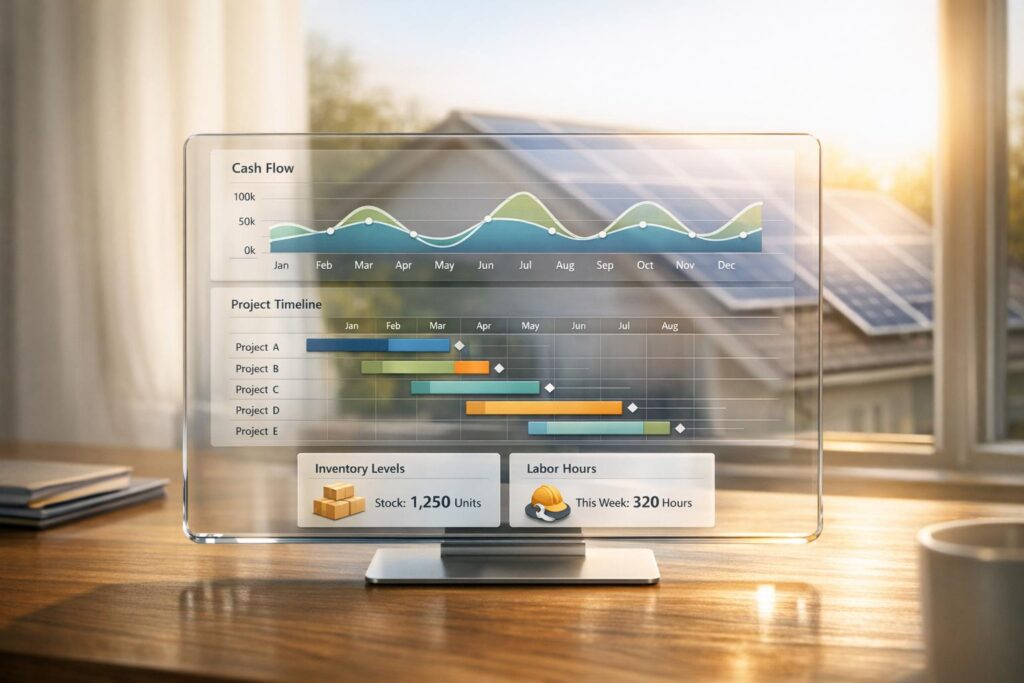
Managing cash flow in solar projects is challenging due to high upfront costs, delayed revenues, and complex soft costs like permitting and financing, which can make up 65% of total expenses. NetSuite, combined with SolarSuccess ERP, simplifies forecasting by automating processes, integrating real-time data, and providing tools tailored for the solar industry. These tools streamline the installation process by optimizing project workflows. Here’s how it helps:
- Real-Time Data Integration: Links CRM, accounting, and project management for accurate forecasts.
- Automation: Updates billing, inventory, and labor costs automatically based on project milestones.
- Customized Dashboards: Seasonal cash flow tracking and insights into weather delays.
- Payment Scheduling: Aligns vendor payments with project progress to maintain liquidity.
- ERP and inventory management: Tracks costs instantly, ensuring precise cash flow predictions.
These tools reduce manual work, improve visibility, and help solar companies stay financially stable even during seasonal fluctuations.
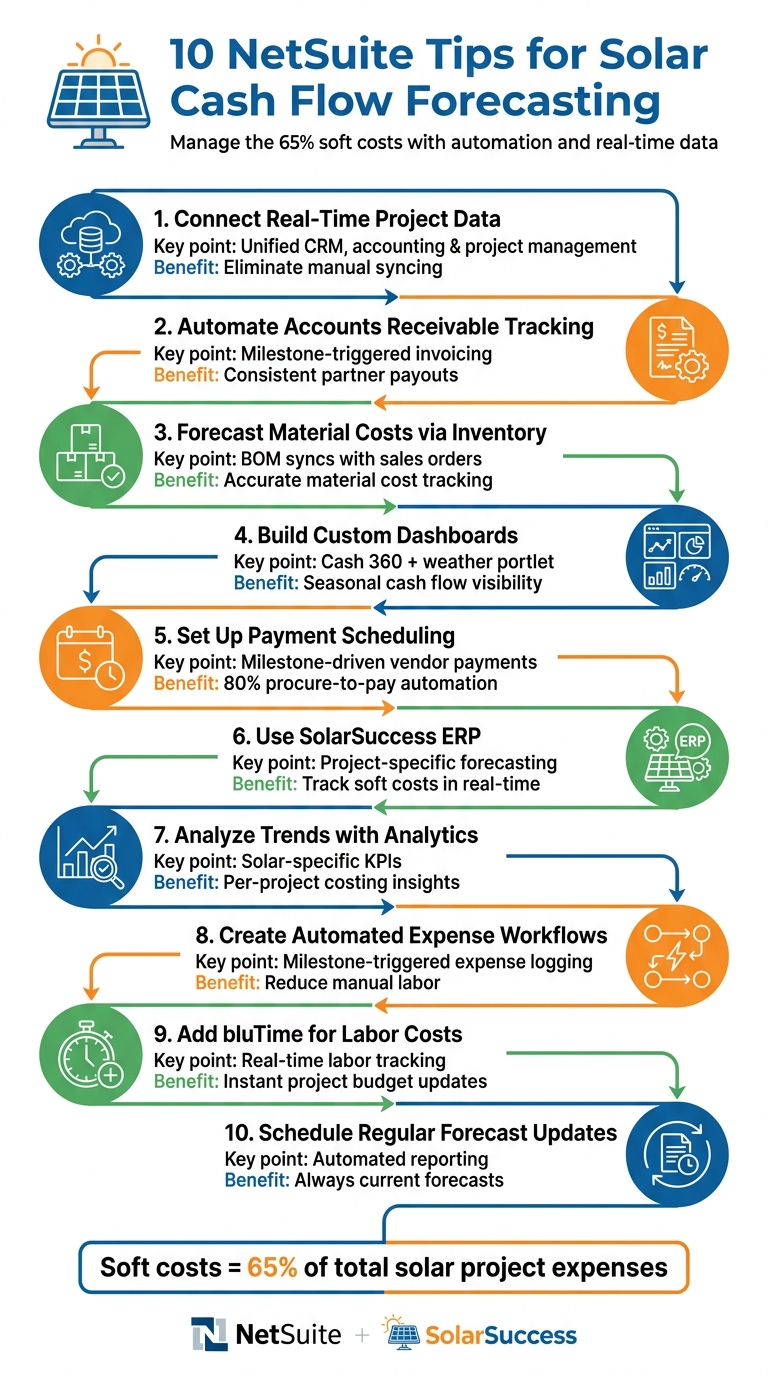
10 NetSuite Tips for Solar Cash Flow Forecasting
1. Connect Real-Time Project Data for Revenue Projections
Real-Time Data Integration
NetSuite’s unified database brings together CRM, accounting, and project management, eliminating the hassle of syncing separate systems manually. This streamlined approach ensures that revenue projections are based on current installation progress rather than outdated figures. For example, key milestone events – like permit approvals or installation completions – immediately trigger accounting updates, keeping forecasts in step with actual project progress.
"Having everything connected makes a tremendous difference." – Jan Rippingale, CEO, Blu Banyan
This seamless connectivity is further enhanced by automation, which takes accuracy to the next level.
Automation Capabilities
Automation in NetSuite ensures that updates happen instantly. For instance, project bills of materials (BOM) and sales orders sync automatically, so material costs are reflected in financial forecasts without delay. If a customer decides to add extra wattage to their solar system, the system adjusts accounting entries automatically – no manual work required. This eliminates errors that could skew revenue projections by thousands of dollars, keeping forecasts precise as project details evolve.
Customization for Solar Industry Needs
Solar projects come with unique challenges, especially since soft costs – like permitting, financing, and customer acquisition – can make up as much as 65% of total project expenses. NetSuite’s customization options address this by enabling milestone-triggered invoicing. For example, when a project reaches a specific construction stage, the system generates invoices automatically. This approach ties billing to project progress, ensuring steady cash flow and removing reliance on arbitrary billing dates.
2. Automate Accounts Receivable Tracking with NetSuite CRM
Unified CRM and Accounting Database
NetSuite brings your CRM and accounting data together in one place, solving the headaches caused by disconnected platforms. When sales and finance teams share a single database, you eliminate the risk of errors and inefficiencies tied to syncing data across multiple systems. This setup creates the perfect foundation for automating accounts receivable tasks.
Automation Capabilities
NetSuite takes automation to the next level by generating invoices automatically as construction milestones are achieved – like completing panel installations or passing inspections. Joe Marhamati, Co-Founder & VP, shared:
"We’ve been able to automate most of our residential invoices. When a deal moves to a particular stage of construction, for example, SolarSuccess generates invoices based on that specific milestone".
The automation doesn’t stop there. It also simplifies partner commission payouts. For example, Titan Solar Power saw a major reduction in manual work after adopting NetSuite. Aaron Casillas, their Technology and Infrastructure Director, explained:
"With NetSuite, we’ve significantly decreased the amount of labor involved in paying out our partners and made that process very consistent across the board".
Enhanced Visibility for Cash Flow Forecasting
With automated processes in place, NetSuite also provides real-time tracking of accounts receivable, offering a clear picture of your cash flow. Instead of relying on outdated spreadsheets or rough estimates, you can instantly see which invoices remain unpaid, which payments are overdue, and how project milestones impact your cash position. This is a game-changer, especially in the solar industry, where soft costs can heavily influence project profitability. By tracking AR in real time, you’ll have a better sense of when cash will come in, enabling smarter decisions about resource allocation and project timelines.
3. Use Inventory Management to Forecast Material Costs
Accurate cash flow forecasting relies heavily on effective inventory management, just like real-time revenue tracking and automated receivables.
Real-Time Data Integration
With NetSuite’s unified database, inventory management is directly linked to accounting and project management systems. This setup provides up-to-date information on inventory availability, pricing, and purchasing – eliminating the need for outdated spreadsheets. When material costs are based on current market data, your cash flow forecasts become much more dependable. As Clive Smith, Chief Business Development Officer at Blu Banyan, puts it:
"Aggregating disparate applications requires a unified database to ensure seamless communication".
Automation Capabilities
NetSuite’s system automates the synchronization of BOM (bill of materials) with sales orders. This means material requirements and costs are updated instantly as project scopes evolve. Additionally, milestone-triggered accounting events are automated, allowing the system to record financial impacts as soon as installation milestones are reached. This ensures precise tracking of when cash flows out for materials and when it’s recovered through billing.
Solar business management software
Solar projects often come with unique challenges that generic inventory systems struggle to address. For example, a small change – like a customer requesting additional wattage – can directly affect material needs and accounting processes. Jan Rippingale, CEO of Blu Banyan, highlighted this:
"By working with NetSuite, Blu Banyan was able to extend the ERP platform… to meet the specific needs of solar installers, such as when small tweaks in system size (i.e., a customer who orders additional wattage) directly impact an installer’s accounting processes".
This level of customization ensures that forecasts remain accurate, even when project details shift unexpectedly, giving teams the tools they need to manage cash flow effectively.
Improved Visibility for Cash Flow Forecasting
Integrated data and automation also enhance visibility into inventory movements, which is essential for cash flow planning. For instance, rising inventory levels indicate cash outflows for materials, while reductions signal cash recovery. NetSuite’s system links inventory tracking with financial forecasting, offering project-specific costing insights that reveal how material costs affect profitability. This is particularly critical in the solar industry, where soft costs can account for up to 65% of total project expenses. By monitoring inventory in real time, businesses can avoid overstocking materials, freeing up capital and maintaining the flexibility needed for growth.
4. Build Custom Dashboards for Seasonal Cash Flow Changes
Real-Time Data Integration
NetSuite’s Cash 360 dashboard offers a streamlined view of real-time bank balances, accounts receivable, and accounts payable, all in one place. By eliminating the need for manual spreadsheets, it provides an instant snapshot of your company’s cash position. For solar businesses, where revenue often swings between seasons, this consolidated view is a game-changer. The dashboard directly integrates with banking systems, as well as receivables and payables, ensuring the data is always up-to-date.
Automation Capabilities
NetSuite uses historical cash flow patterns to create rolling forecasts for upcoming days, weeks, or even months. This is particularly useful for solar companies, which often face seasonal revenue fluctuations – such as slower installation activity during the winter or higher demand in the summer. By identifying these trends automatically, the system helps finance teams prepare for potential cash surpluses or shortages before they occur. These automated insights make it easier to fine-tune solar forecasting strategies.
Customization for Solar Industry Needs
With SolarSuccess, you can tailor dashboards to meet the specific needs of the solar industry. A standout feature is the weather portlet, which enables project managers to anticipate weather-related delays that might affect milestone-based billing and cash flow. Jan Rippingale, CEO of Blu Banyan, shared:
"In four hours we built a portlet that wows and benefits our customers. It took a few years for us to get those needle-movers identified and dialed in, but the results stand for themselves".
Weather delays can significantly impact when invoices are sent and payments are received. Having this level of visibility is critical for maintaining accurate cash flow forecasts.
Enhanced Visibility for Cash Flow Forecasting
With automated and customized insights, these dashboards act as a "single source of truth" for all financial operations. They also enable scenario modeling, allowing businesses to test various assumptions against market changes and internal decisions. This is especially vital in the solar industry, where soft costs – like permitting, financing, and customer acquisition – can account for up to 65% of the total cost of a new solar system. By centralizing all relevant data, finance teams are better equipped to make informed decisions about inventory, labor, and new project opportunities.
5. Set Up Payment Scheduling in NetSuite Procurement
Real-Time Data Integration
NetSuite Procurement integrates seamlessly with your general ledger and the Cash 360 dashboard, giving you an up-to-the-minute view of your bank balances and upcoming payables. Once a purchase order is scheduled for payment, it instantly reflects in your rolling cash flow forecast. This live connection ensures your payment data is always accurate, eliminating the need for manual tracking of vendor obligations. For solar installers juggling multiple projects, this real-time visibility helps avoid cash shortfalls during critical phases of construction. Plus, this synchronization lays the groundwork for automating payment processes, making cash flow management even smoother.
Automation Capabilities
With BILL powering NetSuite’s automated payment scheduling, you can batch and schedule payments directly within the platform to better manage cash flow. Features like three-way matching – comparing invoices, purchase orders, and receiving records – automatically verify transactions. Multilevel approval workflows route payments based on dollar thresholds, and once approved, payments are posted directly to the General Ledger. Together, these tools handle over 80% of the procure-to-pay process. For solar projects, these automated workflows can be customized to align payments with specific project milestones, ensuring cash outflows match the pace of progress.
Customization for Solar Industry Needs
Solar projects often follow milestone-driven schedules, and SolarSuccess leverages this structure to forecast when expenses will hit your accounts. As Blu Banyan explains:
"By accounting for actual project terms and conditions, SolarSuccess proactively addresses the variables inherent in solar projects to bring you the most accurate projections based on real and current milestone durations and averages".
The system can be configured to release payments only after verifying specific stages of installation, such as design completion, permitting approval, or final inspection. This ensures payments are tied to completed work, keeping cash reserves intact. Many large solar installers have already automated partner payments using NetSuite and SolarSuccess, achieving consistency and scalability. By linking payment schedules to project milestones, these businesses maintain better cash reserves while staying aligned with their cash flow forecasts.
Enhanced Visibility for Cash Flow Forecasting
Payment scheduling offers a clear picture of future obligations, which is critical during periods of slower revenue or seasonal downturns. By syncing vendor payments with project milestones instead of arbitrary calendar dates, you can ensure cash outflows match the actual pace of work. Rami Ali, Senior Product Marketing Manager at NetSuite, highlights this advantage:
"Accurate forecasts can serve as an early warning system… allowing businesses to anticipate and address financial challenges before they become critical".
Scenario planning within NetSuite lets you explore how adjusting payment timing – like renegotiating vendor terms or delaying equipment purchases – affects your liquidity. This helps identify potential cash shortages weeks ahead.
6. Use SolarSuccess ERP for Project-Specific Forecasting
Real-Time Data Integration
SolarSuccess takes advantage of NetSuite’s unified platform to bring together CRM, accounting, and project management into a single, cohesive system. This integration fine-tunes cash flow predictions by automatically triggering accounting updates whenever key project milestones – like design completion or equipment delivery – are achieved. The system also aligns project bills of materials with sales orders, giving instant visibility into inventory levels and pricing. As Jan Rippingale, CEO of Blu Banyan, explains:
"Having everything connected makes a tremendous difference… Decades of work went into building the NetSuite unified foundation and getting it right; we obviously couldn’t reinvent that."
Tailored for the Solar Industry
Unlike one-size-fits-all ERP systems, SolarSuccess is designed specifically for the financial complexities of solar projects. It tracks soft costs in real time, covering key areas like permitting, financing, and customer acquisition. If a customer requests changes to system specifications, the software instantly updates the associated accounting entries. Additionally, project manager dashboards can be customized with solar-specific tools, such as weather tracking, to anticipate potential delays that could affect timelines and cash flow. The platform also integrates with various solar financiers, providing clear insights into funding statuses and payment schedules – key elements for improving project-specific forecasting.
Better Visibility for Cash Flow Management
With SolarSuccess, you get detailed per-project costing, allowing for precise tracking of profitability and cash flow needs. This level of detail is essential for managing the complexities of different financing arrangements, suppliers, and schedules. Aaron Casillas, Technology and Infrastructure Director at Titan Solar Power, highlights the benefits:
"SolarSuccess streamlined things even further and allowed us to add our own customizations on top of NetSuite… Our strategic partnership with Blu Banyan enables us to identify and prioritize specific features for development that will increase our productivity."
sbb-itb-2560759
7. Analyze Trends with NetSuite Analytics
Real-Time Data Integration
NetSuite Analytics brings all your operational data together into a single, unified database, solving the forecasting headaches caused by disconnected systems. With everything in one place, your data becomes consistent and reliable, making it easier to identify cash flow patterns. For instance, project milestones now automatically trigger accounting updates, so your revenue and expense projections always reflect the latest project status. Clive Smith, Chief Business Development Officer at Blu Banyan, explains:
"When you’re aggregating discrete applications… you really need them to be able to talk to one another. The only way to make that happen is with an integrated or unified application suite on a single database."
This level of integration lays the groundwork for more advanced trend analysis.
Customization for Solar Industry Needs
NetSuite Analytics doesn’t just stop at integration – it also offers tools tailored specifically to the solar industry. You can configure the platform with solar-specific KPIs and dashboards, focusing on the metrics that matter most for your cash flow. Custom portlets can be added to project dashboards to help you anticipate potential delays that might impact installations and payments. Considering that soft costs – like permitting, financing, and customer acquisition – can account for up to 65% of a solar system’s total cost, these real-time analytics are crucial for accurate expense tracking and forecasting.
Enhanced Visibility for Cash Flow Forecasting
With these custom metrics, NetSuite Analytics takes cash flow forecasting to the next level. Advanced analytics help uncover subtle trends by providing per-project costing insights. This means you can see exactly which installations are hitting their cash flow targets and which are falling short. For example, you might identify patterns like permitting delays in specific areas or seasonal dips in installation rates, allowing you to adjust forecasts proactively. Jan Rippingale, CEO of Blu Banyan, highlights the impact of these tools:
"In four hours we built a portlet that wows and benefits our customers. It took a few years for us to get those needle-movers identified and dialed in, but the results stand for themselves."
8. Create Automated Workflows for Expense Monitoring
Automation Capabilities
NetSuite’s automated workflows make tracking expenses for solar projects much simpler. At key construction milestones – like "Permit Approved" or "Installation Complete" – the system automatically logs expenses. Joe Marhamati, Co-Founder & VP, highlights the benefits:
"When a deal moves to a particular stage of construction, for example, SolarSuccess generates invoices based on that specific milestone. That has been the biggest advantage… We’re doing more with the same number of people."
This feature complements earlier automation for revenue and receivables, offering a complete approach to cash flow forecasting.
Customization for Solar Industry Needs
These workflows can be adjusted to address the specific financial challenges of solar installations. For instance, they can automate commission payouts for sales partners or link Bills of Materials (BOM) with sales orders to keep material costs in check. In February 2020, Titan Solar Power, the third-largest residential solar installer in the U.S., adopted NetSuite-SolarSuccess under the guidance of Aaron Casillas, Technology & Infrastructure Director. The automated workflows significantly reduced the manual effort required for partner commission payouts across their nationwide operations. Aaron Casillas shared:
"With NetSuite, we’ve significantly decreased the amount of labor involved in paying out our partners, and made that process very consistent across the board."
Customizing these workflows ensures that expense data integrates smoothly into overall cash flow forecasting for solar installers.
Enhanced Visibility for Cash Flow Forecasting
Automated expense tracking provides real-time insights into how funds are being spent. Soft costs – like permitting, financing, and supplier payments – can make up as much as 65% of total project expenses. Monitoring these costs automatically is essential. The system helps identify projects that are exceeding their budgets, allowing for timely adjustments to cash flow forecasts and proactive financial management before liquidity issues emerge.
9. Add bluTime for Labor Cost Projections

Real-Time Data Integration
bluTime is a timekeeping SuiteApp designed to simplify labor tracking within NetSuite, eliminating the need for external spreadsheets. It seamlessly integrates with NetSuite, allowing instant updates to accounting and project management modules as soon as labor data is entered. This real-time synchronization ensures that when installation crews log their hours on-site, the information immediately updates project budgets and cash flow forecasts. By aligning labor costs with project milestones, bluTime strengthens cash flow projections and improves financial accuracy.
Customization for Solar Industry Needs
bluTime has been specifically adapted for SolarSuccess, addressing the unique requirements of U.S. rooftop solar installations. It builds on earlier integrations to provide precise labor cost tracking, ensuring every expense contributes to a more accurate cash flow forecast. Solar installations involve numerous moving parts, each generating additional costs. bluTime serves as a comprehensive record of these labor expenses. Aaron Casillas, Technology & Infrastructure Director, highlighted this complexity:
"Solar installation has many moving parts, all generating soft costs, and there is no single application that solves them all, because you have to address inefficiencies across all functions of the entire company… SolarSuccess streamlined things even further and allowed us to add our own customizations on top of NetSuite."
Enhanced Visibility for Cash Flow Forecasting
By integrating real-time labor data with revenue and inventory automation, bluTime provides a more refined view of cash flow. Labor costs are updated instantly, enabling more accurate projections as work progresses. This eliminates the delays caused by waiting for weekly timesheets or manual reconciliations. With bluTime, you can monitor labor expenses in real time, make proactive adjustments to cash flow forecasts, and reduce the risk of liquidity challenges – all while improving operational efficiency.
10. Schedule Regular Forecast Updates with NetSuite Reporting
Automation Capabilities
NetSuite’s reporting tools eliminate the need for tedious manual spreadsheet updates by automating forecast adjustments based on real-time data changes. For example, when a project milestone transitions from permitting to construction, the system updates revenue projections and cash flow forecasts automatically. This ensures financial reports stay aligned with the actual progress of projects.
A great example of this in action is Titan Solar Power. By adopting NetSuite-SolarSuccess, the company significantly reduced manual work in managing financial data. This efficiency allowed them to scale operations and capture a 1% share of the U.S. residential solar market. With automation like this, forecast updates reflect real-time changes, seamlessly integrating into broader financial insights.
Enhanced Visibility for Cash Flow Forecasting
Beyond automation, NetSuite’s unified database connects CRM, accounting, and project management into one cohesive system, creating a reliable foundation for cash flow projections. For instance, if a customer requests additional wattage or changes system components, the bill of materials updates instantly. These changes are immediately reflected in financial forecasts, ensuring accuracy and up-to-date reporting.
Jan Rippingale, CEO of Blu Banyan, emphasized the value of this connectivity:
"Having everything connected makes a tremendous difference."
This integration ensures that businesses can stay agile and maintain precise financial oversight as project details evolve.
Conclusion
Managing cash flow forecasting in the solar industry requires tools that go beyond basic spreadsheets. The strategies discussed here highlight how NetSuite creates a solid foundation by linking real-time project data, automating receivables tracking, managing inventory costs, and offering dashboards that adapt to seasonal shifts.
SolarSuccess takes this a step further with features tailored specifically for the solar sector, such as milestone-based revenue projections and the Cash Management Excellence toolkit. These tools allow companies to compare estimated costs with actuals, helping identify low-margin projects early enough to make adjustments. By automating accounting events tied to project milestones, forecasts stay aligned with real-world progress rather than outdated plans.
With soft costs being a major expense and the industry growing quickly, forecasting systems must grow alongside operations. Clive Smith, Chief Business Development Officer at Blu Banyan, put it best:
"The only way to make that happen is with an integrated or unified application suite on a single database".
Custom NetSuite solutions address the unique forecasting needs of solar projects. They automate processes like commission payouts and integrate tools such as bluTime for real-time labor tracking. The shift from static spreadsheets to dynamic, real-time systems ensures forecasts reflect the current state of projects.
For solar companies ready to move beyond guesswork, a implementing solar ERP software with NetSuite is the way forward. Blu Banyan specializes in solar-focused solutions, turning forecasting into a precise, data-driven process.
FAQs
Which solar project milestones should trigger invoices and cash forecasts in NetSuite?
For solar projects, certain milestones are crucial when it comes to triggering invoices and forecasting cash flow in NetSuite. These include:
- Project Milestones: Specific completion points during the project timeline that mark progress and often align with payment schedules.
- Equipment Shipment or Delivery: The moment equipment is shipped or delivered serves as a key trigger for invoicing and cash forecasting.
- Major Phases of Installation or Construction: Significant stages in the installation or construction process are essential for maintaining accurate financial tracking and managing cash flow effectively.
By aligning financial processes with these milestones, businesses can ensure smoother operations and better financial oversight.
How do I forecast soft costs like permitting and financing inside NetSuite?
When it comes to predicting soft costs like permitting and financing in NetSuite, the platform’s customizable forecasting tools are a great asset. You can configure forecast reports to specifically include these types of expenses, ensuring they’re factored into your financial planning.
NetSuite’s sales forecasting features also allow you to integrate these costs into your cash flow predictions, giving you a clearer picture of your financial outlook. For more precise tracking and real-time forecasting of project-specific expenses, tools like bluBudget can be an excellent addition. They work seamlessly with NetSuite to provide better visibility and improved planning for costs like permitting and financing.
What’s the best way to model weather and seasonal impacts on solar cash flow in NetSuite?
To account for weather and seasonal effects on solar cash flow in NetSuite, you can leverage its trend analysis and forecasting features. By customizing the Cash Flow Dashboard, you can incorporate seasonal variations. This is done by integrating external weather data – like historical trends or forecasts – using custom scripts or SuiteApps. Aligning cash flow projections with seasonal patterns helps improve accuracy and supports more effective financial planning for solar projects.
