
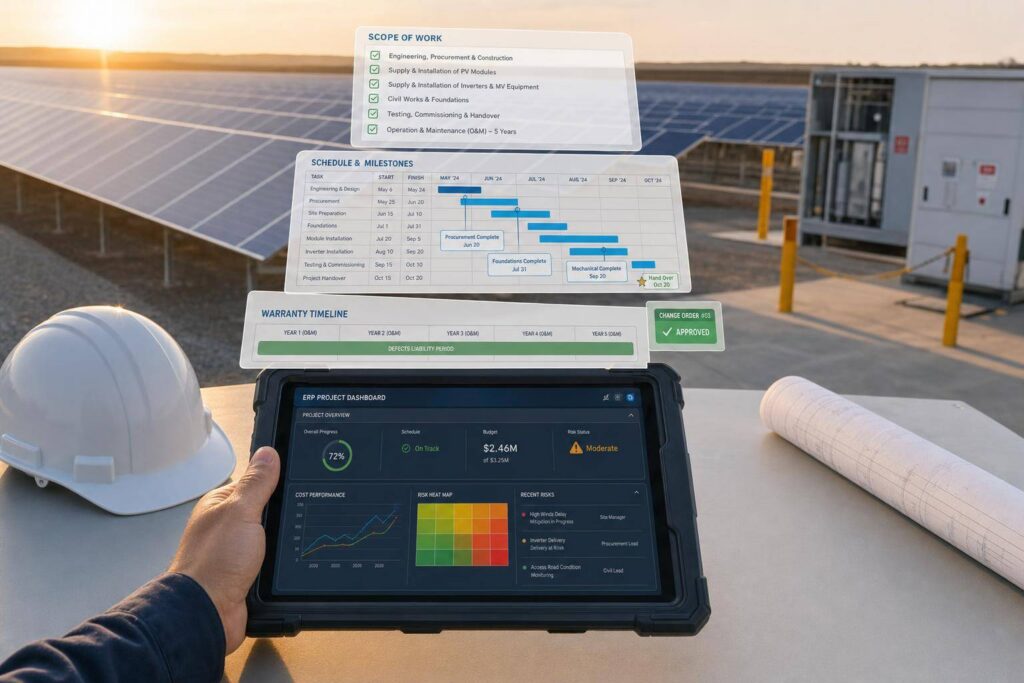
Most EPC problems start with five weak spots: scope, schedule, change orders, payment triggers, and warranty records. If you lock those items down at the start, you cut the odds of cost fights, delay claims, and cash flow issues later.
Here’s the short version:
- Define scope line by line. Match each duty to a contract clause, drawing, BoQ item, and WBS code.
- Set a usable schedule. Long-lead gear can take 20 to 40 weeks, and 50% of solar respondents point to interconnection as the top delay source.
- Require written change orders. If cost and time impacts are not approved in writing before work starts, margin can slip fast.
- Use clear billing milestones. Payment triggers should tie to proof like test results, punch list closeout, and signed records.
- Spell out warranty and PR terms. Define start dates, cure periods, test methods, exclusions, and LD formulas.
- Track all of it in ERP. Contracts stored only in PDFs and email threads tend to turn into claims later.
A few numbers show the stakes: in North America, construction disputes average $60.1 million and take about 12.5 months to resolve. And 52% of projects deal with scope creep, while 85% of those go over budget.
If I had to boil the article down to one point, it would be this: an EPC contract works better when contract terms become day-to-day project data, not just legal language on signed paper.
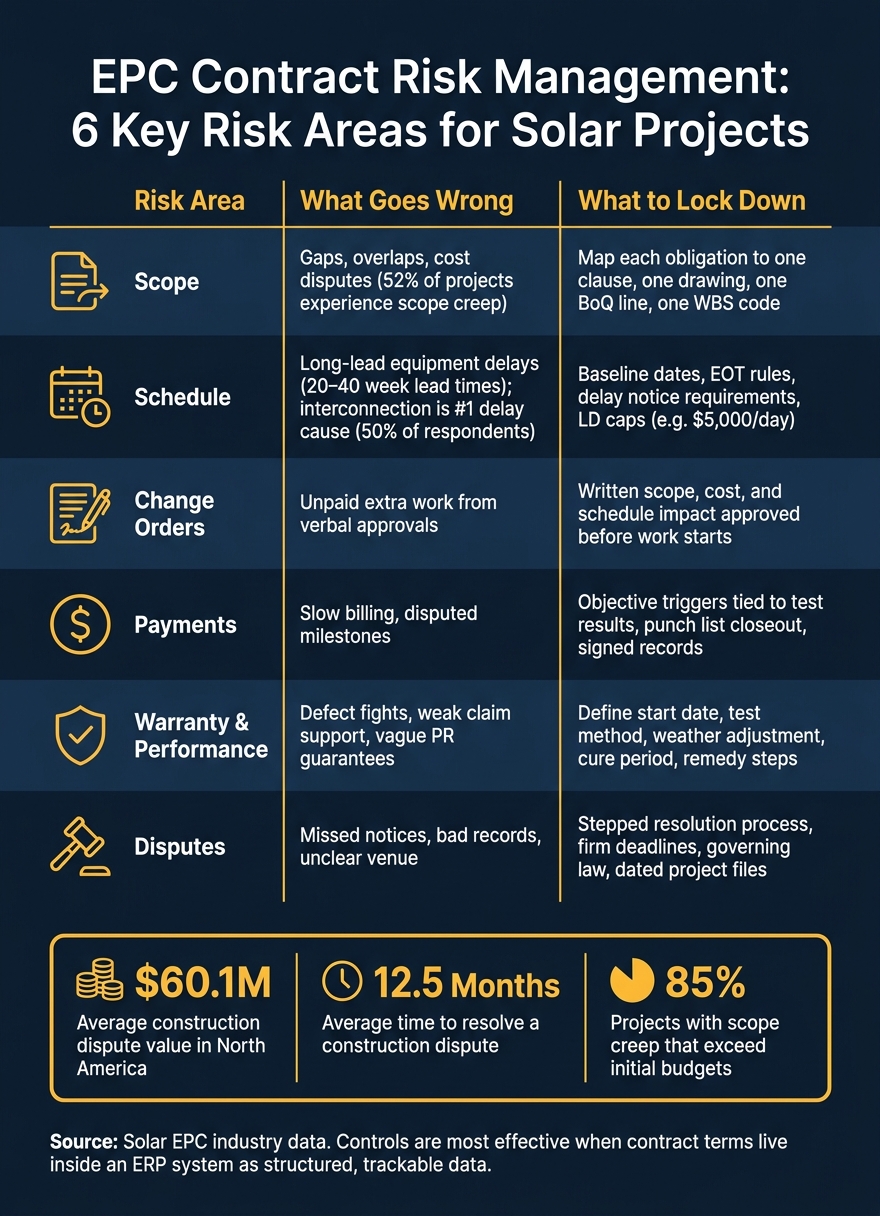
Quick view
| Risk area | What goes wrong | What to lock down |
|---|---|---|
| Scope | Gaps, overlap, cost fights | Clause, drawing, BoQ, WBS match |
| Schedule | Late gear, utility delay, missed COD | Baseline dates, EOT rules, delay notice |
| Change orders | Unpaid extra work | Written scope, cost, time approval |
| Payments | Slow billing, disputed milestones | Objective triggers and proof |
| Warranty/PR | Defect fights, weak claim support | Start date, test method, remedy steps |
| Disputes | Missed notices, bad records | Deadlines, venue, dated project files |
The rest of the article explains how to put those controls in place in a simple, trackable way. This process is often streamlined using asset management software for solar installers.
Scope gaps and schedule delays: the first contract risks to address
Scope and schedule problems usually start long before anyone shows up on-site. They begin in drafting, estimating, and planning. By the time crews are in the field, those weak spots have already turned into tomorrow’s disputes.
How scope gaps cause cost and responsibility disputes
The usual trouble areas are pretty familiar: civil work boundaries, interconnection duties, permitting, testing and commissioning, performance guarantees, and O&M handover. When a contract doesn’t pin each item to one party, people fill in the blanks in the way that suits them best.
Here’s a common scenario. A contract says the EPC will provide “all necessary civil works,” but the drawings and bill of quantities (BoQ) don’t mention access roads. The owner sees that as included. The EPC sees it as excluded. That one fuzzy phrase can lead to a change order fight, added cost, and delay.
The fix is simple in theory, even if it takes discipline in practice. Map each obligation to:
- one clause
- one drawing
- one BoQ line item
- one WBS code
The contract should spell out what gets done, who does it, the standard that applies, and what sits outside the scope. A cross-reference matrix that links each obligation to its controlling document makes gaps much easier to spot before work begins, not months later during a closeout dispute. And those same blurry scope lines often spill into the schedule when procurement or approvals slow down.
Common delay drivers in solar EPC contracts
Long-lead equipment is one of the biggest schedule risks on any utility-scale project. Transformers, switchgear, and inverters can have lead times of 20–40 weeks in tight supply markets [1]. AHJ and utility approvals are the other big pain point. In fact, 50% of solar industry respondents said interconnection is the most common cause of project delays [1].
A well-drafted contract deals with those risks head-on. Fixed completion dates and milestone dates need to match a realistic baseline schedule. Extension-of-time (EOT) terms should make clear which delays count as excusable, including force majeure, unusually severe weather, AHJ or utility delays outside the EPC’s control, and owner-driven changes. They should also state what notice and backup the EPC must provide to get an extension of time.
Liquidated damages (LDs) should be based on a real pre-estimate of owner losses, such as lost production revenue or lost tax benefits. In practice, that usually means a set daily USD amount, like $5,000 per day, plus an overall cap [1]. When those delay assumptions are built into the baseline and tracked in ERP, teams have a much cleaner way to separate excusable delay from slippage that could have been avoided.
How ERP data supports scope and schedule control
The best way to stop scope gaps from slipping through is to load contract obligations into the ERP as structured data right at kickoff. Each scope element, whether it’s DC field installation, AC collection system, civil works, interconnection, permitting, or O&M handover, should sit in the ERP as its own record. That record should include the responsible party, budget, BoQ quantities, and linked drawings.
Those records should then connect to WBS tasks with set start and finish dates, predecessors, and assigned resources. In plain terms, the contract scope shouldn’t live in a PDF alone. It needs to live inside the system the team uses every day.
The ERP should hold both:
- a baseline schedule locked at contract signing
- a current schedule that reflects approved changes
Any update should move through a controlled workflow with justification, approval, and a record of the time and cost impact. Field changes should be blocked until the ERP record is updated and approved.
Blu Banyan‘s SolarSuccess, built on NetSuite, can tie scope items, documents, and field tasks to one project record for traceable contract control. That same contract record can then govern change orders, invoices, warranties, and claims.
Change orders and payment terms: where margin slips
After scope and schedule, the next place margin starts to leak is in the accounting and finance side of the job.
Change orders and payment terms often eat into EPC margin even when the project plan looks solid on paper. The reason is pretty simple: informal scope changes and fuzzy billing triggers lead to work that doesn’t get billed on time, or at all, and cash comes in later than it should.
Why change orders must document cost and time impacts in writing
Verbal approvals are where unpaid work usually begins. If field crews move ahead based on the owner’s verbal direction, without a signed change order, the owner can later challenge the charge or argue that the work was already part of the original scope.
Change orders are the contract tool for scope gaps that get missed during drafting. Each one should spell out:
- the revised scope
- the added or reduced cost
- the schedule impact
- signed approval before the work starts
It also helps to track the base contract, approved changes, and current contract total in one place. That keeps the running total visible and cuts down on billing surprises at closeout.
Even with tight scope control, weak billing terms can still slow cash and squeeze margin.
Payment clauses that support predictable cash flow
Milestone billing only works when each trigger is objective, documented, and tied to a specific project event. If milestone language is vague, disputes tend to follow, and payment gets pushed out.
For example, mechanical completion should depend on passing test results and a closed punch list, not a project manager’s verbal confirmation. That ties milestone proof back to the schedule set at contract signing.
Compare vendor payment timing with customer billing milestones before contract signing to spot cash gaps early. [2][3]
How ERP workflows improve approvals and billing accuracy
ERP shifts change control from a pile of documents into an enforced workflow. A good ERP workflow should store each change order as a required record with scope, cost, schedule impact, and approval status. It should also block field work and purchase orders until approval is done.
A single project record can hold the base contract, approved changes, pending changes, margin status, and billing milestones. bluDocs keeps signed change orders and milestone inspection reports attached directly to the related project and invoice records, linking approvals, field work, and billing in one traceable flow. [2]
The payoff shows up in cash collection and admin costs. For example, Ipsun Solar used automated milestone-based invoicing integrated with payment portals to accelerate receivables and reduce days-to-payment. Titan Solar Power achieved soft cost savings of approximately $0.04 per watt through transaction automation tied to project milestones. [2]
That’s what happens when billing triggers are clear, documented, and tied to what’s happening in the field instead of being managed through spreadsheets and email chains.
Once scope, pricing, and billing are under control, the next risk is whether warranty and dispute terms match how the project will actually be built and operated. Those controls lead straight into the next issue: how warranty language and dispute clauses deal with defects, performance shortfalls, and claims.
Warranty terms, performance guarantees, and dispute clauses
Once the project reaches COD, the risk picture changes. At that point, the big issues usually aren’t construction delays or install mistakes. They’re defects, performance claims, and what happens when the two sides disagree.
Warranty and performance terms that need close review
Most solar EPC contracts stack several warranty layers on top of each other. You’ll usually see manufacturer equipment warranties, EPC workmanship warranties, and a defects liability or cure period that keeps the contractor on the hook for post-handover fixes. On paper, that sounds fine. In practice, those layers often overlap in messy ways and can leave gray areas around who has to fix what.
The contract should spell out exactly when the warranty starts. Is it tied to substantial completion, mechanical completion, final acceptance, or COD? That one detail matters a lot. The same goes for the cure period, exclusions, and the remedy process when the same problem keeps coming back.
An energy-yield or PR guarantee only works if the contract gets specific. It should define:
- the test window
- the data source
- the weather adjustment method
- how grid curtailment or utility outages are treated
If that language is vague, enforcement gets messy fast. A contract that states the PR threshold, the commissioning test protocol, and the pass/fail standard gives both sides something concrete to point to.
Liquidated damages are easier to defend when they reflect a reasonable estimate of expected loss at the time of signing. A common setup is an LD formula tied to a percentage of the EPC price for each point of PR below the guarantee. [4]
Those remedies should also separate short-term commissioning misses from long-term underperformance after final acceptance. Those two situations don’t hit the owner the same way, so they shouldn’t be treated the same way in the contract either.
Before final acceptance, the contract should require a documented commissioning package. That package should include insulation resistance tests, IV curve results, inverter startup reports, string voltage records, as-built documentation, and a closed punch list.
Store that package in the ERP and link it to the project record. That gives the team one dated source of truth if a performance fight shows up later. Without those records, the parties can end up arguing over basic issues, like whether warranty duties have started or whether performance liquidated damages are still on the table.
Why dispute clauses must reflect project reality
Dispute clauses are easy to skim past during negotiation. That’s a mistake. They decide how problems get handled after the project is finished.
A stepped resolution process usually works better than jumping straight into a formal fight. That can mean project-level negotiation first, then executive escalation, then mediation, then arbitration or litigation. It gives both sides a path to follow before legal costs start piling up. But the steps only work if each one has a deadline. Without firm timing, a small issue can drift into a schedule claim, a payment fight, or a warranty dispute.
Notice rules are another trouble spot. A claim can fail on a pure technicality. If the contract says written notice must be sent within a set number of days after a triggering event, missing that deadline – or sending notice to the wrong address – may bar the claim.
The same logic applies to governing law and venue. If that language is missing or conflicts across contract documents, the parties may spend time and money fighting over which state’s law controls before they even get to the real dispute.
How ERP records reduce disputes and support warranty compliance
Warranty control runs on the same discipline as scope control and billing. Every duty, record, and deadline needs to live in the system.
bluDocs can centralize warranty certificates, commissioning records, signed permits, and claim correspondence in the project record. bluChat can preserve the time-stamped history of decisions, field communications, and acknowledgments, so the team doesn’t have to rebuild a timeline from scattered inboxes when a dispute surfaces.
The ERP should also capture key warranty data fields at the start of the project, including:
- warranty duration
- start date trigger
- manufacturer contact
- component serial numbers
- cure period length
- performance guarantee thresholds
- notice addresses
- governing law
With that data in place, the team can set automated reminders for expiration dates and notice windows before a deadline slips by.
Conclusion: Build EPC risk controls into contract data and workflows
EPC risk in solar projects doesn’t usually blow up all at once. It builds bit by bit when scope is vague, changes aren’t tracked, billing proof is missing, and warranty dates slip through the cracks. In North America, construction disputes average $60.1 million and take about 12.5 months to resolve.
To protect margin and cut down on disputes, you need clear scope, a realistic baseline schedule, written change-order approval, milestone-based billing, and warranty and dispute terms that can actually be enforced. That matters because 52% of projects experience scope creep, and 85% of those exceed their initial budgets.
But those controls fall apart if the contract sits in scattered files, inboxes, and folders. The contract needs to live inside the ERP. When scope, milestones, change orders, billing triggers, warranty data, and dispute-related records all sit in one system with enforced approval workflows, the record is there, dated, and tied back to the contract.
In plain terms, that means using a solar ERP built for contract tracking and approvals. SolarSuccess, bluDocs, and bluChat keep contract data, documents, and approvals in one workflow, turning EPC risk management from a legal task into repeatable project control.
FAQs
What should be reviewed first in an EPC contract?
First, check the vendor’s financial health to make sure they can handle long-term obligations, including warranties. Audited financial statements from the past two to three years can help confirm stability and steady cash flow.
Then verify compliance with key industry certifications, including IEC 61215, IEC 61730, and UL standards. Blu Banyan’s SolarSuccess can centralize contract and performance data, which makes these records easier to review and track.
How can ERP reduce EPC contract risk?
An ERP system helps cut EPC contract risk by putting project data, financial workflows, and documents in one place. That single source of truth helps teams avoid mistakes, version mix-ups, and slowdowns that often come from manual work.
It also gives teams tighter control over the contract itself. Milestones can connect directly to billing and revenue recognition, so money movement lines up with actual project progress. At the same time, teams get real-time visibility into schedule, budget, and scope risk, while compliance items and change orders are tracked in step with the work. The result is simple: contract terms stay aligned with what’s happening on the ground.
What records matter most in a solar warranty claim?
The records that matter most are signed installation and field reports, photo or video proof, test results that match the warranty scope, inspection approvals, as-builts, and the signed warranty paperwork.
It also helps to keep component trace records, including the BOM and serial numbers tied to the site. ERP audit trails and document version history can show what was done, when it happened, and which record was current at that time.
