

NetSuite can transform how solar companies manage operations. It tackles common challenges like fragmented systems, manual processes, and inventory issues by offering a centralized platform for project management, financial oversight, and customer relations.
Key Takeaways:
- Streamlined Project Management: Centralized dashboards ensure better scheduling, real-time updates, and smooth handoffs between teams.
- Resource Optimization: Aligns crew skills, material availability, and project timelines, reducing idle time and costs.
- Improved Financial Tracking: Automates reporting, revenue recognition, and compliance with tax credits and regulations.
- Enhanced Inventory Oversight: Real-time tracking prevents stockouts and ensures accurate procurement.
- Better Customer Management: Unified CRM improves communication, service delivery, and retention.
By integrating tools like SolarSuccess and SuiteApps, solar companies can simplify operations, improve efficiency, and scale effectively. NetSuite provides a single solution to manage the unique demands of the solar industry, from installation to long-term service.
Better Project Management and Operations
Solar companies juggle numerous projects, each with its own timeline, resources, and regulatory requirements. Without a unified system, project managers are left struggling to meet deadlines and control costs.
By integrating NetSuite, this chaos is replaced with a single source of truth for all project-related data. Instead of toggling between multiple platforms to monitor progress, teams can access everything they need through one centralized dashboard. This consolidated approach ensures accurate scheduling and resource management.
Centralized Project Tracking and Scheduling
Traditional project management often scatters critical information – site surveys, permits, and schedules are stored in separate tools. This fragmentation creates gaps in communication and makes it difficult to get a real-time overview of project status.
NetSuite simplifies this by consolidating all project data into a centralized dashboard. Every phase of solar installation, from the initial consultation to system commissioning, can be tracked within a single interface.
The system automatically updates timelines when changes occur. For example, if a permit approval is delayed, NetSuite adjusts related schedules and notifies the relevant team members. This real-time synchronization helps avoid cascading delays.
Task dependencies are visible throughout the project lifecycle. When the engineering team finishes system design, installation crews are immediately notified about their next steps. This smooth handoff between departments eliminates downtime caused by waiting for updates via email or phone.
Weather-related delays, a common challenge in solar projects, are easily managed. Project managers can quickly adjust schedules and reassign resources, ensuring minimal disruption to other ongoing projects.
By improving project tracking, solar companies naturally achieve better resource utilization.
Better Resource Allocation
Managing resources in solar projects comes with unique challenges. Installation crews require specific certifications, equipment availability varies by location, and material deliveries need to align perfectly with project timelines. Poor resource planning can lead to idle crews, delayed installations, and underutilized equipment.
NetSuite provides real-time visibility into both human and material resources across all projects. Managers can instantly see which crews are available, where equipment is deployed, and the status of materials.
The system optimizes crew scheduling by aligning technician skills with project requirements. It ensures that the right people are assigned to the right tasks at the right time.
Integrated inventory tracking simplifies material coordination. When scheduling installations, managers can confirm that all necessary components are in stock and reserve them for specific projects. This eliminates the common issue of multiple projects competing for the same materials.
Efficient resource allocation not only improves project timelines but also enhances cost management. For instance, equipment like cranes or specialized testing tools can be scheduled more effectively, reducing rental costs and ensuring they don’t sit idle.
NetSuite also helps manage subcontractors by tracking their performance and availability. Companies can identify their most reliable partners and prioritize them for critical tasks while avoiding scheduling conflicts.
The benefits of better resource allocation extend beyond cost savings. Faster project completion boosts customer satisfaction, and streamlined operations allow companies to take on more work without significantly increasing overhead. This efficiency ultimately strengthens both profitability and reputation.
Improved Financial Management and Regulatory Compliance
Managing finances in the solar industry can be a daunting task. Companies often juggle multiple revenue streams, complex project timelines, and a maze of regulatory requirements. Traditional accounting systems simply aren’t equipped to handle this level of complexity. That’s where specialized tools like NetSuite come into play.
NetSuite provides a suite of financial tools tailored to the solar sector. It handles project accounting, tracks federal tax credit documentation, and ensures precise reporting to meet compliance standards. One standout feature is its ability to automatically manage revenue recognition – from the initial deposit all the way through to system commissioning.
Automated Financial Reporting and Analytics
Manually compiling financial reports is not only time-consuming but also prone to errors that can skew critical business decisions. Solar companies need real-time insights into metrics like project profitability, cash flow, and overall performance to stay ahead in a competitive market.
NetSuite simplifies this process with automated reporting tools. As transactions occur, financial reports update in real time, giving businesses immediate access to essential data. For example, project managers can monitor profitability for specific installations, while executives can view company-wide performance through detailed dashboards.
The platform generates project-specific profit and loss statements, forecasts cash flow using historical and pipeline data, and breaks down profitability by cost category. Real-time dashboards further enhance decision-making by showcasing key metrics like average project margins, installation cycle times, and customer acquisition costs. These continuously updated insights allow managers to identify trends and address potential issues before they escalate.
NetSuite also separates warranty costs and service revenue from installation income, offering a clearer picture of the long-term profitability of different solar products. Advanced analytics uncover seasonal patterns in sales and costs, helping companies fine-tune inventory, staffing, and purchasing decisions.
In addition to financial transparency, the platform’s tools simplify compliance, reducing the risks associated with regulatory challenges.
Simplified Regulatory Compliance
Navigating the regulatory landscape of the solar industry – complete with federal tax credits, state incentives, and local permitting requirements – can be overwhelming. NetSuite streamlines this process by automating compliance documentation and reporting.
For residential solar installations, federal tax credit documentation is a critical component. NetSuite keeps detailed records of system costs, installation dates, and equipment specifications, formatting this data to simplify ITC claims for customers. At the state level, incentive programs often require unique reporting formats and adherence to strict deadlines. NetSuite adapts to these requirements, generating correctly formatted reports and providing reminders for submission deadlines.
Sales tax compliance, often tricky in solar projects, becomes manageable with NetSuite’s automated tax calculation features. The system applies accurate tax rates based on the installation’s location and equipment type, ensuring both taxable and non-taxable items are accounted for correctly.
For commercial projects, prevailing wage compliance is made easier with integrated payroll tracking. NetSuite monitors wage rates by location and project type, ensuring adherence to local labor laws and producing the necessary documentation.
NetSuite also supports renewable energy certificate (REC) tracking, maintaining the detailed records needed for REC trading programs. This feature helps solar companies maximize revenue from environmental incentives while staying fully compliant with program requirements.
Finally, the system extends its compliance capabilities to warranty tracking and service obligations. It maintains comprehensive records of warranty terms, service schedules, and customer interactions, ensuring companies fulfill their long-term commitments to both customers and regulatory bodies.
Better Supply Chain and Inventory Visibility
After refining project and financial management, solar companies often turn their attention to supply chain visibility – a critical aspect of their operations. Managing thousands of components across various sites is no small feat. Panels, inverters, mounting hardware, and electrical components all need to be tracked with precision. When inventory oversight falters, delays mount, costs escalate, and customer satisfaction takes a hit.
NetSuite simplifies the entire supply chain process. It offers end-to-end visibility, covering everything from procurement to installation. With this system, solar companies can monitor every component in real time, predict shortages before they occur, and make smarter purchasing decisions based on actual project needs. This seamless visibility works hand-in-hand with the operational and financial efficiencies discussed earlier.
By directly integrating with suppliers, NetSuite ensures inventory levels are automatically updated as shipments arrive or materials are allocated to specific projects. This direct integration removes the risk of errors caused by manual data entry, bridging the gap between what’s recorded and what’s physically available.
Real-Time Inventory Management
Manual inventory tracking often leaves room for errors and blind spots, which can delay projects. NetSuite eliminates these issues with automated inventory tracking that updates instantly as materials move through the system.
The platform provides real-time updates on inventory as it moves from central warehouses to job sites, with installer scans ensuring stock levels and project statuses are always current. This eliminates the frustrating scenario where missing components are discovered only after crews arrive on-site.
NetSuite’s analytics tools bring precision to demand forecasting. By analyzing historical data, current projects, and seasonal trends, the system predicts future material needs. For example, solar companies can identify patterns such as increased demand for certain panel types during specific months or higher inverter failure rates in certain regions.
The platform also uses automated reorder points to prevent stockouts. It monitors inventory levels and upcoming project requirements, automatically generating purchase orders when stock drops below set thresholds. For high-value items like inverters, this can save companies from costly expedited shipping fees.
Additionally, NetSuite simplifies serial number tracking, which is essential for warranty management. Every panel, inverter, and monitoring device is tracked individually from receipt to installation. This level of detail proves invaluable when handling recalls or warranty claims years down the line.
For managing batches of components, lot tracking is another key feature. If quality issues arise with specific manufacturing runs, NetSuite can quickly identify which projects used the affected components. This allows solar companies to address concerns proactively and communicate with customers efficiently.
Improved Procurement and Vendor Relationships
NetSuite doesn’t just improve inventory management – it also streamlines procurement and vendor relationships. Solar companies often work with dozens of suppliers, each with varying lead times, prices, and quality standards. NetSuite consolidates all vendor data and purchase history, giving procurement teams the insights they need to make smarter decisions.
The platform tracks vendor performance, monitoring on-time delivery rates, quality scores, and pricing trends. This makes it easier to identify reliable suppliers and phase out those who frequently cause delays. By taking a data-driven approach, companies can build stronger partnerships with dependable vendors.
Automated purchase order generation further simplifies procurement. When project managers approve installation schedules, NetSuite automatically creates purchase orders based on project specifications and current inventory levels. Orders can even be split across multiple vendors to secure better prices or ensure backup supplies for critical components.
To avoid costly errors, NetSuite matches purchase orders, receipts, and invoices automatically. Any discrepancies are flagged immediately, preventing overpayments and ensuring inventory records remain accurate.
The platform also enables collaborative planning with suppliers. By sharing anonymized forecasts and demand projections, solar companies help manufacturers align their production schedules. This collaboration ensures priority allocation during supply shortages.
NetSuite also includes contract management tools to track volume discounts, rebates, and special pricing agreements. These features ensure companies take full advantage of savings opportunities by automatically applying the correct pricing based on purchase volumes and contract terms.
A supplier portal allows vendors to update order statuses, shipping details, and delivery schedules directly within the system. This eliminates the back-and-forth of phone calls and emails, freeing up procurement teams to focus on strategic tasks.
Finally, the platform supports drop-shipping arrangements, where materials are sent directly from manufacturers to job sites. This not only reduces handling costs but also accelerates project timelines – especially for large commercial installations – while maintaining accurate inventory tracking and cost allocation.
sbb-itb-2560759
Improved Customer Relationship Management and Service Delivery
Beyond optimizing operations and supply chain visibility, solar companies must prioritize effective customer management to thrive in the long run. High-value solar installations require clear and ongoing communication. Without a cohesive system, customer interactions can become disjointed, leading to missed follow-ups and inconsistent service. NetSuite changes the game by combining CRM with project, inventory, and financial data. This integration gives service representatives instant access to real-time project updates, material availability, and crew schedules – all from a single dashboard.
One of the biggest challenges in customer management is the issue of disconnected data. Sales, project management, and service teams often work with separate information, creating communication gaps. NetSuite eliminates these silos by providing a centralized customer record. With everyone accessing the same data, communication becomes seamless and professional. Customers no longer have to repeat details they’ve already shared with the sales team, making their experience smoother and more satisfying.
This unified CRM system supports every step of the customer journey, ensuring consistency and reliability.
Complete Customer Lifecycle Management
NetSuite takes care of every customer interaction, starting from the first lead and continuing through decades of post-installation service. It tracks lead sources, sales conversations, proposal updates, and project histories, ensuring no important detail slips through the cracks.
The platform automatically logs communications – whether they happen via phone, email, or online inquiries. This means sales representatives can review the entire conversation history before reaching out, letting them pick up exactly where the last discussion ended. This continuity is especially valuable in solar sales, where decision-making timelines can stretch over months.
Automated workflows help maintain momentum during the sales process. For example, the system can schedule follow-ups and send status updates without requiring manual input, ensuring that no lead goes cold.
Solar projects often involve complex documentation, from initial energy assessments to final interconnection agreements. NetSuite keeps all customer documents organized and easy to search, which is especially helpful for warranty claims or system upgrades years later.
For ongoing service, NetSuite tracks system performance, maintenance schedules, and service history. When customers report issues, technicians can quickly access the installation details and previous service records, speeding up problem resolution.
Service contract management becomes simpler with automated renewal reminders and performance tracking. The platform monitors service agreement terms, tracks response times, and ensures compliance with service level commitments. For customers using monitoring services, NetSuite can even integrate with performance data to identify and address potential issues before they escalate.
By linking customer interactions with operational data, NetSuite reinforces its role as a unified ERP solution.
Higher Customer Retention and Satisfaction
A comprehensive approach to lifecycle management naturally leads to better customer retention and satisfaction. With unified customer data, service representatives can deliver personalized and efficient support, which translates into stronger loyalty and higher satisfaction scores. Happy customers are also more likely to recommend your services to others.
Proactive communication is another standout feature. Instead of waiting for customers to reach out with questions, NetSuite can automatically send updates on project progress, maintenance schedules, and performance reports. This consistent outreach builds trust and highlights your company’s ongoing value long after the initial installation.
Customer segmentation tools allow solar companies to tailor their messaging to different audiences. For instance, residential customers might receive tips on maximizing energy savings, while commercial clients get detailed ROI analyses and maintenance updates. This targeted approach fosters deeper engagement and strengthens relationships.
NetSuite’s analytics tools provide valuable insights into customer satisfaction and service performance. Metrics like response times, resolution rates, and feedback scores help companies pinpoint areas for improvement. This data-driven approach allows solar companies to continually refine their processes and deliver exceptional service.
Additionally, the platform supports customer self-service portals, where customers can check project updates, view system performance data, and access service records. These portals reduce the need for status inquiries while giving customers the information they need, whenever they need it. This level of transparency significantly enhances the overall customer experience.
SolarSuccess and SuiteApps: Solar Industry Solutions
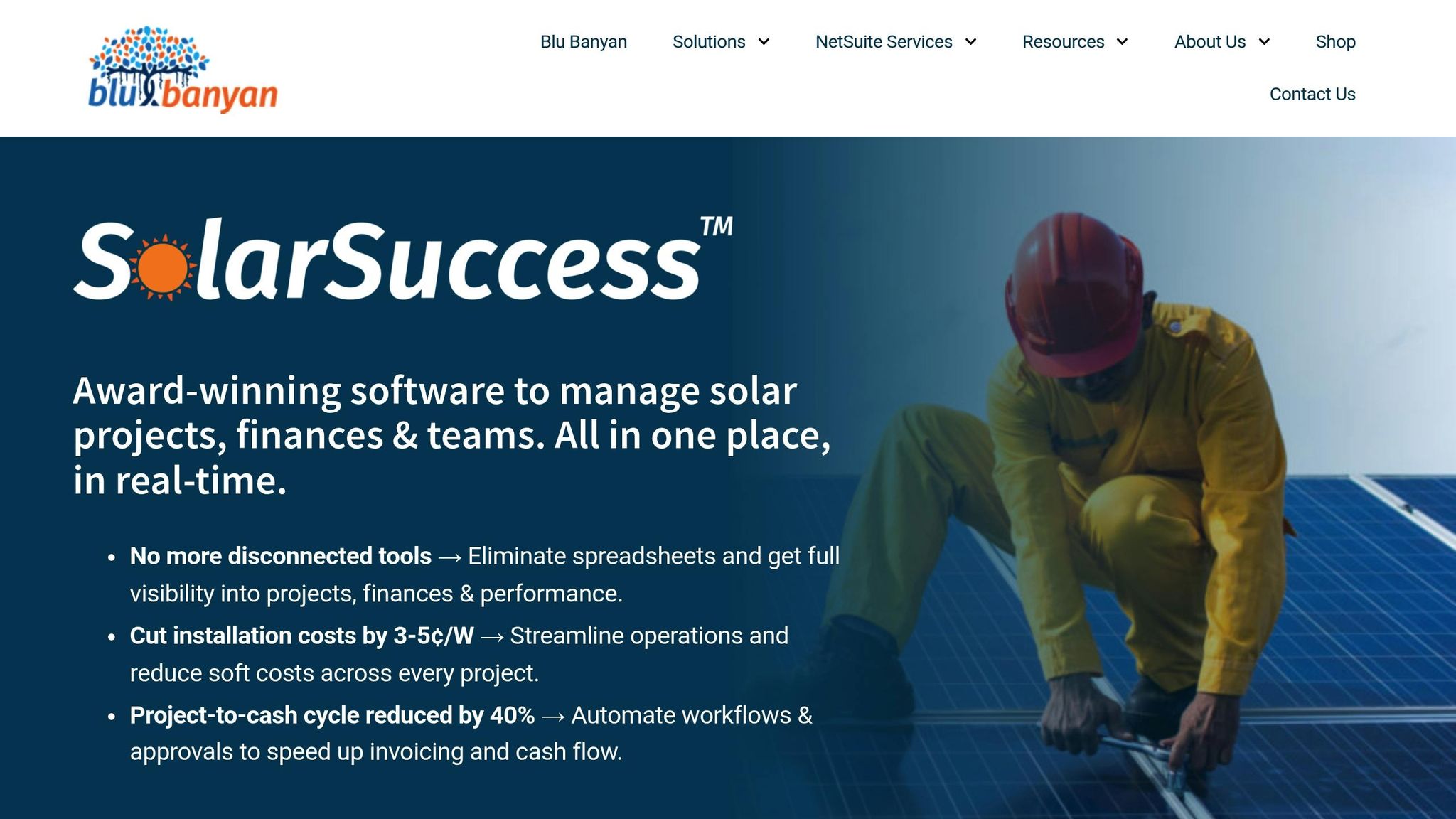
NetSuite provides a strong base for managing business operations, but solar companies often need tools tailored to their unique workflows. Generic ERP systems can struggle with solar-specific tasks like interconnection tracking, permit management, and performance monitoring. That’s where specialized solutions step in to bridge the gap and elevate operations.
Blu Banyan has developed SolarSuccess, an ERP solution designed specifically for the solar industry, alongside productivity-boosting SuiteApps. These tools combine the flexibility of NetSuite with in-depth solar industry knowledge, creating a system tailored for solar professionals.
By offering pre-configured workflows, SolarSuccess eliminates the need for lengthy customizations. Solar businesses can skip months of setup and start using industry-specific features right away. This approach not only speeds up implementation but also reduces costs and delivers immediate operational benefits. Built on NetSuite’s unified platform, SolarSuccess optimizes processes to help solar companies work more efficiently.
SolarSuccess: A Complete ERP for Solar Businesses
SolarSuccess transforms NetSuite into a solar-focused ERP, covering every aspect of a company’s operations. It integrates CRM, project management, financial tracking, and procurement into a single system, all tailored to the solar industry.
The platform is particularly effective at managing the complex solar sales process, from lead qualification to final interconnection. Project managers gain real-time visibility into installation progress, material deliveries, and crew assignments through unified dashboards, streamlining oversight across multiple projects.
Financial management becomes more advanced with SolarSuccess, handling solar-specific needs like renewable energy credit tracking, tax incentive calculations, and performance-based billing. It also generates the necessary financial reports for investors, lenders, and regulatory compliance, making it easier to manage financial operations.
Inventory management gets a solar-focused upgrade. The system tracks panel serial numbers, inverter warranties, and component compatibility. Before materials leave the warehouse, project managers can confirm that all components meet local codes and work seamlessly together.
Supply chain coordination is simplified with automated purchase orders based on project schedules and inventory levels. Lead times for specialized equipment are factored in, ensuring critical components arrive exactly when crews need them.
SolarSuccess also addresses service operations, tracking system performance data, scheduling maintenance, and managing warranty claims. Service technicians have access to complete installation histories and performance benchmarks, enabling faster problem-solving. These features integrate seamlessly into the broader system, ensuring every part of the business is optimized for solar-specific demands.
SuiteApps: Enhancing Productivity and Collaboration
In addition to the core ERP features, Blu Banyan’s SuiteApps tackle daily challenges faced by solar companies. These tools integrate smoothly with both NetSuite and SolarSuccess, creating a unified and efficient system. While SolarSuccess handles operational needs, SuiteApps enhance day-to-day productivity and teamwork.
bluChat improves team communication by embedding real-time messaging directly into NetSuite workflows. Whether it’s installation crews sending updates from the field, office staff addressing urgent questions, or project managers coordinating resources, everyone stays connected. SMS capabilities ensure communication even in areas with limited internet access.
This real-time communication reduces delays. For example, if an installation crew encounters an unexpected roof issue, they can notify the project manager immediately. The manager can then coordinate with engineering and procurement teams to resolve the problem. Importantly, all conversations are tied to specific project records, creating a complete history for future reference.
bluDocs simplifies the document-heavy nature of solar projects. Solar installations generate a mountain of paperwork, from site assessments to interconnection agreements. bluDocs organizes, links, and makes these documents easily accessible within NetSuite.
For instance, when a utility company requests interconnection documentation, project coordinators can quickly locate and share the necessary files without digging through multiple systems. The tool ensures version control, so everyone works with the most up-to-date documents, minimizing errors and rework.
bluTime streamlines time tracking and productivity monitoring for distributed teams. Field crews can log hours directly at job sites, with entries automatically linked to specific projects and tasks. This real-time data feeds into project costing and payroll systems, providing accurate labor tracking without added administrative effort.
Since bluTime integrates with NetSuite’s project management features, labor costs are updated automatically as crews log their time. Project managers can spot cost overruns early and address them before they affect profitability. This detailed tracking also improves the accuracy of future project estimates.
Together, these SuiteApps create a seamless work environment where information flows effortlessly between field teams, project managers, and back-office staff. Solar companies no longer need to juggle separate tools for communication, document management, or time tracking – everything is unified within NetSuite, simplifying operations and improving collaboration.
Measurable Benefits and ROI of NetSuite Integration
Integrating NetSuite into your operations can lead to noticeable improvements in both efficiency and financial performance. By automating processes and cutting down on manual tasks, teams can complete projects faster and work more effectively.
It’s not just about saving time – NetSuite integration can also enhance cash flow, speed up invoicing, and provide clearer insights into project profitability.
Key Metrics to Measure Success
To truly understand the impact of NetSuite integration, consider tracking these key metrics:
- Administrative Efficiency: Automating payroll and data entry allows your team to focus on higher-value, strategic tasks.
- Project Completion: With centralized management, resource coordination improves, and real-time updates help projects move faster.
- Inventory Management: Automated systems for procurement and demand forecasting help avoid stockouts while reducing excess inventory.
- Customer Service: Consolidated project data enables quicker response times, which can lead to stronger customer retention.
- Financial Reporting: Monthly closings become faster and more accurate with automated data collection, supporting better decision-making.
- Regulatory Compliance: Automation reduces the workload tied to compliance reporting and lowers the risk of penalties.
These measurable improvements translate into a strong return on investment. Whether it’s through labor savings, faster project delivery, or happier customers, the benefits quickly add up. Plus, reducing risks – like compliance penalties or inventory mismanagement – further strengthens the case for adopting NetSuite into your business processes.
ROI Comparison Table
Note: The ROI Comparison Table mentioned in the outline has not been included in this section and may be added in a future update.
Conclusion: Future-Ready Solar Operations with NetSuite
As the demand for renewable energy continues to grow, solar companies need tools that can keep pace with their expanding operations. NetSuite offers a strong foundation to manage increasing project loads, navigate complex regulations, and meet evolving customer expectations – all in one unified platform.
Key Takeaways
NetSuite brings all business functions together under a single system, eliminating the hassle of managing multiple platforms. This streamlined approach simplifies operations and improves efficiency across the board.
The financial advantages go beyond cutting costs. Features like automated invoicing, real-time tracking of project profitability, and simplified compliance reporting help solar companies boost cash flow while easing the administrative workload. This allows teams to focus more on strategic initiatives and business growth.
With real-time, centralized data, project management becomes far more predictable. From scheduling installation crews to monitoring equipment deliveries, NetSuite minimizes communication gaps that often lead to delays and unexpected expenses.
What truly sets NetSuite apart is its scalability. As your business expands – whether through new markets, additional services, or increased installation capacity – NetSuite grows with you. There’s no need for a complete system overhaul, ensuring a smoother path to scaling your operations.
These features lay the groundwork for expert implementation, which can further refine and optimize your business processes.
How Blu Banyan Supports Solar Business Success
Blu Banyan enhances NetSuite’s capabilities with SolarSuccess ERP, a system specifically tailored to meet the unique demands of the solar industry. Designed with solar workflows, compliance requirements, and industry-specific reporting in mind, SolarSuccess takes NetSuite to the next level.
Blu Banyan also offers SuiteApps that address common challenges faced by solar companies. Tools like bluChat keep teams connected in real time, bluDocs ensures critical project documents are always accessible, and bluTime provides precise tracking for both field crews and office staff.
With a deep understanding of the solar industry, Blu Banyan ensures SolarSuccess is optimized for both residential and commercial projects. Their expertise extends to managing interconnection complexities and maintaining detailed records for warranties and service needs.
By partnering with a specialized implementation expert like Blu Banyan, solar companies can skip lengthy customizations and start with a system that’s ready to go. At the same time, the platform remains flexible enough to adapt as the business evolves.
The future of the solar industry will belong to companies that can scale efficiently while maintaining the customer experience. With NetSuite’s robust platform and Blu Banyan’s tailored solutions, solar businesses can achieve both, setting themselves up for long-term success.
FAQs
How does integrating NetSuite help solar companies overcome challenges in supply chain and inventory management?
NetSuite integration gives solar companies a clear, real-time view of their inventory – whether it’s panels, batteries, or other components. This level of tracking ensures businesses can stay on top of supply chain needs and respond promptly to changes.
It also simplifies procurement and automates inventory management, eliminating the headaches caused by disconnected systems. With materials readily available when needed, companies can cut down on delays and keep operations running smoothly.
How does SolarSuccess enhance NetSuite for solar companies, and what makes it unique compared to standard ERP systems?
SolarSuccess brings a specialized touch to NetSuite, offering a solution crafted specifically for the solar industry. By combining essential business functions – like project management, CRM, inventory tracking, and financial processes – into a single platform, it gives solar companies a unified way to manage projects, budgets, and resources. This integration not only simplifies workflows but also helps businesses operate more efficiently and make smarter decisions.
What makes SolarSuccess stand out from generic ERP systems is its focus on the unique demands of the solar sector. It includes tools like tailored project workflows, visual timelines, and features designed to meet industry compliance standards. By addressing these specialized needs, SolarSuccess helps solar companies fine-tune their operations and enhance profitability.
How does NetSuite’s real-time data improve customer satisfaction and loyalty for solar companies?
NetSuite’s real-time data features give solar companies the ability to deliver immediate insights into energy usage and savings. This level of transparency allows customers to clearly see how their systems are performing, helping to build trust and confidence in the service.
On top of that, real-time data supports personalized communication and timely updates, making customers feel informed and appreciated. By quickly resolving inefficiencies and providing tailored support, solar companies can strengthen customer relationships and encourage long-term loyalty.
