

Want to reduce downtime and save on maintenance costs for your solar operations? Predictive maintenance, powered by ERP systems, is the answer.
Here’s why it matters:
- 45% less downtime and 30% lower maintenance costs are achievable with predictive strategies.
- It extends equipment lifespan by 20%-40%, maximizing the ROI on high-value assets like inverters and solar panels.
- ERP systems integrate real-time IoT sensor data, machine learning, and automated workflows to streamline maintenance and prevent costly failures.
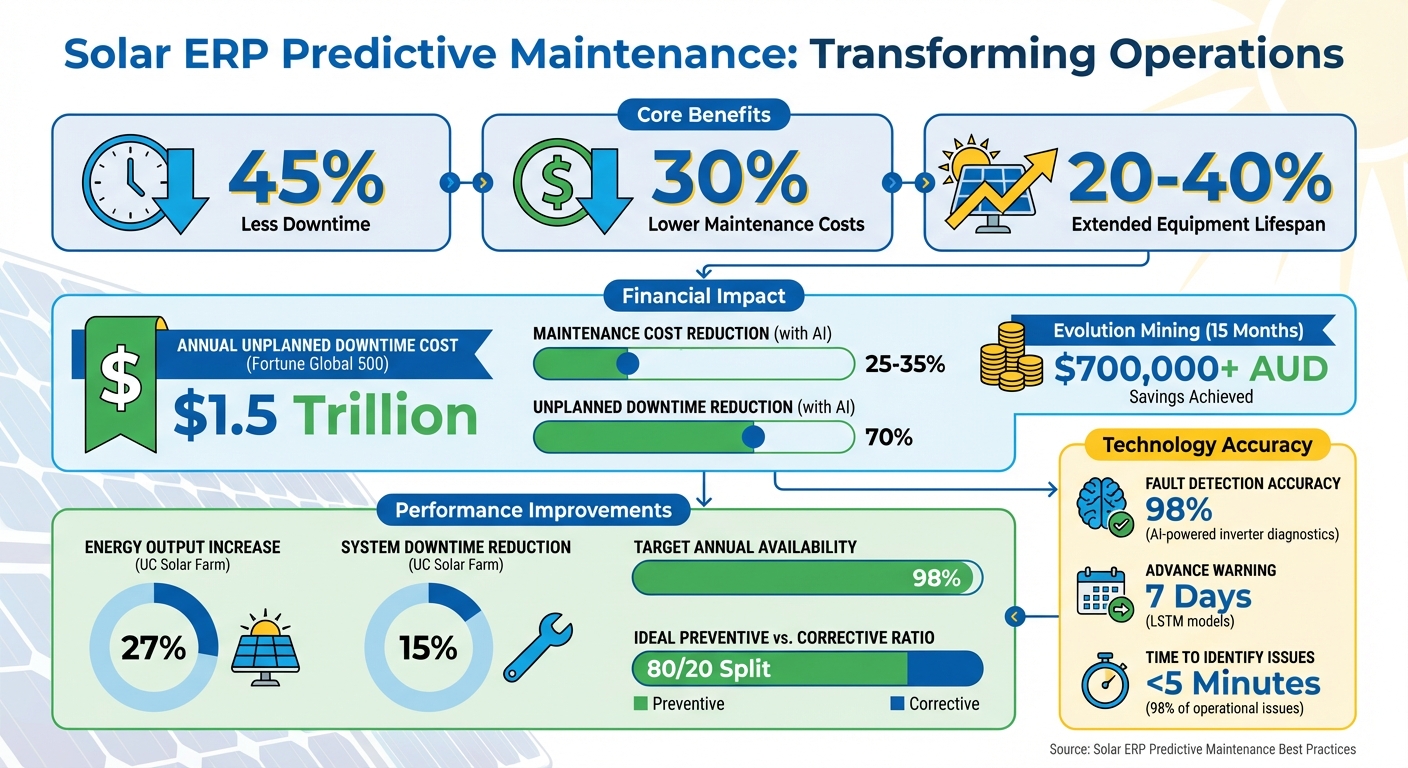
Solar ERP Predictive Maintenance: Key Benefits and Cost Savings Statistics
Technologies That Enable Predictive Maintenance in Solar ERP
Predictive maintenance combines advanced hardware and software tools to collect and analyze data, uncover patterns, and provide actionable insights. These technologies help solar companies maintain equipment efficiently, reducing downtime and costs. Understanding their role within an ERP system is essential to unlock their full potential.
IoT Sensors and Real-Time Data Collection
IoT sensors are the backbone of predictive maintenance, continuously tracking critical parameters like voltage, current, temperature, irradiance, and environmental conditions. By identifying subtle changes in system behavior, these sensors can alert maintenance teams to potential issues before they escalate into costly problems.
Modern sensor networks include tools like thermal imaging, power optimizers, and smart inverters to monitor system performance comprehensively. With edge computing capabilities, data processing happens directly at the sensor level, minimizing network loads and enabling quicker responses to anomalies. When integrated into an ERP system, this sensor data becomes a centralized source of truth for maintenance decisions.
For the best outcomes, focus on installing sensors on high-value equipment like central inverters, where failures can cause significant disruptions. Regular calibration ensures the accuracy of these sensors. Once reliable data is collected, advanced analytics can take maintenance strategies to the next level.
Machine Learning and Predictive Analytics
Machine learning (ML) leverages data from IoT sensors to refine and predict maintenance needs. By analyzing both real-time sensor data and historical records, ML algorithms can detect faults early and automatically trigger maintenance actions. These algorithms excel at identifying subtle patterns – like changes in vibration, temperature, or pressure – that might go unnoticed by human operators.
Advanced models, such as CatBoost, Random Forest, and Long Short-Term Memory (LSTM) autoencoders, have achieved impressive accuracy rates in photovoltaic fault detection, with LSTM models capable of issuing maintenance alerts up to seven days in advance.
Real-world examples highlight the power of these tools. For instance, an AI-powered inverter diagnostic system at a 50 MW solar installation in Taiwan identified 98% of operational issues in less than five minutes. Similarly, researchers in Malaysia achieved a 98% success rate in fault classification using a Random Forest model. When integrated with ERP platforms, these insights can automate maintenance scheduling, optimize technician assignments, and manage solar inventory efficiently.
Thermal Imaging and Advanced Diagnostics
To complement sensor data and machine learning insights, advanced diagnostic tools help pinpoint physical system issues. Thermal imaging uses infrared cameras to identify hot spots caused by electrical defects, mechanical wear, or insulation problems. This non-invasive technique is particularly valuable for solar installations, as it allows for issue detection without interrupting operations.
Other diagnostic tools include vibration analysis for rotating machinery, motor circuit analysis for electric motors and inverters, and ultrasonic analysis to detect high-frequency anomalies like bearing wear or leaks.
| Diagnostic Tool | Primary Application | Detection Capability |
|---|---|---|
| Thermography | Electrical/Mechanical systems | Hot spots, insulation defects, friction |
| Vibration Analysis | Rotating equipment | Misalignment, bearing wear, imbalance |
| Motor Circuit Analysis | Electric motors/circuits | Winding issues, power quality, rotor health |
| Ultrasonic Analysis | Pneumatic/Electrical systems | High-frequency leaks, early bearing wear |
When data from these tools is fed into a solar ERP system, maintenance teams gain a comprehensive view of asset health. Cleaning raw sensor data to eliminate anomalies ensures more reliable analysis.
Best Practices for Implementing Predictive Maintenance in Solar ERP
When it comes to predictive maintenance, taking a phased approach ensures you balance ambitious goals with practical operational needs. Instead of diving into a full-scale rollout, start small – focus on key components, then expand strategically.
Start with a Phased Integration Approach
The first step is conducting a thorough assessment of your current infrastructure. Identify and prioritize critical components where failures have the most significant impact on operations.
Involve key stakeholders from finance, operations, and IT early in the process. Their input ensures the ERP system aligns with the organization’s varied requirements. As one implementation guide aptly puts it:
"A well-defined implementation plan is the backbone of a successful ERP software deployment"
The benefits of this measured approach are clear. AI-driven maintenance systems can slash maintenance costs by 25-35% and reduce unplanned downtime by as much as 70%. A great example comes from the University of California Solar Farm, where adopting AI-driven predictive maintenance boosted energy output by 27% and cut system downtime by 15%. These gains were achieved by focusing on high-value equipment first – components whose failure could disrupt the entire operation – before scaling the system further.
By starting with these targeted efforts, you lay the groundwork for the next essential step: robust data management.
Set Up Strong Data Management Protocols
Once you’ve initiated a phased approach, the next priority is ensuring your data is accurate, consistent, and accessible. Predictive maintenance relies heavily on quality data. Without reliable inputs, even the most advanced algorithms will fail to deliver useful insights. From the outset, establish clear data collection protocols, assign ownership responsibilities, and implement quality control measures.
Address common data issues head-on. Automated validation tools, such as Z-score or IQR detection, can flag unrealistic data points in real time. For missing data caused by issues like sensor failures, techniques like linear interpolation or K-Nearest Neighbor (KNN) algorithms can fill in the gaps. Regular sensor calibration is also critical to avoid errors due to sensor drift.
Consolidating your data into a unified model is another game-changer. It eliminates the inefficiencies caused by incompatible systems. Blu Banyan explains:
"The only way to overcome conflicting data from incompatible applications is a single platform for all business operations, from accounting and inventory, to project management and CRM"
Tick Tock Energy experienced this firsthand. After transitioning to a unified data model, Craig Pals, Vice President and Founder, shared:
"Reconciliation time decreased substantially, and data was much more accurate, giving leadership confidence in making better business decisions"
To ensure smooth communication between SCADA and ERP systems, adopt standardized protocols like Modbus, IEC 60870-5-104, or IEC 61850, and integrate RESTful APIs.
Use Solar-Specific ERP Features
Generic ERP systems often fall short when it comes to the unique needs of the solar industry. Solar-specific platforms, such as SolarSuccess, offer tailored modules for asset management, energy production monitoring, and tracking equipment across its lifecycle. Configure your ERP to monitor key metrics like energy output per string and inverter efficiency – these indicators help detect early signs of equipment degradation.
Real-time dashboards are another essential feature. They provide instant visibility into equipment performance and can trigger automated alerts when components deviate from expected parameters. When maintenance is required, the ERP can automatically check spare part availability and allocate funds by connecting project management, inventory, and accounting systems.
Big Sun Solar illustrates the effectiveness of this approach. After implementing SolarSuccess ERP, Aaron Casillas, Technology & Infrastructure Director, stated:
"SolarSuccess streamlined things even further and allowed us to add our own customizations on top of NetSuite… identifying and prioritizing specific features for development that will increase our productivity"
Additionally, use the ERP’s timelines and milestones to schedule maintenance based on equipment age or performance. This level of coordination is only achievable with an ERP system designed specifically for the solar industry’s operational demands.
sbb-itb-2560759
Key Metrics to Track Predictive Maintenance Success
Incorporating the right KPIs into your solar ERP system can turn predictive maintenance into a measurable strategy that delivers real business value. These metrics help ensure your maintenance efforts are effectively preventing failures, cutting costs, and maximizing energy production.
Energy Output per Panel
One of the most important metrics to monitor is Specific Yield, which measures the total energy generated per kWp installed. This allows you to compare components directly and identify underperforming assets. For better precision, calculate this metric at the inverter level within your ERP rather than just at the plant level. This granular approach helps you pinpoint specific strings or panels that may need attention before they fail.
The Performance Ratio (PR) goes a step further by comparing actual energy yield to the theoretical maximum. This metric accounts for factors like degradation, soiling, and inverter losses, providing a more comprehensive view of system inefficiencies. For short-term analysis, use a temperature-corrected PR to eliminate seasonal variations and focus on true equipment performance. As SolarPower Europe notes:
"The advantage of using the EPI [Energy Performance Index] is that its expected value is 100% at project start-up and is independent of climate or weather".
These metrics form the foundation for assessing overall system efficiency and uptime.
Downtime Reduction Metrics
Technical Availability is a key metric for tracking uptime, specifically measuring operating time above the Minimum Irradiance Threshold (typically set at 50 or 70 W/m²). However, not all downtime is created equal – losing an hour of production at noon has a far greater financial impact than an hour lost at dawn.
To address this, use Energy-based Availability, which weights lost time by the potential energy generation during that period. This approach reflects the higher financial stakes during peak irradiance hours. Aim for a target of 98% annual availability.
Additionally, track the Preventive vs. Corrective Maintenance Ratio. Best practices suggest an 80/20 split, with 80% of maintenance being preventive. A higher preventive ratio indicates you’re effectively identifying and addressing issues before they escalate into failures.
These metrics, combined with uptime tracking, provide insight into how well your maintenance strategy is working financially and operationally.
Maintenance Costs per Kilowatt
To evaluate the cost-effectiveness of your predictive maintenance strategy, monitor Maintenance Cost per Unit of Production. This metric calculates expenses relative to the energy generated, offering a clear picture of your strategy’s ROI. Data-driven maintenance approaches can lower overall costs by up to 30%.
It’s also important to measure Response and Resolution Times, including Acknowledgement Time (how quickly alarms are addressed), Intervention Time (time to arrive on-site), and Resolution Time (time to fix the issue). Faster response times, especially when your ERP can detect potential failures weeks or months in advance, help minimize downtime and protect revenue.
| KPI | Purpose | Target Benchmark |
|---|---|---|
| Performance Ratio (PR) | Captures efficiency losses from all sources | Temperature-corrected for short periods |
| Technical Availability | Measures uptime when irradiance > MIT | 98% annually |
| Preventive/Corrective Ratio | Evaluates maintenance proactivity | 80/20 split |
| Maintenance Cost/kWh | Tracks financial efficiency | 30% reduction vs. reactive approach |
Common Challenges in Solar ERP Predictive Maintenance
Predictive maintenance in solar ERP systems holds a lot of promise, but it doesn’t come without its difficulties. To put things into perspective, unplanned downtime costs Fortune Global 500 companies a staggering $1.5 trillion annually. Tackling these challenges head-on is key to finding workable solutions, especially when dealing with integration hurdles.
Managing Integration Complexities
One of the biggest headaches for solar businesses is dealing with disconnected software systems. Data silos and manual workarounds are all too common. For instance, QuickBooks won’t sync with Salesforce, monitoring platforms don’t talk to accounting systems, and project management tools can’t share data with inventory trackers. Aaron Casillas, Technology & Infrastructure Director at OnPoint Solar, sums it up well:
"Sharing data across these systems was difficult, and in most cases our only way to ‘patch the holes’ was by adding labor. Solar installation has many moving parts… and there is no single application that solves them all, because you have to address inefficiencies across all functions."
On top of that, integrating cutting-edge IoT sensors and predictive analytics with older infrastructure is a technical minefield. Issues like sensor drift – which causes sensors to lose accuracy over time – can mess up maintenance forecasts. To navigate these challenges, start small by piloting predictive maintenance on high-priority assets like utility-scale inverters before scaling up. Opt for solar ERP systems with pre-configured integrations for popular platforms like SolarEdge or AlsoEnergy to avoid the cost and complexity of custom development.
It’s also vital to clean up raw sensor data before using it for predictive modeling. Establish protocols to remove anomalies and schedule regular sensor calibration to keep data accurate. A phased approach can help smooth the transition and minimize disruptions.
Addressing Resource and Skill Limitations
Implementing predictive maintenance isn’t just about technology – it requires expertise in data science, machine learning, and IoT management. Unfortunately, many solar companies lack these skills in-house. Modern ERP systems can help bridge this gap. With AI and machine learning, these systems analyze massive amounts of operational data, spotting patterns that might go unnoticed by human operators. This reduces the dependency on highly specialized experts and can cut maintenance costs by 25-35%.
Outsourcing can also be a smart move. For example, aerial thermography can be handled by Drone Service Providers (DSPs), saving you the expense of maintaining drones and licensing pilots. Joe Marhamati, Co-Founder & VP at Ipsun Solar, highlights the benefits:
"We’re doing more with the same number of people and we have a system that’s more reliable and less stressful than tracking a million different spreadsheets."
To lighten the load on your team, use ERP solutions with built-in automation and financial templates tailored for solar operations. Start with smart sensors in critical areas and provide targeted training for your staff on how to use new predictive tools effectively. Choosing equipment with built-in sensors and automated diagnostics can also cut down on the need for frequent physical inspections.
Ensuring Data Security and System Reliability
With real-time operational data flowing into a central ERP system, cybersecurity becomes a major concern. Protect your data by implementing role-based access controls and using encrypted IoT networks.
Reliability is another key factor. Standardizing status and error codes across all devices ensures your team can quickly and accurately interpret system issues. This reduces the chances of false alarms and makes it easier to pinpoint real problems. By fully integrating applications like monitoring, accounting, and project management into your ERP, you create a single source of truth that ensures data consistency. Additionally, train your algorithms to differentiate between temporary environmental factors – like passing clouds – and actual system malfunctions to avoid unnecessary maintenance calls.
Conclusion
Key Takeaways
Predictive maintenance in solar ERP systems offers a clear path to cutting costs and minimizing downtime. By leveraging IoT sensors, machine learning, and thermal imaging, solar companies have reported 30% cost savings and 45% less downtime. For instance, Evolution Mining in Western Australia implemented an AI-driven solution that saved them over $700,000 AUD in just 15 months.
This shift to data-driven maintenance eliminates the inefficiency of routine, calendar-based schedules. Instead, maintenance is performed only when necessary, extending the lifespan of solar assets by 20% to 40%. By integrating maintenance data into unified ERP platforms like SolarSuccess, companies create a centralized system that connects field service, accounting, and project management teams seamlessly.
The financial benefits go beyond direct maintenance savings. Solar ERP systems also help reduce soft costs – like installation, labor, and supply chain expenses – that can make up as much as 64% of a new solar system’s total cost. As Jan Rippingale, CEO of Blu Banyan, puts it:
"To improve efficiency and profitability, solar installers must have real-time visibility into their entire end-to-end businesses".
This visibility not only boosts efficiency but also enhances resource allocation, improves site safety, and ensures teams focus on high-priority assets that maximize uptime. As the industry continues to refine these strategies, advancements in AI and connectivity promise even greater control over operations.
Future Trends in Predictive Maintenance for Solar ERP
The future of solar ERP maintenance is poised for a leap forward. The industry is progressing from predictive maintenance to prescriptive maintenance (RxM), which doesn’t just forecast potential failures but provides actionable insights. Joseph Clancey, Product Marketing Specialist at NetSuite, explains:
"Prescriptive maintenance builds on predictive maintenance by providing specific, data-driven recommendations for maintaining and improving equipment performance".
In other words, your ERP system won’t just alert you to potential issues – it will guide you on what to fix, when to fix it, and how to minimize disruption.
Another game-changer is edge computing, where data is processed directly at the sensor level. This allows for real-time decision-making without the delays of sending data to a central server. Additionally, smart grid integration is linking predictive maintenance systems with broader energy management platforms, opening the door to more sophisticated optimization. As the solar industry continues to digitize, the availability of critical data will expand, lowering the Levelized Cost of Energy (LCoE) and making solar installations even more competitive.
FAQs
How does predictive maintenance in solar ERP systems help minimize downtime and reduce costs?
Predictive maintenance within solar ERP systems leverages real-time IoT sensor data and advanced analytics to pinpoint potential problems – like component wear, unusual temperature shifts, or performance drops – before they escalate into equipment failures. By tackling these issues early, repairs can be planned proactively, minimizing the risk of costly, unplanned outages. This method has been shown to slash downtime by up to 45%, trim maintenance expenses by roughly 30%, and extend equipment lifespan by around 20%.
Unlike traditional maintenance approaches that follow fixed schedules, predictive maintenance zeroes in on actual issues, making labor and inventory management far more efficient. Solar ERP systems take this a step further by integrating these insights with tools for project management, inventory tracking, and financial analysis. This creates a centralized platform to monitor costs and calculate ROI. For users of Blu Banyan’s SolarSuccess ERP, the benefits are clear: fewer emergency service calls, streamlined operations, and enhanced profitability – all while keeping systems running at peak performance.
How do IoT sensors enhance predictive maintenance in solar ERP systems?
IoT sensors are game-changers for predictive maintenance in solar operations. They continuously monitor essential equipment like inverters, panels, and trackers, gathering real-time data on critical factors such as temperature, voltage, current, and vibration. This constant stream of information provides a clear picture of system performance.
The solar ERP system’s machine-learning tools analyze this data to detect irregularities and anticipate potential issues before they escalate into costly failures. Thanks to this proactive approach, downtime can be cut by up to 45%, while maintenance expenses are reduced by around 30%. Automated alerts and actionable insights ensure maintenance teams can address problems precisely when needed, rather than sticking to a rigid schedule. This not only extends the lifespan of equipment but also improves energy production and increases returns on investment for solar projects.
In short, IoT sensors take raw operational data and turn it into meaningful insights, enabling smarter and more efficient maintenance processes within solar ERP systems.
What metrics should you monitor to measure the success of predictive maintenance in a solar ERP system?
To gauge how well predictive maintenance is working within your solar ERP system, keep an eye on these key metrics:
- Unplanned downtime: Look at how much unexpected equipment failure or system outages have decreased.
- Maintenance cost savings: Check if repair and servicing expenses are going down over time.
- Equipment availability: Evaluate whether your assets are running more consistently and for longer periods.
- Accuracy of failure predictions: Measure how effectively the system spots potential problems before they happen.
Tracking these metrics can shed light on how efficient your predictive maintenance efforts are and the return on investment they bring to your solar ERP setup.
