
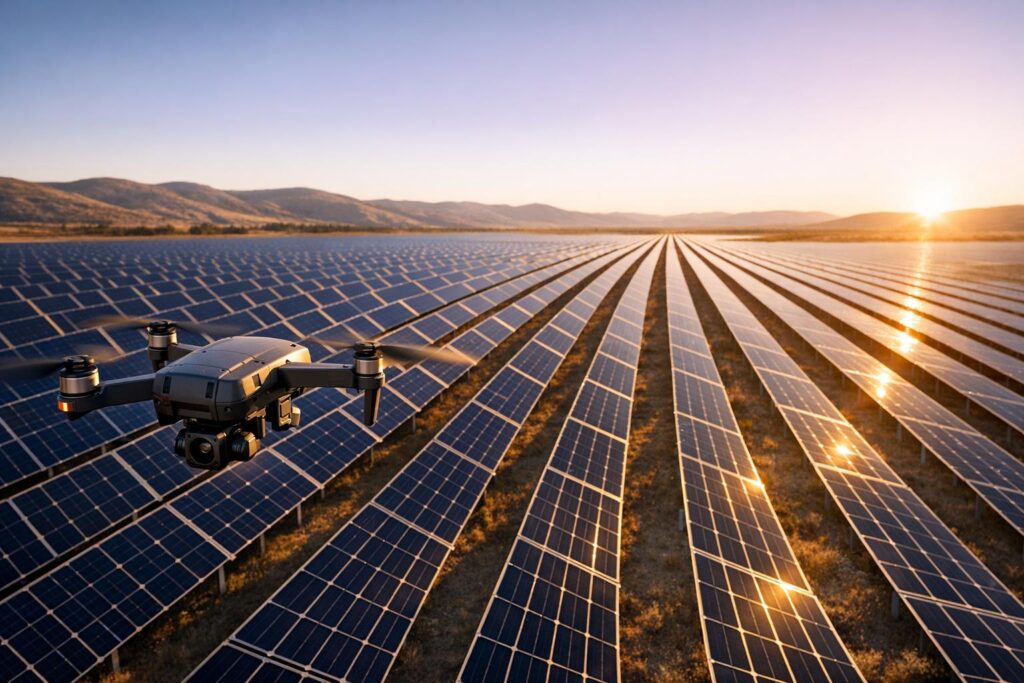
Automated testing is transforming solar projects by reducing costs tied to labor, inspections, permitting, and delays. These expenses, known as soft costs, make up about 65% of a solar system’s total price. Tools like drones, AI, and machine vision streamline inspections, cut labor hours, and identify faults faster, saving money and improving efficiency. For example:
- Labor Savings: Drones reduce inspection time by up to 97%, cutting costs by thousands per site.
- Faster Fault Detection: AI analyzes data in real-time, preventing energy losses and minimizing downtime.
- Lower Permitting Costs: Automation speeds up permitting by 31%, reducing delays and cancellations.
- Improved Maintenance: Real-time data prioritizes repairs, helping teams focus on critical issues.
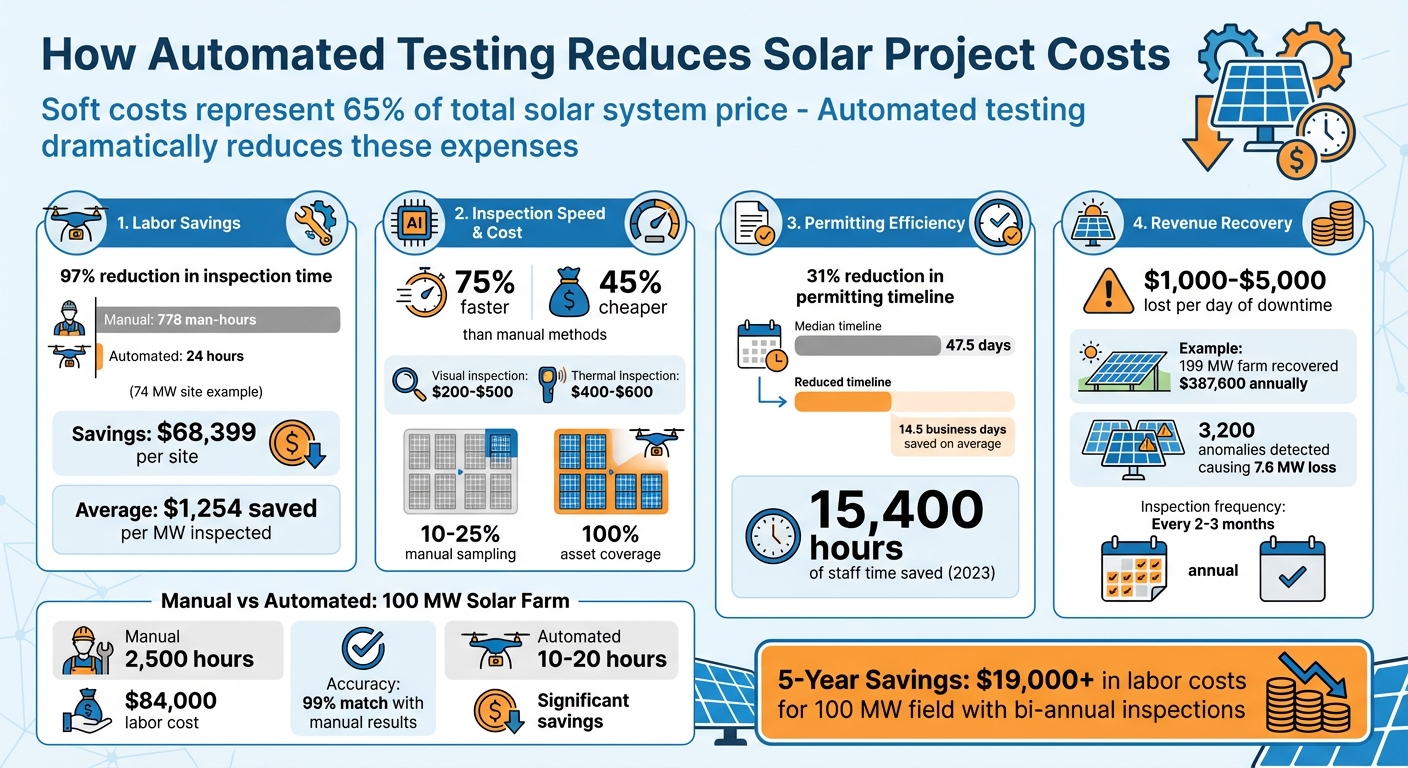
Cost Savings from Automated Solar Testing: Key Statistics and Benefits
Problems with Manual Testing in Solar Projects
Manual testing in solar projects relies on technicians physically inspecting each PV module using handheld devices. While this method has been the norm, it introduces several inefficiencies that inflate costs and hinder performance. The primary issues include high labor costs, delayed fault detection, and increased soft costs from site visits.
High Labor Costs and Infrequent Inspections
Manual inspections are expensive and time-consuming, which limits their frequency to about once a year. In contrast, automated systems can perform inspections every two to three months. A striking example comes from a 74 MW solar site in Sunrall, MS, where manual inspections required 778 man-hours, compared to just 24 hours using automated drones – a staggering 97% time savings.
The high costs stem from the need for a large workforce, vehicles, and equipment – particularly for remote solar farms. Tyrell Mara, VP of Operations & Growth at Scoop Solar, explains the broader aim of automation:
Automation is not about replacing human labor, but about augmenting it. By automating repetitive and mundane tasks, we can free up our team to focus on more strategic and value-adding activities.
Late Fault Detection and Energy Losses
Another drawback of manual testing is the delay in identifying faults. Annual inspections mean that issues like hot spots or string failures can go unnoticed for months, leading to prolonged energy losses and potentially shortening the lifespan of solar assets. The problem is compounded by scattered data stored in emails and spreadsheets, which obstructs real-time fault reporting.
Higher Soft Costs from Site Visits
Manual testing also drives up soft costs due to frequent site visits. Each visit adds expenses, and inefficiencies in permitting processes (often managed through an AHJ registry) can further inflate costs. For instance, permitting fees for an average residential solar system can add around $7,000 to the total cost. Additionally, manual workflows extend the permit-to-inspection timeline to a median of 47.5 business days.
Every one week delay in our installation process correlates to a 5 to 10% increase in cancellation rates from homeowners.
Incomplete or inaccurate permit applications often trigger additional reviews and site visits, creating a loop of inefficiency. In 2023 alone, traditional manual permitting and inspection processes consumed an extra 15,400 hours of staff time compared to automated systems.
Shifting to automated testing is crucial for cutting these inefficiencies, reducing costs, and enhancing the overall performance of solar projects.
sbb-itb-2560759
How Automated Testing Solves These Problems
Automated testing tackles inefficiencies in traditional inspection methods, turning slow, labor-intensive processes into fast, precise operations. By combining drones, AI algorithms, and machine vision systems, these tools work together to gather comprehensive data, pinpoint defects instantly, and direct technicians to exact problem areas. This eliminates much of the guesswork and delays that come with manual inspections, helping companies cut soft costs while improving overall project efficiency.
Tools: Drones, AI, and Machine Vision
Drones equipped with infrared sensors fly along GPS-guided paths, scanning solar farms and capturing thermal images. These images reveal panels operating outside normal temperature ranges. Unlike manual inspections, which typically sample only 10% to 25% of solar assets, drones can inspect 100% of the assets. And what takes days for a manual team can be done in mere hours by drones.
AI tools, such as Convolutional Neural Networks (CNN) and YOLOv4, analyze these thermal images in real-time. They can detect microcracks, finger interruptions, material defects, and hotspots – issues that are often missed by human inspectors. Advanced systems even process images mid-flight, geolocating anomalies immediately so repair teams can act fast. Ground robots complement the aerial inspections by focusing on smaller details like mounting brackets, cables, and rust, which are harder to evaluate from the air.
For example, at a 74 MW solar site in Sunrall, MS, automated inspections saved $68,399 while maintaining 99% accuracy. As EagleNXT reported:
The results from the manual inspection mirrored the results from the drone data with 99 percent accuracy, but the manual inspection took two days for each site compared to two hours with the drone.
This kind of efficiency and precision sets the stage for collecting reliable, actionable data.
Reliable and Accurate Data Collection
Automated inspections ensure consistent, error-free results by following precise GPS-guided routes under standardized conditions. For example, inspections are conducted when irradiance exceeds 600 W/m², wind speeds are under 15 mph, and cloud cover is minimal – conditions that meet IEC 62446-3 standards.
This precision delivers financial benefits, too. Drone inspections are 75% faster and 45% cheaper than manual methods. Thermographic inspection costs for utility-scale farms can drop by 30% to 40%. On average, visual drone inspections cost $200 to $500, while thermal inspections range from $400 to $600 – far lower than the labor costs of manual inspections.
With such accurate, real-time data, companies can make better use of their workforce.
Less Manual Work and Better Resource Use
Automation shifts technicians away from routine inspections, allowing them to focus on higher-priority maintenance tasks. This reduces labor costs and boosts efficiency, often supported by specialized accounting and finance software. As DroneDeploy explains:
By automating repetitive and laborious inspection tasks, your employees are freed up for higher value strategic work, saving money and improving maintenance efficiency.
Automated systems also create "punch lists", which prioritize repairs based on the severity of power loss. This streamlines operations and maintenance (O&M) workflows, ensuring technicians address the most critical issues first. For example, a 100 MW solar field using bi-annual drone inspections can save over $19,000 in labor costs over five years, with average savings of $1,254 per MW in inspection costs.
Cost Savings from Automated Testing
Automated testing offers a clear path to reducing costs by cutting labor requirements, minimizing site visits, and avoiding delays. As solar installations scale, these savings become even more pronounced. Let’s break down how these systems directly lower expenses.
Lower Labor and Site Visit Costs
One of the most noticeable savings comes from reducing the hours spent on inspections. Take a 100 MW solar farm, for instance. A manual inspection typically requires around 2,500 hours of work, while automated drone inspections can complete the same task in just 10–20 hours. With technicians earning about $32–$35 per hour, manual inspections can cost around $84,000 in labor alone. Automation not only slashes these costs but also eliminates unnecessary truck rolls by directing crews straight to malfunctioning modules using precise geo-referenced data.
Additionally, automation allows Operations and Maintenance (O&M) teams to bring inspections in-house. Instead of hiring specialized contractors, smaller teams with less experience can handle the job effectively. Over five years, a 100 MW solar field using bi-annual drone inspections could save more than $19,000 in labor costs – an average of $1,254 saved per MW inspected. These savings, combined with the accuracy of automated testing, significantly enhance the profitability of solar projects.
Faster Inspections and Project Completion
Beyond cutting labor expenses, automation speeds up inspections, which can directly boost revenue by reducing downtime. When components are offline, solar farms can lose between $1,000 and $5,000 per day. Automated inspections, being 75% faster and 45% cheaper than manual methods, help mitigate these losses.
This speed doesn’t just benefit ongoing operations – it also accelerates project development. In 2023, the SolarAPP+ platform helped 668 installers submit 18,906 permits across 150 local governments, trimming permitting and inspection timelines by 14.5 business days on average. This 31% reduction in time saved approximately 15,400 hours of department staff work. Faster project timelines mean solar farms can begin generating revenue sooner, improving overall financial performance and cash management.
For example, a 199 MW, 1,000-acre solar farm in California used drones to complete an inspection in just 8 days. The process uncovered 3,200 anomalies causing a 7.6 MW loss, enabling the recovery of an estimated $387,600 in annual revenue.
Better Resource Planning with Fault Prioritization
Automated systems also enhance resource allocation by ranking faults based on severity, ensuring that O&M managers focus on the most critical issues first. Dani Kiryati from vHive explains:
Immediate insights into fault severity help operators allocate resources more effectively, addressing high-priority concerns first.
Field repair apps further streamline this process by providing technicians with precise GPS coordinates, enabling quicker on-site repairs. This targeted approach reduces unnecessary spending on minor issues and ensures maintenance budgets are spent where they’re needed most. Plus, automation lowers the cost of inspections, making it practical to perform thermal checks every 2–3 months instead of just once a year. This frequent monitoring helps catch faults early, preventing significant power losses down the line.
Increasing Savings with SolarSuccess ERP Integration

Automated testing delivers its best financial benefits when seamlessly integrated into a robust business management system. SolarSuccess ERP takes testing data and transforms it into actionable insights across operations, accounting, and project management. This integration enhances the efficiency of automated testing by ensuring every department can make data-driven decisions instantly.
Real-Time Data for Better Decisions
By connecting automated testing data with SolarSuccess, solar companies gain immediate insight into how faults and anomalies affect project profitability. Managers receive up-to-the-minute updates on project status, costs, and revenue impacts, enabling quick and informed decisions. Aaron Casillas, Technology & Infrastructure Director at Titan Solar Power, shares how this integration reshaped their operations:
"With NetSuite and Blu Banyan, we finally had a unified view of data across the company including real-time insights into project status, costs, inventory, pricing, purchasing, and profitability."
This level of visibility allows companies to prioritize repairs based on their financial implications rather than guesswork. The system processes testing data to pinpoint critical issues, empowering teams to act quickly. Additionally, analytics help identify recurring problems, paving the way for proactive solutions.
Centralized Data for Smoother Operations
In the past, solar companies often relied on disconnected platforms, requiring time-consuming manual data reconciliation. Aaron Casillas highlights this challenge:
"Sharing data across these systems was difficult, and in most cases our only way to ‘patch the holes’ was by adding labor."
SolarSuccess addresses this by consolidating operational data into a single platform. When automated testing detects a fault, the information is instantly integrated into the project record, updating inventory needs, adjusting timelines, and triggering milestone-based invoicing – all without manual input. This streamlined approach typically saves solar companies about $0.04 per Watt, translating to significant labor savings on large-scale projects. Additionally, by linking testing data to financial metrics, the ERP adjusts revenue forecasts and notifies stakeholders of delays. Spencer Newman, CFO of Norwich Solar, underscores the importance of this comprehensive view:
"We can look at all of our subsidiaries as standalones or consolidate them into our main financials. That’s been incredibly useful from a financial planning standpoint."
Using SuiteApps to Boost Productivity
Beyond its core ERP capabilities, productivity tools like bluDocs and bluTime amplify the value of automated testing data across the organization. For instance, field technicians can access inspection reports and related documents directly on mobile devices, cutting down on downtime. bluTime, on the other hand, tracks repair durations, helping to establish benchmarks that improve resource planning and optimize technician assignments based on past performance. Joe Marhamati, Co-Founder & VP at Ipsun Solar, explains the operational benefits:
"We achieve higher productivity with the same workforce and we have a system that’s more reliable and less stressful than tracking a million different spreadsheets."
These tools also support milestone-based invoicing, speeding up cash flow. When automated testing confirms that a project section is fully operational, SolarSuccess can automatically generate and send invoices, reducing the payment cycle without requiring manual effort.
Case Examples: Automated Testing Results
More Frequent Inspections and Earlier Problem Detection
From 2020 to 2024, EnBW (Energie Baden-Württemberg AG) expanded its solar capacity from 150 MW to 1 GW – a massive 567% growth. Leading this shift, Technical Specialist Timo Freund adopted automated inspections using DJI Dock 2 hardware, FlytBase automation, and Sitemark AI analytics. This upgrade allowed the company to move from annual inspections to quarterly monitoring without increasing costs. By eliminating 6-hour round trips, inspections could be triggered remotely from Stuttgart, bypassing weather and grid-related challenges. Freund highlighted the advantage:
The benefit is we now get all the failures on field tracked by the software. The AI… is checking all the images and you will get every single failure down to a very low delta temperature tracked. This is something which the consultant companies never did.
Their system, which captures thermal data at a 3-cm resolution, complies with Fraunhofer Institute standards for warranty-grade inspections.
In another example from September 2018, EagleNXT and Measure UAS compared automated and manual inspections across four solar sites. A prior study at a 74 MW facility revealed that automated inspections cut testing time by 97%, saving about $68,399 in labor costs. Across all four sites (ranging from 12.5 MW to 74 MW), automated inspections delivered an average $1,254 savings per MW. The drone inspections were 99% as accurate as manual methods while covering 100% of the installation – far surpassing the 10-25% sample size typical of walk-throughs.
These results show that adopting automated testing is both efficient and cost-effective.
How to Implement Automated Testing in Solar Projects
Efficiency improvements like these can significantly reduce project soft costs. A good starting point is to shift from consultant-led ground surveys to in-house drone operations. A 5-day pilot certification program focusing on compliance, thermography, and flight training can prepare teams for this transition. For sites between 20-70 MW, investing in an autonomous drone dock typically pays for itself within a year by replacing external pilot costs.
The next step is to integrate AI analytics platforms. These platforms consolidate workflows by using GPS-tagged imagery and automated anomaly detection. By connecting them to an ERP system like SolarSuccess through APIs, maintenance teams can receive precise GPS coordinates for repairs automatically. When automated testing confirms a section is fully operational, the ERP system can trigger milestone-based invoicing, speeding up cash flow. For larger operations, multi-drone autonomous flight software can divide inspection areas, allowing smaller teams to complete work more quickly.
Conclusion: Reducing Costs with Automated Testing
Automated testing can significantly lower soft costs – representing as much as 64% of the total cost of a new solar system. By leveraging drones, AI, and machine vision, these systems reduce the need for labor-intensive site visits and help identify issues early, minimizing energy losses.
The benefits don’t stop there. Integrating automated testing data with an ERP system like SolarSuccess takes these savings even further. When automated platforms feed anomaly reports directly into solar project management workflows, maintenance teams gain access to actionable insights without the hassle of manual data entry. This streamlined process ensures faster, more efficient repairs.
Industry leaders recognize the importance of this shift. Jan Rippingale, CEO of Blu Banyan, highlights the necessity of unified data systems:
Many [companies] won’t even be able to sustain their current profitability levels and competitive position without switching to a system that allows them to use the same data across all of their departments.
Her point emphasizes how real-time data visibility can break down silos that hinder effective decision-making.
With U.S. solar capacity growing more than 20 times since 2008, the need for scalable operations has never been greater. Transitioning from consultant-driven surveys to in-house automated testing, enhanced by AI analytics and ERP integration, provides a sustainable path for handling this rising demand without ballooning overhead costs.
FAQs
What’s the ROI timeline for drone-based solar inspections?
The return on investment (ROI) for drone-based solar inspections usually falls within 12 to 24 months. Research indicates that these inspections are approximately 75% faster and 45% less expensive compared to traditional manual methods. On average, they save more than $2,100 per megawatt inspected, making them a highly efficient way to cut costs in solar projects.
How often should automated inspections run for best cost savings?
Automated inspections play a key role in maintaining systems efficiently, and conducting them regularly ensures that defects are identified and addressed quickly. Take drone-based inspections, for instance – they can often be completed in just 10 minutes per megawatt (MW). This speed allows for more frequent monitoring, which not only helps catch issues early but also contributes to significant cost savings. By keeping operations running smoothly and minimizing downtime, regular inspections help drive down overall project expenses.
What does it take to connect inspection data to SolarSuccess ERP?
Connecting inspection data to SolarSuccess ERP means centralizing all inspection-related information within the system for better organization and efficiency. This process involves automating data capture and enabling real-time updates, ensuring that critical information is always up-to-date. Whether through seamless integrations or direct data entry, Blu Banyan’s solutions are designed to simplify workflows and consolidate project details into a single, unified platform.
