

NetSuite ERP, combined with SolarSuccess by Blu Banyan, is transforming how solar companies manage their supply chains. Many solar businesses still use outdated tools like spreadsheets and disconnected software, which create inefficiencies as the industry grows. NetSuite offers a centralized, cloud-based platform that integrates accounting, inventory, project tracking, and customer management. SolarSuccess enhances this platform with features specifically designed for solar operations, such as milestone-based invoicing, AHJ registries, and supplier coordination tools.
Key Takeaways:
- Unified System: Combines accounting, inventory, and project management into one platform, reducing manual processes.
- Real-Time Insights: Tracks inventory, project milestones, and supplier performance in real time.
- Solar-Focused Features: Includes tools for managing permitting, financing, and over 420+ project data fields.
- Automation: Reduces labor costs by automating tasks like invoicing and procurement.
- Scalability: Supports growth without requiring proportional increases in staff.
For solar companies struggling with fragmented systems, NetSuite with SolarSuccess offers a streamlined solution to improve efficiency, reduce costs, and handle increasing demand.
1. NetSuite ERP
Real-Time Visibility
NetSuite’s cloud-based platform brings together accounting, project management, and inventory into a single database, cutting out the inefficiencies caused by disconnected tools. When key milestones – like passing an inspection or completing an installation – are hit, the system automatically updates accounting records and adjusts inventory levels, removing the need for manual input.
The platform also integrates with IoT devices, RFID tags, and barcoding systems to track solar components from the warehouse all the way to installation. Considering that 87% of supply chain professionals are already using or planning to use IoT tracking, this feature aligns with industry standards. Dashboards provide a clear view of critical solar performance metrics, helping managers quickly identify and address issues like permitting delays or weather-related disruptions before they escalate.
These real-time insights lay the foundation for smarter ERP and inventory management and collaborative supplier relationships.
Inventory and Demand Planning
NetSuite’s Demand Planning Module uses historical sales data and future CRM entries to automate forecasting. By leveraging machine learning, it predicts trends influenced by seasonal changes and market shifts – far surpassing the capabilities of static spreadsheets still used by many solar companies. The platform’s Supply Planning Engine, powered by Material Requirements Planning (MRP), calculates when essential components like inverters or panels might run low. It also optimizes purchase order timing by accounting for manufacturing and shipping lead times.
The Supply Allocation tool enables solar installers to prioritize inventory for higher-margin projects or specific sales channels, using both on-hand stock and incoming orders. With up-to-the-minute inventory visibility across multiple warehouses, companies can avoid costly delays caused by missing equipment at job sites.
While demand planning helps manage internal resources, NetSuite also enhances supplier coordination to ensure smooth operations.
Supplier Coordination
NetSuite simplifies procurement by centralizing processes from supplier evaluation to order tracking. Automated workflows replace manual approval processes, ensuring that purchases are directed to preapproved suppliers with pre-negotiated terms. Through dedicated supplier portals, vendors can monitor order statuses and communicate directly with your team, reducing the need for endless back-and-forth emails.
The platform’s dashboards evaluate supplier performance based on metrics like lead times, delivery accuracy, and costs. This data-driven approach helps solar companies identify reliable suppliers and weed out those causing inefficiencies. Additionally, NetSuite supports traceability from raw materials to installation, a critical feature as sustainability regulations grow stricter and customers increasingly demand proof of ethically sourced components.
sbb-itb-2560759
2. Traditional Supply Chain Methods
Real-Time Visibility
Traditional supply chain methods often rely on fragmented systems, which can lead to costly delays and inefficiencies. Many solar companies use separate tools for project management, file storage, and accounting, but these systems rarely communicate effectively. The lack of integration forces businesses to resort to manual processes, which not only consume time and resources but also increase the likelihood of errors.
"Sharing data across these systems was difficult, and in most cases our only way to ‘patch the holes’ was by adding labor." – Aaron Casillas, Technology and Infrastructure Director, Titan Solar Power
This lack of real-time visibility is a significant hurdle. In fact, more than 40% of companies report having little to no visibility into their Tier 1 suppliers. These challenges ripple through the supply chain, creating inefficiencies in areas like inventory management and supplier coordination.
Inventory and Demand Planning
Traditional forecasting methods often rely on outdated tools like spreadsheets and manual data entry, which use historical data that can quickly become irrelevant. This is particularly troublesome in the solar industry, where fluctuating module prices can lead to orders being placed only to discover that items are either out of stock or priced differently.
"When you’re working with incompatible, incomplete, out-of-date data, it can turn into a nightmare pretty quickly." – Jan Rippingale, CEO, Blu Banyan
This outdated approach creates a disconnect between long-term forecasting, medium-term planning, and short-term execution. The result? Companies often face stockouts at job sites or end up with surplus inventory they can’t use. To make matters worse, legacy on-premise systems demand significant investments in infrastructure, including servers, databases, and IT staff, just to maintain basic functionality. These inefficiencies directly impact supplier coordination and increase operational risks.
Supplier Coordination
Coordination with suppliers under traditional methods often relies on emails, phone calls, and manual purchase orders. Without integrated systems, it becomes challenging for solar companies to allocate specific costs – like rush orders or consulting fees – to individual projects. This lack of granularity makes it difficult to accurately track profitability.
Even as the solar industry grew by 43% in 2020, traditional systems have struggled to keep up without requiring a proportional increase in labor. Additionally, most tracking efforts stop at Tier 1 suppliers, leaving companies blind to deeper supply chain bottlenecks. As regulations around environmental compliance become stricter, this lack of traceability poses serious risks. Noncompliance penalties can reach up to 4% of a company’s annual revenue.
3. NetSuite with SolarSuccess (by Blu Banyan)
Real-Time Visibility
SolarSuccess combines accounting, project management, CRM, and inventory into a single NetSuite platform. When Titan Solar Power adopted NetSuite and SolarSuccess in February 2020, the results were immediate. According to Aaron Casillas, Technology and Infrastructure Director, the company managed over 420 data fields per project and scaled its installed capacity to 153.5 MW. This shift significantly reduced the labor involved in handling complex transactions, such as commission payouts. Now, real-time dashboards provide insights into KPIs like project status, per-project costs, profitability, and sales pipeline – eliminating the need for manual data entry.
"With NetSuite and Blu Banyan, we finally had a unified view of data across the company including real-time insights into project status, costs, inventory, pricing, purchasing, and profitability." – Aaron Casillas, Technology & Infrastructure Director, Titan Solar Power
The platform also integrates with distributors like BayWa r.e., allowing installers to access real-time solar supply chain inventory, pricing, and ordering directly within the ERP. Solar-specific accounting events and invoicing are triggered automatically by project milestones, aligning seamlessly with industry workflows.
This real-time data improves inventory accuracy and demand planning, paving the way for fully integrated operations.
Inventory and Demand Planning
SolarSuccess links Bills of Materials (BOM) with sales orders, ensuring that procurement and sales teams are always aligned. This eliminates the common disconnect between forecasting and execution seen in spreadsheet-based systems.
By integrating with major distributors, the platform provides instant visibility into inventory availability and pricing across the organization. For warehouse operations, it connects with RF-SMART to enable real-time inventory movement, management, and fulfillment, resulting in measurable savings on transaction costs.
Joe Marhamati, Co-Founder and VP of Ipsun Solar, highlighted the impact of automation on their processes:
"We’ve been able to automate most of our residential invoices. When a deal moves to a particular stage of construction, for example, SolarSuccess generates invoices based on that specific milestone."
With this system, Ipsun Solar has been able to handle increased project volume without adding staff, making their workflow far more reliable compared to managing multiple spreadsheets.
This level of precision in forecasting directly supports better coordination with suppliers, ensuring that every project component is available when needed.
Supplier Coordination
SolarSuccess’s unified database ensures that all departments – from procurement to project management – work from the same data at the same time. BOMs automatically sync with sales orders, so when a project manager updates material requirements, the procurement team knows immediately what to order. Installers can even place orders directly within the ERP, thanks to integrations with distributors.
This coordination is especially critical when managing the 36,177 different Authorities Having Jurisdiction (AHJs) across the United States, each with its own unique inspection and approval codes. SolarSuccess simplifies this complexity with an integrated AHJ registry, helping installers quickly identify the governing authority for each installation site.
Solar-Specific Features
SolarSuccess goes beyond standard ERP capabilities to address challenges unique to the solar industry. For instance, milestone-based invoicing automatically generates invoices as projects reach specific construction stages, speeding up cash flow.
A weather portlet provides real-time updates, helping project managers anticipate delays and avoid unnecessary site visits. Jan Rippingale, CEO of Blu Banyan, described the rapid development of this feature:
"We put thousands of hours into developing SolarSuccess. In four hours we built a [weather] portlet that wows and benefits our customers."
For utility-scale projects exceeding 5 MW – equivalent to over 125,000 solar modules – the platform supports Special Purpose Entities (SPEs) for project financing and includes asset management tools for operational needs. It also integrates various financing mechanisms like loans and leases directly into the ERP.
The platform addresses solar-specific accounting challenges, including work-in-progress (WIP) accounting, deferred revenue, and commission payout management, all tailored to solar sales structures. This is crucial considering that soft costs account for up to 65% of the total cost of a new solar system.
These tailored features allow SolarSuccess to overcome the limitations of traditional methods, creating a system designed specifically for the solar industry. Currently, the platform powers nearly one-third of all rooftop solar installations in the United States and is used by leading residential and commercial installers. Blu Banyan’s achievements with SolarSuccess have earned them the title of NetSuite’s Micro-Vertical Solution Provider Partner of the Year for three consecutive years.
Advantages and Disadvantages
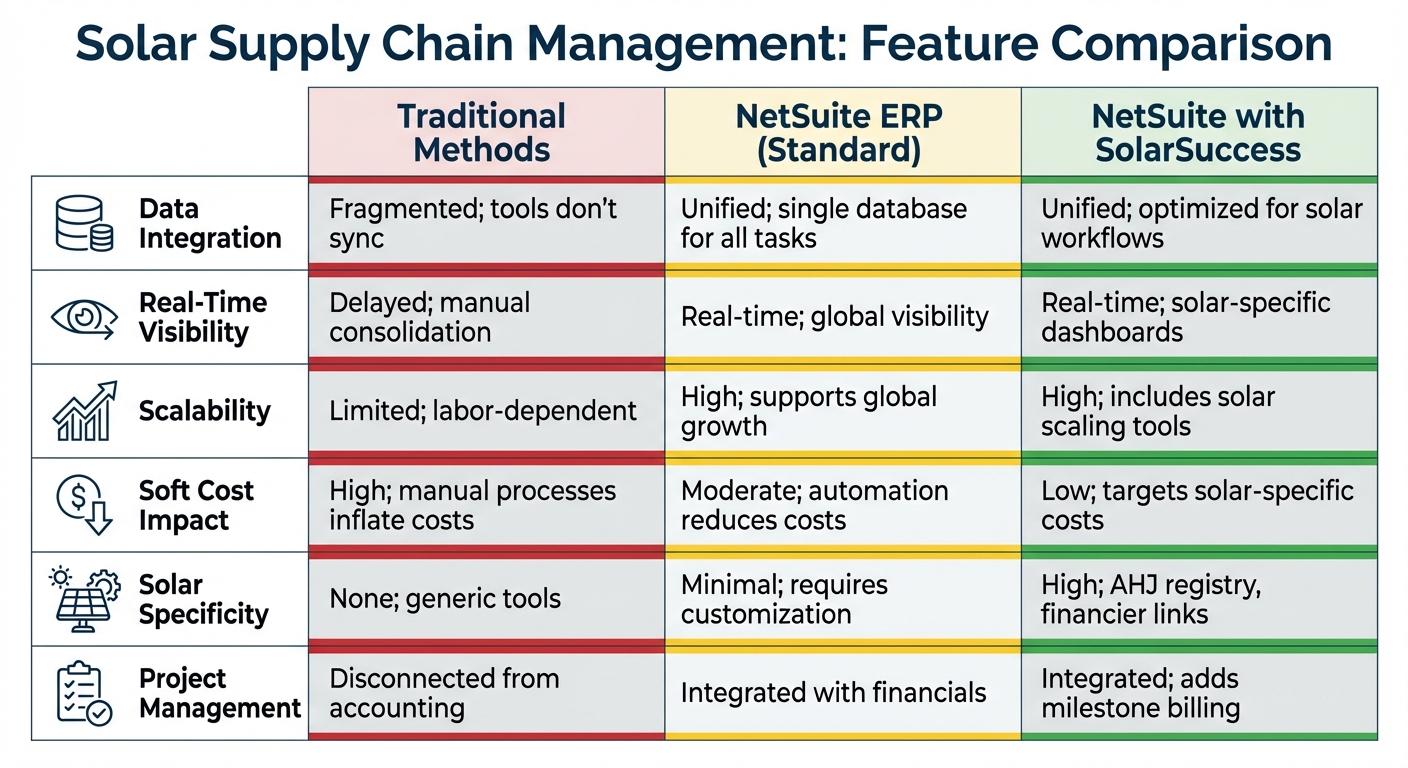
NetSuite vs Traditional Solar Supply Chain Methods Comparison
This section dives into the strengths and weaknesses of various supply chain management approaches, building on earlier comparisons.
Traditional methods rely on disconnected tools that often lead to information silos, where teams work with fragmented data sets. These setups are not only labor-intensive but also struggle to scale effectively.
Standard NetSuite ERP addresses these challenges by unifying operations on a single cloud-based platform. It consolidates accounting, inventory, and project management into a single database, automating key processes and offering real-time visibility across operations. This eliminates the need for manual data transfers and reduces inefficiencies. However, it falls short when it comes to industry-specific requirements, like permitting tools or milestone-based accounting, which are crucial for the solar sector.
NetSuite with SolarSuccess builds on the standard platform by incorporating tools tailored to the solar industry. It tackles operational hurdles with features like an AHJ registry (to navigate the 36,177 inspection jurisdictions in the U.S.), financier connectivity, and automated milestone-based invoicing. As Jan Rippingale, CEO of Blu Banyan, explains:
"Decades of work went into building the NetSuite unified foundation and getting it right; we obviously couldn’t reinvent that".
These enhancements make SolarSuccess a more effective solution for streamlining solar supply chain processes. The following table outlines how each approach measures up against key operational criteria:
| Feature/Criteria | Traditional Methods | NetSuite ERP (Standard) | NetSuite with SolarSuccess |
|---|---|---|---|
| Data Integration | Fragmented; tools don’t sync | Unified; single database for all tasks | Unified; optimized for solar workflows |
| Real-Time Visibility | Delayed; manual consolidation | Real-time; global visibility | Real-time; solar-specific dashboards |
| Scalability | Limited; labor-dependent | High; supports global growth | High; includes solar scaling tools |
| Soft Cost Impact | High; manual processes inflate costs | Moderate; automation reduces costs | Low; targets solar-specific costs |
| Solar Specificity | None; generic tools | Minimal; requires customization | High; AHJ registry, financier links |
| Project Management | Disconnected from accounting | Integrated with financials | Integrated; adds milestone billing |
Traditional methods simply cannot scale without increasing administrative overhead. While the standard NetSuite ERP provides a solid foundation, it often requires extensive customization to meet the unique needs of solar businesses. SolarSuccess bridges this gap by offering specialized tools that directly address permitting, financing, and other solar-specific workflows. For companies seeking to maintain margins amid hardware commoditization, SolarSuccess offers a clear advantage in both scalability and cost efficiency.
Conclusion
NetSuite ERP reshapes solar supply chain management by replacing disconnected systems with a unified cloud platform that provides real-time visibility across accounting, inventory, and project management. For U.S. solar companies juggling tools like QuickBooks, Salesforce, and scattered spreadsheets, this integration removes the need for manual data transfers and reduces administrative burdens tied to high soft costs.
While NetSuite offers a strong foundation, SolarSuccess by Blu Banyan takes it further by addressing the unique needs of the solar industry. Features like an AHJ registry covering all 36,177 inspection jurisdictions in the U.S., milestone-based invoicing, and direct links to solar financiers bring capabilities that go beyond what standard ERPs can provide. As Jan Rippingale, CEO of Blu Banyan, puts it:
"The only way to make that happen [reducing soft costs] is with an integrated or unified application suite on a single database".
These tailored enhancements not only simplify operations but also strengthen a company’s ability to surge ahead of competitors. Whether it’s residential installers handling a large volume of projects or utility-scale developers managing multi-year initiatives, NetSuite with SolarSuccess offers a scalable solution that avoids the need for proportional increases in labor costs. With nearly one-third of all U.S. rooftop solar installations already relying on the platform, its scalability is well-established.
As margins tighten and market demands grow, solar businesses should act quickly to adopt an integrated ERP system before scaling challenges become unmanageable. The combination of NetSuite’s unified platform and SolarSuccess’s industry-specific features ensures the operational efficiency needed to stay competitive.
FAQs
What does SolarSuccess add to standard NetSuite for solar companies?
SolarSuccess integrates seamlessly with NetSuite, adding features tailored specifically for the solar industry. These include tools for streamlined project management, efficient resource allocation, automated milestone-based invoicing, and better financial and inventory control. By embedding these capabilities directly into NetSuite, SolarSuccess helps solar companies operate more efficiently and scale their operations effectively.
How does milestone-based invoicing improve solar project cash flow?
Milestone-based invoicing helps streamline cash flow for solar projects by tying payments directly to verified stages of project completion. This method speeds up receivables, minimizes payment delays, and improves cash flow management, offering quicker and more reliable payment timelines.
How does the AHJ registry help with U.S. permitting and inspections?
The AHJ registry streamlines the permitting and inspection process in the U.S. by offering an online database tailored for solar developers. With this tool, developers can easily locate and compare local permitting requirements, ensuring applications are sent to the right authority. This minimizes mistakes and helps accelerate the overall process.
