
Managing resources across multiple solar project sites can be challenging, but with the right tools and strategies, you can avoid delays, reduce costs, and keep operations running smoothly. Here’s a quick summary of the five key tips to improve resource allocation for solar projects:
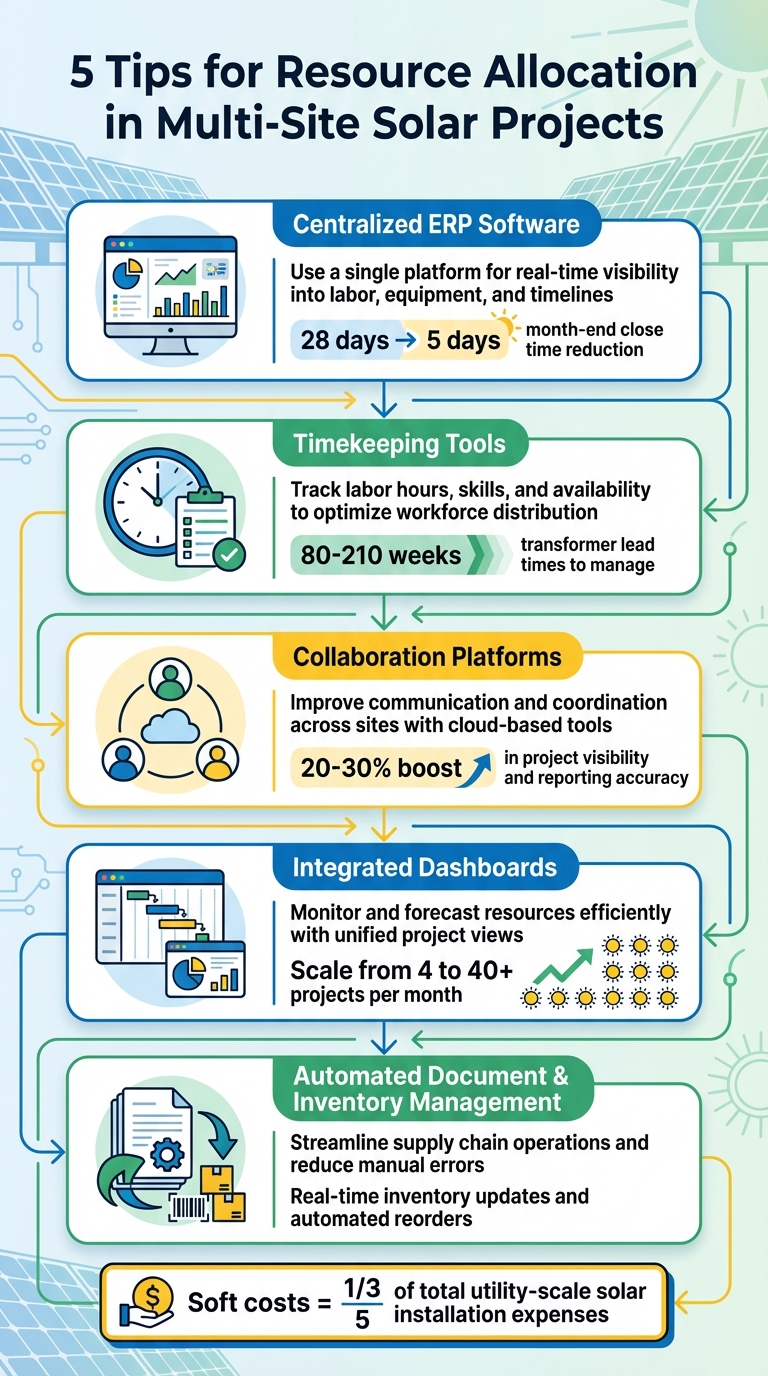
- Centralized ERP Software: Use a single platform for real-time visibility into labor, equipment, and timelines.
- Timekeeping Tools: Track labor hours, skills, and availability to optimize workforce distribution.
- Collaboration Platforms: Improve communication and coordination across sites with cloud-based tools.
- Integrated Dashboards: Monitor and forecast resources efficiently with unified project views.
- Automated Document and Inventory Management: Streamline supply chain operations and reduce manual errors.
These approaches help solar companies manage resources effectively, scale operations, and maintain profitability in a growing industry.
5 Resource Allocation Strategies for Multi-Site Solar Projects
1. Use Centralized ERP Software for Real-Time Visibility
Real-Time Visibility of Resources
Managing multiple installations across different locations – whether in Arizona, Texas, or California – can get chaotic if you’re juggling multiple spreadsheets or browser tabs. Centralized ERP software simplifies this process by offering a single dashboard that shows everything in one place: labor availability, equipment locations, task progress, and potential bottlenecks.
With centralized data, consistency is maintained across departments like sales, accounting, and project management. This means the inverter count in your system will match what’s actually in the warehouse. As Jan Rippingale, CEO of Blu Banyan, explains:
"To improve efficiency and profitability, solar installers must have real-time visibility into their entire end-to-end businesses".
This unified view is the foundation for better labor and task management.
Efficiency in Labor and Task Allocation
Centralized systems do more than just show where your resources are – they enable predictive resource allocation, helping you avoid bottlenecks before they happen. Tools like the All Projects Gantt Chart let you view multiple project timelines side by side, making it easy to identify scheduling conflicts or underutilized crews. From this high-level perspective, you can assess labor capacity across all active projects and drill down into specific tasks. This ensures smooth operations across multiple sites.
For instance, in 2021, POWERHOME Solar (now Pink Energy) transitioned from QuickBooks to NetSuite ERP. By automating their order-to-cash process and integrating it with their CRM, they cut their month-end financial close time from 28 days to just 5 days. This improvement allowed them to scale to $600 million in revenue while maintaining an accounting team of just six people. That’s the impact of centralized, real-time resource management.
Streamlined Resource Planning and Forecasting
Real-time insights combined with efficient scheduling pave the way for automation to further refine your workflow. Centralized ERPs use features like "Preceding Action" automation to sequence tasks. For example, when trenching wraps up at Site A, the system triggers the next task and notifies the appropriate team. This reduces manual tracking errors, ensures labor moves seamlessly to the next site, and adjusts resource forecasts based on current project needs.
Blu Banyan’s SolarSuccess ERP (https://blubanyan.com), built on NetSuite, is a prime example of a tool designed for multi-site coordination. It integrates systems like QuickBooks and Salesforce, which often operate independently, to provide real-time analytics and a consolidated view of budgets, timelines, and resource allocation. As Rippingale emphasizes:
"The only way to… effectively reduce soft costs… is with an integrated application suite that provides reliable data and a common interface across all functions".
sbb-itb-2560759
2. Use Timekeeping Tools to Optimize Labor Distribution
Timekeeping tools offer a deeper level of insight into labor management, complementing the broader visibility provided by implementing solar ERP software. These tools focus on the finer details of labor allocation, ensuring that resources are used efficiently and effectively.
Timekeeping-Driven Visibility
Managing solar installations across multiple states requires precise knowledge of your workforce – who’s available, where they are, and what skills they bring to the table. Timekeeping tools integrated with HRM systems provide up-to-date data on employee absences, certifications, and specialized skills. For multi-site projects, this location-based visibility is invaluable. It enables you to quickly identify which crew members are nearest to a job site, cutting down on travel time and fuel expenses. For example, you can avoid assigning a technician scheduled for training in one state to a job in another, ensuring smoother operations. By offering this level of detail, timekeeping tools help match the right technician to the right task with precision.
Efficiency in Labor and Task Allocation
Advanced timekeeping systems take labor management a step further by aligning technicians with jobs based on their skills, location, and project priorities. These tools can monitor employee utilization by comparing actual hours worked, scheduled hours, and availability. This helps prevent overloading your team and reduces the risk of burnout. Mobile platforms like bluTime allow field technicians to log hours, track parts, and submit expenses in real time. This eliminates delays in updating task statuses and provides immediate insight into labor costs for ongoing projects. As Victoria Sokolova from Epicflow explains:
"Efficient allocation ensures the right people handle the right tasks without overloading."
Streamlined Resource Planning and Forecasting
Accurate timekeeping data doesn’t just improve day-to-day operations – it also strengthens long-term resource planning. Historical data, such as the number of residential installations completed each month or the total modules installed, can guide staffing decisions during busy seasons. This is particularly useful when dealing with long lead times for critical components like power transformers, which can range from 80 to 210 weeks. Using "Hard" allocations for fixed commitments and "Soft" allocations for flexible tasks allows for adaptability as project priorities shift. Tools like "Future Load Graphs" offer a proactive way to spot and resolve labor imbalances. Blu Banyan highlights the value of this approach:
"Using your own historical data to inform your current and future decision-making is an important strategy for making informed decisions and driving continuous improvement."
3. Use Collaboration Platforms to Coordinate Across Sites
Centralized ERP systems and accurate timekeeping lay the groundwork, but collaboration platforms take multi-site coordination to the next level.
Improved Collaboration and Communication
Managing solar installations across multiple states comes with its fair share of communication hurdles. Relying on scattered emails, spreadsheets, and phone calls often leads to silos, mistakes, and delays. Cloud-based collaboration platforms solve this by consolidating updates, schedules, and documents into one central hub. This eliminates the hassle of chasing down updated permits or specifications.
Organizations using digital tools for multi-site coordination report a 20–30% boost in project visibility and reporting accuracy. Jane Doe, Project Manager at Jessop & Co. Construction, captures the challenge well:
"It was a struggle to keep everything organized and on track. Our teams were constantly chasing down documents, waiting for updates from the field, and trying to coordinate with clients and subcontractors spread across the country."
With a unified system, teams can rely on real-time updates from the field without the usual chaos.
Real-Time Visibility of Resources
Collaboration platforms provide mobile-friendly tools that allow on-site teams to share updates instantly. Engineers can upload geo-tagged photos, quality checklists, and daily logs straight from the field – even in areas with limited connectivity. This direct communication helps prevent disputes and simplifies compliance checks during inspections.
AI-powered milestone tracking adds another layer of efficiency. It monitors progress on specific tasks – like civil work or electrical installations – and flags potential risks before they disrupt schedules. For instance, if a transformer delivery faces delays beyond its typical 80–210 week lead time, automated alerts notify stakeholders immediately.
These platforms don’t just focus on live updates; they also integrate data to streamline long-term planning.
Streamlined Resource Planning and Forecasting
Collaboration platforms bring developers, vendors, consultants, and internal teams together on a shared system. Subcontractor portals further enhance this by integrating vendor activities, RFIs, and invoices into the workflow, ensuring accountability and quicker responses. Considering soft costs make up about one-third of total utility-scale solar installation expenses, reducing delays and unnecessary back-and-forth can significantly impact overall costs.
Standardized reporting tools also help. By using structured templates, teams can generate consistent data across multiple locations. This makes it easier to spot trends, compare performance, and make smarter resource decisions. Tools like bluChat even embed team collaboration directly into solar business management software, enabling real-time problem-solving without jumping between platforms. When combined with centralized systems, these tools create a comprehensive framework for managing resources across multiple sites.
4. Standardize Resource Planning with Integrated Dashboards
Integrated dashboards take the benefits of centralized ERP systems and collaborative tools to the next level, making resource planning for multi-site projects smoother and more efficient.
Real-Time Visibility of Resources
Jumping between spreadsheets and separate project files eats up valuable time. With integrated dashboards, all project timelines come together in one place using project management software. This lets managers quickly evaluate capacity across multiple projects, detect scheduling conflicts, and pinpoint bottlenecks – all without toggling between different systems. When critical components have extended lead times, this unified view becomes even more crucial. It simplifies forecasting and ensures tasks are allocated effectively.
Streamlined Resource Planning and Forecasting
Gantt chart dashboards allow managers to compare projects side by side, making it easier to identify overlapping resources. Forecasting improves when it’s backed by data. By comparing current performance with historical benchmarks – like the number of modules installed or system sizes – dashboards reveal seasonal trends and support better planning. Blu Banyan highlights this approach:
"Using your own historical data to inform your current and future decision-making is an important strategy for making informed decisions and driving continuous improvement."
Efficiency in Labor and Task Allocation
Automated triggers ensure the next resource owner is notified as soon as a task is completed, keeping workflows on track. Dashboards also make it easy to monitor monthly metrics like installed modules, open receivables by deal stage, and completed appointments, ensuring resources are deployed as planned. Whether you’re managing four projects a month or scaling up to 40 or more, these tools adapt seamlessly. By standardizing resource planning through these dashboards, you can boost the efficiency and responsiveness of your multi-site solar projects.
5. Automate Document and Inventory Management for Supply Chain Efficiency
Automation for Supply Chain and Document Management
Once resource planning is streamlined, the next step to boosting supply chain efficiency is automating document and inventory management. Relying on manual processes – especially across multi-site solar projects – often leads to confusion. Misplaced files, outdated specs, and time wasted hunting for documents can bring progress to a halt. Automation platforms solve this by centralizing project data and workflows. Everyone involved in the project works with the latest information, following standardized procedures across all sites.
Mobile-integrated tools make routine tasks faster and easier. Field teams can use their phones to take site photos, fill out checklists, and log inventory usage in real time. This eliminates delays caused by back-and-forth communication, speeding up decisions and keeping projects on track.
"This integration helps in reducing duplicate data entry, ensuring that information flows seamlessly between different systems used by subcontractors and project managers." – Scoop
When project management tools are connected to ERP and accounting systems, information flows effortlessly from field operations to the supply chain. For instance, if a technician logs the use of parts at a site, inventory levels update instantly. This can even trigger automatic reorders and adjust project budgets in real time. Automated access controls ensure subcontractors get the documents they need while keeping sensitive data, like financials, secure.
Real-time reporting makes inventory management across multiple locations even more effective. For example, knowing the exact truck stock in real time helps technicians avoid unnecessary return trips by ensuring they have the right parts on their first visit. Automated billing based on actual usage speeds up invoicing, improving cash flow. For solar companies juggling specialized contractors in different regions, this level of automation is crucial to maintaining quality and managing costs.
Conclusion
Centralized ERP software, smarter labor distribution, better collaboration across sites, integrated dashboards, and automated document management can help keep your solar projects on track and within budget. Managing resources across multiple solar sites doesn’t have to feel like juggling chaos. With the right tools and strategies, you can move away from disconnected spreadsheets and endless phone calls.
Integration is the key. As Jan Rippingale, CEO of Blu Banyan, puts it:
"The only way to… effectively reduce the soft costs… is with an integrated application suite that provides reliable data and a common interface across all functions."
This unified approach ensures every part of your operation fits seamlessly into project budgets, giving you the visibility needed to protect your margins across multiple locations.
SolarSuccess is purpose-built for managing multiple solar projects. It combines sales, accounting, inventory, and project management into one platform. Features like the All Projects Gantt Chart and Enhanced Scheduler provide a clear view of resource allocation across your sites. Add tools like bluTime for labor tracking, bluDocs for document management, and bluConnect for field-to-office communication, and you’ve got a scalable system tailored to your needs.
With real-time data, you can identify scheduling issues early, ensure technicians have the right materials, and automatically trigger follow-up tasks. This level of coordination allows solar companies to expand from managing four projects a month to more than 40 – without compromising on quality or efficiency.
These strategies don’t just simplify operations; they prepare you for the rapid growth of the solar industry. Since 2008, the amount of solar energy connected to the U.S. grid has grown more than 20 times. To seize this momentum and manage the complexities of multi-site operations, you need tools designed for the unique demands of solar project management. Smart technology and careful planning are the building blocks of scalable, profitable growth.
FAQs
What should I implement first – ERP, timekeeping, or dashboards?
Start with the ERP system – it acts as the backbone by offering centralized data, real-time insights, and automation. These core features are crucial for managing resources efficiently, tracking time accurately, and maintaining clear project visibility. By implementing an ERP system first, you set the stage for seamless integration and improved performance when adding timekeeping tools and dashboards down the line.
How do I forecast labor and materials with long equipment lead times?
To effectively manage labor and materials for equipment with long lead times, it’s crucial to identify these long-lead items as early as possible and plan their procurement with precision. Utilize tools like ERP systems to monitor inventory, delivery schedules, and project timelines in real time. Build forecasts using historical data, supplier lead times, and current market conditions. This approach ensures labor and materials are aligned with procurement schedules, helping to reduce delays caused by extended lead times.
How can I keep crews aligned when sites have limited cell service?
When working in areas with limited or no cell service, offline-capable field management tools can be a game-changer. These tools let teams pre-load essential resources like maps, forms, and workflows, so they can continue working seamlessly without needing an internet connection.
For improved coordination, satellite connectivity solutions are another solid option. They enable features like location tracking and safety alerts, ensuring teams can stay connected and secure, even in the most remote locations.
By combining offline tools with satellite-based communication, crews can maintain productivity and stay informed, no matter the connectivity challenges they face.
