
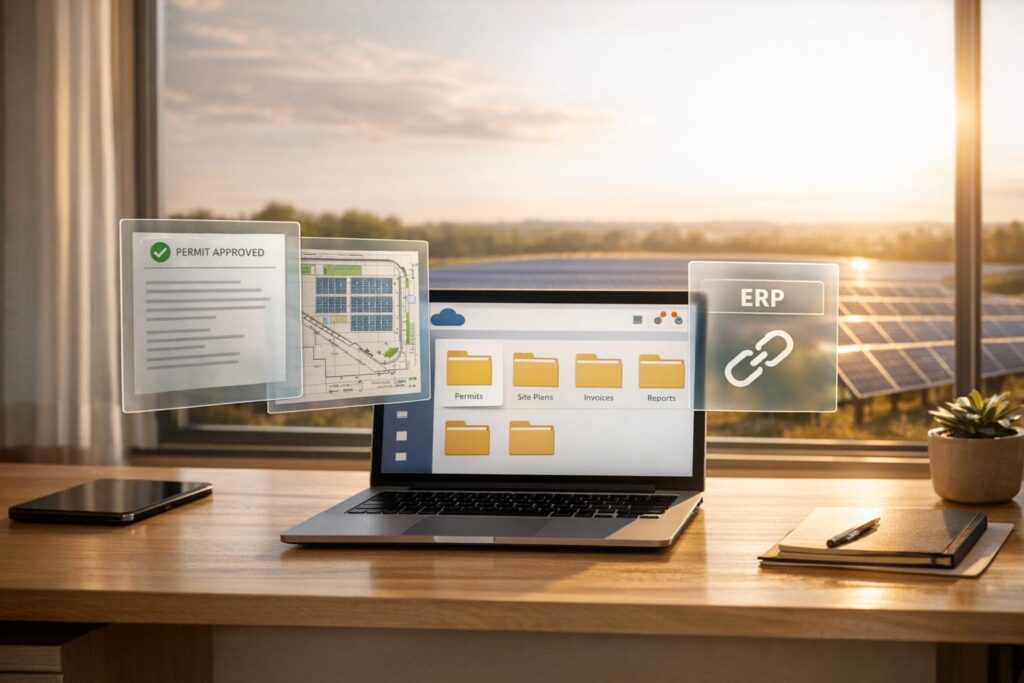
Soft costs – like permitting, administrative tasks, and customer acquisition – account for roughly two-thirds of the total expense of solar installations. Despite hardware prices dropping over 65% in the past decade, these non-hardware costs remain stubbornly high, cutting into profits and slowing project timelines.
The main culprit? Inefficiencies in document management, such as scattered files, outdated versions, and slow approval processes. These issues lead to delays, errors, and unnecessary expenses, like costly rework or permit rejections.
Cloud storage offers a practical solution by centralizing documents and improving collaboration between office and field teams. Key benefits include:
- Centralized file access: A single repository ensures everyone works with the latest documents.
- Faster approvals: Digital workflows reduce delays in permitting and closeout processes.
- Improved coordination: Real-time updates prevent errors like outdated designs reaching field crews.
- Reduced rework costs: Eliminating version confusion cuts down on expensive fixes.
Tools like Blu Banyan‘s bluDocs integrate cloud storage with ERP systems, automating administrative tasks and improving efficiency. The result? Faster project completion, reduced costs, and higher margins for solar companies.
If your solar business is struggling with inefficiencies, it might be time to rethink how you manage your documents.
What Are Soft Costs in Solar Projects?
Soft costs refer to the non-hardware expenses involved in deploying a solar system. According to the U.S. Department of Energy:
"Soft costs are the non-hardware costs associated with going solar. These costs include permitting, financing, and installing solar, as well as the expenses solar companies incur to acquire new customers, pay suppliers, and cover their bottom line."
In simpler terms, soft costs encompass the time, labor, and administrative efforts required before, during, and after installation. They exclude physical components like panels, inverters, and wiring.
Common Examples of Soft Costs
Soft costs cover a wide range of activities that are essential but often hidden in the overall project budget. Some typical examples include:
- Permitting and inspections
- Grid interconnection fees
- Customer acquisition
- Installation labor
- Financing costs
- Administrative overhead (e.g., document management and project coordination)
While these costs don’t appear on hardware invoices, they can add up quickly and are notoriously hard to track. For both residential and commercial solar projects, soft costs often make up the bulk of overall expenses. As hardware prices continue to decline, the proportion of soft costs in the total price has grown, making them a critical area for cost management.
Why Soft Costs Are Hard to Control
One of the main challenges with soft costs is that many of them are influenced by external factors beyond a solar company’s control. Across the U.S., there are around 23,000 local jurisdictions, each with its own building codes, electrical regulations, and interconnection requirements. Navigating this patchwork of rules is inherently slow and unpredictable.
Even minor administrative mistakes can create delays. Barry Cinnamon, CEO of Cinnamon Energy Systems, explains:
"In cities where the permitting is slow, you inevitably get them coming back in two weeks saying, ‘You’re missing a dash in that form – send it back.’"
Beyond external hurdles, internal inefficiencies also play a significant role. Poor document management and data control are common culprits. When project information is scattered across emails, spreadsheets, and individual devices, teams waste valuable time searching for files, fixing errors, and waiting for approvals. These recurring inefficiencies quietly eat into project margins on every job. Streamlining processes, such as using centralized cloud storage, can help solar companies reduce these soft costs.
sbb-itb-2560759
How Poor Document Management Drives Up Soft Costs
Inefficient document management significantly increases soft costs in solar projects. Surprisingly, most delays in solar installations don’t start on the roof – they begin with disorganized files and messy communication. When documents are scattered, the consequences ripple through every stage of the project: wasted time, permit rejections, and miscommunication between office and field teams.
Scattered and Hard-to-Find Files
In many solar projects, critical information often gets lost in a maze of emails, spreadsheets, and personal devices. Without a unified system, managing these documents becomes chaotic. Fadi Abourjeily, Energy Solutions Product Manager at Sitetracker, captures the issue perfectly:
"That’s in sharp contrast with the classic issue of project information scattered about in the […] formats of email, docs, slides, and spreadsheets residing in SharePoint, Dropbox, and various laptops."
This lack of organization makes it nearly impossible to maintain a single source of truth. Project managers end up wasting hours every week manually compiling reports and closeout packages instead of focusing on advancing the project. To make matters worse, when a field technician leaves, their valuable site-specific knowledge often goes with them because it wasn’t documented in a shared system.
Version Confusion and Manual Errors
When different versions of the same document circulate across multiple platforms, errors become unavoidable. For instance, field crews might unknowingly follow outdated designs while engineers have already made crucial updates. Similarly, procurement teams could order the wrong materials by referencing an older version of the bill of materials.
These mistakes come with hefty price tags. A single "truck roll" – sending a crew back to a site to fix an error caused by outdated documents – can cost solar installers between $500 and $1,000 per incident in labor and fuel alone. submitting an outdated site plan to the Authority Having Jurisdiction (AHJ) can result in immediate permit rejection, delaying the project by weeks.
Slow Document Sharing and Approval Processes
Manual approval workflows further drag out project timelines. At project closeout, for example, a project manager often has to track down legal, financial, regulatory, and installation documents from various disconnected sources and organize them into a cohesive package. As Abourjeily explains:
"Automated document generation’s value is most obvious at project closeout. That’s when a project manager must collect and organize documents, maps, renderings, and images from various sources… and present them cohesively."
When subcontractor RFIs, invoices, and submittals are handled through fragmented systems instead of a centralized platform, administrative tasks pile up quickly. These inefficiencies add to the soft cost burden, making it clear why streamlined document management, such as cloud storage solutions, is essential for reducing delays and cutting costs.
How Cloud Storage Cuts Solar Soft Costs
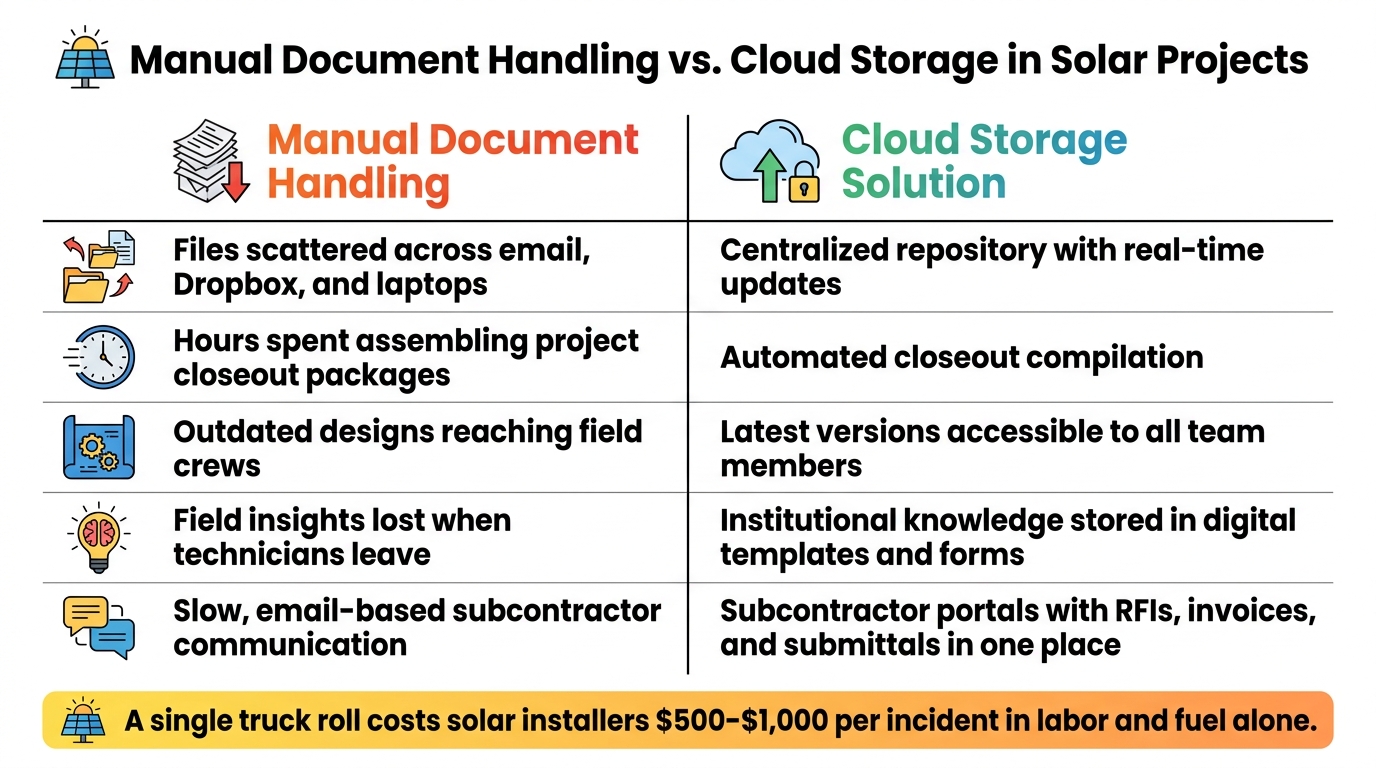
Manual Document Handling vs. Cloud Storage in Solar Projects
Cloud-based document storage streamlines workflows by ensuring every team member works with the most up-to-date information. This approach directly tackles inefficiencies, paving the way for measurable reductions in soft costs.
One Central Place for All Documents
Centralized cloud storage addresses document fragmentation by providing a single source of truth. This is often achieved through NetSuite Cloud ERP Solutions that unify data across the organization. It becomes the go-to repository for everything – permits, contracts, design files, and inspection records – kept in sync by both field crews and office staff in real time.
Parjanya Rijal, Director of Product Management for Energy at Sitetracker, highlights its impact:
"When you have comprehensive, reliable information to work with, automated document generation becomes a reality, saving hours of management time and thousands of dollars in legal and other costs."
Faster Permitting and Approvals
Permit delays are a major contributor to soft costs in solar projects. Issues like outdated site plans or missing documents often cause rejections, delaying timelines by weeks. Cloud storage eliminates these problems by ensuring submissions always include the most current documents. Digital workflows also track permit statuses and flag missing items, reducing the chance of rejections. Pre-built templates tailored to local Authority Having Jurisdiction (AHJ) requirements further cut down on technical errors. Speeding up permit approvals minimizes administrative bottlenecks and associated expenses.
Better Coordination Between Office and Field Teams
Real-time access to documents strengthens collaboration between office and field teams. For example, when an engineer updates a wiring diagram, field technicians can immediately view the latest version on their devices. Likewise, field crews can attach photos or notes directly to tasks, offering instant, actionable feedback. This seamless coordination helps prevent rework and unexpected costs, aligning with the broader goal of reducing soft costs across projects with solar business management software.
| Manual Document Handling | Cloud Storage Solution |
|---|---|
| Files scattered across email, Dropbox, and laptops | Centralized repository with real-time updates |
| Hours spent assembling project closeout packages | Automated closeout compilation |
| Outdated designs reaching field crews | Latest versions accessible to all team members |
| Field insights lost when technicians leave | Institutional knowledge stored in digital templates and forms |
| Slow, email-based subcontractor communication | Subcontractor portals with RFIs, invoices, and submittals in one place |
How Blu Banyan Supports Solar Document Management

Blu Banyan takes the cost-saving benefits of cloud storage a step further by embedding document management directly into the operational core of solar businesses. Instead of relying on a basic file storage system, their solutions integrate seamlessly with business workflows, reducing soft costs and improving efficiency.
bluDocs for Document Storage and Sharing

bluDocs is a SuiteApp designed to work natively within the NetSuite platform. This means it operates as part of the SolarSuccess ERP system rather than as a separate tool requiring synchronization. With bluDocs, all essential documents – contracts, permits, compliance records, inspection reports – are stored in one central location. These files can be accessed in real time by teams across Sales, Operations, and Accounting.
One standout feature is role-based access control, which ensures users only see documents relevant to their roles. For example, a field technician can quickly access an updated site plan, while an accountant can retrieve a signed contract to process an invoice. This eliminates the inefficiency of email chains or digging through shared drives for critical files.
Additionally, bluDocs organizes files by project milestones and purchase orders, making it easier to meet the diverse documentation requirements of solar financiers from the very beginning.
"When you’re aggregating a group of point applications – regardless of how good each of those programs is individually – you really need them to be able to talk to one another." – Clive Smith, Chief Business Development Officer, Blu Banyan
This integrated, centralized system ensures that document management is not just an add-on but a key part of the business process.
Integration with SolarSuccess ERP

bluDocs works hand-in-hand with SolarSuccess ERP, creating a unified system that ties document management to all core business functions. SolarSuccess ERP combines CRM, accounting, project management, and inventory tracking into one database. This ensures that data entered once is automatically shared across all relevant departments.
Aaron Casillas, Technology and Infrastructure Director at Titan Solar Power, highlighted the challenges this integration solves:
"Sharing data across these systems was difficult, and in most cases our only way to ‘patch the holes’ was by adding labor. We wanted to get everything on one system."
With SolarSuccess, accounting events are automatically triggered by documented project milestones, streamlining processes like invoice generation. This approach has allowed companies to achieve three times the project throughput without increasing office staff. Impressively, the platform supports nearly one-third of all rooftop solar installations in the U.S.. These results demonstrate how a unified system with integrated document management can drive efficiency and scale for solar businesses.
What to Look for in a Cloud Document Storage Solution
Not every cloud storage tool is designed to meet the specific needs of solar companies. A good solution should do more than just store files – it should help cut down on the administrative tasks that contribute to soft costs.
Features That Streamline Daily Operations
Key features to focus on include role-based access control and mobile accessibility. Role-based access control ensures only authorized personnel can view or edit certain documents, safeguarding sensitive financial data while allowing field crews to easily access updated site plans or inspection checklists.
Mobile accessibility is equally important. Field teams need the ability to pull up documents, take photos, and gather signatures while out in the field. Look for a platform that offers automatic cloud updates to keep everything running smoothly and consistently.
While efficiency is a priority, don’t overlook the importance of strong security features to protect critical solar project data.
Security and Audit Features
Solar projects involve handling contracts, financing documents, permits, and compliance records – all of which require careful protection. A good storage solution should include audit trails to log document access and modifications. This ensures you’re prepared for inspections, financing reviews, or any disputes that might arise. Secure file-sharing options are another must-have, allowing you to share specific documents with external parties – like utility companies or inspectors – without exposing the entire system.
For even greater efficiency, direct ERP integration can significantly enhance workflows by ensuring all systems are aligned with accurate, real-time data.
ERP Integration
A standalone document storage tool often means relying on manual data entry – a process that’s both slow and prone to errors. By integrating directly with your ERP, you can eliminate this step, allowing for faster generation of proposals, invoices, and compliance logs. As Quickbase puts it:
"Integrations reduce the risk of data transfer errors and maintain consistent records across platforms."
This kind of connectivity ensures your operations are not only faster but also more reliable.
Conclusion: Reducing Soft Costs with Cloud Storage
Soft costs make up about two-thirds of the total cost for residential and commercial solar installations. Even with hardware prices dropping by over 65% in the last decade, these costs remain stubbornly high. The main culprit? Operational inefficiencies.
Cloud storage tackles this issue head-on by centralizing documents, minimizing errors, streamlining permitting, and improving coordination between office and field teams. When paired with an ERP system, cloud storage takes it further – automating invoicing, improving real-time visibility, and cutting down on manual work, all of which directly reduce soft costs.
"Reducing soft costs is critical to increasing the rate in which installations can be deployed while also solving one of the biggest threats to the solar industry: revenue drain." – Jan Rippingale, CEO, Blu Banyan
By addressing inefficiencies consistently, cloud storage becomes a key driver for long-term savings. For solar companies ready to make a change, Blu Banyan’s bluDocs and SolarSuccess ERP provide a reliable solution. These tools integrate document management seamlessly into operational and financial workflows, ensuring smooth communication between the field, office, and back office. As Joe Marhamati, Co-Founder & VP at Big Sun Solar, shared after adopting SolarSuccess, "We’re doing more with the same number of people and we have a system that’s more reliable and less stressful than tracking a million different spreadsheets."
The tools to reduce soft costs are already available. The real question is: is your current document management system solving problems – or creating new ones?
FAQs
What documents should we store in the cloud for each solar project?
Storing essential documents such as contracts, permits, compliance records, project schedules, and performance metrics in the cloud offers several advantages. It ensures easier access from anywhere, improves project oversight, and facilitates automation processes. Together, these benefits help simplify and organize solar project management.
How do we keep field crews from using outdated plans?
Using cloud-based project management tools like SolarSuccess helps field crews stay updated with the latest plans, permits, and compliance documents. By centralizing project data, these platforms allow real-time updates, ensuring that no one is working with outdated information. Plus, built-in collaboration tools improve communication across teams, keeping everyone on the same page and reducing mistakes caused by outdated documents.
How can cloud storage connect to our ERP to reduce admin work?
Integrating cloud storage with your ERP system simplifies workflows and cuts down on administrative tasks by automating how data moves between systems. This setup consolidates project documents, supplier information, and operational data in one place, removing the need for manual data entry and reducing the chance of mistakes. Cloud-based ERP platforms, such as SolarSuccess, keep data updated across teams in real time. This not only boosts collaboration and clarity but also frees up your team to focus on getting the work done instead of dealing with paperwork.
